
CdZnTe Detector Market Insights
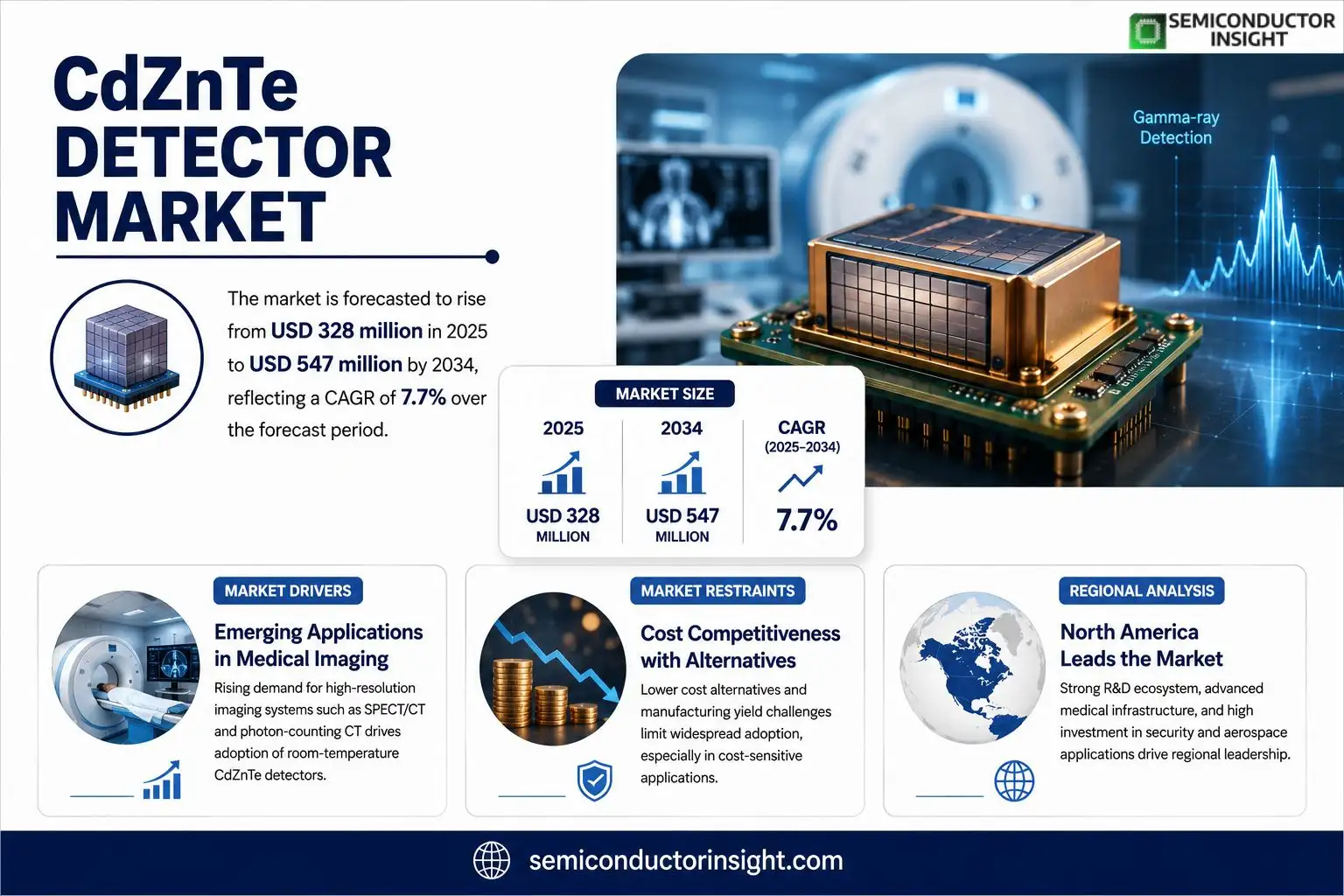
CdZnTe Detector market size was valued at USD 328 million in 2025. The market is forecasted to rise from USD 328 million in 2025 to USD 547 million by 2034, reflecting a CAGR of 7.7% over the period.
The zinc‑cadmium‑telluride detector operates at room temperature, converting incident X‑ray or gamma‑ray photons directly into electrical signals. Its high atomic number, density and a wide bandgap (~1.6 eV) deliver superior energy resolution and detection efficiency without cryogenic cooling, making it suitable for medical imaging such as SPECT/CT, nuclear safety monitoring, industrial non‑destructive testing and space‑based astronomy.Growth is fueled by expanding demand for photon‑counting CT systems, tighter nuclear safety regulations and increased adoption in high‑resolution industrial inspection. Leading manufacturersincluding Redlen Technologies, eV Products and Kromekare advancing crystal‑growth techniques and integrating ASIC readout circuits to lower unit costs while preserving performance.
MARKET DRIVERS
Emerging Applications in Medical Imaging
The rise of compact gamma cameras and handheld radiopharmaceutical scanners has created a tangible demand for high‑resolution, room‑temperature detectors. CdZnTe crystals deliver superior energy discrimination, allowing clinicians to detect low‑contrast lesions without cooling infrastructure. This operational advantage translates into lower total cost of ownership, prompting hospitals to replace legacy scintillators with CdZnTe‑based solutions.
Growth in Security and Border Control
Governments worldwide are upgrading cargo inspection portals to spot illicit nuclear material. CdZnTe detectors, with their rapid response and high stopping power, enable real‑time spectroscopy that is difficult to achieve with older NaI(Tl) devices. The resulting performance edge is encouraging procurement agencies to allocate budget toward next‑generation screening systems.
➤ ‘The ability to operate without cryogenic cooling cuts installation time by up to 40 %,’ notes a senior engineer at a leading security vendor.
Beyond specific sectors, the overall CdZnTe Detector Market benefits from a broader trend toward miniaturization in electronic devices. As designers shrink system footprints, the compact form factor of CdZnTe modules becomes a decisive factor, driving a steady uptick in unit sales across multiple verticals.
MARKET CHALLENGES
Manufacturing Yield Constraints
Growing crystal size while preserving defect‑free quality remains a bottleneck. Yield losses during boule growth lead to higher per‑unit costs, which can deter price‑sensitive buyers, especially in emerging markets where budget constraints are pronounced.
Other Challenges
Supply‑Chain Volatility
Fluctuations in raw material availability, combined with limited number of certified foundries, introduce lead‑time uncertainties. Companies that cannot secure a reliable supply risk losing contracts to rivals with more diversified sourcing strategies.
MARKET RESTRAINTS
Cost Competitiveness with Alternative Technologies
While CdZnTe offers clear performance benefits, silicon‑based and perovskite detectors continue to drop in price due to economies of scale. For applications where ultra‑high resolution is not critical, customers may opt for cheaper alternatives, limiting the addressable market for CdZnTe devices.Regulatory approval timelines in the medical sector add another layer of restraint. Obtaining clearance for new detector designs can take years, slowing the introduction of innovative products and compressing revenue cycles.Finally, the niche expertise required for device integration means that only a handful of OEMs can fully exploit CdZnTe’s capabilities. This concentration of know‑how can impede broader market diffusion, as smaller players struggle to adopt the technology without extensive training.
MARKET OPPORTUNITIES
Expansion into Autonomous Vehicle Lidar Systems
Emerging research suggests that CdZnTe arrays can enhance lidar sensitivity under adverse weather conditions. Manufacturers that pioneer hybrid lidar‑detector modules could capture a premium segment of the autonomous‑driving market, where performance differentials command higher prices.
Integration with IoT Edge Analytics
Edge devices equipped with on‑board spectral analysis are gaining traction in industrial monitoring. Embedding CdZnTe detectors into smart sensors allows real‑time radiation assessment without cloud latency, opening revenue streams for vendors that bundle hardware with analytics platforms.Strategic collaborations between semiconductor fabricators and system integrators present a pathway to lower production costs. Joint ventures that pool R&D resources can accelerate the rollout of larger‑area CdZnTe wafers, unlocking applications that were previously cost‑prohibitive.
CdZnTe Detector Market Trends
Rising Adoption in High‑End Medical Imaging
CdZnTe Detector Market is witnessing accelerated uptake in photon‑counting computed tomography (CT) and single‑photon emission computed tomography/computed tomography (SPECT/CT) systems. The detector’s high atomic number and wide bandgap enable room‑temperature operation while delivering energy resolution that surpasses conventional scintillators. In 2025, manufacturers sold roughly 37,800 units at an average price of US$9,500, translating into a revenue base of $328 million. The premium pricing reflects the challenges of crystal growth and the limited batch size that can be reliably produced. Nevertheless, hospitals are willing to absorb the cost because the technology improves lesion detectability and reduces patient dose, creating a compelling value proposition for equipment vendors seeking differentiation.
Other Trends
Supply‑Chain Constraints and Profitability
The industry chain divides into upstream raw‑material sourcing, midstream detector‑chip fabrication, and downstream system integration. Upstream players enjoy gross margins of 20‑40 % but grapple with yield‑related bottlenecks; cadmium, zinc and tellurium purity levels dictate crystal quality. Midstream activitiescutting, polishing, electrode deposition and ASIC integrationcapture 40‑60 % margins, underscoring the segment’s role as the profit engine. Downstream system integrators, tasked with embedding detectors into imaging, security and nuclear‑safety platforms, experience margins of 30‑50 % that fluctuate with project size and contract terms. The disparity between capacity (54,000 units) and actual shipments (37,800 units) indicates unused manufacturing headroom, which could be leveraged if supply‑chain coordination improves.
Long‑Term Cost‑Reduction Outlook
While current adoption concentrates in high‑value medical and security niches, analysts anticipate a gradual cost decline as manufacturers scale crystal‑growth furnaces and refine wafer‑splitting techniques. Process optimisation is expected to lower per‑unit costs, making the technology viable for broader industrial non‑destructive testing and radiation‑monitoring applications. A more competitive price point would encourage OEMs to replace legacy scintillators, opening new revenue streams for midstream module suppliers. Companies that invest early in automation and secure long‑term raw‑material contracts are positioned to capture the incremental demand that follows cost normalization.
COMPETITIVE LANDSCAPEKey Industry Players
CdZnTe Detector Market – Competitive Overview
The segment is dominated by a handful of firms that have built vertically integrated capabilities from crystal growth to ASIC‑coupled modules. Redlen Technologies, now operating under the X‑Ray Instrumentation group, leverages a proprietary high‑yield growth process that secures a 30‑plus percent share of mid‑stream detector shipments. Its aggressive pricing combined with a robust IP portfolio forces rival manufacturers to either specialize in niche form factors or pursue strategic alliances. The concentration of profit in the detector‑chip and module tier explains why the market’s value added remains disproportionately high relative to raw material margins.Beyond the clear leader, a diverse set of specialists addresses application‑specific demands. Kromek concentrates on compact, high‑resolution units for security scanning, while Teledyne e2v supplies large‑area crystals for astronomical observatories. Mirion Technologies and SONY’s semiconductor arm occupy the nuclear‑safety niche, offering ruggedized packages that satisfy stringent regulatory standards. Smaller innovators such as eV Products and Orbotech focus on custom ASIC integration for photon‑counting CT, carving out value from the emerging medical‑imaging wave. The coexistence of these players creates a competitive fabric where technology depth, application focus, and supply‑chain resilience dictate market positioning.
List of Key CdZnTe Detector Companies Profiled
- Redlen Technologies (X‑Ray Instrumentation Group)
- Kromek Ltd.
- Teledyne e2v
- Mirion Technologies
- SONY Semiconductor Solutions
- eV Products
- Orbotech Ltd.
- IMARAD (Fujikura)
- Radiation Monitoring Devices (RMD)
- Lindell Group
- Gammex
- XRON Ltd.
Segment Analysis:
| Segment Category | Sub-Segments | Key Insights |
| By Type |
|
Pixelated arrays dominate the market due to their ability to deliver superior spatial resolution and flexible integration options. – Enable high‑resolution imaging for demanding medical and security applications. – Offer modular scalability that supports both compact devices and larger system architectures. – Benefit from ongoing advances in ASIC readout technology that enhance signal fidelity and reduce system complexity. |
| By Application |
|
Medical imaging is the leading application segment, driven by the demand for high‑contrast, low‑dose diagnostic capabilities. – The room‑temperature operation simplifies system design and reduces maintenance overhead. – Superior energy resolution supports advanced photon‑counting techniques that improve tissue differentiation. – Strong clinical validation encourages adoption across major imaging centers. |
| By End User |
|
Hospitals and diagnostic centers lead the end‑user landscape because of the direct impact on patient outcomes. – Integration with existing imaging suites accelerates deployment timelines. – The technology’s high detection efficiency aligns with clinical goals of reducing radiation exposure. – Ongoing collaborations with equipment manufacturers foster tailored solutions for specific clinical pathways. |
| By Technology |
|
Direct‑conversion semiconductor remains the core technological driver, offering unmatched energy resolution. – Eliminates the need for intermediate scintillators, simplifying system architecture. – High atomic number and density provide efficient photon absorption across a broad energy spectrum. – Continuous improvements in crystal uniformity reduce defect‑related performance variability. |
| By Market Phase |
|
Emerging high‑end niche characterises the current market, where premium performance outweighs cost considerations. – Early adopters prioritize technical superiority for critical imaging tasks. – Collaborative R&D programs accelerate technology readiness for broader markets. – Anticipated economies of scale from larger production volumes are expected to enable more widespread deployment. |
Regional Analysis: CdZnTe Detector Market
North America
The integration of crystal growth facilities with downstream packaging labs reduces lead times and aligns quality controls, enabling faster rollout of customized detector modules for niche applications such as space‑borne spectroscopy.
Harmonizing safety and performance standards across medical imaging and national security creates a predictable compliance landscape, encouraging OEMs to embed CdZnTe sensors in next‑generation devices without extensive redesign.
Federal grants targeting quantum‑grade material purity are steering research toward higher-resolution detectors, which in turn fuels commercial interest from firms seeking differentiation through superior energy discrimination.
Large end‑users in aerospace and health sectors are consolidating procurement, pressuring suppliers to offer end‑to‑end service contracts that include calibration, software support, and lifecycle management.
Europe
European markets are distinguished by a strong emphasis on collaborative research frameworks that blend academic insight with industrial application. Countries such as Germany and the United Kingdom host consortiums that focus on radiation detection technologies, providing a fertile ground for co‑development of CdZnTe detectors that meet stringent environmental standards. The region’s mature medical imaging sector values the material’s ability to deliver fine spectral resolution, prompting manufacturers to tailor modules for high‑throughput PET and SPECT systems. Meanwhile, the growing demand for non‑invasive security scanners in major transport hubs fuels a parallel push for compact, low‑power detector designs. Policy incentives, particularly those supporting green manufacturing processes, are nudging suppliers toward more sustainable crystal growth methods, which could reshape cost structures over the medium term. Companies that align product roadmaps with these policy directions are likely to secure preferential access to public procurement contracts.
Asia‑Pacific
The Asia‑Pacific region exhibits rapid adoption of CdZnTe sensors, propelled by expanding healthcare infrastructure and ambitious national security programs. Nations such as China, Japan, and South Korea are investing heavily in home‑grown semiconductor capabilities, seeking to reduce reliance on imported detector components. This drive is evident in the establishment of state‑backed pilot plants that experiment with high‑throughput crystal synthesis, promising to lower unit costs while maintaining performance. Simultaneously, burgeoning satellite constellations demand radiation‑hard detectors capable of operating in harsh orbital environments, creating a niche market for ruggedized CdZnTe modules. Industry players that can navigate complex export controls and deliver localized technical support stand to gain a competitive edge as regional demand diversifies across medical, industrial, and aerospace applications.
South America
In South America, market growth is anchored by the modernization of diagnostic imaging facilities and a nascent interest in nuclear safety monitoring. Brazil leads the charge, leveraging government‑funded research centers that explore advanced detector geometries for environmental radiation assessment. While overall market size remains modest, the region’s emphasis on cost‑effective solutions drives a preference for modular CdZnTe units that can be retrofitted into existing equipment. Partnerships between local distributors and North American OEMs facilitate technology transfer, yet challenges persist around supply chain reliability and after‑sales service coverage. Firms that establish robust training programs and guarantee long‑term parts availability are poised to capture the incremental demand arising from regional healthcare reforms.
Middle East & Africa
The Middle East & Africa present a heterogeneous landscape where high‑value projects coexist with emerging market dynamics. Wealthier Gulf states are channeling resources into sophisticated security screening systems for airports and seaports, where CdZnTe detectors offer the precision needed for concealed threat identification. Meanwhile, African nations are beginning to upgrade radiology departments, creating a latent demand for versatile detectors that can operate under variable power conditions. The scarcity of local manufacturing capabilities means the region relies heavily on imports, making logistics and trade policies a critical factor in pricing strategies. Companies that can deliver end‑to‑end solutionsincluding installation, calibration, and trainingare likely to differentiate themselves in an environment where technical expertise is a scarce commodity.
Report Scope
This market research report provides a comprehensive analysis of the CdZnTe Detector Market , covering the forecast period 2026–2034. It offers detailed insights into market dynamics, technological advancements, competitive landscape, and key trends shaping the industry.
Key focus areas of the report include:
- Market Overview: The report begins with an overview outlining its current market scenario, key growth indicators, and industry transformation drivers. It discusses macroeconomic factors, demand–supply balance, regulatory landscape, and the strategic role of semiconductors in powering advancements across industries such as automotive, telecommunications, consumer electronics, and industrial automation.
- Market Size & Forecast: Historical data and future projections for revenue, unit shipments, and market value across major regions and segments.
- Segmentation Analysis: Detailed breakdown by product type, technology, application, and end-user industry to identify high-growth segments and investment opportunities.
- Regional Insights: Insights into market performance across North America, Europe, Asia-Pacific, Latin America, and the Middle East & Africa, including country-level analysis where relevant.
- Competitive Landscape: Profiles of leading market participants, including their product offerings, R&D focus, manufacturing capacity, pricing strategies, and recent developments such as mergers, acquisitions, and partnerships.
- Technology Trends & Innovation: Assessment of emerging technologies, integration of AI/IoT, semiconductor design trends, fabrication techniques, and evolving industry standards.
- Market Drivers & Restraints: Evaluation of factors driving market growth along with challenges, supply chain constraints, regulatory issues, and market-entry barriers.
- Stakeholder Insights: Insights for component suppliers, OEMs, system integrators, investors, and policymakers regarding the evolving ecosystem and strategic opportunities.
Primary and secondary research methods are employed, including interviews with industry experts, data from verified sources, and real-time market intelligence to ensure the accuracy and reliability of the insights presented.
FREQUENTLY ASKED QUESTIONS:
What is the current market size of CdZnTe Detector Market?
-> CdZnTe Detector Market was valued at USD 328 million in 2025 and is expected to reach USD 547 million by 2034.
Which key companies operate in CdZnTe Detector Market?
-> Key players are not disclosed in the provided information.
What are the key growth drivers?
-> Key growth drivers include increasing demand for high‑precision medical imaging (e.g., photon‑counting CT), nuclear safety monitoring, and industrial non‑destructive testing, as well as the unique room‑temperature operation of CdZnTe detectors.
Which region dominates the market?
-> Regional dominance is not explicitly stated in the source material.
What are the emerging trends?
-> Emerging trends involve cost reduction through process optimization, scaling up crystal growth for larger‑size detectors, and expanding applications beyond high‑end radiation detection to broader industrial and scientific fields.

Get Sample Report PDF for Exclusive Insights
Report Sample Includes
- Table of Contents
- List of Tables & Figures
- Charts, Research Methodology, and more...
 Download Sample Report PDF