
CBRN Sensors Market Insights
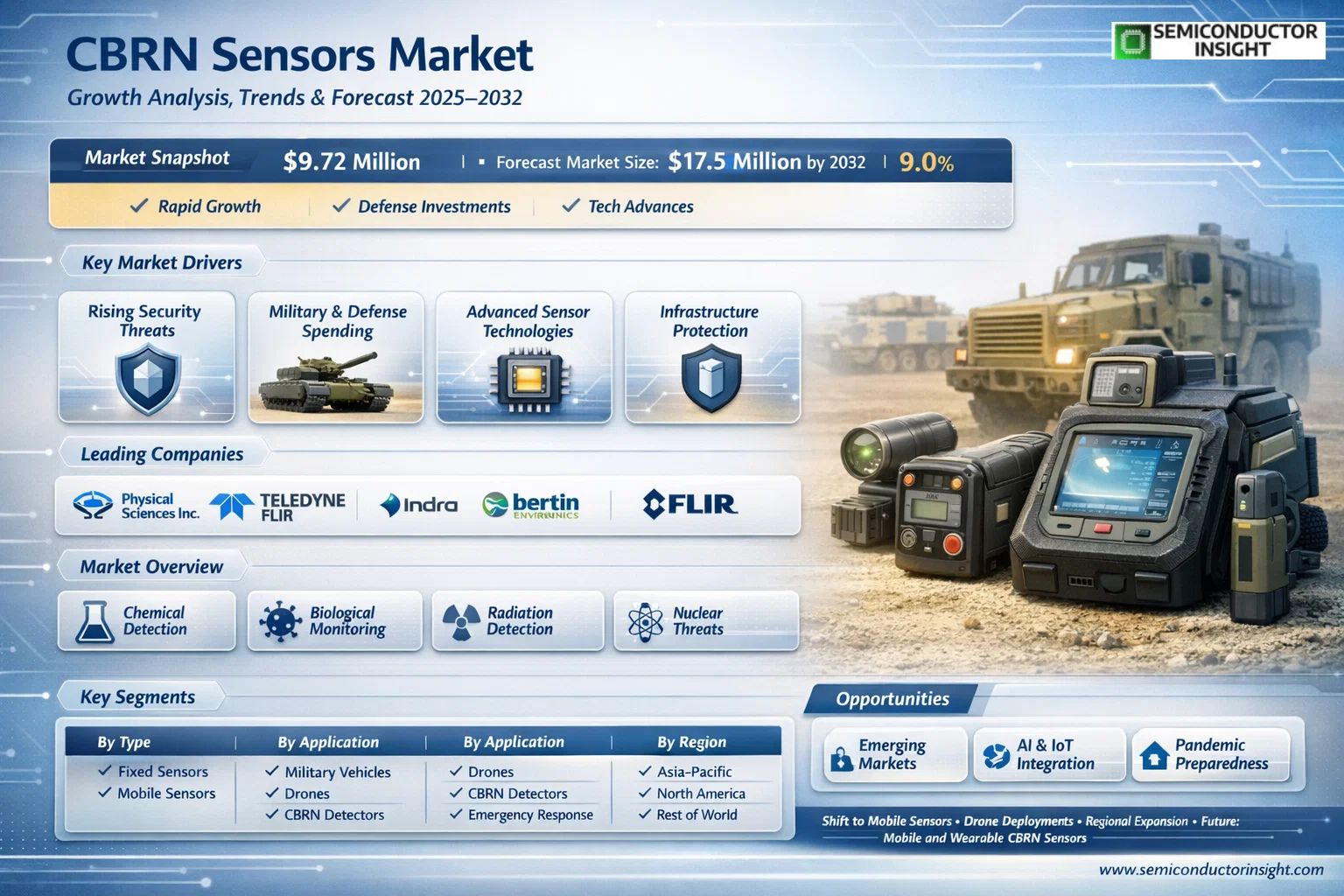
Global CBRN Sensors market size was valued at USD 9.72 million in 2025. The market is projected to reach USD 17.5 million by 2032, exhibiting a CAGR of 9.0% during the forecast period.
CBRN sensors are sensors specifically designed to detect chemical, biological, radiological and nuclear (CBRN) threats. CBRN sensors are key equipment used to monitor and identify chemical, biological, radiological and nuclear substances. They are able to detect potential threats such as chemicals, biological pathogens, radioactive particles and nuclear radiation in the air, providing important intelligence and decision support for military, security, environmental protection and emergency response.
The market is experiencing rapid growth due to several factors, including heightened geopolitical tensions, increased global defense spending, and advancements in sensor detection technologies. Additionally, rising concerns over terrorism and chemical-biological incidents are driving demand across military and homeland security sectors. Initiatives by key players are fueling further expansion. The global key manufacturers of CBRN Sensors include Physical Sciences Inc., Teledyne, Indra, TAR Ideal, Bertin Environics, FLIR Systems, JPM CBRN Sensors, Bruhn NewTech, and Draper, among others.
MARKET DRIVERS
Rising Global Security Threats
CBRN Sensors Market is propelled by escalating geopolitical tensions and terrorism risks, prompting governments to invest heavily in detection technologies. Nations worldwide are bolstering defense budgets, with military expenditures reaching $2.24 trillion in 2023, significantly fueling demand for advanced CBRN sensors capable of real-time threat identification.
Advancements in Sensor Technology
Innovations such as miniaturization and multi-spectral detection have enhanced the portability and accuracy of CBRN sensors, driving market expansion. Integration with IoT and AI enables faster response times, making these systems indispensable for military and first-responder applications in the evolving CBRN Sensors Market.
➤ The market is projected to grow at a CAGR of 8.2% from 2024 to 2030, driven by rising adoption in homeland security.
Government mandates for critical infrastructure protection further accelerate deployment, ensuring sustained growth in CBRN Sensors Market.
MARKET CHALLENGES
High Development and Deployment Costs
Developing reliable CBRN sensors involves substantial R&D investments, posing a major hurdle in CBRN Sensors Market. Costs for calibration and maintenance often exceed initial procurement, limiting adoption among smaller agencies and emerging economies.
Other Challenges
False Positive Rates
Environmental interferences frequently trigger alarms in CBRN sensors, eroding user confidence and complicating field operations despite ongoing improvements in algorithms.
Integration Complexities
Retrofitting legacy systems with modern CBRN sensor networks demands extensive interoperability testing, delaying widespread implementation across diverse platforms.
MARKET RESTRAINTS
Regulatory and Standardization Hurdles
Stringent international regulations on CBRN sensor performance and data handling slow market entry for new players. Compliance with varying standards across regions fragments CBRN Sensors Market, increasing certification timelines and costs.Technical limitations in detecting low-level contaminants persist, restraining broader commercial applications beyond defense sectors. Sensitivity thresholds often fail in complex urban environments, capping market penetration.Supply chain disruptions for rare earth materials used in sensor components add volatility, further constraining growth in the global CBRN Sensors Market.
MARKET OPPORTUNITIES
Emerging Markets and Urban Security
Expansion into Asia-Pacific and Middle East regions offers substantial potential in CBRN Sensors Market, where urbanization and infrastructure projects heighten the need for robust detection systems. Investments in smart cities could drive demand for networked CBRN sensors.AI-driven analytics and edge computing integrations present opportunities to overcome detection challenges, enabling predictive threat modeling and real-time analytics in CBRN Sensors Market.Public-private partnerships for pandemic preparedness post-COVID are fostering innovation, positioning the market for accelerated growth through next-generation wearable and drone-mounted sensors.
CBRN Sensors Market Trends
Shift to Mobile Sensors Dominating CBRN Sensors Market
In CBRN Sensors Market, a primary trend is the transition from fixed to mobile sensors, enhancing real-time threat detection across diverse environments. Mobile sensors provide portability for military, security, and emergency response teams, allowing detection of chemical agents, biological pathogens, radiological particles, and nuclear radiation in dynamic settings. This shift supports faster decision-making, as these devices integrate seamlessly into field operations, reducing response times compared to stationary systems.
Other Trends
Integration in Military Vehicles and Drones
Military vehicles and drones represent key applications driving growth in CBRN Sensors Market. Sensors embedded in vehicles enable continuous monitoring during patrols, while drone-mounted units extend surveillance reach into hazardous areas. This trend reflects heightened demand from defense sectors, where manufacturers like Teledyne, FLIR Systems, and Bertin Environics are advancing compact, rugged designs for these platforms, improving operational safety and intelligence gathering.
Expansion Across Regional Markets
CBRN Sensors Market is witnessing balanced regional expansion, with North America leading due to robust defense investments, followed by growing activity in Asia, particularly China and Japan. European countries like Germany and the U.K. focus on environmental and security applications, while emerging markets in the Middle East and South America address rising threats. Industry surveys highlight drivers such as geopolitical tensions and policy emphasis on preparedness, alongside challenges like technological integration and supply chain dynamics. Leading players, including Physical Sciences Inc., Indra, and Draper, are responding through product innovations and strategic partnerships, fostering competitive advancements in sensor accuracy and multi-threat capabilities. This evolution positions CBRN Sensors Market for sustained development amid global security priorities.
COMPETITIVE LANDSCAPE
Key Industry Players
Leading Innovators in CBRN Threat Detection
CBRN Sensors Market exhibits a moderately concentrated structure dominated by a handful of established leaders such as Physical Sciences Inc., Teledyne FLIR, and Indra Sistemas, which collectively hold a significant revenue share estimated at over 40% among the top five players in 2025. These frontrunners benefit from robust R&D investments and long-standing contracts with military and homeland security agencies, driving innovations in fixed and mobile sensor technologies. The market’s growth, projected from $9.72 million in 2025 to $17.5 million by 2032 at a 9.0% CAGR, underscores their strategic positioning amid rising global threats from chemical, biological, radiological, and nuclear agents. Competitive dynamics emphasize integration capabilities for applications in military vehicles, drones, and standalone detectors, with leaders differentiating through high-sensitivity detection and real-time analytics.
Beyond the top tier, niche players like Bertin Environics, Bruhn NewTech, and Draper carve out specialized segments by focusing on portable solutions and environmental monitoring integrations. These companies target underserved areas such as emergency response and industrial safety, often partnering with primes for system-level deployments. Emerging competitors including Smiths Detection and Mirion Technologies intensify rivalry through advancements in multi-threat sensing and cost-effective scalability, challenging incumbents in regional markets like North America and Europe. This fragmented yet innovative landscape fosters mergers, acquisitions, and technology licensing, enhancing overall market resilience against evolving CBRN risks.
List of Key CBRN Sensors Companies Profiled
- Physical Sciences Inc.
- Teledyne FLIR
- Indra Sistemas
- TAR Ideal Innovaciones
- Bertin Environics
- FLIR Systems
- JPM CBRN Sensors
- Bruhn NewTech
- Draper
- Smiths Detection
- Thermo Fisher Scientific
- Environics Oy
- Mirion Technologies
- Leidos
- ChemImage Corporation
Segment Analysis:
| Segment Category | Sub-Segments | Key Insights |
| By Type |
|
Mobile Sensor
|
| By Application |
|
Military Vehicles
|
| By End User |
|
Defense & Military
|
| By Threat Type |
|
Chemical
|
| By Technology |
|
Ion Mobility Spectrometry
|
Regional Analysis: CBRN Sensors Market
North America
Government-led initiatives and defense modernization programs dominate, with emphasis on early warning systems. Heightened focus on biothreat detection fuels demand for next-generation sensors integrated into wearable devices for first responders.
R&D hubs pioneer AI-enhanced analytics and miniaturized detectors, improving portability and real-time data processing. Collaborative efforts yield hybrid sensors capable of simultaneous threat identification.
Leading firms drive innovation through proprietary technologies and extensive field testing. Strategic alliances with defense contractors expand deployment across military and civilian sectors.
Expanding applications in smart cities and counter-terrorism promise sustained leadership. Focus on cybersecurity for sensor networks addresses vulnerabilities in connected ecosystems.
Europe
Europe exhibits strong growth in CBRN Sensors Market, underpinned by EU-wide security mandates and cross-border collaboration. Nations like the UK, France, and Germany invest in networked sensor arrays for rapid threat assessment in densely populated areas. Emphasis on dual-use technologies supports both military and civil protection, with NATO frameworks promoting standardized interoperability. Innovation centers in the Netherlands and Switzerland advance spectroscopic and ion mobility-based detectors, enhancing sensitivity to low-level contaminants. Regulatory harmonization accelerates adoption in transportation hubs and public events, while public-private partnerships address legacy infrastructure upgrades. Rising concerns over industrial accidents and asymmetric threats bolster demand for resilient, scalable solutions. Europe’s mature market navigates budget constraints through shared R&D funding, positioning it as a key innovator in integrated CBRN defense strategies.
Asia-Pacific
Asia-Pacific emerges as a dynamic force in CBRN Sensors Market, propelled by geopolitical shifts and rapid urbanization. Countries such as India, China, and Japan prioritize sensor deployment amid border tensions and natural disaster preparedness. Defense modernization drives demand for ruggedized, multi-hazard detectors suited to diverse terrains. Local manufacturing hubs in South Korea and Singapore foster indigenous capabilities, reducing reliance on imports. Integration into smart surveillance networks enhances urban resilience, particularly in megacities vulnerable to intentional releases. Collaborative initiatives under ASEAN frameworks promote technology transfer and joint exercises, strengthening regional response postures. Challenges like varying regulatory standards are mitigated through bilateral agreements, fueling market expansion with a focus on cost-effective, high-performance solutions.
South America
South America shows nascent yet promising development in CBRN Sensors Market, centered on counter-narcotics and public safety enhancements. Brazil and Chile lead with investments in border and port security systems to detect illicit chemical precursors. Limited infrastructure spurs demand for low-maintenance, solar-powered sensors adaptable to remote areas. Regional blocs like Mercosur facilitate knowledge sharing and procurement, addressing capability gaps. Growing awareness of agro-terrorism risks prompts agricultural monitoring applications. Partnerships with international donors support capacity building, gradually elevating market sophistication amid economic fluctuations and political priorities.
Middle East & Africa
The Middle East & Africa region advances in CBRN Sensors Market, driven by counter-terrorism imperatives and energy infrastructure protection. Gulf states like Saudi Arabia and UAE deploy advanced perimeter detection for oil facilities and critical assets. Israel’s expertise in miniaturized sensors influences export-oriented growth across the region. Africa focuses on epidemic response and peacekeeping missions, favoring portable units for field operations. Harsh climates necessitate durable designs, with customization for dust and heat prevalent. International aid and defense pacts accelerate technology infusion, countering fragmented markets and fostering strategic resilience against non-state actors.
Report Scope
This market research report provides a comprehensive analysis of the CBRN Sensors Market , covering the forecast period 2025–2032. It offers detailed insights into market dynamics, technological advancements, competitive landscape, and key trends shaping the industry.
Key focus areas of the report include:
- Market Overview: The report begins with an overview outlining its current market scenario, key growth indicators, and industry transformation drivers. It discusses macroeconomic factors, demand–supply balance, regulatory landscape, and the strategic role of CBRN sensors in detecting chemical, biological, radiological, and nuclear threats across sectors such as military, security, environmental protection, and emergency response.
- Market Size & Forecast: Historical data and future projections for revenue, unit shipments, and market value across major regions and segments.
- Segmentation Analysis: Detailed breakdown by product type, technology, application, and end-user industry to identify high-growth segments and investment opportunities.
- Regional Insights: Insights into market performance across North America, Europe, Asia-Pacific, Latin America, and the Middle East & Africa, including country-level analysis where relevant.
- Competitive Landscape: Profiles of leading market participants, including their product offerings, R&D focus, manufacturing capacity, pricing strategies, and recent developments such as mergers, acquisitions, and partnerships.
- Technology Trends & Innovation: Assessment of emerging technologies, integration of AI/IoT, CBRN detection trends, fabrication techniques, and evolving industry standards.
- Market Drivers & Restraints: Evaluation of factors driving market growth along with challenges, supply chain constraints, regulatory issues, and market-entry barriers.
- Stakeholder Insights: Insights for component suppliers, OEMs, system integrators, investors, and policymakers regarding the evolving ecosystem and strategic opportunities.
Primary and secondary research methods are employed, including interviews with industry experts, data from verified sources, and real-time market intelligence to ensure the accuracy and reliability of the insights presented.
FREQUENTLY ASKED QUESTIONS:
What is the current market size of CBRN Sensors Market?
-> CBRN Sensors Market was valued at USD 9.72 million in 2025 and is expected to reach USD 17.5 million by 2032, at a CAGR of 9.0% during the forecast period.
Which key companies operate in CBRN Sensors Market?
-> Key players include Physical Sciences Inc., Teledyne, Indra, TAR Ideal, Bertin Environics, FLIR Systems, JPM CBRN Sensors, Bruhn NewTech, Draper, among others.
What are the key growth drivers?
-> Key growth drivers include heightened security threats, military and defense investments, and advancements in detection technologies.
Which region dominates the market?
-> North America dominates the market, while Asia is the fastest-growing region.
What are the emerging trends?
-> Emerging trends include integration with drones and military vehicles, portable multi-threat sensors, and AI-enhanced detection.

Get Sample Report PDF for Exclusive Insights
Report Sample Includes
- Table of Contents
- List of Tables & Figures
- Charts, Research Methodology, and more...




