Market Insights
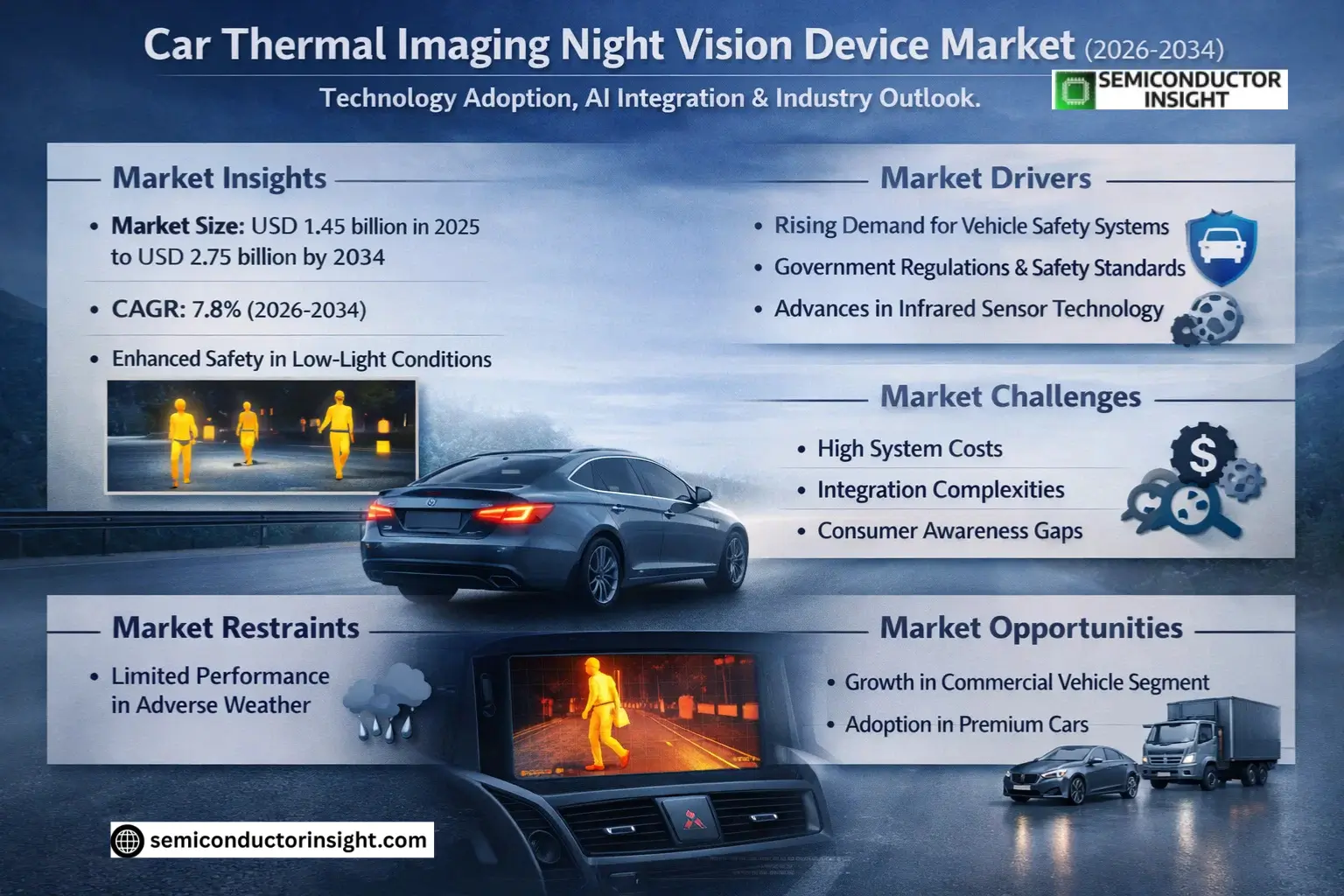
Global Car Thermal Imaging Night Vision Device Market size was valued at USD 1.45 billion in 2025. The market is projected to grow from USD 1.58 billion in 2026 to USD 2.75 billion by 2034, exhibiting a CAGR of 7.8% during the forecast period.
Car thermal imaging night vision devices are advanced automotive safety systems that detect infrared radiation to enhance visibility in low-light or adverse weather conditions. These devices utilize thermal sensors to identify pedestrians, animals, and obstacles beyond the range of standard headlights, significantly improving driver awareness and accident prevention.
The market growth is driven by increasing demand for advanced driver-assistance systems (ADAS), rising safety regulations, and growing consumer awareness about vehicle safety features. Furthermore, technological advancements such as higher resolution sensors and AI-powered object recognition are accelerating adoption across both passenger and commercial vehicle segments.
MARKET DRIVERS
Rising Demand for Advanced Vehicle Safety Systems
Car Thermal Imaging Night Vision Device Market is experiencing growth due to increasing emphasis on road safety. Thermal imaging technology enhances visibility in low-light conditions, reducing night-time accidents by up to 35%. Automakers are integrating these systems as premium features in luxury and commercial vehicles.
Government Regulations and Safety Standards
Stricter safety norms worldwide are accelerating adoption. The European New Car Assessment Programme (Euro NCAP) now awards points for night vision systems, pushing manufacturers to incorporate them. This regulatory push is expected to drive market growth by 8-10% annually over the next five years.
Technological advancements in infrared sensors have reduced costs while improving performance, making thermal imaging night vision devices more accessible across vehicle segments.
MARKET CHALLENGES
High System Costs and Integration Complexities
The premium pricing of Car Thermal Imaging Night Vision Devices remains a barrier for mass-market adoption. Current systems can add USD 2,000-USD 5,000 to vehicle costs, limiting penetration to luxury segments. Integration with existing ADAS requires complex calibration, increasing development expenses.
Other Challenges
Consumer Awareness Gaps
Despite proven safety benefits, over 65% of consumers in emerging markets remain unaware of thermal imaging night vision capabilities in vehicles.
MARKET RESTRAINTS
Limited Performance in Adverse Weather Conditions
While thermal imaging outperforms standard headlights in darkness, heavy rain or fog can reduce effectiveness by 30-40%. This performance limitation affects consumer confidence and adoption rates, particularly in regions with extreme weather patterns.
MARKET OPPORTUNITIES
Expansion in Commercial Vehicle Segment
The commercial vehicle sector presents significant growth potential for Car Thermal Imaging Night Vision Devices. Fleet operators are increasingly investing in safety technologies to reduce accident-related costs, with adoption rates in trucks and buses expected to triple by 2026.
Car Thermal Imaging Night Vision Device Market Trends
Increasing Adoption in Premium and Commercial Vehicles
Car Thermal Imaging Night Vision Device Market is witnessing growing demand from both premium passenger cars and commercial vehicle segments. Manufacturers are integrating these systems to enhance driver safety during low-visibility conditions. Thermal imaging technology provides superior object detection compared to conventional headlights, particularly for pedestrians and animals at night.
Other Trends
Technological Advancements in Sensor Resolution
Leading manufacturers are developing higher-resolution thermal sensors with improved detection ranges exceeding 200 meters. These advancements enable earlier hazard identification while maintaining image clarity. Improved signal processing algorithms are also reducing false positives in urban environments.
Shift Toward Integrated ADAS Solutions
Automakers are increasingly bundling thermal imaging devices with advanced driver assistance systems (ADAS). This integration allows for automatic braking and collision avoidance triggered by thermal detection. The market is seeing rapid adoption of these combined systems in Europe and North America, supported by stricter vehicle safety regulations.
Expansion in Emerging Markets
Developing economies are showing increased demand for Car Thermal Imaging Night Vision Devices, particularly in China and India. Local manufacturers are competing through cost-effective solutions while maintaining core functionality. Government initiatives for vehicle safety standards are accelerating market penetration in these regions.
Consolidation Among Market Leaders
The competitive landscape continues to evolve with strategic partnerships between thermal imaging specialists and automotive suppliers. Leading players like Teledyne FLIR and ADASKY are expanding their OEM collaborations to secure long-term supply contracts. This trend is expected to intensify as the technology becomes standard in luxury vehicle segments.
COMPETITIVE LANDSCAPE
Key Industry Players
Thermal Imaging Night Vision Devices Revolutionizing Automotive Safety
Car Thermal Imaging Night Vision Device Market is dominated by technology leaders like Teledyne FLIR and ADASKY, which collectively hold over 30% of the global market share. These players leverage advanced infrared sensor technologies and strong OEM partnerships with automotive manufacturers. The market exhibits moderate consolidation, with the top five companies controlling approximately 45-50% of revenue share through patented thermal imaging solutions and integrated ADAS platforms.
Emerging Chinese manufacturers such as IRay Technology and Zhejiang Dali Technology are gaining traction through cost-competitive offerings, particularly in the Asia-Pacific market. Specialized players like Xuanyuan Technology focus on commercial vehicle applications, while Jaguar Land Rover collaborates with thermal imaging providers for premium automotive integrations. The competitive landscape sees increasing R&D investments in AI-powered thermal image processing and compact sensor designs.
List of Key Car Thermal Imaging Night Vision Device Companies Profiled
- Teledyne FLIR
- ADASKY
- IRay Technology
- Zhejiang Dali Technology
- Shenzhen Zhitai Lianchuang Technology
- BAE Systems
- Xuanyuan Technology
- Denso Corporation
- Guide Infrared
- Yantai Raytron Technology
- Autoliv
- Hikvision
- Continental AG
- Jaguar Land Rover
- Seek Thermal
Segment Analysis:
| Segment Category | Sub-Segments | Key Insights |
| By Type |
|
Large Viewing Angle devices dominate due to:
|
| By Application |
|
Passenger Cars represent the fastest-growing segment because:
|
| By End User |
|
OEMs drive the market growth through:
|
| By Technology |
|
Uncooled Thermal Imaging leads due to:
|
| By Vehicle Type |
|
Luxury Vehicles remain the primary adopters with:
|
Regional Analysis: Car Thermal Imaging Night Vision Device Market
U.S. automakers lead in integrating AI with thermal imaging, featuring real-time object classification and predictive collision alerts. Canadian manufacturers focus on extreme weather optimization, enhancing system reliability in harsh conditions.
Stringent NHTSA vehicle safety standards accelerate adoption, while Transport Canada mandates specific thermal performance metrics. OEMs must comply with varying state/provincial regulations affecting system specifications.
Luxury segments showcase strongest penetration, while commercial fleets increasingly specify thermal options. Ride-hailing services in major cities are piloting night vision-equipped vehicles for driver safety.
Extensive 5G networks enable cloud-based thermal data processing, while smart city initiatives create demand for vehicle-to-infrastructure thermal visibility sharing in urban centers.
Europe
Europe shows robust growth in Car Thermal Imaging Night Vision Device Market through stringent Euro NCAP safety protocols incentivizing adoption. German automakers lead in premium system integration while French manufacturers focus on cost-effective solutions for mid-range models. The EU’s Vision Zero initiative drives regulatory support for advanced driver assistance technologies including thermal imaging. Mountainous regions like the Alps and Scandinavia’s extended winters create natural demand drivers. UK-based developers are pioneering AI algorithms specifically for European road conditions and wildlife patterns.
Asia-Pacific
Asia-Pacific emerges as the fastest-growing region for Car Thermal Imaging Night Vision Device Market, led by China’s booming premium automotive sector. Japanese OEMs integrate thermal systems with existing safety suites, while South Korean manufacturers emphasize sleek HMI interfaces. India’s expanding luxury car market and challenging road conditions present significant opportunities. Southeast Asia’s tropical climate creates unique requirements for thermal system durability against humidity and heavy rains. Australia’s outback driving conditions spur innovation in long-range thermal detection capabilities.
Middle East & Africa
The GCC nations drive Middle East demand for Car Thermal Imaging Night Vision Device Market, particularly in luxury SUVs and security vehicles. Desert conditions necessitate sand-resistant thermal camera systems with enhanced cooling. African markets show potential with mining operators adopting specialized vehicle-mounted thermal systems. South Africa leads in regional R&D for wildlife detection applications, while North African coastal cities prioritize fog-penetrating capabilities in premium vehicles.
South America
Brazil and Argentina form the core of South America’s Car Thermal Imaging Night Vision Device Market, with emphasis on agricultural and off-road vehicle applications. Brazilian automakers adapt systems for sugarcane ethanol-powered vehicles, while Andean nations prioritize high-altitude performance. Urban security applications drive adoption in major cities, with thermal systems integrated into armored vehicles and police fleets throughout the continent.
Report Scope
This market research report provides a comprehensive analysis of the Car Thermal Imaging Night Vision Device Market, covering the forecast period 2025–2034. It offers detailed insights into market dynamics, technological advancements, competitive landscape, and key trends shaping the industry.
Key focus areas of the report include:
- Market Overview: The report begins with an overview outlining its current market scenario, key growth indicators, and industry transformation drivers. It discusses macroeconomic factors, demand–supply balance, regulatory landscape, and the strategic role of thermal imaging technologies in advancing automotive safety and night vision capabilities.
- Market Size & Forecast: Historical data and future projections for revenue, unit shipments, and market value across major regions and segments.
- Segmentation Analysis: Detailed breakdown by product type, application, and end-user industry to identify high-growth segments and investment opportunities.
- Regional Insights: Insights into market performance across North America, Europe, Asia, South America, and Middle East & Africa, including country-level analysis where relevant.
- Competitive Landscape: Profiles of leading market participants, including their product offerings, R&D focus, manufacturing capacity, pricing strategies, and recent developments such as mergers, acquisitions, and partnerships.
- Technology Trends & Innovation: Assessment of emerging technologies, integration with ADAS systems, and evolving industry standards.
- Market Drivers & Restraints: Evaluation of factors driving market growth along with challenges, supply chain constraints, regulatory issues, and market-entry barriers.
- Stakeholder Insights: Insights for component suppliers, OEMs, system integrators, investors, and policymakers regarding the evolving ecosystem and strategic opportunities.
Primary and secondary research methods are employed, including interviews with industry experts, data from verified sources, and real-time market intelligence to ensure the accuracy and reliability of the insights presented.
FREQUENTLY ASKED QUESTIONS:
What is the current market size of Car Thermal Imaging Night Vision Device Market?
-> Car Thermal Imaging Night Vision Device Market size was valued at USD 1.45 billion in 2025. The market is projected to grow from USD 1.58 billion in 2026 to USD 2.75 billion by 2034, exhibiting a CAGR of 7.8% during the forecast period.
Which key companies operate in Car Thermal Imaging Night Vision Device Market?
-> Key players include Teledyne FLIR, ADASKY, IRay Technology, Zhejiang Dali Technology, and Shenzhen Zhitai Lianchuang Technology. In 2025, the global top five players held approximately % market share in terms of revenue.
What are the key market segments?
-> The market is segmented by product type into Large Viewing Angle and Small Viewing Angle, and by application into Passenger Car and Commercial Vehicle. The Large Viewing Angle segment is projected to reach USD million by 2034.
Which region dominates the market?
-> The U.S. market is estimated at USD million in 2025, while China is expected to reach USD million by 2034. Asia is a key growth region with expanding automotive safety regulations.
What are the key growth drivers?
-> Key drivers include increasing demand for advanced driver assistance systems (ADAS), rising automotive safety regulations, and technological advancements in thermal imaging technologies.
Get Sample Report PDF for Exclusive Insights
Report Sample Includes
- Table of Contents
- List of Tables & Figures
- Charts, Research Methodology, and more...
 Download Sample Report PDF