MARKET INSIGHTS
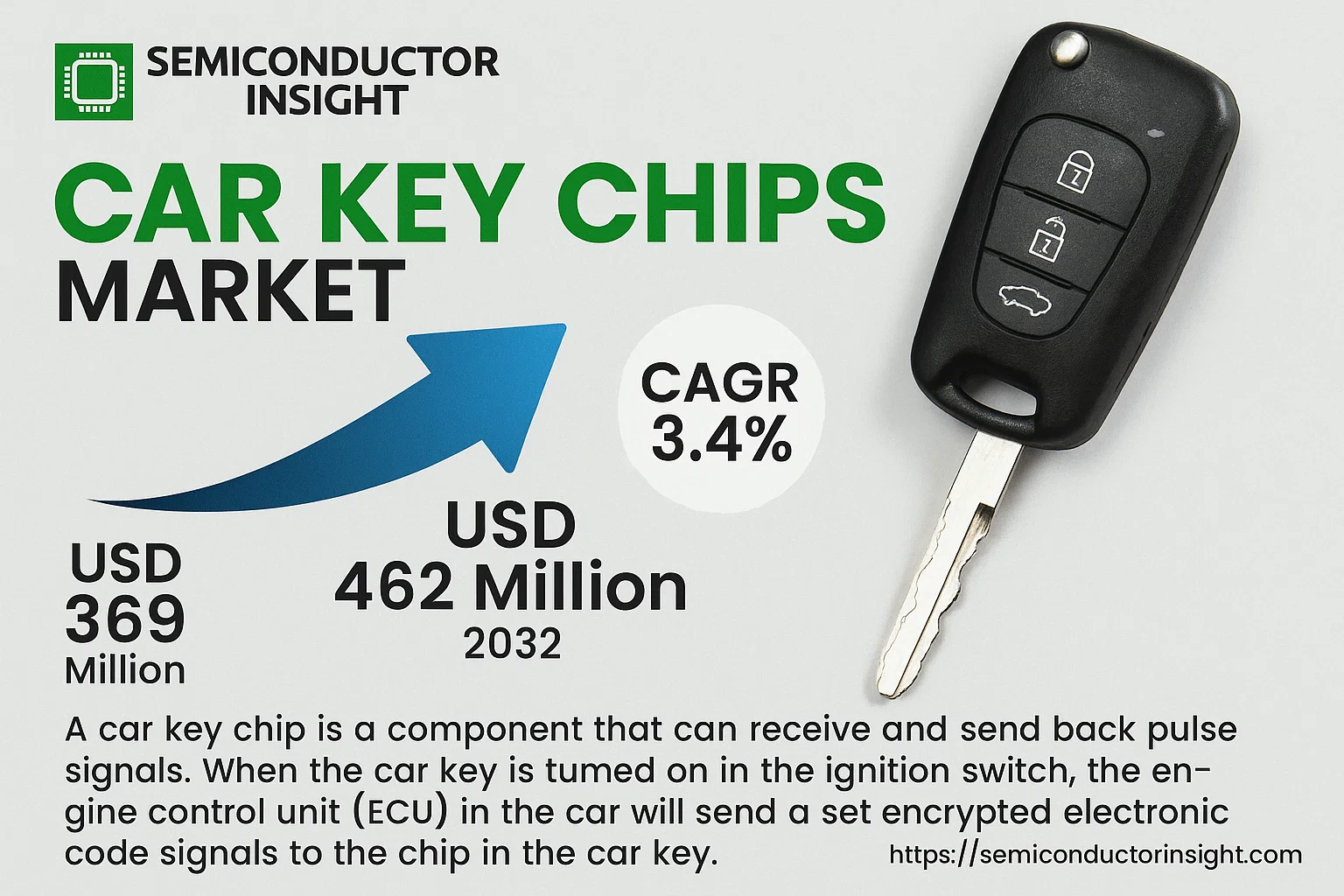
Global Car Key Chips Market was valued at USD 369 million in 2024 and is projected to reach USD 462 million by 2032, exhibiting a CAGR of 3.4% during the forecast period.
A car key chip is a component that can receive and send back pulse signals. When the car key is turned on in the ignition switch, the engine control unit (ECU) in the car will send a set of encrypted electronic code signals to the chip in the car key. Only when the car ECU unit can read and feedback the correct anti-theft code signal will the vehicle be allowed to start.
Global key players of Car Key Chips include NXP Semiconductors, Texas Instruments, Microchip and STMicroelectronics, etc. Top three players occupy for a share about 86%. China is the largest market, with a share about 30%, followed by Europe and North America. In terms of product, Keyless Startup Chip is the largest segment, with a share over 83%. In terms of application, Passenger Cars is the largest market, with a share over 95%.
The development of electric vehicles has made the automotive industry increasingly inclined towards intelligence and electrification, and people’s pursuit of the convenience of in-car functions and the technological attributes of the entire vehicle has been continuously improved; and the door, as one of the earliest electrified parts, has gone through the development stages of mechanical key – remote control key – passive keyless entry – electronic key based on mobile phones and other mobile devices. As the core part supporting the latter three stages, the global market for chips has been continuously developing rapidly.
We have surveyed the Car Key Chips manufacturers, suppliers, distributors, and industry experts on this industry, involving the sales, revenue, demand, price change, product type, recent development and plan, industry trends, drivers, challenges, obstacles, and potential risks.
MARKET DRIVERS
Rising Global Vehicle Production and Ownership
The steady growth in global automotive production, particularly in emerging economies, directly fuels demand for new car key chips. Every new vehicle requires an integrated electronic immobilizer system, making car key chips a consistent aftermarket. The rise of vehicle electrification and connected car technologies further embeds the necessity of sophisticated key systems from the point of manufacture.
Escalating Concerns Over Vehicle Security
Increasing incidents of vehicle theft have compelled both consumers and regulatory bodies to prioritize advanced anti-theft solutions. Car key chips, utilizing technologies like Radio-Frequency Identification (RFID) and rolling codes, provide a significant barrier against traditional hot-wiring, making them a critical security feature. This security imperative is a primary driver for both OEM installations and aftermarket upgrades.
➤ The integration of car key chips is no longer a luxury but a standard security protocol, with over 95% of new vehicles produced globally now equipped with transponder-based immobilizers.
Furthermore, consumer expectation for convenience features, such as keyless entry and push-button start systems, which rely on advanced chip technology, continues to push the market forward. The seamless user experience offered by these systems creates a strong pull from the demand side.
MARKET CHALLENGES
High Cost and Complexity of Replacement
When a key is lost or malfunctions, the replacement process is significantly more complex and expensive than with traditional mechanical keys. It requires specialized diagnostic tools and programming expertise to synchronize the new chip with the vehicle’s Engine Control Unit (ECU), creating a barrier for independent locksmiths and increasing costs for consumers.
Other Challenges
Vulnerability to Sophisticated Cyber-Theft
While effective against physical theft, certain keyless systems are susceptible to relay attacks, where thieves amplify the signal from a key fob inside a home to unlock and start a car. This ongoing cybersecurity arms race requires continuous and costly R&D to stay ahead of criminal methodologies.
Supply Chain Disruptions and Component Shortages
The car key chip market is susceptible to global semiconductor supply chain issues. Shortages of microcontrollers and other essential components can lead to production delays for both OEMs and aftermarket key suppliers, impacting market stability.
MARKET RESTRAINTS
Growth of Digital Key Solutions
The emergence of smartphone-based digital keys poses a significant long-term restraint on the physical car key chip market. Automakers are increasingly offering systems that allow a smartphone to function as a key, leveraging Bluetooth Low Energy (BLE) and Near Field Communication (NFC). This trend could reduce the reliance on dedicated physical key fobs over time.
Market Saturation in Developed Regions
In mature automotive markets like North America and Western Europe, the penetration rate of transponder keys is already near 100% for new vehicles. This high saturation level limits the growth potential from new car sales, shifting the market’s focus primarily toward the replacement and duplication segment, which has a slower growth trajectory.
MARKET OPPORTUNITIES
Expansion in Emerging Economies
As automotive production and ownership rates increase in Asia-Pacific, Latin America, and Africa, there is a substantial opportunity for market expansion. The gradual shift from basic mechanical keys to secure transponder-based systems in these regions represents a significant untapped market for key chip manufacturers and programmers.
Integration with Advanced Access Systems
The ongoing development of biometric authentication (e.g., fingerprint readers embedded in keys or door handles) and Ultra-Wideband (UWB) technology for more secure, precise passive entry presents a key opportunity. Integrating these advanced features into next-generation key fobs can create higher-value products and drive revenue growth.
Aftermarket and Service Sector Growth
The vast installed base of vehicles with chip keys ensures a steady and growing aftermarket for replacements, duplications, and repair services. Partnerships with automotive locksmiths, dealerships, and roadside assistance programs to provide efficient and accessible key programming services represent a robust and recurring revenue stream.
Car Key Chips Market Trends
Steady Growth Fueled by Vehicle Electrification and Security Demands
The global Car Key Chips market is on a trajectory of steady expansion, valued at US$ 369 million in 2024 and projected to reach US$ 462 million by 2032, representing a Compound Annual Growth Rate (CAGR) of 3.4%. This sustained growth is fundamentally driven by the automotive industry’s accelerated shift towards electrification and intelligence. Car key chips, which are essential components for receiving and sending encrypted signals to a vehicle’s Engine Control Unit (ECU) for secure start-up, are at the heart of modern vehicle access systems. The continuous consumer demand for enhanced convenience and advanced technological features in vehicles is a primary catalyst for market development.
Other Trends
Dominance of Keyless Start Technology and Regional Markets
The market is clearly segmented by technology, with Keyless Startup Chips holding a dominant position, accounting for over 83% of the market share. This underscores the automotive industry’s widespread adoption of passive entry and push-to-start systems. Geographically, China stands as the largest market, representing approximately 30% of the global share, followed by Europe and North America. This regional concentration reflects high vehicle production and consumer adoption rates of advanced automotive electronics in these areas. The application landscape is overwhelmingly dominated by Passenger Cars, which constitute over 95% of the market, indicating the critical role of these chips in the mass consumer automotive segment.
Consolidated Competitive Landscape and Future Evolution
The competitive environment is highly concentrated, with the top three players—NXP Semiconductors, Texas Instruments, and Microchip—collectively holding a significant share of about 86% of the global market. This consolidation points to high barriers to entry, including advanced semiconductor design expertise and stringent automotive-grade certification requirements. The evolution from mechanical keys to remote controls, and now to passive keyless entry and smartphone-based digital keys, illustrates the ongoing innovation in the sector. This progression ensures the car key chip market will continue to develop rapidly, closely aligned with broader trends in vehicle connectivity and automation.
COMPETITIVE LANDSCAPE
Key Industry Players
An Oligopolistic Market Dominated by Semiconductor Giants
The global Car Key Chips market is characterized by a highly concentrated competitive environment, with the top three players collectively commanding approximately 86% of the market share. NXP Semiconductors stands as the undisputed leader, leveraging its powerful portfolio in secure identification solutions. The market structure is oligopolistic, where a few large multinational semiconductor corporations hold significant sway over technology standards, pricing, and supply. Market concentration is further intensified by the high technical barriers to entry, including the need for advanced semiconductor fabrication capabilities, stringent security certifications, and deep, long-standing relationships with major automotive OEMs. These leading players have cemented their positions by consistently investing in R&D to develop more secure, power-efficient, and feature-rich chips that support advanced functionalities like passive keyless entry (PKE) and keyless start systems.
Beyond the dominant tier, several other significant players maintain a presence by focusing on niche applications, specific geographic markets, or by serving as secondary suppliers to the automotive industry. Companies like Infineon Technologies and Renesas Electronics offer robust alternatives with their own secure microcontroller and RF expertise. Additionally, specialized firms such as Maxim Integrated (now part of Analog Devices) have historically played important roles. Chinese manufacturers are also increasingly active, aiming to capture a larger share of the domestic market and expand globally. The competitive dynamics are shaped by continuous innovation in encryption protocols, integration of new communication standards like Ultra-Wideband (UWB) for secure phone-as-a-key solutions, and the push towards more compact and cost-effective chip designs.
List of Key Car Key Chips Companies Profiled
- NXP Semiconductors
- Texas Instruments
- Microchip Technology
- STMicroelectronics
- Infineon Technologies
- Renesas Electronics
- Analog Devices Inc.
- ON Semiconductor
- Cypress Semiconductor (Infineon)
- Melexis
- ROHM Semiconductor
- Denso Corporation
- Autocrypt
- Qualcomm
- Beijing Watchdata System Co., Ltd.
Segment Analysis:
| Segment Category | Sub-Segments | Key Insights |
| By Type |
|
Keyless Startup Chip is the predominant category, reflecting the automotive industry’s strong and sustained shift towards convenience and sophisticated access systems. This technology, essential for passive entry and push-button start functions, is increasingly viewed as a standard offering in modern vehicles, particularly as consumer demand for seamless user experiences grows. Its integration is central to the vehicle’s overall electronic architecture, making it a critical component in the evolution towards more connected and intelligent automotive platforms. |
| By Application |
|
Passenger Cars represent the most significant application segment, driven by high global production volumes and the rapid adoption of advanced keyless entry and start systems across all vehicle classes. The continuous consumer demand for enhanced security, convenience, and the integration of smart features in personal vehicles solidifies this segment’s leadership. Furthermore, the aggressive rollout of electric vehicles, which often feature state-of-the-art digital keys and connectivity, provides substantial additional momentum for chip integration in this category. |
| By End User |
|
OEMs (Original Equipment Manufacturers) are the dominant end users, as the vast majority of car key chips are integrated directly into new vehicles during the production process. This dominance is underpinned by the necessity for seamless integration with the vehicle’s complex electronic control units and anti-theft systems. The trend towards vehicles being equipped with advanced key systems as standard features from the factory ensures that OEMs remain the primary channel, with the aftermarket primarily serving replacement and specialized upgrade needs. |
| By Technology Level |
|
Passive Keyless Entry (PKE) is the leading technological segment, offering an optimal balance of high convenience and robust security that resonates strongly with consumers. This technology has become widely adopted across mid-range and premium vehicle segments. While Advanced Digital Keys represent the cutting edge, particularly in the context of electric and connected vehicles, PKE currently enjoys broader market penetration and is a key driver of growth, as it is seen as a must-have feature for modern automotive convenience. |
| By Security Protocol |
|
Encrypted Challenge-Response protocols are the leading security standard, driven by the critical need to protect vehicles from increasingly sophisticated electronic theft methods. This protocol, which involves dynamic, encrypted communication between the key fob and the vehicle’s ECU, provides a significantly higher level of security compared to older fixed or rolling code systems. Its adoption is essential for modern vehicle security architectures and is a key factor in maintaining consumer trust in keyless entry systems, making it the dominant and most critical segment for future development. |
Regional Analysis: Car Key Chips Market
Government and insurance mandates across North America, particularly in the US, promote the use of advanced vehicle security systems. This creates a consistent regulatory push that standardizes the integration of high-security immobilizer chips and encrypted key fobs as essential components in both new and existing vehicle fleets, ensuring market stability and growth.
There is a high rate of consumer readiness for advanced automotive technologies in North America. The demand for convenience features such as keyless entry, push-button ignition, and smartphone-as-a-key functionality is particularly strong, driving OEMs to incorporate more complex and secure chip-based key systems as standard or premium offerings.
The region is a hub for technological advancements in chip design and cryptography. Collaboration between automotive OEMs and semiconductor companies leads to the development of chips with higher encryption levels and energy efficiency, often integrating with broader vehicle connectivity and telematics systems for enhanced functionality and security.
A robust automotive aftermarket exists, supporting demand for replacement key chips and fobs. High vehicle ownership rates and a network of specialized locksmiths and dealerships ensure that the market for replacements, reprogramming, and upgrades remains active, contributing significantly to the overall regional market volume.
Europe
Europe represents a mature and highly regulated market for car key chips, characterized by a strong focus on vehicle security standards. The region has been an early adopter of electronic immobilizers, with mandates requiring such systems for many years. This has created a deeply integrated market where advanced encryption and rolling code technologies are commonplace. Consumer expectations for security and convenience are very high, driving the adoption of sophisticated keyless entry systems. However, concerns about relay attacks have spurred further innovation in secure communication protocols. The presence of major luxury and premium vehicle manufacturers, particularly in Germany, fuels the demand for high-end chip solutions integrated with comprehensive vehicle access systems.
Asia-Pacific
The Asia-Pacific region is the fastest-growing market for car key chips, driven by massive automotive production and sales, particularly in China, Japan, and South Korea. Rapid urbanization, increasing disposable incomes, and a growing middle class are leading to higher vehicle ownership and a subsequent demand for enhanced security features. While the market includes a broad spectrum from basic immobilizers to advanced smart keys, the trend is decisively shifting towards more sophisticated systems. Local semiconductor manufacturing capabilities are expanding, supporting the supply chain. However, the market is highly price-sensitive, which influences the pace and nature of technology adoption, with a strong focus on cost-effective yet reliable chip solutions.
South America
The car key chip market in South America is developing, with growth primarily driven by increasing vehicle production and a gradual rise in security awareness. Brazil and Argentina are the key markets, though economic volatility can impact the pace of adoption. The market is characterized by a mix of basic immobilizer systems in entry-level vehicles and more advanced key fobs in premium segments. The aftermarket for replacements is significant due to high rates of vehicle aging and theft, creating demand for chip programming and cloning services. Regulatory frameworks regarding vehicle security are evolving but are less stringent compared to North America or Europe.
Middle East & Africa
This region presents a diverse market landscape for car key chips. The Gulf Cooperation Council (GCC) countries have a high penetration of luxury vehicles, which drives demand for advanced keyless entry and smart key systems. In contrast, other parts of Africa see a much higher volume of used vehicle imports, where basic immobilizer systems are more common. The market is influenced by the need for robust security solutions due to varying theft rates across the region. The overall market growth is tied to economic conditions and the development of the automotive retail and service infrastructure, with potential for significant expansion as security standards become more widely adopted.
Report Scope
This market research report provides a comprehensive analysis of the Car Key Chips Market , covering the forecast period 2025–2032. It offers detailed insights into market dynamics, technological advancements, competitive landscape, and key trends shaping the industry.
Key focus areas of the report include:
- Market Overview: The report begins with an overview outlining its current market scenario, key growth indicators, and industry transformation drivers. It discusses macroeconomic factors, demand–supply balance, regulatory landscape, and the strategic role of semiconductors in powering advancements across industries such as automotive, telecommunications, consumer electronics, and industrial automation.
- Market Size & Forecast: Historical data and future projections for revenue, unit shipments, and market value across major regions and segments.
- Segmentation Analysis: Detailed breakdown by product type, technology, application, and end-user industry to identify high-growth segments and investment opportunities.
- Regional Insights: Insights into market performance across North America, Europe, Asia-Pacific, Latin America, and the Middle East & Africa, including country-level analysis where relevant.
- Competitive Landscape: Profiles of leading market participants, including their product offerings, R&D focus, manufacturing capacity, pricing strategies, and recent developments such as mergers, acquisitions, and partnerships.
- Technology Trends & Innovation: Assessment of emerging technologies, integration of AI/IoT, semiconductor design trends, fabrication techniques, and evolving industry standards.
- Market Drivers & Restraints: Evaluation of factors driving market growth along with challenges, supply chain constraints, regulatory issues, and market-entry barriers.
- Stakeholder Insights: Insights for component suppliers, OEMs, system integrators, investors, and policymakers regarding the evolving ecosystem and strategic opportunities.
Primary and secondary research methods are employed, including interviews with industry experts, data from verified sources, and real-time market intelligence to ensure the accuracy and reliability of the insights presented.
FREQUENTLY ASKED QUESTIONS:
What is the current market size of Car Key Chips Market?
-> Global Car Key Chips Market was valued at USD 369 million in 2024 and is projected to reach USD 462 million by 2032, exhibiting a CAGR of 3.4% during the forecast period.
Which key companies operate in Car Key Chips Market?
-> Key players include NXP Semiconductors, Texas Instruments, Microchip, and STMicroelectronics, among others. The top three players hold a combined market share of approximately 86%.
What are the key growth drivers?
-> Key growth drivers include the development of electric vehicles and the automotive industry’s shift towards intelligence and electrification, along with increasing consumer demand for convenient in-car functions and advanced vehicle technology.
Which region dominates the market?
-> China is the largest market with a share of about 30%, followed by Europe and North America.
What are the emerging trends?
-> Emerging trends include the evolution from mechanical keys to electronic keys based on mobile devices and the continued technological advancement in passive keyless entry and keyless startup systems.

Get Sample Report PDF for Exclusive Insights
Report Sample Includes
- Table of Contents
- List of Tables & Figures
- Charts, Research Methodology, and more...
 Download Sample Report PDF