
Market Insights
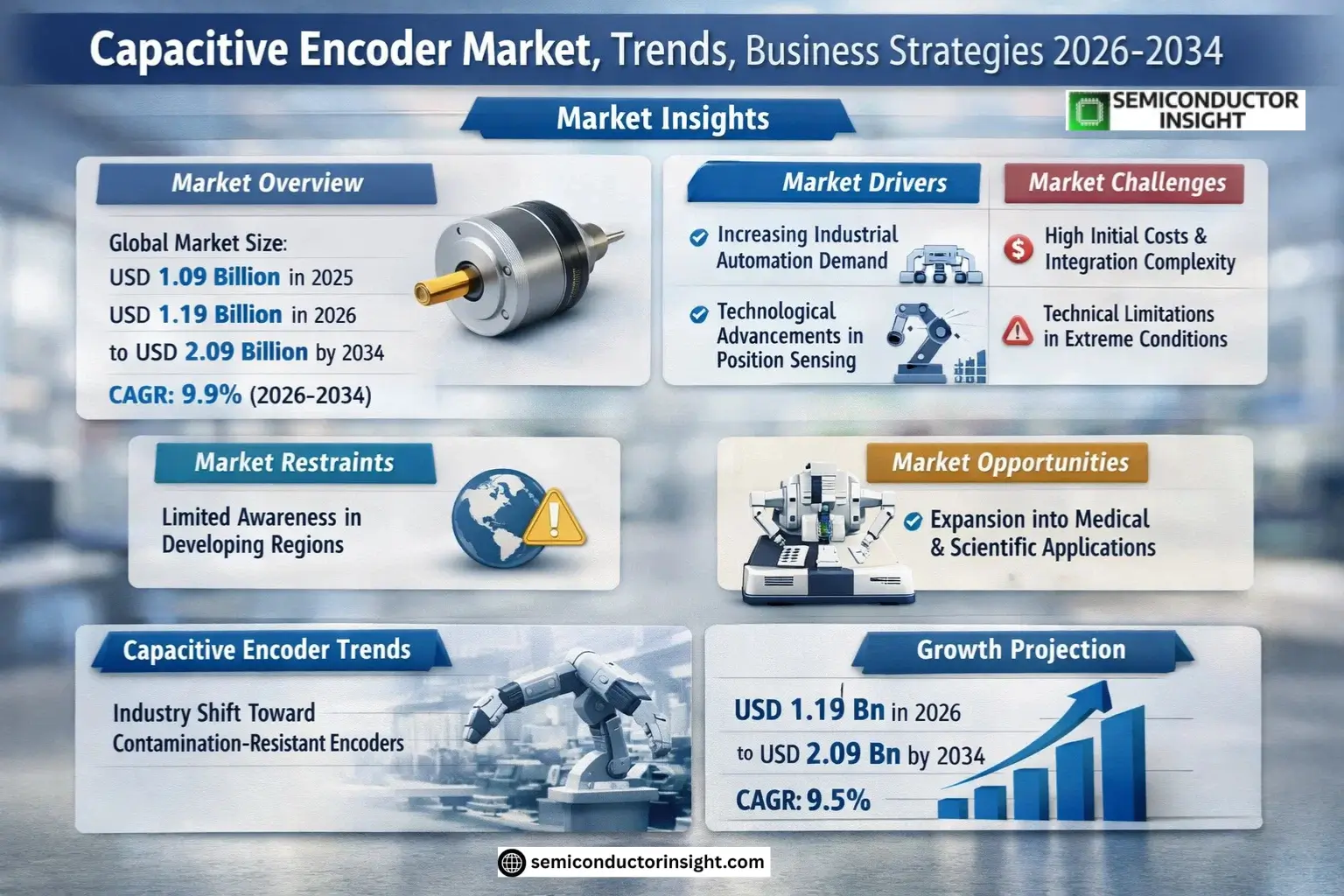
Global Capacitive Encoder Market size was valued at USD 1.09 billion in 2025. The market is projected to grow from USD 1.19 billion in 2026 to USD 2.09 billion by 2034, exhibiting a CAGR of 9.9% during the forecast period.
Capacitive encoders are advanced feedback devices used in motion control, robotics, and industrial automation applications. These encoders measure angular or linear displacement by detecting changes in capacitance between electrode patterns on rotating or moving components. Unlike optical or magnetic alternatives, capacitive encoders offer superior resistance to environmental contaminants like dust, oil mist, and condensation while maintaining high precision and resolution.
The market growth is driven by increasing demand for reliable position sensing in harsh industrial environments and the expanding adoption of automation across manufacturing sectors. Key applications include robotic joints, semiconductor handling equipment, medical imaging systems, and aerospace positioning systems where traditional encoder technologies face limitations. Major industry players are focusing on developing ultra-thin designs with higher resolutions up to 24 bits to address emerging requirements in compact motion control applications.
MARKET DRIVERS
Increasing Industrial Automation Demand
Capacitive Encoder Market is experiencing growth due to rising adoption in industrial automation. These devices provide high precision and durability in harsh environments, making them ideal for factory automation and robotics. Industries are increasingly replacing traditional optical encoders with capacitive encoders for their superior dust and contamination resistance.
Technological Advancements in Position Sensing
Recent innovations in capacitive sensing technology have improved resolution and accuracy, with some models now offering sub-micron precision. The development of contactless capacitive encoders has expanded applications in semiconductor manufacturing and medical equipment where vibration resistance and longevity are critical.
Another significant driver is the shift towards Industry 4.0 implementations, where capacitive encoders play a key role in smart manufacturing systems by providing accurate real-time position data for predictive maintenance applications.
MARKET CHALLENGES
High Initial Costs and Integration Complexity
While capacitive encoders offer long-term benefits, their higher upfront costs compared to optical or magnetic alternatives present adoption barriers. System integration challenges in retrofitting existing equipment with capacitive encoder technology also slow market penetration.
Other Challenges
Technical Limitations in Extreme Conditions
Capacitive encoders can experience performance degradation in environments with rapid temperature fluctuations or high electromagnetic interference, requiring additional shielding and compensation circuitry.
MARKET RESTRAINTS
Limited Awareness in Developing Regions
In emerging economies, the Capacitive Encoder Market faces slower growth due to limited technical understanding of advantages over traditional encoders. Many manufacturers continue to rely on established technologies, creating resistance to adoption of capacitive solutions despite their benefits.
MARKET OPPORTUNITIES
Expansion into Medical and Scientific Applications
The medical device industry presents significant growth potential for capacitive encoders, particularly in precision surgical robots and imaging systems. Their non-contact operation and immunity to sterilization processes make them ideal for cleanroom applications and sterile environments.
Capacitive Encoder Market Trends
Industry Shift Toward Contamination-Resistant Encoders
Capacitive Encoder Market is witnessing strong adoption in industrial automation sectors where traditional optical encoders struggle with reliability. These devices excel in environments with dust, oil mist, or condensation while maintaining high precision – a combination that magnetic encoders cannot match. Manufacturers are increasingly specifying capacitive solutions for robotic joints, semiconductor equipment, and medical imaging systems where contamination resistance and precision coexist.
Other Trends
Advancements in Measurement Technology
Recent capacitive encoder designs achieve 23-24 bit absolute resolution through improved electrode patterning and advanced interpolation algorithms. This positions them competitively against high-end optical encoders while retaining their environmental advantages. Key manufacturers are investing in ASIC development to reduce noise and improve signal processing capabilities.
Expansion in Collaborative Robotics
The collaborative robot segment is driving demand for compact, low-inertia capacitive encoders that can operate maintenance-free in shared workspaces. Their wider installation tolerances simplify robot arm assembly while withstand vibration better than optical alternatives. This trend aligns with industry needs for flexible automation with minimal downtime.
Material and Manufacturing Innovations
Supply chain enhancements focus on high-stability PCB substrates and specialized dielectric materials that improve temperature performance. Leading manufacturers are vertically integrating key components like measurement ASICs to control quality and costs, particularly for aerospace and medical applications requiring extended lifecycle performance.
Other Trends
Standardization in Motion Control Systems
Major motion control platform providers are incorporating capacitive encoder interfaces as standard options, reducing integration complexity for OEMs. This shift is particularly evident in semiconductor handling equipment and precision test benches where unified communication protocols improve system reliability and simplify maintenance.
Regional Manufacturing Hubs Driving Growth
Asia-Pacific semiconductor and robotics clusters are adopting capacitive encoders at accelerated rates, with China representing over 35% of new installations. European medical equipment manufacturers and North American aerospace suppliers also show strong uptake, particularly for absolute encoder variants with functional safety certifications.
COMPETITIVE LANDSCAPE
Key Industry Players
Technological Leadership and Market Positioning in Capacitive Encoders
Capacitive Encoder Market is led by specialized manufacturers like Kappasense, Netzer, and Same Sky, who dominate high-precision industrial automation segments with patented electrode patterning and signal processing technologies. Kappasense holds particular strength in absolute linear encoders for semiconductor equipment, while Netzer’s ultra-thin aerospace-grade designs cater to robotic arm manufacturers facing space constraints. These innovators differentiate through contamination-resistant designs achieving optical-grade resolutions up to 24 bits, capturing premium segments where traditional encoders underperform.
Established motion control suppliers like Heidenhain and SICK are expanding portfolios with capacitive solutions, leveraging existing distribution networks in machine tool and logistics automation markets. Emerging Asian players such as PoLabs and Georg Schlegel focus on cost-competitive rotary encoders for AGV/AMR applications, benefiting from regional robotics industry growth. The market shows consolidation trends with strategic acquisitions like Posital-Fraba’s 2023 purchase of a capacitive encoder startup to strengthen medical equipment offerings.
List of Key Capacitive Encoder Companies Profiled
- Kappasense
- Same Sky
- Netzer Precision
- TR Electronic
- Heidenhain
- PoLabs
- Posital-Fraba
- Hengstler
- Bourns
- SICK AG
- Georg Schlegel
- Micro-Epsilon
- Celera Motion
- ATI Industrial Automation
- Zettlex (now Novanta)
Segment Analysis:
| Segment Category | Sub-Segments | Key Insights |
| By Type |
|
Rotary Capacitive Encoders dominate due to widespread adoption in robotics and motor control applications:
|
| By Application |
|
Industrial Robotics represents the most significant growth area:
|
| By End User |
|
OEMs drive the majority of demand across all segments:
|
| By Technology Level |
|
High Precision models are seeing accelerated adoption:
|
| By Environmental Resistance |
|
High Contamination Resistance models are key differentiators:
|
Regional Analysis: Global Capacitive Encoder Market
North America’s advanced manufacturing sector extensively utilizes capacitive encoders for precision motion control in automated assembly lines. The growing adoption of collaborative robots across automotive and electronics manufacturing drives consistent demand for reliable position feedback devices.
Silicon Valley and other tech clusters foster capacitive encoder advancements, with companies developing compact, high-resolution solutions. Emerging applications in medical robotics and semiconductor equipment manufacturing continue to push performance requirements for encoder technologies.
U.S. defense contractors require high-reliability capacitive encoders for aerospace and naval applications, creating specialized market segments. Stringent military specifications drive development of encoders with enhanced durability and performance in extreme conditions.
Oil and gas operations in the Permian Basin and Canadian oil sands utilize capacitive encoders for pipeline monitoring and drilling equipment. Growing renewable energy installations also contribute to market expansion through wind turbine pitch control systems.
Europe
Europe maintains a strong position in the Capacitive Encoder Market with its precision engineering tradition and emphasis on industrial quality. Germany’s Mittelstand manufacturers drive demand for high-accuracy encoders in machine tool applications, while Italian packaging machinery sector requires robust solutions for high-speed operations. The European market benefits from strict EU regulations on energy efficiency in industrial equipment, prompting encoder innovation. Growing medical device manufacturing in Switzerland and increasing automation in Scandinavian countries contribute to steady regional growth.
Asia-Pacific
The Asia-Pacific region shows the fastest growth in capacitive encoder adoption, fueled by expanding manufacturing bases in China, Japan, and South Korea. China’s push for industrial automation and semiconductor self-sufficiency creates substantial encoder demand, while Japanese robotics companies require precision components for export markets. India’s growing automotive sector presents new opportunities, though price sensitivity remains a market characteristic. Regional suppliers are increasingly developing cost-competitive encoder solutions without compromising performance standards.
South America
South America’s Capacitive Encoder Market remains developing, with Brazil and Argentina showing gradual adoption in agricultural and mining equipment. Brazilian automation initiatives in food processing and packaging create localized demand, while Chilean mining operations invest in encoder-equipped heavy machinery. Infrastructure challenges and economic volatility occasionally impact market growth pace in the region.
Middle East & Africa
The Middle East demonstrates selective demand for capacitive encoders in oilfield applications and infrastructure projects, with UAE and Saudi Arabia leading adoption. Africa’s market remains nascent outside South Africa’s mining sector and North African automotive manufacturing clusters. Growing industrial development in Egypt and Morocco shows potential for future encoder market expansion.
Report Scope
This market research report provides a comprehensive analysis of the Capacitive Encoder Market, covering the forecast period 2025–2032. It offers detailed insights into market dynamics, technological advancements, competitive landscape, and key trends shaping the industry.
Key focus areas of the report include:
- Market Overview: The report begins with an overview outlining its current market scenario, key growth indicators, and industry transformation drivers. It discusses macroeconomic factors, demand–supply balance, regulatory landscape, and the strategic role of semiconductors in powering advancements across industries such as automotive, telecommunications, consumer electronics, and industrial automation.
- Market Size & Forecast: Historical data and future projections for revenue, unit shipments, and market value across major regions and segments.
- Segmentation Analysis: Detailed breakdown by product type, technology, application, and end-user industry to identify high-growth segments and investment opportunities.
- Regional Insights: Insights into market performance across North America, Europe, Asia-Pacific, Latin America, and the Middle East & Africa, including country-level analysis where relevant.
- Competitive Landscape: Profiles of leading market participants, including their product offerings, R&D focus, manufacturing capacity, pricing strategies, and recent developments such as mergers, acquisitions, and partnerships.
- Technology Trends & Innovation: Assessment of emerging technologies, integration of AI/IoT, semiconductor design trends, fabrication techniques, and evolving industry standards.
- Market Drivers & Restraints: Evaluation of factors driving market growth along with challenges, supply chain constraints, regulatory issues, and market-entry barriers.
- Stakeholder Insights: Insights for component suppliers, OEMs, system integrators, investors, and policymakers regarding the evolving ecosystem and strategic opportunities.
Primary and secondary research methods are employed, including interviews with industry experts, data from verified sources, and real-time market intelligence to ensure the accuracy and reliability of the insights presented.
FREQUENTLY ASKED QUESTIONS:
What is the current market size of Capacitive Encoder Market?
-> Capacitive Encoder Market size was valued at USD 1.09 billion in 2025. The market is projected to grow from USD 1.19 billion in 2026 to USD 2.09 billion by 2034, exhibiting a CAGR of 9.9% during the forecast period.
Which key companies operate in Capacitive Encoder Market?
-> Key players include Kappasense, Same Sky, Netzer, TR Electronic, Heidenhain, PoLabs, Posital-Fraba, Hengstler, Bourns, SICK, Georg Schlegel, and Micro-Epsilon.
What are the key growth drivers?
-> Key growth drivers include rising demand in robotics and semiconductor equipment, contamination resistance advantages over optical encoders, and superior precision compared to magnetic encoders.
Which region dominates the market?
-> Asia-Pacific shows fastest growth due to robotics and semiconductor industry expansion, while Europe leads in high-end industrial applications.
What are the emerging trends?
-> Emerging trends include higher resolution (up to 24-bit), ultra-thin designs for robotics, integrated modular solutions, and functional safety features.
Get Sample Report PDF for Exclusive Insights
Report Sample Includes
- Table of Contents
- List of Tables & Figures
- Charts, Research Methodology, and more...
 Download Sample Report PDF


