
Brushed Coreless Motor Market Insights
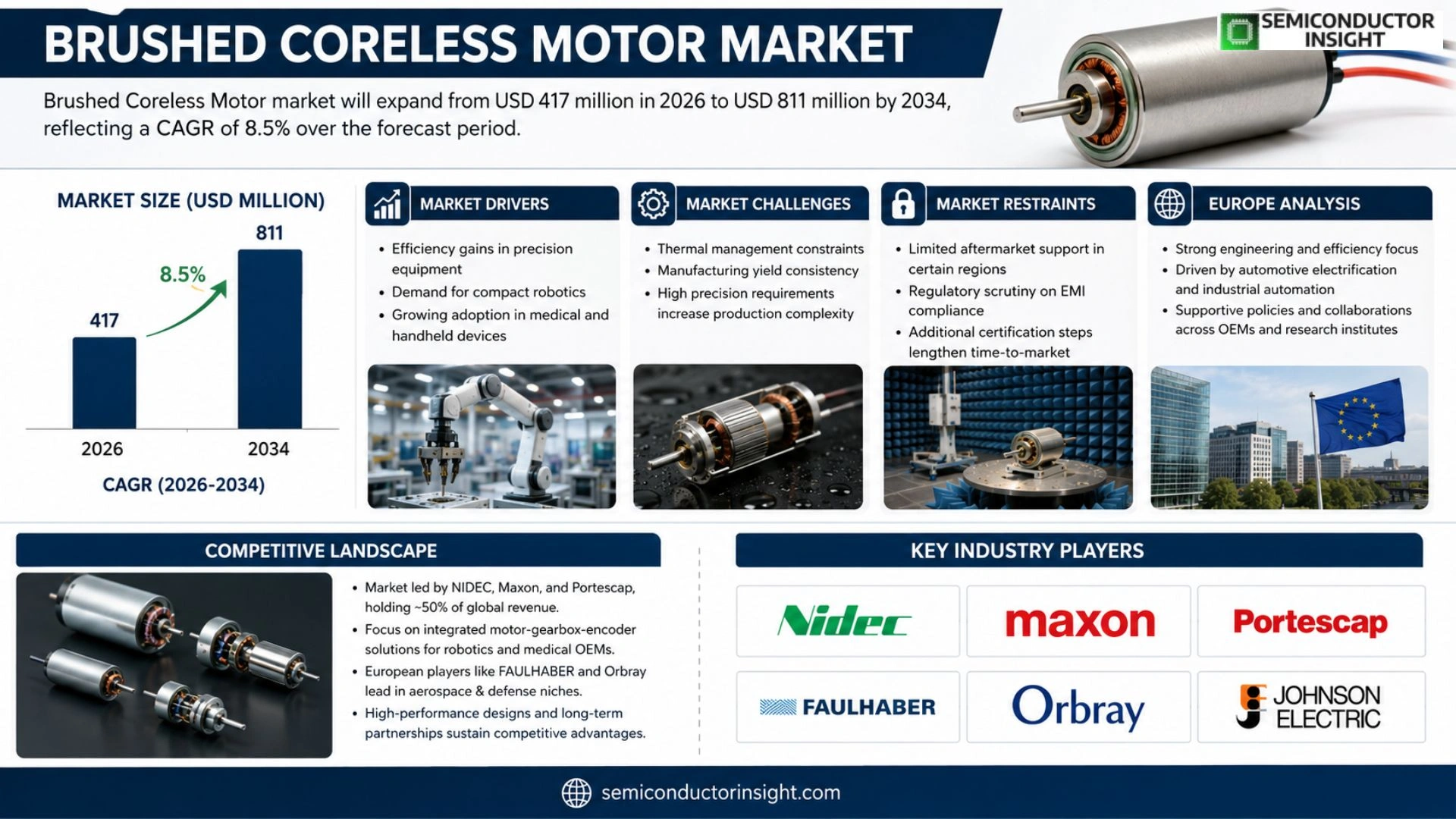
Global Brushed Coreless Motor market size will expand from USD 417 million in 2026 to USD 811 million by 2034, reflecting a CAGR of 8.5% over the forecast period.
Brushed coreless motors are miniature DC motors that incorporate a core‑less rotor made of hollow cup windings and a mechanical brush commutation system. Unlike traditional designs, the rotor’s cup‑shaped hollow structure is formed directly from enameled wire using oblique, straight or saddle winding techniques, while the stator employs high‑performance permanent magnets. This architecture eliminates core eddy‑current and hysteresis losses, allowing energy conversion efficiencies of 70‑90 % and delivering millisecond‑level start/stop response with low noise.
The market’s expansion is driven by rising demand for compact, high‑efficiency drives in robotics, medical devices and precision instrumentation. Upstream components such as permanent magnets, enameled copper wire and precision bearings have seen increased procurement volumes, while manufacturers like Maxon, Portescap, FAULHABER, Orbray and NIDEC continue to broaden their product portfolios with integrated gearboxes and encoders. In China, firms such as Shanghai Moons’ Electric and Shenzhen Topband Motor are targeting handheld tools and life‑science equipment, reinforcing the sector’s overall momentum.
MARKET DRIVERS
Efficiency Gains in Precision Equipment
Brushed Coreless Motor market benefits from manufacturers seeking higher torque density while reducing acoustic noise. By eliminating the traditional iron core, these motors achieve lighter assemblies, which directly translates into lower power consumption for handheld and medical devices. OEMs cite measurable improvements in battery life, prompting design teams to prioritize core‑less solutions in new product cycles.
Demand for Compact Robotics
Robotic arms and micro‑automation platforms demand actuators that fit within stringent envelope constraints. Brushed coreless designs deliver smooth, high‑speed operation without the bulk of conventional windings, enabling tighter kinematic configurations. Integrators note a clearer path to multi‑axis coordination, which, in turn, expands the addressable market for collaborative robots in factories.
➤ “Design engineers now view core‑less brushes as a baseline rather than a niche option, reshaping component selection criteria across sectors.”
Beyond the technical merits, supply‑chain resilience is improving as more specialized vendors diversify production across regions. This reduces lead‑time volatility, encouraging companies to commit larger volumes to Brushed Coreless Motor market with greater confidence.
MARKET CHALLENGES
Thermal Management Constraints
Without the iron core to dissipate heat, brushed coreless motors can experience localized temperature spikes when operated near their peak speed. Designers must incorporate auxiliary cooling methods or derate performance, which can erode the cost advantage that initially attracted buyers.
Other Challenges
Manufacturing Yield Consistency
Achieving uniform brush contact and rotor balance across large production runs remains a delicate process. Variability in these parameters can lead to premature wear, prompting end‑users to demand stricter quality certifications and potentially slowing adoption rates.
MARKET RESTRAINTS
Higher Up‑Front Component Costs
Although total lifecycle expenses may decline, the initial purchase price of brushed coreless units often exceeds that of conventional brushed motors. Budget‑conscious projects, especially in cost‑sensitive consumer electronics, may postpone migration until price parity is achieved.
Customers also confront limited aftermarket support in regions where legacy motor suppliers dominate. The scarcity of trained service technicians can deter small‑scale manufacturers from integrating core‑less technology into their product lines.
Regulatory scrutiny around electromagnetic interference (EMI) adds another layer of complexity. While the core‑less architecture inherently reduces certain EMI signatures, compliance testing still imposes additional certification steps that can lengthen time‑to‑market.
MARKET OPPORTUNITIES
Expansion into Wearable Medical Devices
The rise of portable therapeutic equipment,such as insulin pumps and compact ventilators,creates a fertile niche for Brushed Coreless Motor market. These applications demand ultra‑low vibration, precise speed control, and extended battery operation, all attributes that align with core‑less motor capabilities.
Collaborations between motor manufacturers and semiconductor firms are opening avenues for integrated drive electronics, further streamlining system architecture. Such joint solutions can lower overall system cost while delivering the performance envelope required by next‑generation portable health monitors.
Finally, emerging standards for drone propulsion encourage adoption of lightweight, high‑efficiency motors. By positioning core‑less offerings within OEM certification programs for aerial platforms, suppliers can capture a share of the rapidly evolving unmanned aerial vehicle sector.
Brushed Coreless Motor Market Trends
Efficiency Gains and Ultra‑Low Inertia Drive Adoption
Brushed Coreless Motor market is witnessing a pronounced shift toward applications that demand rapid start‑stop cycles and minimal acoustic signature. By eliminating core losses, the motor’s conversion efficiency routinely exceeds 80 %, a level that materially reduces overall system power draw in battery‑operated platforms. Manufacturers of handheld surgical instruments and precision pick‑and‑place machines are capitalizing on this efficiency envelope, because every watt saved translates into longer runtimes or smaller power supplies. Moreover, the near‑zero rotational inertia enables response times measured in milliseconds, a characteristic that directly improves positioning accuracy for robotic arms used in semiconductor assembly. The convergence of high efficiency and swift torque response is reshaping procurement specifications, pressuring traditional brushed DC suppliers to augment their portfolios with coreless variants.
Other Trends
Supply‑Chain Consolidation and Component Standardization
Upstream, the Brushed Coreless Motor ecosystem is coalescing around a limited set of high‑performance permanent‑magnet producers and specialty enameled‑wire manufacturers. This concentration reduces lead‑time volatility for OEMs, yet it also raises barriers for new entrants lacking secured magnet allocations. Companies such as NIDEC, Maxon and Shanghai Moons’ Electric have begun offering bundled solutions that combine motor, gearbox and encoder into a single contract‑manufacture unit. The strategic bundling not only simplifies inventory management for end‑users but also creates a pricing power lever that can be leveraged in competitive bids for industrial automation projects.
Smart Integration and Miniaturization
Another decisive trend is the embedding of micro‑controller based driver electronics within the motor housing itself. By integrating power‑stage MOSFETs and feedback loops, manufacturers are delivering plug‑and‑play modules that reduce wiring complexity and improve reliability in constrained environments such as endoscopic devices and wearable haptics. This integration aligns with the broader industry movement toward modular, software‑defined motion solutions, where firmware updates can unlock new performance curves without physical redesign. For system integrators, the ability to remotely calibrate torque limits or adjust commutation timing represents a tangible cost‑saving avenue, while also opening revenue streams for service contracts tied to motor performance analytics.
COMPETITIVE LANDSCAPE
Key Industry Players
Competitive Dynamics in the Global Brushed Coreless Motor Market
The market is dominated by a handful of technology‑focused firms that have built extensive motor‑gearbox‑encoder platforms. NIDEC, Maxon and Portescap together account for roughly half of global revenue, leveraging high‑performance permanent‑magnet designs and deep relationships with OEMs in robotics and medical equipment. Their ability to offer turnkey solutions,combining precision winding, customized brushes and integrated control electronics,creates a barrier for smaller entrants and sustains relatively high gross margins. Meanwhile, European specialists such as FAULHABER and Orbray maintain niche leadership in aerospace and defense through rigorous certification processes and long‑term supply contracts, reinforcing a tiered competitive structure where scale and specialization coexist.
Beyond the tier‑one group, a vibrant cohort of Asian manufacturers expands the supply base with cost‑effective, application‑specific offerings. Shanghai Moons’ Electric, Shenzhen Topband Motor, Jiangsu DINGS’ Intelligent Control Technology and Zhejiang Hechuan Technology have introduced micro‑geared variants tailored for handheld tools and dexterous robotic hands. Their strategies hinge on rapid prototyping, localized sourcing of permanent magnets and copper wire, and aggressive pricing. Companies such as Shenzhen Zhaowei Machinery & Electronics and Suzhou Veichi Electric focus on the consumer electronics segment, supplying high‑volume, low‑inertia motors for optical measurement devices. This diversification of providers intensifies pricing pressure while fostering innovation in winding geometries and brush materials.
List of Key Brushed Coreless Motor Companies Profiled
- Maxon
- Portescap
- FAULHABER
- Orbray
- NIDEC
- Allied Motion
- Nanotec
- Namiki
- Pelonis Technologies
- C.I. Takiron Corporation
- ISL Products
- Shanghai Moons’ Electric
- Jiangsu DINGS’ Intelligent Control Technology
- Shenzhen Zhaowei Machinery & Electronics
- Shenzhen Topband Motor
- Shenzhen Kegu Technology
- Shenzhen Sinbad Motor
- Zhejiang Hechuan Technology
- Jiangsu Leili
- Constar Micromotor
Segment Analysis:
| Segment Category | Sub-Segments | Key Insights |
| By Type |
|
Coreless Brush-Type Motors dominate discussions because of their minimal inertia and rapid response, which are crucial for precision equipment. • They enable ultra‑quiet operation suited for medical and optical devices. • Their design simplifies integration with compact gearboxes, supporting handheld tools and dexterous robot hands. • The absence of a ferrous core reduces electromagnetic losses, extending component life and easing thermal management. |
| By Application |
|
Precision Robotics is a leading application segment because the motors’ swift start‑stop capability matches the dynamic demands of collaborative robots. • In medical devices, the low noise and fine torque control support implantable pumps and imaging tools. • Optical measurement equipment benefits from the stable rotation and minimal vibration, enhancing accuracy. • Consumer electronics leverage compact form factor for wearable and portable gadgets, while industrial automation values reliability under continuous operation. |
| By End User |
|
Medical & Life Sciences lead due to stringent performance criteria such as ultra‑quiet operation and precise motion control. • End users in this segment value the motor’s rapid response for drug delivery and microsurgical tools. • The low inertia supports high‑frequency positioning in imaging systems. • Reliability and long service life align with regulatory expectations, prompting manufacturers to tailor motor designs for sterility and biocompatibility. |
| By Voltage |
|
Low and Medium Voltage motors are preferred for most portable and handheld applications where energy efficiency and battery compatibility are paramount. • Their modest voltage range simplifies power‑management circuitry, facilitating integration into compact devices. • High‑voltage variants find niche use in industrial machines that demand higher torque without sacrificing the coreless benefits, yet they require more robust insulation and thermal design. |
| By Winding Structure |
|
Saddle and Diamond Windings are emerging as preferred structures for ultra‑compact motor designs because they maximize magnetic flux density while preserving the coreless advantage. • Straight and diagonal windings continue to serve cost‑sensitive markets where manufacturing simplicity is valued. • Advanced winding techniques enable finer control over torque ripple, supporting high‑precision positioning tasks across robotics and medical instrumentation. |
Regional Analysis: Brushed Coreless Motor Market
German and French carmakers are integrating brushed‑coreless units into e‑powertrain sub‑systems, valuing the motors’ high power density for compact chassis layouts. The shift supports lighter vehicle architectures and aligns with EU emissions targets, prompting a surge in collaborative development programmes between Tier‑1 suppliers and motor specialists.
Factories across the Nordics are replacing legacy actuation assemblies with brushed coreless variants, attracted by the reduced heat generation and longer service intervals. This transition enables higher throughput in packaging lines while cutting operational expenditures tied to maintenance cycles.
Premium home‑appliance brands are adopting these motors for quiet, precise operation in devices such as robotic vacuums and smart kitchen tools. The ability to deliver consistent torque at low speeds satisfies consumer expectations for durability and silent performance.
European aerospace firms are testing brushed coreless motors in actuators for unmanned aerial systems, where weight savings translate directly into endurance gains. Defense contractors also appreciate the motors’ resistance to magnetic interference in sensitive avionics applications.
North America
In the United States, Brushed Coreless Motor market is being shaped by a convergence of defense procurement and advanced manufacturing initiatives. Federal research grants encourage startups to explore high‑efficiency motor topologies for unmanned ground vehicles, while automotive OEMs focus on integrating these motors into electric power‑steering modules. Canadian producers add a North‑American dimension by targeting renewable‑energy equipment, where low‑inertia drive units improve turbine responsiveness. The market benefits from a robust IP framework that protects innovative designs, prompting larger firms to pursue strategic acquisitions of niche technology firms to broaden their portfolio and accelerate time‑to‑market for new applications.
Asia‑Pacific
Rapid urbanization across China, India, and Southeast Asia fuels demand for compact, reliable motors in mass‑market appliances and electric two‑wheelers. Local manufacturers exploit cost‑effective supply chains to produce brushed coreless units at scale, meeting price‑sensitive consumer expectations while adhering to emerging energy‑efficiency regulations. Joint ventures between Japanese motor specialists and Indian electronics firms illustrate a collaborative trend that leverages design expertise with expansive manufacturing capacity, positioning the region as a pivotal growth engine for the global market.
South America
Brazil and Argentina are witnessing incremental adoption of brushed coreless motors within agricultural equipment and small‑scale industrial machinery. Government incentives aimed at modernizing farming practices encourage the replacement of antiquated diesel‑driven systems with electrically powered alternatives that incorporate these motors for precise seed‑planting mechanisms. Although market penetration remains modest, the region’s focus on sustainability and labor‑efficiency creates a fertile environment for future expansion, especially as export‑driven manufacturers seek to meet higher standards in overseas markets.
Middle East & Africa
The Middle East’s investment in smart‑city infrastructure and renewable‑energy projects offers a niche for brushed coreless motor applications, particularly in HVAC systems and solar‑tracking hardware where reliability under harsh climatic conditions is essential. In Africa, emerging telecom networks rely on compact motor‑driven cooling solutions for base‑station equipment, fostering a modest yet strategic demand segment. Partnerships between OEMs in the Gulf and European design houses help transfer technology, laying groundwork for broader adoption as regional economies diversify beyond traditional oil‑centric models.
Report Scope
This market research report provides a comprehensive analysis of the Brushed Coreless Motor Market , covering the forecast period 2026–2034. It offers detailed insights into market dynamics, technological advancements, competitive landscape, and key trends shaping the industry.
Key focus areas of the report include:
- Market Overview: The report begins with an overview outlining its current market scenario, key growth indicators, and industry transformation drivers. It discusses macroeconomic factors, demand–supply balance, regulatory landscape, and the strategic role of semiconductors in powering advancements across industries such as automotive, telecommunications, consumer electronics, and industrial automation.
- Market Size & Forecast: Historical data and future projections for revenue, unit shipments, and market value across major regions and segments.
- Segmentation Analysis: Detailed breakdown by product type, technology, application, and end-user industry to identify high-growth segments and investment opportunities.
- Regional Insights: Insights into market performance across North America, Europe, Asia-Pacific, Latin America, and the Middle East & Africa, including country-level analysis where relevant.
- Competitive Landscape: Profiles of leading market participants, including their product offerings, R&D focus, manufacturing capacity, pricing strategies, and recent developments such as mergers, acquisitions, and partnerships.
- Technology Trends & Innovation: Assessment of emerging technologies, integration of AI/IoT, semiconductor design trends, fabrication techniques, and evolving industry standards.
- Market Drivers & Restraints: Evaluation of factors driving market growth along with challenges, supply chain constraints, regulatory issues, and market-entry barriers.
- Stakeholder Insights: Insights for component suppliers, OEMs, system integrators, investors, and policymakers regarding the evolving ecosystem and strategic opportunities.
Primary and secondary research methods are employed, including interviews with industry experts, data from verified sources, and real-time market intelligence to ensure the accuracy and reliability of the insights presented.
FREQUENTLY ASKED QUESTIONS:
What is the current market size of Brushed Coreless Motor Market?
-> Brushed Coreless Motor market size will expand from USD 417 million in 2026 to USD 811 million by 2034, reflecting a CAGR of 8.5% over the forecast period.
Which key companies operate in Brushed Coreless Motor Market?
-> Key players include Maxon, Portescap, FAULHABER, Orbray, Allied Motion, NIDEC, ISL, Shanghai Moons’ Electric, Jiangsu DINGS’ Intelligent Control Technology, Shenzhen Zhaowei Machinery & Electronics, Shenzhen Topband Motor, Zhejiang Hechuan Technology, Jiangsu Leili, among others.
What are the key growth drivers?
-> Key growth drivers include high energy‑conversion efficiency (70‑90%), extremely low rotational inertia enabling millisecond start/stop, expanding applications in robotics, medical devices, industrial automation, and the demand for compact, low‑noise drive solutions.
Which region dominates the market?
-> Asia leads the market, driven by strong manufacturing bases in China, Japan, and South Korea, while North America and Europe show steady demand from aerospace and medical sectors.
What are the emerging trends?
-> Emerging trends include integration of coreless motors into dexterous robotic hands, development of micro‑drive solutions for handheld power tools, and increased use of advanced winding techniques (oblique, saddle‑shaped) to further reduce inertia and improve response times.

Get Sample Report PDF for Exclusive Insights
Report Sample Includes
- Table of Contents
- List of Tables & Figures
- Charts, Research Methodology, and more...
 Download Sample Report PDF