
Market Insights
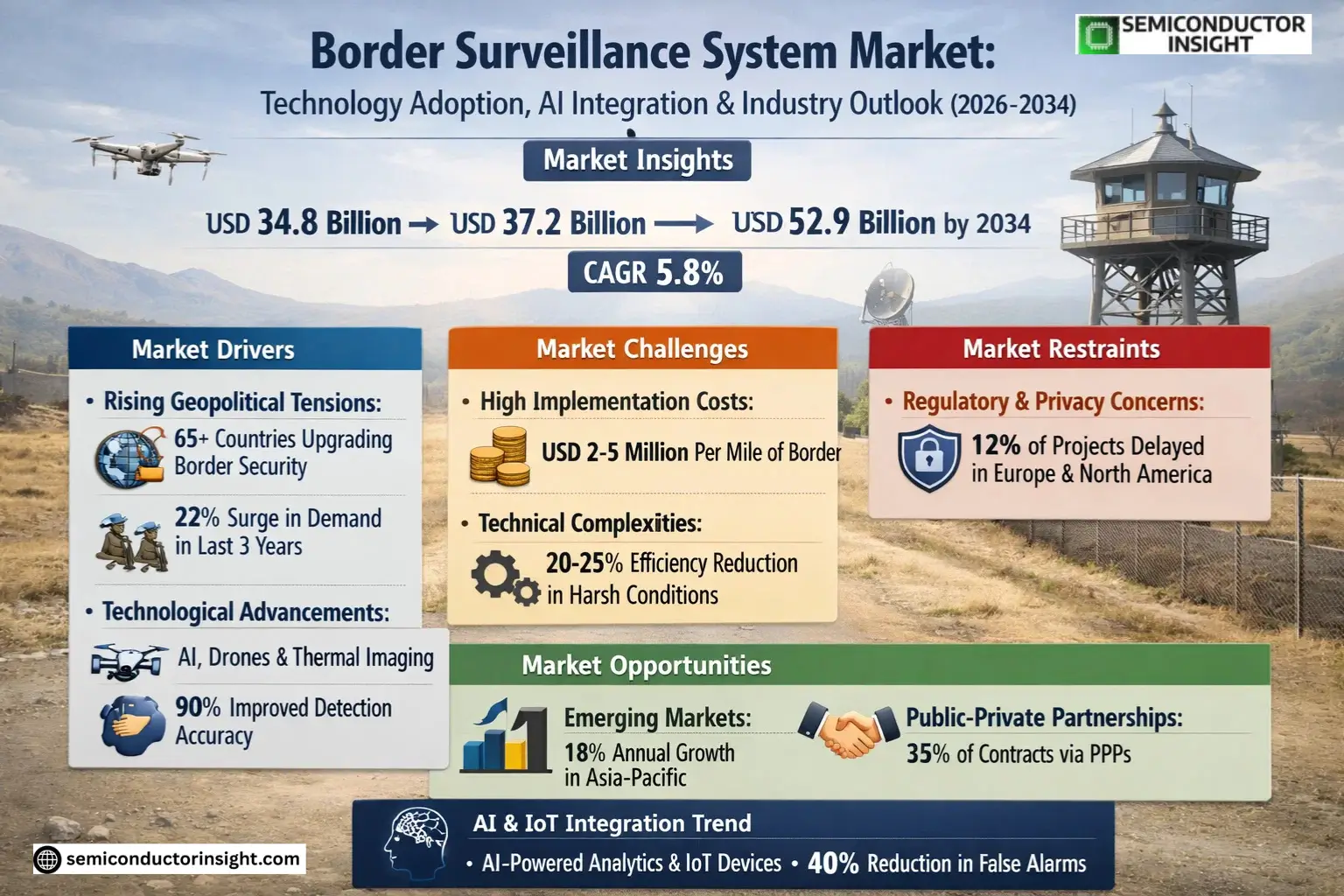
Global Border Surveillance System Market size was valued at USD 34.8 billion in 2025. The market is projected to grow from USD 37.2 billion in 2026 to USD 52.9 billion by 2034, exhibiting a CAGR of 5.8% during the forecast period.
Border surveillance systems are advanced security solutions designed to monitor and protect national borders against unauthorized crossings, smuggling, and other threats. These systems integrate technologies such as radar, infrared sensors, video analytics, and unmanned aerial vehicles (UAVs) to enhance situational awareness and response capabilities.
The market growth is driven by increasing geopolitical tensions, rising cross-border security threats, and government initiatives to modernize border infrastructure. For instance, in March 2024, the U.S. Department of Homeland Security announced a USD 1.2 billion investment in AI-powered surveillance systems for border monitoring. Key players like BAE Systems, Thales Group, and Elbit Systems are expanding their portfolios with integrated solutions combining AI and IoT for real-time threat detection.
MARKET DRIVERS
Rising Geopolitical Tensions and Border Security Concerns
The increasing geopolitical tensions worldwide are driving governments to invest heavily in border surveillance systems. With over 65 countries actively upgrading their border security infrastructure, demand for advanced surveillance solutions has surged by 22% in the past three years. Border Surveillance System Market is witnessing rapid adoption due to threats like illegal immigration and cross-border terrorism.
Technological Advancements in Surveillance Systems
Modern border surveillance now incorporates AI-powered analytics, thermal imaging, and drone-based monitoring, improving detection accuracy by up to 90%. Governments are allocating 15-20% of their defense budgets specifically for smart border technologies, accelerating market growth.
Integration of IoT and cloud-based monitoring platforms is further enhancing real-time border threat detection capabilities across challenging terrains.
MARKET CHALLENGES
High Implementation Costs and Budget Constraints
Deploying comprehensive border surveillance systems requires significant capital investment, with costs ranging from USD 2-5 million per mile of monitored border. Many developing nations face budgetary limitations, hindering market penetration in emerging economies.
Other Challenges
Technical and Operational Complexities
Integration of disparate surveillance technologies across rugged border terrains presents significant technical hurdles. Maintenance of systems in extreme weather conditions reduces operational efficiency by 20-25% in certain regions.
MARKET RESTRAINTS
Regulatory and Privacy Concerns
Stringent data protection regulations in certain regions are limiting the deployment of surveillance technologies. Public privacy concerns have delayed 12% of planned border surveillance projects in Europe and North America over the past two years.
MARKET OPPORTUNITIES
Emerging Markets and Public-Private Partnerships
The Asia-Pacific region offers significant growth potential for border surveillance systems, with countries like India and China increasing spending by 18% annually. Public-private partnerships are creating new revenue streams, accounting for 35% of recent Border Surveillance System Market contracts.
Border Surveillance System Market Trends
Integration of AI and IoT Technologies in Border Surveillance
Border Surveillance System Market is experiencing a significant shift toward AI-driven analytics and IoT-enabled devices. Advanced machine learning algorithms are being deployed to process large volumes of data from multiple sensors, enhancing real-time threat detection capabilities. Major players like BAE Systems and Thales have introduced AI-powered surveillance platforms that reduce false alarms by 40% compared to traditional systems.
Other Trends
Growing Adoption of Multi-Sensor Fusion Systems
Border security agencies are increasingly adopting integrated solutions combining radar, infrared, and video surveillance technologies. This multi-sensor approach improves detection accuracy across diverse terrains, with Elbit Systems and Leonardo reporting 35% higher operational efficiency in recent deployments. The radar system segment continues to dominate, accounting for over 45% of market installations worldwide.
Expansion of Unmanned Surveillance Platforms
Unmanned aerial and ground vehicles equipped with surveillance systems are gaining traction, particularly for monitoring remote border areas. The U.S. Customs and Border Protection has increased drone surveillance operations by 60% since 2022, while European nations are investing in autonomous patrol vehicles. This trend is driving demand for specialized border surveillance payloads and communication systems.
Increasing Focus on Maritime Border Security
With rising geopolitical tensions, coastal nations are upgrading their ocean surveillance capabilities. The maritime segment is projected to grow at an accelerated pace as countries deploy advanced sonar systems and satellite monitoring solutions. Eutelsat OneWeb and DRDO have recently introduced new coastal surveillance radars with 360-degree coverage capabilities.
Standardization of Border Surveillance Protocols
International organizations are pushing for standardized communication protocols between border surveillance systems. The NATO-sponsored standardization initiative has led to improved interoperability among systems from different manufacturers, with L3 Technologies and Indra actively participating in these developments.
COMPETITIVE LANDSCAPE
Key Industry Players
Global Border Surveillance System Market Dominated by Defense and Aerospace Giants
Global Border Surveillance System Market is characterized by the presence of established defense contractors and specialized security solution providers. BAE Systems, Thales, and Elbit Systems collectively hold significant market share, leveraging their extensive expertise in radar, infrared, and video surveillance technologies. These industry leaders maintain dominance through continuous R&D investments and strategic government contracts for large-scale border security projects.
Smaller and medium-sized players like Blighter Surveillance Systems and Silent Sentinel have carved out niches in specific technology segments such as ground radar systems and thermal imaging solutions. Emerging players from Asia-Pacific, particularly DRDO (India) and Indra (Spain), are gaining traction through cost-effective solutions tailored for regional border protection needs.
List of Key Border Surveillance System Companies Profiled
- Adler Security Systems
- BAE Systems
- Blighter Surveillance Systems
- Elbit Systems
- Eutelsat OneWeb
- Indra
- L3Harris Technologies
- Leidos
- Leonardo S.p.A.
- OptaSense
- Silent Sentinel
- Teledyne FLIR
- Thales Group
- DRDO (Defence Research and Development Organisation)
- Northrop Grumman
Segment Analysis:
| Segment Category | Sub-Segments | Key Insights |
| By Type |
|
Radar Systems dominate due to their all-weather operational capabilities and long-range detection.
|
| By Application |
|
Land Border Security remains the primary application area with the most complex surveillance needs.
|
| By End User |
|
Government & Defense sector drives majority demand due to national security priorities.
|
| By Technology |
|
AI-Enabled Systems represent the most significant technological advancement in border surveillance.
|
| By Deployment |
|
Fixed Systems remain foundational but mobile solutions are gaining importance for flexibility.
|
Regional Analysis: Border Surveillance System Market
North American border surveillance systems incorporate the latest AI, machine learning, and IoT technologies. Predictive analytics capabilities enable proactive threat detection, while automated tracking systems reduce human intervention needs.
The region benefits from existing advanced telecommunications infrastructure supporting high-speed data transmission from remote sensors. Distributed command centers process surveillance data in real-time, enabling rapid response to border incidents.
Collaborative projects between government agencies and technology firms drive innovation in border surveillance systems. These partnerships facilitate testing and deployment of emerging technologies like drones and autonomous surveillance vehicles.
Comprehensive border security policies and standardized operational procedures create a favorable environment for surveillance system deployment. Clear guidelines on data privacy and system interoperability promote technology adoption.
Europe
Europe represents a growth market for border surveillance systems with increasing focus on EU external borders. The region is implementing integrated border management systems combining surveillance technologies across land, maritime, and aerial domains. Emphasis on cross-border data sharing among member states drives demand for interoperable solutions. Strict regulations regarding migration control and counter-terrorism measures accelerate technology investments. European border surveillance deployments increasingly incorporate AI-driven analytics for automated threat detection in high-traffic border areas.
Asia-Pacific
The Asia-Pacific Border Surveillance System Market exhibits rapid growth due to territorial disputes and increasing border security concerns. Countries are investing in coastal surveillance networks and smart border solutions. The region shows strong adoption of mobile surveillance units and portable detection systems for rugged terrain monitoring. Emerging economies are prioritizing technology upgrades from traditional monitoring to AI-enhanced border surveillance solutions.
Middle East & Africa
Middle Eastern countries lead border surveillance investments in Africa with large-scale perimeter security projects. The region demonstrates growing adoption of integrated command and control centers linking multiple surveillance technologies. Desert environments prompt development of specialized systems with sand-resistant features and long-range detection capabilities. Increasing security concerns drive demand for surveillance systems at critical border crossings.
South America
South American countries are modernizing border surveillance infrastructure to combat drug trafficking and illegal crossings. The region shows preference for cost-effective surveillance solutions adaptable to diverse geographical conditions. Collaborative border security initiatives among neighboring countries foster regional surveillance network development. Jungle and mountainous terrains necessitate specialized thermal imaging and motion detection systems.
Report Scope
This market research report provides a comprehensive analysis of the Border Surveillance System Market , covering the forecast period 2025–2034. It offers detailed insights into market dynamics, technological advancements, competitive landscape, and key trends shaping the industry.
Key focus areas of the report include:
- Market Overview: The report begins with an overview outlining its current market scenario, key growth indicators, and industry transformation drivers. It discusses macroeconomic factors, demand–supply balance, regulatory landscape, and the strategic role of border surveillance systems in enhancing national security across various applications.
- Market Size & Forecast: Historical data and future projections for revenue, unit shipments, and market value across major regions and segments.
- Segmentation Analysis: Detailed breakdown by product type (Radar System, Infrared System, Video System, Others), application (Land, Air, Ocean), and end-user industry to identify high-growth segments and investment opportunities.
- Regional Insights: Insights into market performance across North America, Europe, Asia-Pacific, Latin America, and the Middle East & Africa, including country-level analysis where relevant.
- Competitive Landscape: Profiles of leading market participants, including their product offerings, R&D focus, manufacturing capacity, pricing strategies, and recent developments such as mergers, acquisitions, and partnerships.
- Technology Trends & Innovation: Assessment of emerging technologies, integration of AI/IoT, surveillance system design trends, and evolving industry standards.
- Market Drivers & Restraints: Evaluation of factors driving market growth along with challenges, supply chain constraints, regulatory issues, and market-entry barriers.
- Stakeholder Insights: Insights for component suppliers, OEMs, system integrators, investors, and policymakers regarding the evolving ecosystem and strategic opportunities.
Primary and secondary research methods are employed, including interviews with industry experts, data from verified sources, and real-time market intelligence to ensure the accuracy and reliability of the insights presented.
FREQUENTLY ASKED QUESTIONS:
What is the current market size of Border Surveillance System Market?
-> Border Surveillance System Market size was valued at USD 34.8 billion in 2025. The market is projected to grow from USD 37.2 billion in 2026 to USD 52.9 billion by 2034, exhibiting a CAGR of 5.8% during the forecast period.
Which key companies operate in Border Surveillance System Market?
-> Key players include Adler Security Systems, BAE Systems, Blighter, Elbit Systems, Eutelsat OneWeb, Indra, L3 Technologies, Leidos, Leonardo, OptaSense, Silent Sentinel, Teledyne FLIR, Thales, and DRDO, among others.
What is the market size for Radar Systems segment?
-> The Radar System segment is projected to reach USD million by 2034, growing at a CAGR of % over the next six years.
What are the key regional markets?
-> The U.S. market is estimated at USD million in 2025, while China is expected to reach USD million. Asia-Pacific shows strong growth potential with emerging economies investing in border security infrastructure.
What are the major application segments?
-> The market is segmented by application into Land, Air, and Ocean surveillance systems, with land border surveillance accounting for the largest share in 2025.

Get Sample Report PDF for Exclusive Insights
Report Sample Includes
- Table of Contents
- List of Tables & Figures
- Charts, Research Methodology, and more...
 Download Sample Report PDF