Boost Converter IC Market Insights
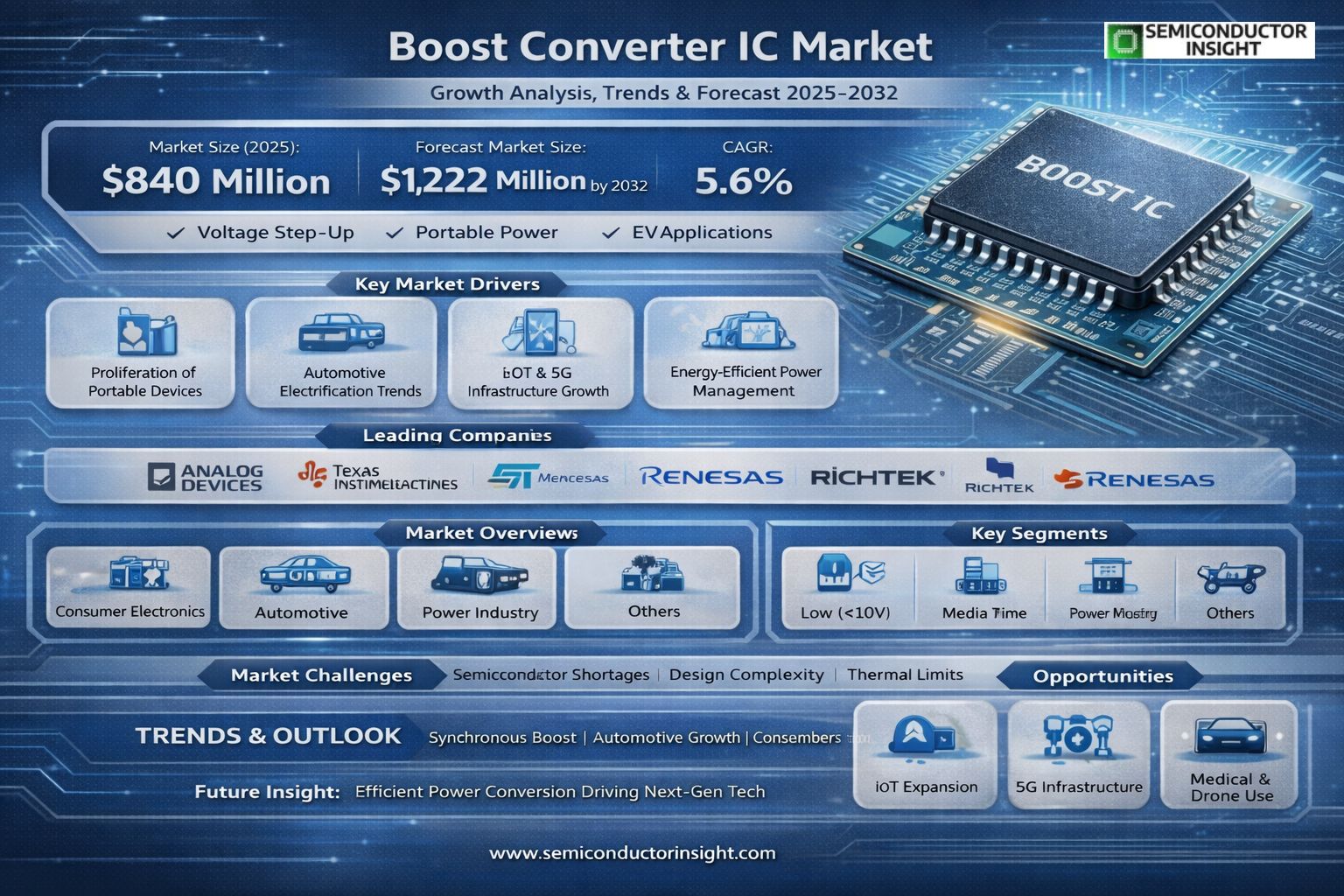
Global Boost Converter IC market size was valued at USD 840 million in 2025. The market is projected to reach USD 1,222 million by 2032, exhibiting a CAGR of 5.6% during the forecast period.
Boost converter ICs, also known as boost integrated circuits, are electronic components designed to step up input voltage to a specified higher output level. At their core, these ICs integrate essential elements including switching transistors, inductors, diodes, and filter capacitors. These components collaborate within the circuit topology to efficiently transform lower input voltages into elevated outputs, enabling reliable power delivery across diverse applications.
The market is experiencing steady expansion driven by surging demand in consumer electronics, automotive electrification, and advanced power management systems. Furthermore, the growth of portable devices, IoT ecosystems, and energy-efficient solutions amplifies this trend. Key players such as Analog Devices, Texas Instruments, STMicroelectronics, Richtek Technology, and Renesas Electronics Corporation lead with innovative portfolios, continually advancing high-efficiency boost technologies to meet evolving industry needs.
MARKET DRIVERS
Proliferation of Portable Devices
Boost Converter IC Market is propelled by surging demand in consumer electronics, where devices like smartphones, tablets, and wearables require efficient voltage step-up solutions for backlights, displays, and sensors. With global smartphone shipments exceeding 1.2 billion units annually, these ICs enable compact power management, optimizing battery life and performance.
Automotive Electrification Trends
Advancements in electric vehicles (EVs) and hybrid systems are key boosters, as boost converter ICs support power distribution for infotainment, LED lighting, and auxiliary systems from low-voltage batteries. The automotive segment, accounting for over 25% market share, benefits from ICs handling up to 60V outputs with high efficiency above 95%.
➤ Boost Converter IC Market is expected to expand at a CAGR of 7.8% from 2023 to 2030, driven by EV adoption projected to reach 17 million units sold globally by 2028.
Additionally, renewable energy applications, such as solar inverters, leverage these ICs for maximum power point tracking, further accelerating market growth amid global sustainability pushes.
MARKET CHALLENGES
Semiconductor Supply Disruptions
Persistent global chip shortages have hampered production in Boost Converter IC Market, causing lead times to extend up to 50 weeks and inflating costs by 20-30% for manufacturers reliant on Asian foundries.
Other Challenges
Design Complexity for High-Efficiency
Balancing switching frequencies above 2MHz with low EMI remains difficult, often requiring advanced PCB layouts and external components that increase bill-of-materials costs.
Competition from integrated power management ICs (PMICs) erodes standalone boost converter demand, as system-on-chip solutions offer smaller footprints and reduced external passives.
MARKET RESTRAINTS
Thermal Management Limitations
High power density in boost converter ICs generates significant heat, particularly in applications exceeding 10W, constraining adoption in space-limited environments like wearables without advanced cooling.
Manufacturing on advanced nodes below 40nm drives up costs, with R&D expenses for radiation-hardened variants for aerospace adding further barriers in niche segments of Boost Converter IC Market.
Strict regulatory standards for efficiency and RoHS compliance demand iterative testing, slowing time-to-market for new designs amid volatile raw material prices.
MARKET OPPORTUNITIES
IoT and 5G Infrastructure Expansion
Boost Converter IC Market stands to gain from IoT device proliferation, forecasted at 30 billion connections by 2025, where ultra-low quiescent current ICs under 1µA enable long battery life in sensors and edge devices.
5G base stations require robust boost solutions for powering RF amplifiers from 48V rails, opening doors for synchronous rectification ICs achieving 98% efficiency.
Emerging applications in medical wearables and drones further unlock potential, with customizable ICs supporting wide input ranges from 1.8V to 40V.
Boost Converter IC Market Trends
Rise of Synchronous Boost Converter ICs
Boost Converter IC Market is witnessing a shift toward synchronous boost converter ICs, which offer superior efficiency compared to non-synchronous variants. These ICs integrate MOSFETs for both high-side and low-side switches, reducing conduction losses and enabling higher switching frequencies. This trend is driven by the demand for compact, energy-efficient power management solutions in portable devices and battery-powered systems. Industry surveys indicate that synchronous types are gaining prominence as manufacturers prioritize lower power dissipation and improved thermal performance in their designs.
Other Trends
Growth in Automotive Applications
Automotive sector expansion is a key trend in Boost Converter IC Market, fueled by the rise of electric vehicles and advanced driver-assistance systems. Boost converters are essential for stepping up low battery voltages to power LEDs, infotainment systems, and sensors. With increasing electrification, automakers are integrating these ICs for reliable power delivery in harsh environments, emphasizing robustness against temperature variations and vibrations. This application segment is expanding as vehicle complexity grows, supported by stringent efficiency standards.
Dominance of Consumer Electronics
Consumer electronics continue to lead demand within Boost Converter IC Market, particularly in smartphones, wearables, and laptops. These devices require efficient voltage boosting from diminishing battery levels to maintain performance. Trends show a focus on ultra-low quiescent current ICs to extend battery life, aligning with consumer preferences for longer usage times. Manufacturers are responding with ICs featuring adjustable output voltages and protection features like overcurrent and thermal shutdown.
Competitive Landscape and Regional Shifts
Competition among leading players such as Analog Devices, Texas Instruments, STMicroelectronics, and Renesas Electronics is intensifying Boost Converter IC Market trends. Top firms hold significant revenue shares through innovations in integration and miniaturization. Regionally, Asia, particularly China and Japan, dominates production and consumption due to robust electronics manufacturing ecosystems. North America and Europe follow, driven by automotive and industrial applications. Emerging markets in Southeast Asia and India are seeing accelerated adoption, reflecting global supply chain diversification and localized production strategies. Overall, these dynamics underscore a market evolving toward higher efficiency, broader applications, and strategic consolidations.
COMPETITIVE LANDSCAPE
Key Industry Players
Leading Manufacturers Shaping the Global Boost Converter IC Market
Boost Converter IC Market exhibits an oligopolistic structure dominated by established semiconductor leaders such as Analog Devices and Texas Instruments, which together command substantial revenue shares among the global top five players. These frontrunners benefit from advanced fabrication capabilities, broad product portfolios encompassing synchronous and non-synchronous variants, and strong integration in applications like consumer electronics and automotive systems. Analog Devices excels in high-efficiency, precision boost solutions, while Texas Instruments (TI) leverages its scale for cost-effective, high-volume production, driving market growth projected from $840 million in 2025 to $1,222 million by 2032 at a 5.6% CAGR.
Beyond the top tier, niche players like STMicroelectronics, Renesas Electronics, and Richtek Technology carve out significant positions through specialized innovations, such as compact designs for power management in portable devices and industrial applications. Companies including Semtech, Toshiba, and NXP Semiconductors focus on differentiated features like ultra-low power consumption and robustness for automotive and IoT uses, fostering competitive dynamics. Emerging contributors such as Qualcomm and ESMT enhance the landscape with integrated solutions for wireless and display technologies, collectively challenging leaders while expanding market accessibility across regions like North America, China, and Europe.
List of Key Boost Converter IC Companies Profiled
- Analog Devices
- Texas Instruments
- STMicroelectronics
- Renesas Electronics Corporation
- Richtek Technology
- Semtech
- Toshiba
- NXP Semiconductors
- Qualcomm
- ESMT
- Monolithic Power Systems
- onsemi
- Maxim Integrated
Segment Analysis:
| Segment Category | Sub-Segments | Key Insights |
| By Type |
|
Synchronous Boost Converter IC leads the segment with its advanced architecture tailored for modern power needs.
|
| By Application |
|
Consumer Electronics stands out as the frontrunner driven by innovative device designs.
|
| By End User |
|
Consumer Electronics OEMs dominate as primary adopters with high-volume demands.
|
| By Output Voltage Range |
|
Medium Voltage Output (10-30V) excels in versatility for prevalent applications.
|
| By Package Type |
|
QFN (Quad Flat No-Lead) leads with its performance advantages in demanding environments.
|
Regional Analysis: Boost Converter IC Market
Asia-Pacific
Robust consumer electronics demand propels Boost Converter IC adoption, with smartphones and laptops requiring efficient power boosting. Automotive sector growth, especially EVs, fuels advanced IC solutions for battery management. Government support for chipmaking enhances supply chain resilience, while renewable energy pushes for energy-harvesting applications in Boost Converter IC designs.
Boost Converter ICs thrive in portable devices, LED drivers, and solar-powered systems. High-volume production for wearables and tablets emphasizes compact, low-power ICs. Industrial automation increasingly integrates these for stable voltage in sensors and actuators across the region.
Local giants dominate with in-house fabrication, offering cost-effective Boost Converter IC variants. Strategic partnerships with global firms accelerate tech transfers. Focus on customization meets diverse end-user needs, from telecom to consumer goods.
Expansion into edge AI and 5G modules promises sustained Boost Converter IC demand. Sustainability initiatives drive eco-friendly IC development. Regional hubs will pioneer next-gen synchronous designs for superior efficiency.
North America
North America exhibits strong growth in Boost Converter IC Market, fueled by innovation in high-performance computing and electric vehicles. Tech hubs drive demand for advanced power management ICs in data centers and autonomous systems. Leading semiconductor firms prioritize Boost Converter ICs with integrated protection features for rugged applications. The region’s emphasis on energy efficiency aligns with green tech mandates, boosting adoption in renewables and consumer electronics. Collaborative R&D ecosystems foster cutting-edge topologies for ultra-low quiescent current, enhancing battery life in portable devices.
Europe
Europe’s Boost Converter IC Market benefits from stringent efficiency regulations and automotive prowess. Premium vehicle manufacturers integrate sophisticated ICs for hybrid powertrains, emphasizing reliability and thermal performance. Industrial automation sectors favor Boost Converter IC solutions for precise voltage regulation in machinery. Sustainability goals accelerate deployment in smart grids and lighting, with focus on wide input range designs. Regional collaborations enhance supply chain diversity amid global shifts.
South America
South America shows emerging potential in Boost Converter IC Market, driven by expanding consumer electronics and renewable energy projects. Urbanization spurs demand for affordable power ICs in off-grid solar setups and budget mobiles. Local assembly initiatives reduce import dependency, tailoring Boost Converter ICs for tropical climates. Infrastructure development in telecom amplifies needs for robust, cost-sensitive solutions, positioning the region for steady growth.
Middle East & Africa
Middle East & Africa witness gradual Boost Converter IC Market maturation, led by oil-to-renewables transition and mobile penetration. Harsh environments demand durable ICs for solar inverters and telecom base stations. Investment in digital infrastructure boosts voltage step-up needs in remote IoT deployments. Regional partnerships introduce efficient Boost Converter IC variants, supporting energy diversification and consumer tech adoption.
Report Scope
This market research report provides a comprehensive analysis of Boost Converter IC Market, covering the forecast period 2025–2032. It offers detailed insights into market dynamics, technological advancements, competitive landscape, and key trends shaping the industry.
Key focus areas of the report include:
- Market Overview: The report begins with an overview outlining its current market scenario, key growth indicators, and industry transformation drivers. It discusses macroeconomic factors, demand–supply balance, regulatory landscape, and the strategic role of semiconductors in powering advancements across industries such as automotive, telecommunications, consumer electronics, and industrial automation.
- Market Size & Forecast: Historical data and future projections for revenue, unit shipments, and market value across major regions and segments.
- Segmentation Analysis: Detailed breakdown by product type, technology, application, and end-user industry to identify high-growth segments and investment opportunities.
- Regional Insights: Insights into market performance across North America, Europe, Asia-Pacific, Latin America, and the Middle East & Africa, including country-level analysis where relevant.
- Competitive Landscape: Profiles of leading market participants, including their product offerings, R&D focus, manufacturing capacity, pricing strategies, and recent developments such as mergers, acquisitions, and partnerships.
- Technology Trends & Innovation: Assessment of emerging technologies, integration of AI/IoT, semiconductor design trends, fabrication techniques, and evolving industry standards.
- Market Drivers & Restraints: Evaluation of factors driving market growth along with challenges, supply chain constraints, regulatory issues, and market-entry barriers.
- Stakeholder Insights: Insights for component suppliers, OEMs, system integrators, investors, and policymakers regarding the evolving ecosystem and strategic opportunities.
Primary and secondary research methods are employed, including interviews with industry experts, data from verified sources, and real-time market intelligence to ensure the accuracy and reliability of the insights presented.
FREQUENTLY ASKED QUESTIONS:
What is the current market size of Boost Converter IC Market?
-> Boost Converter IC Market was valued at USD 840 million in 2025 and is expected to reach USD 1,222 million by 2032, at a CAGR of 5.6% during the forecast period.
Which key companies operate in Boost Converter IC Market?
-> Key players include Analog Devices, Texas Instruments, Richtek Technology, STMicroelectronics, TI, Renesas Electronics Corporation, Qualcomm, Renesas, Semtech, Toshiba, NXP, ESMT, among others.
What are the key growth drivers?
-> Key growth drivers include demand from consumer electronics, automotive, power industry, and other applications.
Which region dominates the market?
-> Asia is the fastest-growing region, while North America remains significant with the U.S. market.
What are the emerging trends?
-> Emerging trends include synchronous boost converter ICs, advancements in efficient power conversion using switch tube, inductor, diode, and filter capacitor components.

Get Sample Report PDF for Exclusive Insights
Report Sample Includes
- Table of Contents
- List of Tables & Figures
- Charts, Research Methodology, and more...
 Download Sample Report PDF