
Market Insights
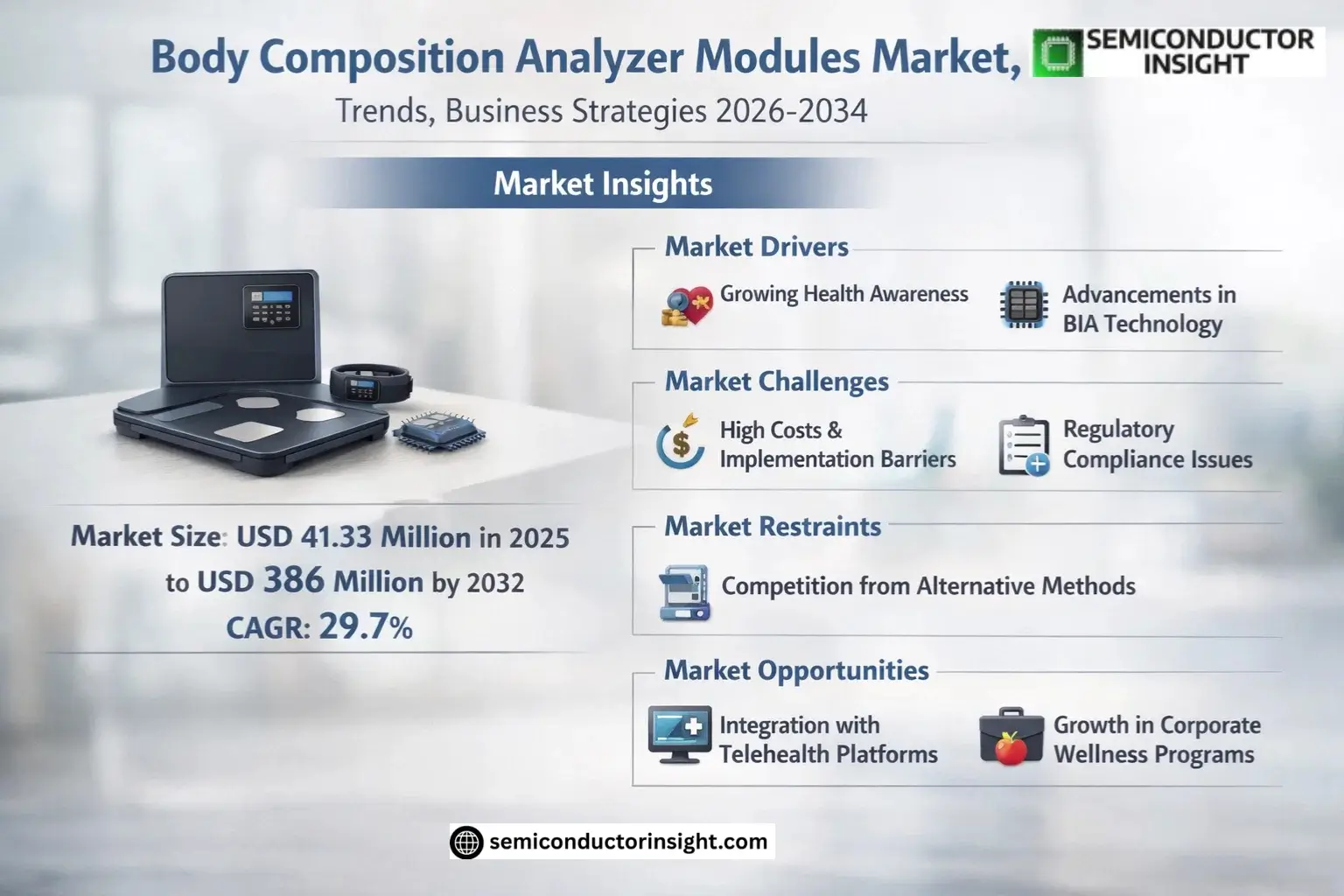
Global Body Composition Analyzer Modules Market size was valued at USD 41.33 million in 2025 and is projected to reach USD 386 million by 2032, exhibiting a CAGR of 29.7% during the forecast period.
Body composition analyzer modules are dedicated electronic measurement and algorithm units based on bioelectrical impedance analysis (BIA). These modules integrate into devices such as smart scales, wearable health monitors, and medical equipment to estimate body fat, muscle mass, water content, and other vital metrics. They incorporate specialized circuitry for impedance measurement, weight sensing, and algorithmic processing, delivering high accuracy and scalability. Global gross profit margin for these modules stood at approximately 48% in 2025.
The market growth is driven by shifting consumer preferences from basic weight tracking to comprehensive body composition analysis, alongside rising demand for non-invasive health monitoring in home, fitness, and clinical settings. Technological advancements in multi-frequency BIA and integration with IoT-enabled devices further propel adoption. Key players like Texas Instruments and Analog Devices are enhancing module capabilities with features such as intracellular fluid detection and cloud connectivity.
MARKET DRIVERS
Growing Health Awareness and Fitness Trends
The increasing global focus on health and preventive care is driving demand for body composition analyzer modules. These devices provide precise measurements of muscle mass, body fat percentage, and water content, making them essential for fitness centers and medical facilities.
Technological Advancements in Bioelectrical Impedance Analysis
Recent advancements in BIA technology have improved the accuracy and affordability of body composition analyzer modules. Integration with smart devices and cloud platforms enables real-time tracking, appealing to both consumers and healthcare providers.
Hospitals and clinics are also adopting these modules for obesity management and metabolic disorder diagnosis, further expanding the market.
MARKET CHALLENGES
High Costs and Implementation Barriers
Premium body composition analyzer modules require significant investment, limiting adoption among small fitness centers. Medical-grade devices often need specialized training for accurate operation and data interpretation.
Other Challenges
Regulatory Compliance Issues
Medical device certification processes vary by region, creating complexity for manufacturers expanding into new markets. The FDA and CE marking requirements add development time and costs for advanced body composition analyzer modules.
MARKET RESTRAINTS
Competition from Alternative Assessment Methods
DEXA scans and hydrostatic weighing remain the gold standard for body composition analysis in clinical settings. While body composition analyzer modules offer convenience, some healthcare professionals still question their precision for diagnostic applications.
MARKET OPPORTUNITIES
Integration with Telehealth Platforms
The rise of remote patient monitoring creates significant opportunities for connected body composition analyzer modules. Manufacturers developing HIPAA-compliant solutions that integrate with electronic health records stand to capture this growing segment.
Expansion in Corporate Wellness Programs
As companies invest more in employee health, demand grows for onsite body composition analysis. Compact, user-friendly modules designed for workplace wellness initiatives represent an underserved market niche.
Body Composition Analyzer Modules Market Trends
Shift Toward Comprehensive Health Monitoring
Body Composition Analyzer Modules Market is experiencing rapid growth driven by the transition from simple weight measurement to comprehensive body composition analysis. Advanced bioelectrical impedance analysis (BIA) modules now integrate multiple vital sign measurements including body fat percentage, muscle mass, and hydration levels. Leading manufacturers like Analog Devices and Shenzhen Chipsea Technologies are developing solutions that combine intracellular/extracellular fluid detection with multi-frequency impedance measurements for enhanced accuracy.
Other Trends
Integration with Connected Health Ecosystems
Body Composition Analyzer Modules are increasingly being designed with wireless connectivity and API interfaces to seamlessly integrate with mobile apps and health platforms. This allows real-time data tracking through smart scales, wearable devices, and fitness equipment. The growing demand for IoT-enabled home healthcare solutions is accelerating this trend across residential and commercial applications.
Technological Advancements in Electrode Configurations
The market is witnessing innovation in electrode configurations, with eight-electrode modules gaining prominence due to their higher measurement precision compared to traditional four-electrode systems. Companies like Dongguan BestHealth are advancing dual-frequency measurement capabilities in their module offerings, while maintaining compact form factors suitable for integration into various health monitoring devices.
Expansion in Medical and Wellness Applications
Beyond fitness tracking, Body Composition Analyzer Modules are finding increased adoption in clinical settings for patient monitoring and preventive healthcare. Their non-invasive nature and ability to track multiple biomarkers make them valuable tools for nutritional assessment, disease management, and post-operative recovery tracking in medical applications.
COMPETITIVE LANDSCAPE
Key Industry Players
Global Body Composition Analyzer Modules Market Dominated by Specialized Tech Providers
Body Composition Analyzer Modules Market is led by semiconductor giants and specialized health tech providers, with Texas Instruments and Analog Devices commanding significant market share through advanced BIA (Bioelectrical Impedance Analysis) solutions. These industry leaders offer highly integrated modules combining impedance measurement circuits, weight sensors, and algorithm processors, catering to both medical-grade and consumer applications. The market structure shows vertical specialization, with module manufacturers supporting OEMs across smart scales, wearables, and medical devices.
Niche players like Shenzhen Chipsea Technologies and Dongguan BestHealth have carved substantial positions through complete solutions combining hardware with proprietary algorithms and connectivity options. Emerging Asian manufacturers are gaining traction by offering cost-optimized modules with localized support, particularly for the booming smart home health device markets in China and Southeast Asia. The competitive landscape also includes specialized providers focusing on clinical-grade modules with FDA/CE certifications for medical applications.
List of Key Body Composition Analyzer Modules Companies Profiled
- Texas Instruments
- Analog Devices
- Shenzhen Chipsea Technologies
- Dongguan BestHealth
- Guangzhou Tengli Technology
- InBody Co., Ltd.
- Omron Healthcare
- Tanita Corporation
- Biotekna
- Seca GmbH & Co. KG
- Withings
- RJL Systems
- Bodystat Ltd
- Hologic, Inc.
- COSMED
Segment Analysis:
| Segment Category | Sub-Segments | Key Insights |
| By Type |
|
Body Fat Modules are witnessing accelerated adoption due to:
|
| By Application |
|
Fitness Applications dominate module integration due to:
|
| By End User |
|
Residential Segment shows strongest growth potential because:
|
| By Technology |
|
Eight-electrode BIA technology is gaining traction as:
|
| By Integration |
|
Smart Scale Integration represents the most dynamic segment:
|
Regional Analysis: Body Composition Analyzer Modules Market
Hospitals and clinics across North America extensively use body composition analyzer modules for obesity management, nutritional assessment, and chronic disease monitoring, with integrated EHR systems enhancing diagnostic workflows.
Premium fitness chains and rehabilitation centers deploy advanced bioelectrical impedance analysis (BIA) modules, with smart gym equipment incorporating real-time body composition tracking features for personalized training programs.
North American manufacturers lead in developing AI-powered analyzer modules with multi-frequency BIA and 3D body scanning capabilities, setting global benchmarks for accuracy in lean mass and visceral fat measurement.
FDA-cleared devices dominate the regional market, with rigorous validation protocols ensuring clinical reliability. Medical-grade analyzer modules must comply with Class II device requirements for body composition assessment.
Europe
Europe represents the second-largest market for Body Composition Analyzer Modules, characterized by universal healthcare systems promoting preventive care. Germany and the UK lead regional adoption, with hospitals utilizing these modules for metabolic syndrome screening. The EU Medical Device Regulation ensures standardized performance across all member states, while growing fitness consciousness drives demand in sports clubs. Scandinavian countries show particular strength in research applications, with universities incorporating analyzers in nutritional studies. Manufacturers focus on compact, portable designs suitable for home healthcare settings, creating new growth avenues beyond clinical environments.
Asia-Pacific
The Asia-Pacific region exhibits the fastest growth for Body Composition Analyzer Modules, fueled by expanding medical tourism and rising disposable incomes. Japan and South Korea lead technological adoption, integrating analyzers with smart scales and wearable devices. China’s market expands through domestic manufacturers offering cost-effective solutions for community health centers. India shows emerging potential with increasing awareness about lifestyle diseases, though market penetration remains concentrated in urban hospitals and premium fitness chains. Government healthcare digitization initiatives create opportunities for cloud-connected analyzer modules across the region.
South America
South America demonstrates steady growth in the Body Composition Analyzer Modules Market, primarily driven by Brazil’s private healthcare sector. Sports academies and clinical nutrition centers increasingly adopt basic BIA devices. Argentina and Chile show growing demand in elite athlete training programs. Economic constraints limit hospital investments, but mid-range analyzer modules find applications in obesity clinics. Regional manufacturers focus on Spanish/Portuguese interfaces and tropical climate-resistant designs to cater to local requirements, though reliance on imports persists for high-end medical devices.
Middle East & Africa
The MEA region presents niche opportunities for Body Composition Analyzer Modules, with UAE and Saudi Arabia leading through luxury fitness centers and specialized clinics. Government health initiatives promote analyzer adoption for diabetes management programs. Africa’s market remains underpenetrated but shows potential through public-private partnerships in urban healthcare facilities. Temperature-resistant devices designed for harsh climates gain traction, while religious considerations influence product designs in conservative markets. The region imports majority of analyzer modules, with localized maintenance services becoming a key competitive factor.
Report Scope
This market research report provides a comprehensive analysis of the Body Composition Analyzer Modules Market , covering the forecast period 2025–2032. It offers detailed insights into market dynamics, technological advancements, competitive landscape, and key trends shaping the industry.
Key focus areas of the report include:
- Market Overview: The report begins with an overview outlining its current market scenario, key growth indicators, and industry transformation drivers. It discusses macroeconomic factors, demand–supply balance, regulatory landscape, and the strategic role of bioelectrical impedance analysis (BIA) technology in powering advancements across industries such as medical, fitness, and consumer electronics.
- Market Size & Forecast: Historical data and future projections for revenue, unit shipments, and market value across major regions and segments.
- Segmentation Analysis: Detailed breakdown by product type, electrode configuration, application, and end-user industry to identify high-growth segments and investment opportunities.
- Regional Insights: Insights into market performance across North America, Europe, Asia-Pacific, Latin America, and the Middle East & Africa, including country-level analysis where relevant.
- Competitive Landscape: Profiles of leading market participants, including their product offerings, R&D focus, manufacturing capacity, pricing strategies, and recent developments such as mergers, acquisitions, and partnerships.
- Technology Trends & Innovation: Assessment of emerging technologies, integration of wireless connectivity, algorithm advancements, and evolving industry standards.
- Market Drivers & Restraints: Evaluation of factors driving market growth along with challenges, supply chain constraints, regulatory issues, and market-entry barriers.
- Stakeholder Insights: Insights for component suppliers, OEMs, system integrators, investors, and policymakers regarding the evolving ecosystem and strategic opportunities.
Primary and secondary research methods are employed, including interviews with industry experts, data from verified sources, and real-time market intelligence to ensure the accuracy and reliability of the insights presented.
FREQUENTLY ASKED QUESTIONS:
What is the current market size of Body Composition Analyzer Modules Market?
-> Body Composition Analyzer Modules Market size was valued at USD 41.33 million in 2025 and is projected to reach USD 386 million by 2032, exhibiting a CAGR of 29.7% during the forecast period.
What is the projected growth rate (CAGR) for Body Composition Analyzer Modules Market?
-> The market is projected to grow at a CAGR of 29.7% during the forecast period 2025–2032.
Which key companies operate in Body Composition Analyzer Modules Market?
-> Key players include Texas Instruments, Analog Devices, Shenzhen Chipsea Technologies, Dongguan BestHealth, and Guangzhou Tengli Technology.
What are the key growth drivers?
-> Key growth drivers include rising health awareness, shift from weight to body composition monitoring, increasing demand for non-invasive measurement solutions, and adoption in medical and fitness applications.
Which region dominates the market?
-> Asia is the dominant region, led by China, Japan, and South Korea, due to strong consumer electronics and healthcare sectors.
What are the emerging technology trends?
-> Emerging trends include multi-frequency BIA technology, eight-electrode configurations, integration with wearable devices, and AI-powered health analytics.
What is the gross profit margin for this market?
-> Global gross profit margin for body composition analyzer modules is approximately 48% in 2025.
Get Sample Report PDF for Exclusive Insights
Report Sample Includes
- Table of Contents
- List of Tables & Figures
- Charts, Research Methodology, and more...
 Download Sample Report PDF




