
MARKET INSIGHTS
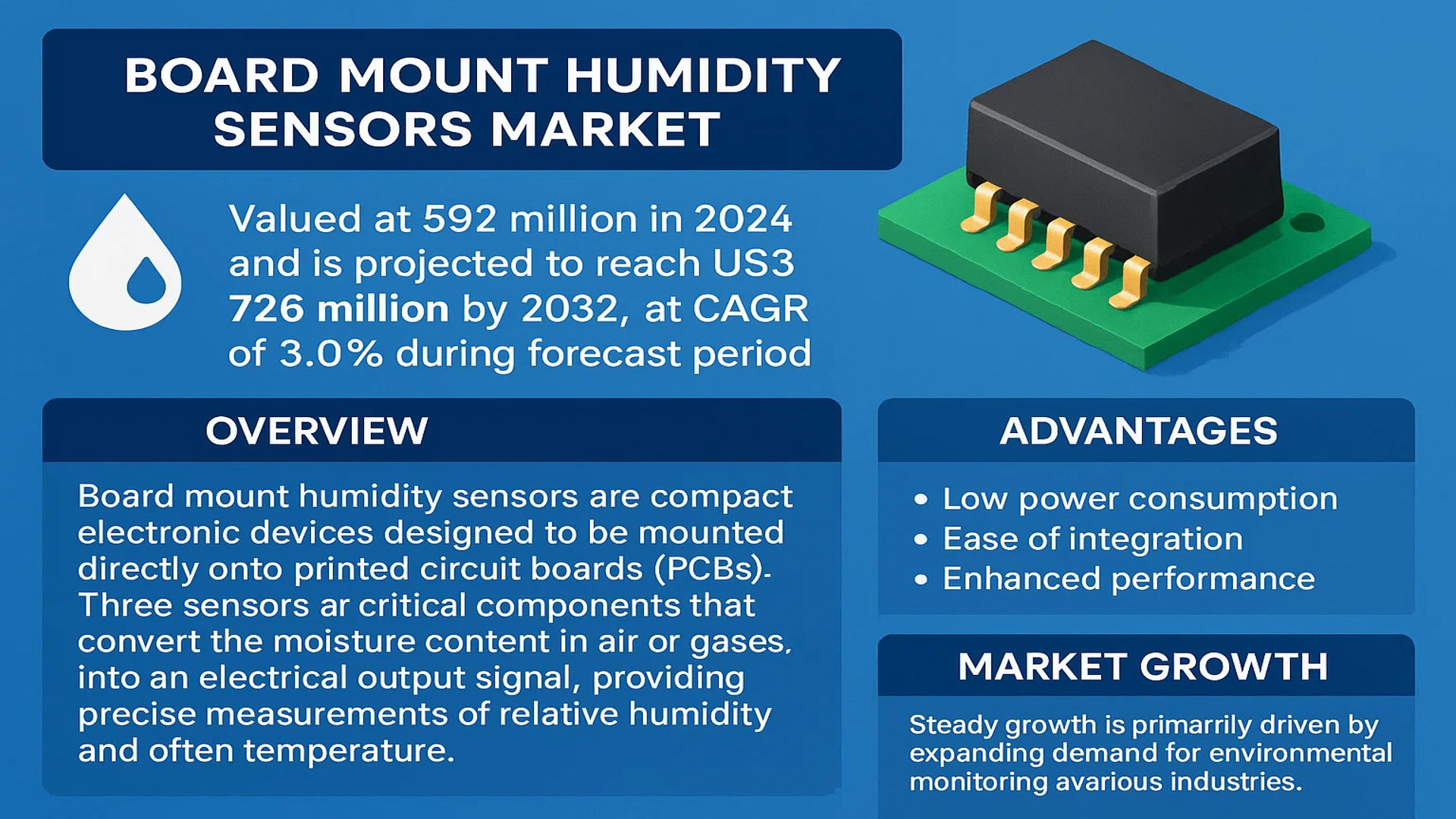
The global Board Mount Humidity Sensors Market was valued at 592 million in 2024 and is projected to reach US$ 726 million by 2032, at a CAGR of 3.0% during the forecast period.
Board mount humidity sensors are compact electronic devices designed to be mounted directly onto printed circuit boards (PCBs). These sensors are critical components that convert the moisture content in air or gases into an electrical output signal, providing precise measurements of relative humidity and often temperature. They are integral to modern automated systems due to their advantages, including low power consumption, ease of integration, and enhanced performance compared to traditional sensing methods.
The market’s steady growth is primarily driven by the expanding demand for environmental monitoring and control across various industries. Key applications fueling adoption include the automotive sector for cabin air quality systems, the aerospace & defense industry for avionics and equipment preservation, and the textile industry for process optimization. However, challenges such as sensor calibration drift and contamination in harsh environments can pose restraints. The competitive landscape is concentrated, with Honeywell, Texas Instruments, and Silicon Labs collectively holding approximately 50% of the global market share, underscoring their significant influence on product innovation and pricing.
MARKET DYNAMICS
MARKET DRIVERS
Rising Demand for Smart Home and Building Automation Systems to Propel Market Expansion
The global board mount humidity sensors market is experiencing robust growth driven by increasing adoption in smart home and building automation systems. These sensors are integral to maintaining optimal environmental conditions, energy efficiency, and occupant comfort in residential and commercial spaces. The smart home market has demonstrated remarkable expansion, with installations projected to exceed 400 million units annually by 2025. This growth is fueled by consumer demand for connected devices that monitor and regulate indoor air quality, particularly in regions with extreme climate conditions. Board mount humidity sensors enable precise humidity control in HVAC systems, preventing mold growth and reducing energy consumption by optimizing heating and cooling cycles. Their compact size, low power consumption, and digital interface capabilities make them ideal for integration into modern smart devices and IoT ecosystems.
Expansion of Automotive Electronics and Climate Control Systems to Accelerate Adoption
Automotive applications represent a significant growth avenue for board mount humidity sensors, particularly in advanced climate control and safety systems. Modern vehicles incorporate sophisticated environmental control systems that automatically adjust cabin conditions based on sensor readings. The automotive electronics market has been growing at approximately 7% annually, with humidity sensors becoming standard features in mid-to-high-end vehicles. These sensors prevent windshield fogging by activating defogging systems when humidity levels reach critical thresholds, enhancing driving safety. Additionally, they contribute to passenger comfort by maintaining optimal humidity levels between 40-60%, which is particularly important in electric vehicles where energy-efficient climate control is essential for maximizing range. The integration of these sensors in automotive applications requires robust performance across temperature ranges from -40°C to 125°C, driving innovations in sensor design and materials.
Growing Industrial IoT and Predictive Maintenance Applications to Fuel Market Growth
Industrial IoT applications are creating substantial opportunities for board mount humidity sensors in predictive maintenance and process control systems. Manufacturing facilities increasingly deploy sensor networks to monitor environmental conditions that affect production quality and equipment reliability. Humidity sensors help prevent condensation in electronic enclosures, reducing corrosion and electrical failures in industrial control systems. The industrial IoT market has demonstrated consistent growth, with sensor deployments increasing by approximately 15% annually across various sectors. In pharmaceutical manufacturing, humidity control is critical for maintaining product stability and compliance with regulatory requirements, with sensors ensuring environments remain within specified parameters. Food processing applications similarly rely on precise humidity monitoring to prevent spoilage and maintain product quality throughout storage and transportation.
MARKET RESTRAINTS
Technical Limitations in Extreme Environments to Hinder Market Penetration
Board mount humidity sensors face performance challenges in extreme environmental conditions, particularly in industrial and outdoor applications. These sensors typically exhibit reduced accuracy and long-term stability when operating outside their specified temperature and humidity ranges. In high-temperature environments exceeding 85°C, sensor drift can occur at rates up to 0.5% RH per year, requiring frequent recalibration and maintenance. Condensation presents another significant challenge, as direct water contact can permanently damage sensing elements and electronic components. Applications in tropical climates with consistently high humidity levels above 90% RH often experience accelerated aging of sensor materials, reducing operational lifespan from the typical 5-10 years to just 2-3 years in some cases. These limitations restrict adoption in sectors requiring reliable operation in harsh conditions, such as marine applications, outdoor weather stations, and industrial processes with steam or high moisture content.
Cost Sensitivity in Price-Driven Markets to Limit Widespread Adoption
The market faces significant price pressure, particularly in consumer electronics and mass-produced applications where cost sensitivity is paramount. While premium sensors from leading manufacturers offer high accuracy and reliability, their price points ranging from $2-10 per unit make them prohibitive for many cost-sensitive applications. This price sensitivity has created a bifurcated market where high-performance applications utilize premium sensors while price-driven applications often compromise on accuracy and longevity. The consumer electronics sector, which accounts for approximately 25% of total sensor demand, consistently pressures manufacturers to reduce costs, leading to trade-offs in performance characteristics. This dynamic creates challenges for sensor manufacturers who must balance research and development investments against market price expectations, potentially slowing innovation in advanced sensing technologies.
Integration Complexity and Calibration Requirements to Impede Market Growth
System integration challenges present significant barriers to adoption across various applications. Board mount humidity sensors require careful PCB layout considerations to minimize thermal effects and electromagnetic interference that can affect measurement accuracy. Many applications necessitate custom calibration procedures to achieve the required precision, adding complexity and cost to manufacturing processes. The calibration process itself can account for up to 30% of total sensor production costs, particularly for high-accuracy applications requiring individual sensor characterization across multiple temperature and humidity points. Additionally, sensor integration often requires specialized knowledge of analog signal conditioning and digital interface protocols, creating a skills gap that limits adoption among smaller manufacturers and system integrators. These technical complexities particularly affect markets with limited engineering resources and those requiring rapid deployment of sensor solutions.
MARKET CHALLENGES
Long-Term Stability and Calibration Drift Issues to Challenge Market Reliability
The market faces persistent challenges regarding long-term stability and calibration drift, particularly in applications requiring sustained accuracy over extended periods. Humidity sensors typically experience annual drift rates between 0.2-1.0% RH depending on environmental conditions and sensor technology. This drift necessitates periodic recalibration, creating significant maintenance challenges in installed systems. Applications in critical environments such as healthcare facilities, data centers, and industrial processes require accuracy within ±2% RH, making drift management essential. The recalibration process often involves system downtime and specialized equipment, with costs that can exceed the initial sensor price by factors of three to five. These challenges are particularly acute in distributed sensor networks where physical access for maintenance is difficult or costly. Manufacturers continue to invest in improved materials and compensation algorithms to address these stability issues, but achieving maintenance-free operation over multi-year periods remains an ongoing challenge.
Other Challenges
Standardization and Interoperability Issues
The lack of industry-wide standardization creates interoperability challenges across different sensor platforms and manufacturers. While digital interfaces like I2C and SPI have become common, implementation details vary significantly between vendors, requiring custom software development for each sensor type. Electrical characteristics including supply voltage requirements, output signal levels, and power consumption profiles differ across products, complicating system design and limiting component interchangeability. These variations force designers to commit to specific vendor ecosystems early in the development process, reducing flexibility and increasing dependency on single sources.
Environmental Contamination and Performance Degradation
Sensor performance degradation due to environmental contamination presents significant challenges in many applications. Airborne contaminants including dust, chemical vapors, and oil mist can accumulate on sensor surfaces, affecting measurement accuracy and response time. Cleaning procedures are often impractical or ineffective, particularly in sealed assemblies. Applications in manufacturing environments, commercial kitchens, and agricultural settings experience particularly high contamination risks, with some studies showing accuracy degradation exceeding 5% RH within six months of operation in challenging environments.
MARKET OPPORTUNITIES
Emerging Applications in Healthcare and Medical Devices to Create New Growth Avenues
Healthcare applications represent a significant growth opportunity for board mount humidity sensors, particularly in respiratory devices, incubators, and medical storage equipment. The global medical device market has been expanding at approximately 5% annually, with increasing integration of environmental monitoring capabilities. Respiratory care devices including CPAP machines and ventilators require precise humidity control to prevent airway drying and ensure patient comfort. Medical incubators for neonatal care maintain humidity levels between 40-60% to prevent dehydration and support development. Pharmaceutical storage and transportation applications monitor humidity to ensure medication stability and compliance with storage requirements. These medical applications typically demand higher accuracy and reliability than consumer applications, supporting premium pricing and creating opportunities for manufacturers with medical-grade certifications and proven reliability records.
Advancements in Energy Management and Green Building Initiatives to Drive Demand
Energy management applications in commercial buildings and data centers present substantial opportunities for advanced humidity sensing solutions. Modern building management systems utilize humidity data to optimize HVAC operation, reducing energy consumption while maintaining occupant comfort. Data centers require precise humidity control between 40-60% RH to prevent electrostatic discharge damage to sensitive equipment while avoiding condensation risks. Green building certifications including LEED and BREEAM encourage comprehensive environmental monitoring, driving sensor adoption in new construction and retrofitting projects. The energy management systems market has demonstrated consistent growth, with humidity sensors becoming integral components of comprehensive building automation strategies. These applications often justify higher-performance sensors due to potential energy savings and equipment protection benefits, creating opportunities for manufacturers offering advanced features including temperature compensation, digital interfaces, and self-diagnostic capabilities.
Expansion of Agricultural Technology and Precision Farming to Open New Markets
Agricultural technology applications are emerging as significant growth opportunities for board mount humidity sensors in precision farming and controlled environment agriculture. Modern greenhouse operations utilize sensor networks to maintain optimal growing conditions, with humidity control critical for plant health and disease prevention. Precision agriculture systems monitor microclimate conditions to optimize irrigation schedules and predict disease outbreaks. The controlled environment agriculture market has experienced rapid expansion, with annual growth rates exceeding 15% as food production increasingly moves indoors. These applications require sensors capable of operating in high-humidity environments while resisting contamination from soil, pesticides, and fertilizers. The agricultural sector typically prioritizes reliability and longevity over ultimate accuracy, creating opportunities for robust sensor designs that can withstand challenging operating conditions while providing years of maintenance-free operation.
BOARD MOUNT HUMIDITY SENSORS MARKET TRENDS
Miniaturization and Integration with IoT Ecosystems Emerge as a Dominant Trend
The relentless drive towards miniaturization and seamless integration with Internet of Things (IoT) ecosystems is fundamentally reshaping the board mount humidity sensor landscape. As consumer and industrial devices become smarter and more interconnected, the demand for compact, low-power, and highly reliable sensors has surged. This trend is particularly evident in the consumer electronics sector, where smartphones, wearables, and smart home devices require precise environmental monitoring without sacrificing valuable board space or battery life. Consequently, manufacturers are heavily investing in Micro-Electro-Mechanical Systems (MEMS) technology, which allows for the production of sensors that are not only smaller but also offer improved performance and lower power consumption. This technological evolution is critical for enabling the next generation of connected devices, from smart thermostats that optimize energy use to wearable health monitors that track personal environmental exposure.
Other Trends
Rising Demand from the Automotive Sector
The automotive industry represents a significant and rapidly growing application area for board mount humidity sensors, driven by the proliferation of advanced driver-assistance systems (ADAS) and enhanced passenger comfort features. These sensors are now integral components for climate control systems, ensuring optimal cabin air quality and defogging efficiency. Furthermore, their role is expanding into critical safety applications; for instance, sensors are used to detect humidity levels on windshields to automatically activate wipers or defoggers, thereby improving driver visibility and safety. The transition towards electric and autonomous vehicles is further accelerating this demand, as these vehicles rely on a vast array of sensors to manage their internal environments and support complex electronic systems. This sector’s growth is a powerful driver for innovation, pushing manufacturers to develop sensors that meet stringent automotive-grade reliability and longevity standards.
Advancements in Material Science and Sensing Technologies
Significant advancements in material science and core sensing technologies are directly enhancing the performance and application range of board mount humidity sensors. Traditional capacitive sensing elements are being refined with new polymer and ceramic materials that offer greater stability, faster response times, and reduced hysteresis over a wider range of operating temperatures and humidity levels. This is crucial for applications in harsh industrial environments or extreme climates. Moreover, the development of digital output sensors, which now command a substantial market share, simplifies integration with microcontrollers and system-on-chip (SoC) designs, reducing overall system complexity and cost. These technological improvements are not only making sensors more accurate and reliable but are also enabling their use in new, demanding sectors such as medical devices for respiratory equipment and industrial process control, where precision is non-negotiable.
COMPETITIVE LANDSCAPE
Key Industry Players
Technological Innovation and Strategic Expansion Define Market Leadership
The global board mount humidity sensors market exhibits a semi-consolidated competitive structure, characterized by the presence of established multinational electronics giants alongside specialized sensor manufacturers. This dynamic creates an environment where competition is driven by technological prowess, product reliability, and extensive distribution networks. Market leadership is not solely defined by size but by the ability to deliver high-precision, low-power sensors that meet the stringent requirements of modern applications like automotive HVAC systems, industrial automation, and consumer electronics.
Honeywell International Inc. stands as a dominant force, leveraging its decades of experience in sensing technologies and its vast industrial customer base. Its market position is reinforced by a comprehensive portfolio that includes both analog and digital output sensors known for their accuracy and durability in harsh environments. Similarly, Texas Instruments capitalizes on its stronghold in semiconductor manufacturing and integrated circuit design to produce highly integrated sensor solutions, often combining humidity sensing with temperature measurement and signal conditioning on a single chip. This approach provides significant value to customers seeking to simplify their board design and reduce component count.
Sensirion AG represents a pure-play specialist that has carved out a substantial market share through a singular focus on sensor technology. The Swiss company is widely recognized for its innovative CMOSens® Technology, which integrates the sensor element, calibration data, and analog/digital signal processing on a single microchip. This dedication to R&D has made Sensirion a preferred supplier for applications demanding miniaturization and high accuracy, particularly in the automotive and medical sectors. Their growth is a testament to how specialized players can compete effectively against larger, diversified conglomerates.
Furthermore, companies are actively engaging in strategic initiatives to cement their positions. This includes significant investments in expanding production capacity to meet rising demand, particularly from the Asia-Pacific region. Partnerships with major automotive tier-one suppliers and consumer electronics OEMs are also common, ensuring design-in wins for future product generations. The continuous launch of next-generation products with enhanced features, such as lower power consumption for battery-operated IoT devices and improved long-term stability, is a critical battleground for maintaining technological leadership and customer loyalty in this evolving market.
List of Key Board Mount Humidity Sensor Companies Profiled
- Honeywell International Inc. (U.S.)
- Texas Instruments Incorporated (U.S.)
- Silicon Labs (U.S.)
- Sensirion AG (Switzerland)
- STMicroelectronics N.V. (Switzerland)
- ALPS ALPINE CO., LTD. (Japan)
- Robert Bosch GmbH (Germany)
- TE Connectivity Ltd. (Switzerland)
- Amphenol Corporation (U.S.)
Segment Analysis:
By Type
Digital Output Segment Leads the Market Owing to Superior Integration Capabilities and Data Accuracy
The market is segmented based on type into:
- Analog Output
- Digital Output
By Application
Automotive Segment Holds Significant Share Driven by Advanced Climate Control and EV Battery Management Systems
The market is segmented based on application into:
- Automotive
- Aerospace & Defense
- Textile Industry
- Others
By End User
Industrial Manufacturing Represents a Key End-User Segment Due to Process Control and Quality Assurance Requirements
The market is segmented based on end user into:
- Industrial Manufacturing
- Consumer Electronics
- Healthcare
- Building Automation
- Others
Regional Analysis: Board Mount Humidity Sensors Market
Asia-Pacific
The Asia-Pacific region dominates the global board mount humidity sensors market, accounting for over 45% of total consumption by volume. This leadership is driven by massive electronics manufacturing hubs in China, Japan, and South Korea, coupled with rapid industrial automation and IoT adoption across India and Southeast Asia. The region’s thriving automotive sector, which produced over 50 million vehicles in 2023, is a major consumer of these sensors for climate control and battery management systems in electric vehicles. Furthermore, the consumer electronics boom, textile industry expansion, and growing emphasis on smart agriculture fuel consistent demand. While cost sensitivity remains a factor, leading to a mix of analog and digital output sensors, there is a clear trend toward higher-accuracy digital sensors as manufacturing processes advance and quality requirements increase.
North America
North America represents a high-value market characterized by stringent performance requirements and early adoption of advanced technologies. The region’s strong aerospace and defense sector, alongside premium automotive manufacturing, demands highly reliable and precise digital output humidity sensors. Regulatory standards, particularly in the United States, emphasize environmental monitoring and energy efficiency, further propelling sensor integration in HVAC systems and industrial automation. Major players like Texas Instruments and Honeywell have a significant presence, driving innovation in low-power and high-stability sensors. While the market volume is smaller compared to Asia-Pacific, the average selling price is higher due to the preference for advanced features and robust performance.
Europe
Europe’s market is shaped by rigorous environmental regulations and a strong focus on industrial quality and precision. The EU’s emphasis on energy efficiency and sustainable practices accelerates the adoption of board mount humidity sensors in automotive applications, smart building systems, and industrial process control. Germany, as a manufacturing powerhouse, and the U.K., with its focus on aerospace, are key contributors. The region shows a pronounced preference for digital output sensors due to their accuracy and ease of integration with digital control systems. However, economic fluctuations and high manufacturing costs sometimes slow broader adoption, though innovation from companies like STMicroelectronics and Bosch helps maintain technological leadership.
South America
South America is an emerging market with growth potential driven by gradual industrial modernization and increasing automotive production, particularly in Brazil and Argentina. The adoption of board mount humidity sensors is growing in applications such as automotive climate control and agricultural equipment. However, the market faces challenges due to economic volatility, which impacts investment in advanced electronics and automation. Cost sensitivity often leads to a higher reliance on analog sensors, though digital variants are gaining traction in premium segments. Infrastructure development and increasing environmental awareness are expected to support steady, long-term growth.
Middle East & Africa
The Middle East & Africa region is in the nascent stages of adoption for board mount humidity sensors. Demand is primarily driven by the automotive aftermarket, limited industrial automation, and growing awareness of environmental monitoring. Countries like Israel and the UAE show higher adoption rates due to their focus on technology and infrastructure development. However, the market is constrained by limited local manufacturing, reliance on imports, and economic challenges in many African nations. The preference is largely for cost-effective analog sensors, though digital sensors are used in specific high-value applications. Long-term growth is anticipated as industrialization and technological integration increase.
Report Scope
This market research report provides a comprehensive analysis of the global and regional Board Mount Humidity Sensors markets, covering the forecast period 2025–2032. It offers detailed insights into market dynamics, technological advancements, competitive landscape, and key trends shaping the industry.
Key focus areas of the report include:
- Market Size & Forecast: Historical data and future projections for revenue, unit shipments, and market value across major regions and segments.
- Segmentation Analysis: Detailed breakdown by product type, technology, application, and end-user industry to identify high-growth segments and investment opportunities.
- Regional Outlook: Insights into market performance across North America, Europe, Asia-Pacific, Latin America, and the Middle East & Africa, including country-level analysis where relevant.
- Competitive Landscape: Profiles of leading market participants, including their product offerings, R&D focus, manufacturing capacity, pricing strategies, and recent developments such as mergers, acquisitions, and partnerships.
- Technology Trends & Innovation: Assessment of emerging technologies, integration of AI/IoT, semiconductor design trends, fabrication techniques, and evolving industry standards.
- Market Drivers & Restraints: Evaluation of factors driving market growth along with challenges, supply chain constraints, regulatory issues, and market-entry barriers.
- Stakeholder Analysis: Insights for component suppliers, OEMs, system integrators, investors, and policymakers regarding the evolving ecosystem and strategic opportunities.
Primary and secondary research methods are employed, including interviews with industry experts, data from verified sources, and real-time market intelligence to ensure the accuracy and reliability of the insights presented.
FREQUENTLY ASKED QUESTIONS:
What is the current market size of Global Board Mount Humidity Sensors Market?
-> Board Mount Humidity Sensors Market was valued at 592 million in 2024 and is projected to reach US$ 726 million by 2032, at a CAGR of 3.0% during the forecast period.
Which key companies operate in Global Board Mount Humidity Sensors Market?
-> Key players include Texas Instruments, Silicon Labs, Honeywell, Sensirion, STMicroelectronics, ALPS, Bosch, TE Connectivity, and Amphenol, among others. The top three suppliers—Honeywell, Texas Instruments, and Silicon Labs—collectively hold approximately 50% of the global market share.
What are the key growth drivers?
-> Key growth drivers include increasing demand for smart HVAC systems, growth in automotive electronics, expansion of IoT applications, and rising adoption in consumer electronics and industrial automation.
Which region dominates the market?
-> Asia-Pacific is the largest and fastest-growing market, driven by strong manufacturing and electronics industries in countries like China, Japan, and South Korea. North America and Europe also hold significant shares due to advanced technological adoption.
What are the emerging trends?
-> Emerging trends include miniaturization of sensors, integration with AI and IoT platforms, development of low-power and high-accuracy digital sensors, and increasing use in electric vehicles and renewable energy systems.

Get Sample Report PDF for Exclusive Insights
Report Sample Includes
- Table of Contents
- List of Tables & Figures
- Charts, Research Methodology, and more...
 Download Sample Report PDF


