MARKET INSIGHTS
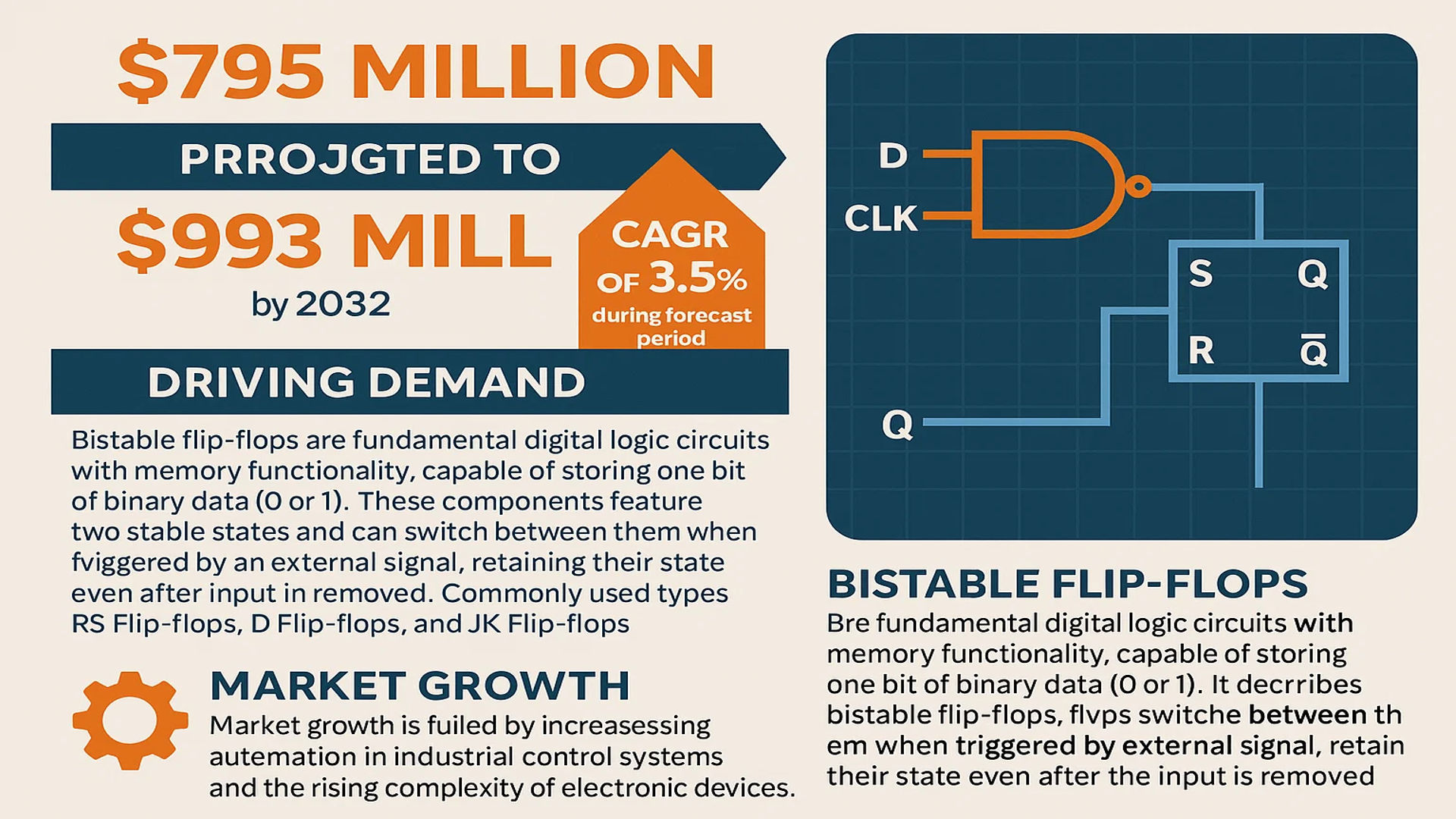
The global Bistable Flip-flop Market was valued at 795 million in 2024 and is projected to reach US$ 993 million by 2032, at a CAGR of 3.5% during the forecast period. While the market is growing steadily, the adoption of advanced digital logic circuits in industries such as automotive electronics and communication equipment is driving demand.
Bistable flip-flops are fundamental digital logic circuits with memory functionality, capable of storing one bit of binary data (0 or 1). These components feature two stable states and can switch between them when triggered by an external signal, retaining their state even after the input is removed. Commonly used types include RS Flip-flops, D Flip-flops, and JK Flip-flops, each serving specific applications in sequential logic design.
The market growth is fueled by increasing automation in industrial control systems and the rising complexity of electronic devices. Key players such as Texas Instruments, NXP Semiconductors, and STMicroelectronics dominate the landscape, collectively holding a significant market share. Technological advancements in low-power flip-flop designs and the integration of these components in IoT devices further contribute to market expansion.
MARKET DYNAMICS
MARKET DRIVERS
Expanding Demand for Consumer Electronics to Accelerate Market Growth
The global bistable flip-flop market is experiencing robust growth, primarily driven by the soaring demand for consumer electronics. With smartphones, tablets, and smart devices becoming ubiquitous, semiconductor manufacturers are increasingly incorporating bistable flip-flops in their designs to enhance memory functionality and power efficiency. The consumer electronics sector accounted for approximately 28% of the total bistable flip-flop application share in 2024, making it the dominant segment. As 5G adoption rises and IoT devices proliferate, this demand is projected to grow at a steady CAGR of 4.2% through 2030. Major manufacturers are responding to this trend by developing compact, low-power flip-flop variants specifically tailored for portable electronics.
Automotive Electronics Revolution to Fuel Market Expansion
The automotive sector is emerging as a key growth driver for bistable flip-flops, with modern vehicles incorporating an average of 1,400 semiconductor components per unit. Advanced driver assistance systems (ADAS), infotainment systems, and electric vehicle powertrains all require reliable memory circuits for data storage and signal processing. The automotive electronics segment is projected to grow at 5.8% CAGR through 2032, outpacing the overall market. Recent developments in autonomous vehicle technologies are creating new application areas for flip-flops in sensor fusion and decision-making circuits. Industry analysts note that the average semiconductor content per electric vehicle is about twice that of conventional vehicles, suggesting sustained demand growth in this vertical.
Industrial Automation Trends to Create New Growth Avenues
Industry 4.0 initiatives are driving unprecedented demand for industrial control systems that utilize bistable flip-flops in programmable logic controllers and embedded systems. The industrial sector now accounts for approximately 22% of the total bistable flip-flop market, with particular strength in Asia-Pacific manufacturing hubs. Predictive maintenance systems, industrial IoT sensors, and factory automation solutions all incorporate these components for their reliability and noise immunity. A recent industry survey revealed that 68% of manufacturers plan to increase automation investments over the next three years, indicating strong potential for market expansion. The growing emphasis on edge computing in industrial environments is further accentuating the need for robust memory circuits in distributed control systems.
MARKET RESTRAINTS
Miniaturization Challenges to Limit Market Penetration
While the bistable flip-flop market shows promising growth, physical scaling limitations present significant challenges. As semiconductor geometries shrink below 7nm, maintaining signal integrity in flip-flop circuits becomes increasingly difficult. Designers report that power leakage and timing violations in advanced nodes can increase development costs by 30-40%. Additionally, the industry faces yield challenges with sub-10nm flip-flop implementations, with some foundries reporting initial yields below 70% for complex memory arrays. These technical hurdles are particularly problematic for price-sensitive applications where cost-per-bit is a critical factor. Many system designers are being forced to make difficult trade-offs between performance, power consumption, and die area when implementing flip-flop-based solutions.
Supply Chain Disruptions to Constrain Market Growth
The semiconductor industry’s ongoing supply chain challenges are particularly acute for basic logic components like bistable flip-flops. Foundry capacity allocation priorities shifting toward high-margin products have created delivery lead times of 26-32 weeks for standard logic ICs. Component shortages have forced some automotive manufacturers to delay production schedules, with estimates suggesting 3.5 million fewer vehicles were produced in 2023 due to semiconductor shortages. The geographical concentration of semiconductor manufacturing creates additional vulnerability, as approximately 75% of global logic IC production occurs in just three countries. These constraints are expected to persist through 2025 as the industry works to expand capacity and diversify supply sources.
Competition from Alternative Technologies to Pressure Market Share
Bistable flip-flops face increasing competition from emerging non-volatile memory technologies and advanced FPGA architectures. In certain applications, resistive RAM and magnetic flip-flop alternatives offer advantages in power consumption and density. Industry benchmarks indicate that some novel memory technologies reduce standby power by up to 90% compared to conventional CMOS flip-flops. While these alternatives currently serve niche applications, their improving economics threaten the dominance of traditional flip-flop designs in battery-powered systems. Design teams report that approximately 15% of new product developments now evaluate alternative memory technologies, particularly for ultra-low-power IoT applications where energy harvesting is required.
MARKET OPPORTUNITIES
5G Infrastructure Buildout to Create New Application Areas
The global rollout of 5G networks presents significant opportunities for bistable flip-flop manufacturers. Base station equipment requires robust memory elements for signal processing and beamforming applications, with each 5G small cell incorporating hundreds of flip-flop circuits. Market projections indicate that 5G infrastructure spending will reach $26 billion annually by 2026, driving demand for high-reliability logic components. The millimeter-wave spectrum’s stringent timing requirements are particularly well-suited to flip-flop-based synchronization circuits. Recent design wins with major telecom equipment providers suggest that the 5G sector could account for 12-15% of the total flip-flop market by 2027, up from just 5% in 2024.
Artificial Intelligence Edge Devices to Drive Innovation
The proliferation of AI at the edge is creating demand for specialized flip-flop architectures optimized for neural network acceleration. New synchronous and asynchronous flip-flop designs are emerging to meet the unique requirements of AI inference engines, particularly in low-latency applications. Industry prototypes demonstrate that optimized flip-flop arrays can reduce power consumption in AI accelerators by up to 25% while maintaining throughput. With edge AI chipset shipments projected to grow at 28% CAGR through 2028, component manufacturers are investing heavily in flip-flop variants tailored for machine learning workloads. Recent patent filings indicate intense R&D activity in this area, with leading companies submitting 40% more memory circuit patents in 2023 compared to 2020.
Emerging Memory Technologies to Open New Frontiers
The development of novel non-volatile flip-flop architectures presents exciting opportunities for market expansion. Spin-transfer torque and ferroelectric flip-flop technologies are showing promise for applications requiring instant-on capability and radiation hardness. While these technologies currently represent less than 5% of the total market, their compound annual growth rate of 35% suggests rapid adoption in aerospace, medical, and industrial applications. Early adopters report significant advantages in system start-up times and reliability, with some designs achieving sub-nanosecond restore times from non-volatile states. As fabrication costs decline and yields improve, these advanced flip-flop variants could capture substantial market share in critical applications where conventional solutions face limitations.
MARKET CHALLENGES
Design Complexity to Increase Development Costs
The bistable flip-flop market faces mounting challenges from escalating design complexity in advanced nodes. Verification and validation of flip-flop arrays in modern SoCs now accounts for approximately 40% of total design effort, up from 25% just five years ago. Timing closure becomes particularly problematic at high frequencies, with some designs requiring dozens of iterations to meet specifications. Design teams report that clock domain crossing verification alone can consume 15-20% of the total verification budget for complex chips. These challenges are compounded by the need to support multiple voltage domains and power gating schemes, which has increased flip-flop architectural variants by a factor of three since 2018.
Intellectual Property Management to Create Strategic Challenges
The competitive landscape for bistable flip-flop IP presents unique challenges for market participants. With over 200 active patents filed annually in memory circuit technologies, companies face increasing litigation risks and licensing complexities. A recent industry analysis revealed that 35% of semiconductor patent disputes now involve basic logic elements like flip-flops. The situation is further complicated by divergent international IP regimes, with some jurisdictions offering weaker protection for circuit innovations. These factors have led several major players to establish dedicated IP acquisition teams, with some companies spending upwards of $50 million annually to build and defend their flip-flop patent portfolios.
Workforce Shortages to Constrain Industry Growth
The semiconductor industry’s talent gap presents a significant challenge for bistable flip-flop manufacturers. Specialized skills in memory circuit design and verification are in particularly short supply, with some companies reporting 6-9 month vacancies for senior design positions. Industry surveys indicate that 60% of semiconductor firms consider workforce availability their top growth constraint. The situation is most acute in analog/mixed-signal design, where experienced engineers capable of optimizing flip-flop performance trade-offs command premium compensation. Training and onboarding new designers has become increasingly costly, with estimates suggesting it takes 12-18 months to fully qualify an entry-level engineer for memory circuit development tasks. These human resource challenges are likely to persist as the industry continues to expand faster than educational pipelines can supply qualified graduates.
BISTABLE FLIP-FLOP MARKET TRENDS
Growing Demand for High-Speed Digital Electronics Drives Market Expansion
The global bistable flip-flop market is witnessing significant growth due to the increasing adoption of high-speed digital electronics in industrial automation, automotive, and communication systems. With a projected CAGR of 3.5% from 2024 to 2032, the market is expected to reach $993 million by 2032, up from $795 million in 2024. This growth is attributed to the essential role of flip-flops as fundamental components in sequential logic circuits, memory storage, and data synchronization. The U.S. and China are leading contributors, with China showing particularly strong demand due to rapid advancements in consumer electronics and automotive electronics manufacturing.
Other Trends
Automotive Electronics Evolution
The automotive sector is driving substantial demand for bistable flip-flops, particularly in applications such as advanced driver-assistance systems (ADAS), infotainment, and vehicle control modules. The increasing integration of digital logic circuits in modern electric and autonomous vehicles has amplified the need for reliable flip-flop solutions. Market studies suggest that automotive electronics accounted for over 25% of bistable flip-flop applications in 2024, with this share expected to rise due to advancements in smart mobility solutions.
Advancements in Semiconductor Technology Fuel Innovation
Technological advancements in semiconductor manufacturing, including the development of low-power and high-efficiency flip-flop designs, are reshaping the competitive landscape. Key players such as Texas Instruments, STMicroelectronics, and Infineon are introducing compact, high-speed variants optimized for IoT devices and 5G communication equipment. Furthermore, the transition to smaller process nodes (below 10nm) has enabled flip-flops with reduced power consumption, making them ideal for battery-operated and wearable devices. Emerging applications in AI edge computing are also contributing to higher demand for reliable bistable logic circuits.
COMPETITIVE LANDSCAPE
Key Industry Players
Semiconductor Giants Dominate the Bistable Flip-flop Market Through Technological Superiority
The global bistable flip-flop market is characterized by a moderately consolidated structure, dominated by established semiconductor leaders with robust R&D capabilities and extensive product portfolios. Texas Instruments and NXP Semiconductors collectively held a significant market share in 2024, leveraging their expertise in analog and digital logic components for diverse applications spanning industrial automation to consumer electronics.
While traditional players maintain strong positions, companies like Onsemi and Infineon Technologies are rapidly gaining traction through strategic focus on energy-efficient flip-flop solutions. The automotive sector’s growing demand for reliable memory components has particularly benefited these players, with Infineon’s recent acquisition of Cypress Semiconductor strengthening its position in advanced automotive electronics.
Asian manufacturers are making notable inroads into the market. Toshiba‘s continuous innovation in high-speed flip-flop variants and STMicroelectronics‘ expansion of its mixed-signal product line are reshaping competitive dynamics. Market data suggests that these tactical moves helped increase their combined global market share by nearly 2 percentage points since 2022.
The competitive landscape is further intensified by mid-sized specialists such as Nexperia and Microchip Technology, which compete through customized solutions and rapid prototyping capabilities. Their ability to deliver application-specific flip-flop configurations has made them preferred partners for IoT and edge computing applications.
List of Leading Bistable Flip-flop Manufacturers
- Texas Instruments (U.S.)
- NXP Semiconductors (Netherlands)
- Onsemi (U.S.)
- Infineon Technologies (Germany)
- Toshiba Electronic Devices & Storage (Japan)
- STMicroelectronics (Switzerland)
- Nexperia (Netherlands)
- Analog Devices (U.S.)
- Microchip Technology (U.S.)
Segment Analysis:
By Type
RS Flip-flop Segment Leads the Market Due to Its Widespread Use in Memory Circuits
The market is segmented based on type into:
- RS Flip-flop
- Key features: Simple design, used in basic memory applications
- D Flip-flop
- JK Flip-flop
- Advantages: Eliminates indeterminate state, widely used in counters
- T Flip-flop
- Others
By Application
Industrial Control Segment Dominates Owing to Increasing Automation
The market is segmented based on application into:
- Industrial Control
- Automotive Electronic
- Communication Equipment
- Consumer Electronic
- Others
By Technology
CMOS Technology Holds Majority Share Due to Low Power Consumption
The market is segmented based on technology into:
- CMOS
- TTL
- ECL
- Bipolar
By End-User
Electronics Manufacturing Sector Accounts for Largest Consumption
The market is segmented based on end-user into:
- Electronics Manufacturers
- Automotive Industry
- Telecommunication Providers
- Industrial Sector
Regional Analysis: Bistable Flip-flop Market
Asia-Pacific
The Asia-Pacific region dominates the bistable flip-flop market, driven by rapid growth in consumer electronics, telecommunications, and automotive industries. China leads the region with over 40% market share, supported by its strong semiconductor manufacturing ecosystem and government investments in chip design. India’s market is expanding at over 7% CAGR, fueled by the “Make in India” initiative and rising demand for digital devices. Japan and South Korea remain innovation hubs, focusing on advanced flip-flop designs for high-performance computing and memory applications, particularly in IoT and AI-driven devices.
North America
North America, especially the U.S., represents a mature but technology-driven market. The region contributes nearly 30% of global revenue, owing to its strong presence in semiconductor R&D, aerospace, defense, and data center applications. The U.S. leads adoption, driven by major chipmakers like Intel, AMD, and Qualcomm incorporating bistable flip-flops in processors and FPGAs. Canada supports growth with investments in telecom and 5G networks, while Mexico contributes through electronics assembly plants. Rising demand for low-power, high-speed digital circuits is fueling innovation in the region.
Europe
Europe’s market is shaped by its emphasis on industrial automation, automotive electronics, and compliance with strict design standards. Germany remains the largest consumer due to its strong automotive and industrial electronics sectors, while the UK and France lead in R&D for low-power logic circuits. Eastern Europe shows increasing adoption with growing semiconductor design houses. The EU’s push for digital sovereignty and chip independence is accelerating investment in bistable flip-flop integration within next-generation processors and controllers.
Middle East & Africa
The Middle East market, led by the UAE and Saudi Arabia, is seeing growth due to investments in digital infrastructure, 5G deployment, and smart city initiatives. Bistable flip-flops are increasingly used in telecom equipment and industrial automation systems. Africa’s market is emerging, with South Africa and Nigeria showing adoption in consumer electronics and energy applications. However, challenges such as limited semiconductor manufacturing capabilities and higher import dependency may slow rapid expansion in the region.
South America
Brazil and Argentina are the key markets in South America, driven by the growing consumer electronics, telecom, and automotive industries. Brazil’s increasing focus on semiconductor localization and R&D collaborations is creating opportunities for bistable flip-flop demand in embedded systems and IoT applications. Argentina supports market growth through industrial automation and telecom expansion. However, economic instability and dependency on imports hinder faster adoption across the region.
Report Scope
This market research report provides a comprehensive analysis of the Global Bistable Flip-flop Market, covering the forecast period 2024–2032. It offers detailed insights into market dynamics, technological advancements, competitive landscape, and key trends shaping the industry.
Key focus areas of the report include:
- Market Size & Forecast: Historical data and future projections for revenue, unit shipments, and market value across major regions and segments. The global market was valued at USD 795 million in 2024 and is projected to reach USD 993 million by 2032, growing at a CAGR of 3.5%.
- Segmentation Analysis: Detailed breakdown by product type (RS Flip-flop, D Flip-flop, JK Flip-flop, Others), application (Industrial Control, Automotive Electronics, Communication Equipment, Consumer Electronics), and end-user industry.
- Regional Outlook: Insights into market performance across North America, Europe, Asia-Pacific, Latin America, and the Middle East & Africa, including country-level analysis. The U.S. and China are key markets with significant growth potential.
- Competitive Landscape: Profiles of leading market participants including Onsemi, NXP, Texas Instruments, Toshiba, STMicroelectronics, Nexperia, Infineon, Analog Devices, and Microchip Technology, covering their product portfolios, R&D investments, and strategic initiatives.
- Technology Trends & Innovation: Assessment of emerging semiconductor design trends, miniaturization technologies, and integration with advanced computing systems.
- Market Drivers & Restraints: Evaluation of factors driving market growth such as increasing demand for consumer electronics and automotive electronics, along with challenges like supply chain constraints and semiconductor shortages.
- Stakeholder Analysis: Strategic insights for component manufacturers, OEMs, system integrators, and investors regarding market opportunities and competitive positioning.
The report employs both primary and secondary research methodologies, including expert interviews, company financial reports, and verified market data to ensure accuracy and reliability.
FREQUENTLY ASKED QUESTIONS:
What is the current market size of Global Bistable Flip-flop Market?
-> Bistable Flip-flop Market was valued at 795 million in 2024 and is projected to reach US$ 993 million by 2032, at a CAGR of 3.5% during the forecast period.
Which key companies operate in Global Bistable Flip-flop Market?
-> Key players include Onsemi, NXP, Texas Instruments, Toshiba, STMicroelectronics, Nexperia, Infineon, Analog Devices, and Microchip Technology.
What are the key growth drivers?
-> Key growth drivers include increasing demand for consumer electronics, automotive electronics expansion, and industrial automation adoption.
Which region dominates the market?
-> Asia-Pacific is the largest and fastest-growing market, while North America remains a significant player due to technological advancements.
What are the emerging trends?
-> Emerging trends include miniaturization of components, integration with IoT devices, and development of energy-efficient flip-flop designs.

Get Sample Report PDF for Exclusive Insights
Report Sample Includes
- Table of Contents
- List of Tables & Figures
- Charts, Research Methodology, and more...