
BiPolar Power Supplies Market Insights
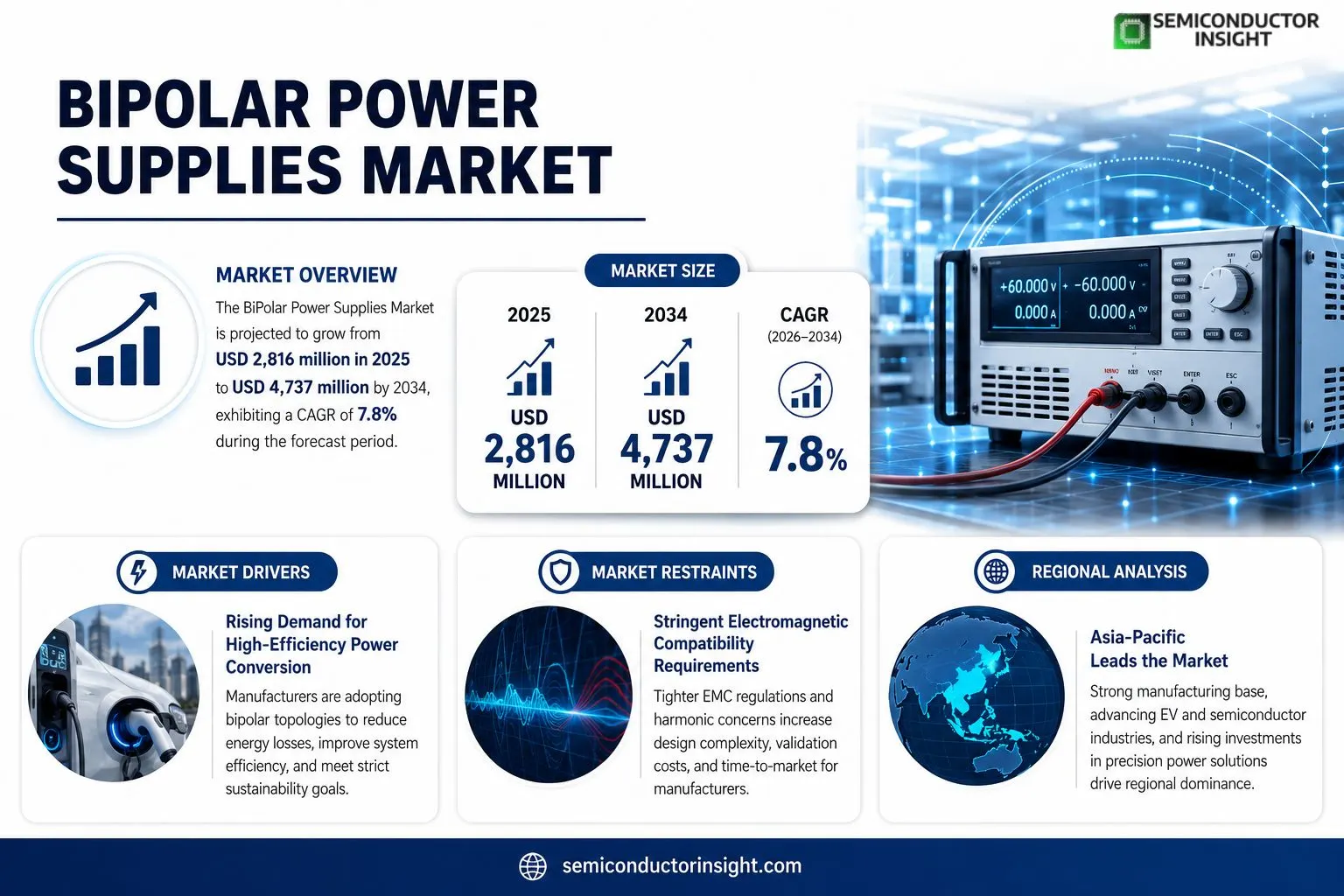
BiPolar Power Supplies market was valued at USD 2,816 million in 2025 and is projected to reach USD 4,737 million by 2034, exhibiting a CAGR of 7.8% during the forecast period.
Bipolar power supplies are systems capable of delivering both positive and negative voltage or current from a single unit, often providing four‑quadrant source‑and‑sink control. Their core value lies in enabling zero‑crossing output, energy regeneration, dynamic waveform simulation and complex load driving without extensive rewiring. Product families include programmable DC supplies for automotive electronics, battery simulation and semiconductor testing; precision units for magnets, piezo devices and accelerators; as well as high‑voltage process‑oriented supplies used in dual‑cathode sputtering, ion implantation and X‑ray systems. Key technical attributes centre on four‑quadrant power stages, stable zero‑crossing control, low noise broadband performance and digital communication interfaces.The market momentum stems from expanding electric‑vehicle production EV sales are set to exceed 20 million units in 2025and continued capacity growth in semiconductor fabs where reversible power is essential for ion implantation and wafer‑level testing. Standards such as ISO 16750‑2 and GB/T 28046‑2 further institutionalise demand for realistic power disturbance simulation. Leading suppliers such as Keysight Technologies, Spellman High Voltage Electronics Corporation, CAEN ELS S.r.l., Kikusui Electronics Corp. and ULVAC are actively broadening their portfolios through modular software upgrades and application‑specific customisation.
MARKET DRIVERS
Rising Demand for High‑Efficiency Power Conversion
BiPolar Power Supplies Market is being pulled upward by manufacturers’ push for energy‑saving designs. In data‑center deployments, operators are swapping legacy units for bipolar topologies that trim losses by roughly 15 % at comparable power levels. This shift not only lowers operating expense but also aligns with stricter carbon‑footprint policies demanded by large enterprises.
Growth of Renewable Energy Installations
Solar‑farm developers and wind‑turbine OEMs require power converters that can handle bidirectional current flow without compromising reliability. Bipolar converters meet that need, offering smoother voltage regulation under fluctuating generation conditions. As renewable capacity expands at an estimated 7 % annual rate, the ancillary demand for robust bipolar supplies climbs in step.
➤ Systems that integrate storage and generation benefit from the inherent symmetry of bipolar architectures, reducing component count and simplifying thermal management.
Automotive electrification presents a parallel catalyst. Electric‑vehicle architectures that combine traction and auxiliary loads increasingly adopt bipolar modules to harmonize power distribution across the vehicle’s high‑voltage bus. The ripple‑free output improves both efficiency and longevity of downstream electronics, reinforcing supplier confidence in the segment.
MARKET CHALLENGES
Stringent Electromagnetic Compatibility Requirements
Regulatory bodies in North America and Europe have tightened electromagnetic compatibility (EMC) limits for power equipment. Bipolar converters, while efficient, generate harmonic spectra that can breach these thresholds if not carefully filtered. Engineering teams therefore face higher design complexity and need additional validation steps, inflating time‑to‑market.
Other Challenges
Component Cost Volatility
Silicon carbide (SiC) and gallium‑nitride (GaN) chips, which underpin many modern bipolar designs, experience price swings tied to supply chain constraints. When component prices surge, OEMs are forced to weigh performance gains against margin pressure, sometimes reverting to older, less efficient solutions.
MARKET RESTRAINTS
Limited Awareness Among End‑Users
Many system integrators remain unfamiliar with the operational advantages of bipolar topologies. In sectors such as industrial automation, the default recommendation still favors traditional unipolar supplies, simply because they are better known. This knowledge gap curtails adoption rates, especially in regions where engineering talent is scarce.
Thermal Management Constraints
Although bipolar designs can reduce conduction losses, they often concentrate heat in compact magnetic cores. Without advanced cooling strategies, the thermal envelope can become a bottleneck, limiting power density and forcing designers to over‑size enclosuresa drawback for space‑constrained applications such as aerospace.
MARKET OPPORTUNITIES
Integration of Smart Monitoring Platforms
Embedding IoT‑enabled diagnostics into bipolar power units creates a compelling value proposition for operators seeking predictive maintenance. Real‑time data on temperature, load cycles, and efficiency enable service providers to shift from reactive repairs to condition‑based servicing, unlocking new revenue streams for both manufacturers and end‑users.
Expansion into Edge‑Computing Infrastructure
Edge nodes demand compact, high‑efficiency power solutions that can operate reliably in remote or harsh environments. Bipolar converters, with their balanced current paths, fit the profile, especially when paired with ruggedized casings. As edge deployments proliferate across logistics, smart cities, and telecom, the demand for such tailored power modules is set to rise sharply.
BiPolar Power Supplies Market Trends
Four‑Quadrant Architecture Becomes a System‑Level Differentiator
BiPolar Power Supplies Market is moving beyond a niche laboratory component toward a comprehensive control platform. Manufacturers that combine four‑quadrant power stages with zero‑crossing stability, low‑noise design, and programmable waveform capability are securing contracts that include software integration, remote diagnostics, and on‑site calibration services. This evolution matters because customersautomotive OEMs, semiconductor fab equipment builders, and research labsnow evaluate supply solutions on total‑system performance rather than on raw voltage or current ratings alone. Firms that can present a turnkey package, including digital communication protocols and application‑specific firmware, command higher price points and longer service life cycles, reshaping the revenue structure of the market.
Other Trends
Regional Competitive Landscape
In BiPolar Power Supplies Market, Japan retains leadership in precision four‑quadrant modules, leveraging decades of experience in high‑speed control and robust component qualification. Chinese suppliers are aggressively expanding into battery‑simulation and ion‑implantation applications, using localized engineering resources to shorten development cycles and reduce cost of entry. U.S. players continue to dominate high‑voltage, low‑noise test equipment, while European firms focus on regenerative power solutions for scientific magnets and large‑scale research facilities. The resulting geography‑based differentiation forces OEMs to manage a multi‑vendor strategy, balancing cost, performance, and regulatory compliance across regions.
Automotive Electrification and Semiconductor Expansion Drive Adoption
The convergence of electric‑vehicle growth and increased fab capacity is amplifying demand for BiPolar Power Supplies Market. Over 20 million electric cars are slated for delivery in 2025, pushing test rigs that replicate rapid charge‑discharge cycles, motor‑drive transients, and battery‑management anomalies. Simultaneously, 300 mm wafer fabs are scaling equipment inventories, with ion‑implantation, dual‑cathode sputtering, and high‑precision device testing all requiring reversible power sources. Standards such as ISO 16750‑2 and GB/T 28046‑2 formalize test‑procedure complexity, creating a stable pipeline of orders that is less tied to any single economic cycle. Companies that embed application‑knowledgeelectric‑vehicle power‑train testing or semiconductor process integrationinto their product roadmaps are positioning themselves to capture this multi‑sector growth.
COMPETITIVE LANDSCAPEKey Industry Players
Bipolar Power Supplies: Competitive Forces and Market Structure
The market is anchored by a handful of multinational firms that have transformed the traditional laboratory‑grade power source into a platform for system‑level control. ITECH ELECTRONIC CO., LTD. leverages a deep portfolio of four‑quadrant modules and a robust software stack, allowing it to secure high‑value contracts with semiconductor equipment manufacturers and automotive test labs. Keysight Technologies, with its legacy in precision measurement, combines low‑noise architecture with extensive remote‑access capabilities, positioning it as a preferred supplier for research institutions seeking reproducible waveform generation. In North America, KEPCO, INC. differentiates through high‑voltage reversible designs that meet stringent safety standards, while Japan’s ULVAC, Inc. dominates the niche of ion‑implantation power supplies by offering tightly integrated hardware‑software solutions that reduce calibration cycles. These leaders control a significant share of total revenue, set pricing benchmarks, and drive the evolution toward turnkey, application‑centric offerings.Beyond the tier‑one giants, a vibrant set of regional specialists fuels market depth. Chinese manufacturers such as Lanzhou Jingxin Power Supply Equipment Co., Ltd. and Shandong Ainuo Instrument Co., Ltd. accelerate adoption in electric‑vehicle battery simulation and coating‑process testing by pairing competitive pricing with rapid customization cycles. European firms including CAEN ELS S.r.l. and NF Corporation focus on regenerative systems for scientific magnets, emphasizing ultra‑low noise and wide bandwidth to satisfy large‑scale research facilities. Mid‑size Japanese playersKIKUSUI ELECTRONICS CORP., Matsusada Precision Inc., and Japan Stabilizer Industry Co., Ltd.continue to refine precision controls for piezo‑actuated devices, reinforcing Japan’s reputation for high‑accuracy power stages. The interplay of these niche competitors creates a fragmented yet purposeful landscape where domain expertise, after‑sales support, and integration services increasingly determine winning bids.
List of Key BiPolar Power Supplies Companies Profiled
- ITECH ELECTRONIC CO., LTD.
- Keysight Technologies, Inc.
- KEPCO, INC.
- ULVAC, Inc.
- Lanzhou Jingxin Power Supply Equipment Co., Ltd.
- Shandong Ainuo Instrument Co., Ltd.
- KIKUSUI ELECTRONICS CORP.
- Matsusada Precision Inc.
- NF Corporation
- Japan Stabilizer Industry Co., Ltd.
- CAEN ELS S.r.l.
- Spellman High Voltage Electronics Corporation
- Hitachi High‑Tech Corp.
- Zurich Instruments AG
- TAISEI Electric Co., Ltd.
Segment Analysis:
| Segment Category | Sub-Segments | Key Insights |
| By Type |
|
Programmable Bipolar Supplies are gaining traction because they combine four‑quadrant capability with flexible waveform sequencing; they enable test engineers to emulate real‑world power disturbances without hardware rewiring; they serve as a platform for remote digital control and integration into larger test systems. |
| By Application |
|
Semiconductor Process & Equipment drives demand for reversible high‑voltage sources that support ion implantation and dual‑cathode sputtering; the need for low‑noise, high‑bandwidth supplies aligns with precision device testing; integration of digital communication standards makes these supplies essential for automated fab lines. |
| By End User |
|
Semiconductor Equipment Manufacturers prioritize four‑quadrant platforms that can be seamlessly embedded into test chambers; they value regenerative capability for energy‑efficient operation; they also seek extensive waveform libraries to support diverse device characterizations. |
| By Capability |
|
Four‑Quadrant Power Stage is the core differentiator that enables both sourcing and sinking of power; mastery of this capability allows suppliers to address complex load‑driving scenarios across multiple industries; it also underpins regenerative testing approaches that reduce overall energy consumption. |
| By Industry |
|
Electric Vehicle Testing creates a sustained pull for bipolar supplies that can emulate rapid load transients and regenerative braking scenarios; manufacturers that embed comprehensive communication stacks gain preference in OEM validation labs; the convergence of automotive standards and high‑precision power control spurs ecosystem development. |
Regional Analysis: BiPolar Power Supplies Market
North America
Engineers prioritize monolithic integration of driver and regulation stages, trimming board footprint while preserving isolation characteristics. The push toward wider voltage ranges stems from mixed‑signal environments where bipolar supplies must coexist with digital power architecture.
The UL and IEC certifications that dominate the market are interpreted with consistency, allowing manufacturers to certify multiple product families under a single test regime, thereby reducing overhead and accelerating rollout cycles.
End users increasingly demand converters that deliver low electromagnetic interference alongside high transient response, traits that influence component selection and drive collaborations between supply‑chain partners.
Domestic sourcing of high‑temperature alloys and advanced packaging materials has become a strategic priority, mitigating exposure to geopolitical disruptions while supporting rapid prototyping.
Europe
European firms leverage a regulatory environment that emphasizes energy efficiency, prompting designers to adopt advanced magnetic materials in bipolar converters. Collaborative research initiatives across Germany, France, and the Nordic region foster cross‑border knowledge transfer, especially in automotive electrification where compact, high‑reliability supplies are essential. Market participants note that customer procurement policies increasingly reward sustainability certifications, nudging suppliers toward greener production methods without compromising performance.
Asia‑Pacific
The Asia‑Pacific corridor exhibits a vibrant manufacturing base, with rapid product iteration driven by demand from consumer electronics and telecom infrastructure upgrades. While cost competitiveness remains a focal point, firms are also investing in localized design capabilities to shorten development cycles. Emerging standards in Japan and South Korea encourage higher power density, pushing suppliers to experiment with wide‑bandgap semiconductors despite limited domestic expertise.
South America
In South America, growth is anchored to expanding renewable‑energy projects, where bipolar supplies are employed in inverter modules that require robust isolation. Local players often partner with North American technology firms to import design IP, adapting it to regional climatic conditions. The market’s evolution is tempered by infrastructure constraints, yet policy incentives for grid modernization provide a catalyst for incremental adoption.
Middle East & Africa
The Middle East & Africa region reflects a niche yet steadily maturing demand profile, primarily within defense and oil‑&‑gas sectors that value rugged power solutions. Suppliers focus on delivering units capable of withstanding extreme temperature swings, a requirement shaped by both environmental factors and stringent operational standards. Strategic joint ventures with established manufacturers are emerging as a pathway to bridge expertise gaps while meeting local content regulations.
Report Scope
This market research report provides a comprehensive analysis of the BiPolar Power Supplies Market , covering the forecast period 2026–2034. It offers detailed insights into market dynamics, technological advancements, competitive landscape, and key trends shaping the industry.
Key focus areas of the report include:
- Market Overview: The report begins with an overview outlining its current market scenario, key growth indicators, and industry transformation drivers. It discusses macroeconomic factors, demand–supply balance, regulatory landscape, and the strategic role of semiconductors in powering advancements across industries such as automotive, telecommunications, consumer electronics, and industrial automation.
- Market Size & Forecast: Historical data and future projections for revenue, unit shipments, and market value across major regions and segments.
- Segmentation Analysis: Detailed breakdown by product type, technology, application, and end-user industry to identify high-growth segments and investment opportunities.
- Regional Insights: Insights into market performance across North America, Europe, Asia-Pacific, Latin America, and the Middle East & Africa, including country-level analysis where relevant.
- Competitive Landscape: Profiles of leading market participants, including their product offerings, R&D focus, manufacturing capacity, pricing strategies, and recent developments such as mergers, acquisitions, and partnerships.
- Technology Trends & Innovation: Assessment of emerging technologies, integration of AI/IoT, semiconductor design trends, fabrication techniques, and evolving industry standards.
- Market Drivers & Restraints: Evaluation of factors driving market growth along with challenges, supply chain constraints, regulatory issues, and market-entry barriers.
- Stakeholder Insights: Insights for component suppliers, OEMs, system integrators, investors, and policymakers regarding the evolving ecosystem and strategic opportunities.
Primary and secondary research methods are employed, including interviews with industry experts, data from verified sources, and real-time market intelligence to ensure the accuracy and reliability of the insights presented.
FREQUENTLY ASKED QUESTIONS:
What is the current market size of BiPolar Power Supplies Market?
-> BiPolar Power Supplies Market was valued at USD 2816 million in 2025 and is expected to reach USD 4737 million by 2034, growing at a CAGR of 7.8% during the forecast period.
Which key companies operate in BiPolar Power Supplies Market?
-> Key players include ITECH ELECTRONIC CO., LTD., Lanzhou Jingxin Power Supply Equipment Co., Ltd., Shandong Ainuo Instrument Co., Ltd., Japan Stabilizer Industry Co., Ltd., KIKUSUI ELECTRONICS CORP., Matsusada Precision Inc., NF Corporation, ULVAC, Inc., KEPCO, INC., Keysight Technologies, Inc., Spellman High Voltage Electronics Corporation, CAEN ELS S.r.l..
What are the key growth drivers?
-> Key growth drivers include rapid expansion of electric vehicle testing, increasing semiconductor fab equipment spending, stricter automotive electrical load standards (ISO 16750-2, GB/T 28046-2), and rising demand for high‑precision four‑quadrant power platforms in advanced manufacturing and scientific research.
Which region dominates the market?
-> Asia‑Pacific leads the market, driven by strong contributions from Japan’s precision four‑quadrant products and China’s application‑focused solutions, while the United States and Europe hold high‑end and regenerative system niches.
What are the emerging trends?
-> Emerging trends include integration of digital communications and remote control, AI‑enabled waveform generation, regenerative energy handling, and the convergence of power supplies with broader test‑system platforms for automotive and semiconductor applications.
Get Sample Report PDF for Exclusive Insights
Report Sample Includes
- Table of Contents
- List of Tables & Figures
- Charts, Research Methodology, and more...
 Download Sample Report PDF