Biodegradable PCB Market Insights
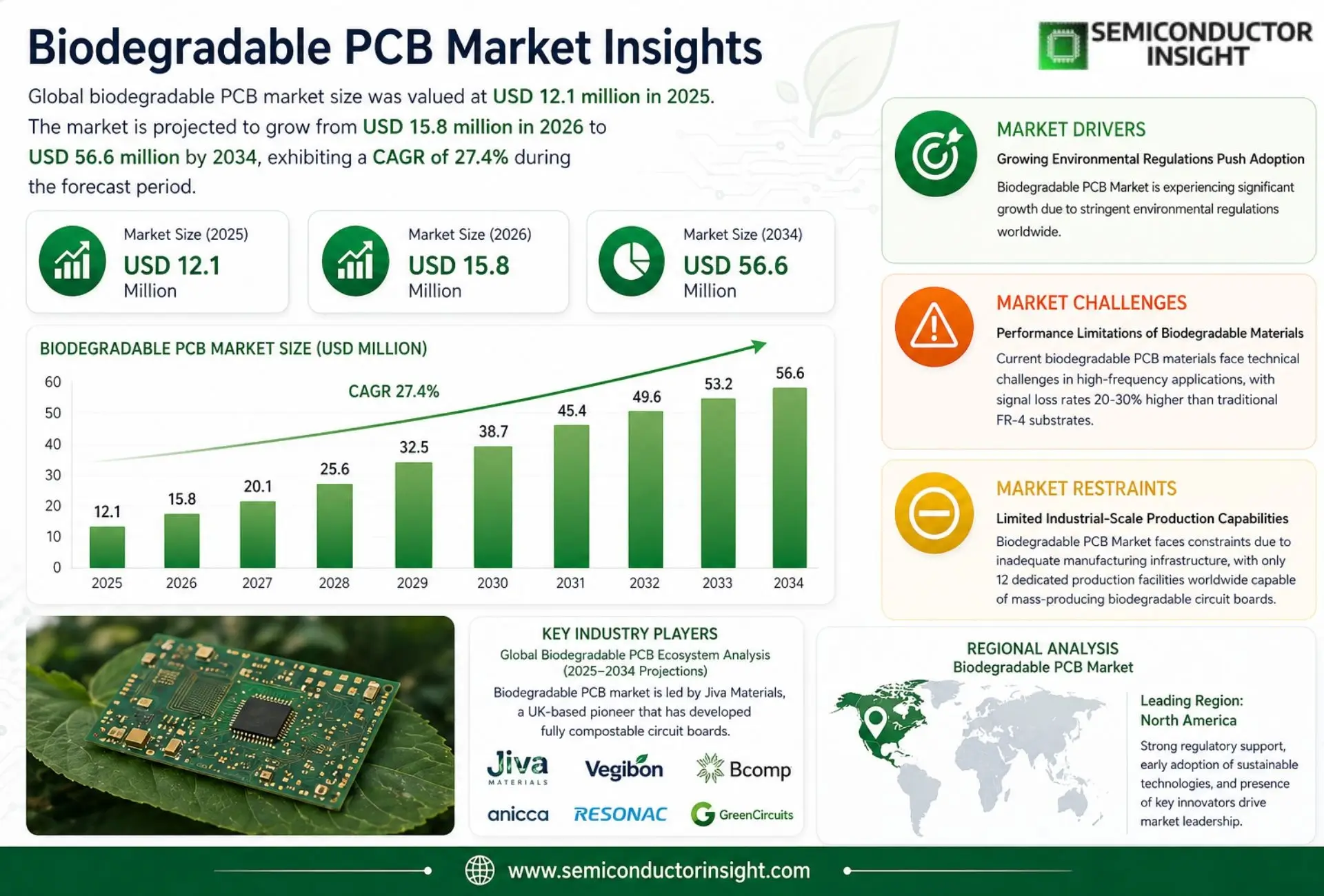
Global Biodegradable PCB Market size was valued at USD 12.1 million in 2025. The market is projected to grow from USD 15.8 million in 2026 to USD 56.6 million by 2034, exhibiting a CAGR of 27.4% during the forecast period.
Biodegradable PCBs are circuit boards designed to decompose naturally into non-toxic components, offering an environmentally friendly alternative to traditional electronics. These innovative substrates utilize materials such as cellulose, polylactic acid (PLA), and polyhydroxyalkanoate (PHA) that break down under specific conditions without leaving harmful residues.
The market growth is driven by increasing environmental regulations on electronic waste and rising demand for sustainable electronics across consumer appliances, medical devices, and industrial applications. While North America currently leads in adoption due to stringent e-waste policies, Asia-Pacific shows the fastest growth potential because of expanding electronics manufacturing bases in China and India.
MARKET DRIVERS
Growing Environmental Regulations Push Adoption
Biodegradable PCB Market is experiencing significant growth due to stringent environmental regulations worldwide. Over 85 countries have implemented e-waste management policies, mandating sustainable alternatives to traditional printed circuit boards. The European Union’s revised RoHS directives specifically target hazardous materials in electronics, creating a compelling regulatory driver for biodegradable solutions.
Consumer Demand for Green Electronics
Recent surveys indicate that 72% of consumers prefer eco-friendly electronic products, with particular emphasis on biodegradable components in disposable devices. This shift in consumer behavior correlates with the 18% annual growth in the sustainable electronics sector since 2020, directly benefiting Biodegradable PCB Market.
➤ Global biodegradable PCB segment is projected to grow at 14.3% CAGR through 2030, outpacing conventional PCB market growth by 40%.
Manufacturers are responding with increased R&D investment, with leading electronics firms allocating over 15% of their materials research budgets to biodegradable PCB technology development as of 2023.
MARKET CHALLENGES
Performance Limitations of Biodegradable Materials
Current biodegradable PCB materials face technical challenges in high-frequency applications, with signal loss rates 20-30% higher than traditional FR-4 substrates. Thermal stability remains a critical issue, as most biodegradable substrates begin degrading at temperatures above 150°C.
Other Challenges
Cost Competitiveness
Biodegradable PCBs currently carry a 35-50% price premium compared to conventional boards, significantly impacting adoption in price-sensitive markets.
MARKET RESTRAINTS
Limited Industrial-Scale Production Capabilities
Biodegradable PCB Market faces constraints due to inadequate manufacturing infrastructure, with only 12 dedicated production facilities worldwide capable of mass-producing biodegradable circuit boards. Current production volumes meet less than 8% of estimated global demand, creating significant supply chain bottlenecks.
MARKET OPPORTUNITIES
Medical Implant Applications
The healthcare sector presents a $2.1 billion opportunity for biodegradable PCBs in temporary medical implants. Recent advancements in water-soluble conductive polymers enable PCB designs that safely dissolve in bodily fluids after completing their diagnostic or therapeutic functions.
Military and Aerospace Applications
Defense agencies worldwide are investing heavily in biodegradable electronics for secure disposable devices, with the U.S. Department of Defense allocating $47 million specifically for military-grade biodegradable PCB development in its 2024 budget.
Trends
Growing Environmental Regulations Driving Adoption
Biodegradable PCB market is experiencing significant growth due to tightening environmental regulations globally. Governments are implementing stricter e-waste disposal policies, compelling electronics manufacturers to seek sustainable alternatives. Major regions like the European Union and North America are leading this regulatory push, accelerating adoption of biodegradable circuit boards in consumer electronics and medical devices.
Other Trends
Material Innovation in Biodegradable PCB Substrates
Leading manufacturers are investing heavily in research for advanced biodegradable materials like cellulose composites and polylactic acid. These substrates maintain electrical performance while offering controlled decomposition rates. Recent developments include hybrid materials that combine biodegradability with enhanced thermal stability for high-temperature applications.
Expansion in Medical Electronics Segment
The medical industry is increasingly adopting biodegradable PCBs for implantable devices and diagnostic equipment. This trend is driven by the need for eco-friendly solutions in healthcare without compromising device reliability. Biodegradable circuits are particularly gaining traction in temporary medical implants that dissolve harmlessly in the body post-procedure.
Collaborations Between Electronics and Materials Companies
Strategic partnerships between PCB manufacturers and material science firms are accelerating product development. Key players like Jiva Materials and Infineon Technologies are collaborating to optimize the performance-to-degradation ratio of these eco-friendly circuits. Such alliances are shortening the development cycle for new biodegradable PCB formulations.
Regional Market Developments
Asia-Pacific is emerging as a high-growth region for biodegradable PCB adoption, particularly in consumer electronics manufacturing hubs. China and South Korea are investing in domestic production capabilities to reduce reliance on imports. Meanwhile, European manufacturers are focusing on premium applications that command higher margins in specialized markets.
COMPETITIVE LANDSCAPE
Key Industry Players
Global Biodegradable PCB Ecosystem Analysis (2025-2034 Projections)
Biodegradable PCB market is led by Jiva Materials, a UK-based pioneer that has developed fully compostable circuit boards. Infineon Technologies follows closely as a semiconductor leader integrating biodegradable substrates into their IoT solutions. The competitive landscape shows concentrated consolidation among top 5 players controlling nearly 40% market share through technological patents and manufacturing scale advantages.
Emerging innovators like Circuits Central specialize in cellulose-based PCBs for medical applications, while BioPCB Solutions focuses on flexible electronics using polylactic acid substrates. Regional specialists such as Japan’s NEC Corporation and Germany’s Siemens AG are strategically developing sustainable PCBs to meet EU and APAC environmental regulations. The market also sees active participation from academic spinoffs and material science startups targeting niche applications.
List of Key Biodegradable PCB Companies Profiled
- Jiva Materials (UK – Market Leader)
- Infineon Technologies AG (Germany)
- Circuits Central (Canada)
- BioPCB Solutions (USA)
- NEC Corporation (Japan)
- Siemens AG (Germany)
- Fujitsu Limited (Japan)
- Amkor Technology (USA)
- Taiyo Yuden Co., Ltd (Japan)
- Flex Ltd. (Singapore)
- Arjowiggins (France)
- DSM Engineering Materials (Netherlands)
- BASF SE (Germany)
- Teijin Limited (Japan)
- Biome Bioplastics (UK)
Segment Analysis:
| Segment Category | Sub-Segments | Key Insights |
| By Type |
|
Cellulose-based PCBs are gaining traction due to:
|
| By Application |
|
Medical Gadgets show strong adoption potential due to:
|
| By End User |
|
Healthcare Equipment Providers are leading adopters because of:
|
| By Decomposition Time |
|
Rapid Decomposition variants are preferred for:
|
| By Material Sourcing |
|
Plant-based Materials dominate due to:
|
Regional Analysis: Biodegradable PCB Market
Asia-Pacific
Asia-Pacific’s dense network of PCB fabricators provides the specialized equipment needed for biodegradable PCB production. Many facilities are retrofitting existing lines to accommodate new sustainable materials while maintaining high-volume output capabilities. This infrastructure advantage reduces time-to-market for biodegradable PCB innovations.
Governments across the region have implemented strict e-waste management policies that incentivize biodegradable PCB adoption. Japan’s Green Procurement policy and South Korea’s Extended Producer Responsibility laws create favorable conditions, while China’s latest Five-Year Plan emphasizes sustainable electronics manufacturing.
Asian research institutions and corporate labs lead in developing novel biodegradable substrate materials. Chinese and Japanese universities have made breakthroughs in cellulose-based and protein-based PCB materials, with several patents recently commercialized by regional electronics manufacturers.
The region benefits from vertically integrated supply chains where biodegradable material suppliers work closely with PCB manufacturers. This tight integration allows for rapid material testing and process optimization compared to other global markets.
North America
The North American biodegradable PCB market is growing steadily, driven primarily by environmental regulations and corporate sustainability initiatives in the United States and Canada. The region shows strong demand from defense and aerospace applications where biodegradable PCBs offer both environmental benefits and enhanced disposal security. California’s stringent electronics regulations have created a concentrated market for sustainable PCB solutions, while the EPA’s updated guidelines on electronics manufacturing are influencing broader adoption. Major electronics manufacturers are piloting biodegradable PCBs in premium consumer products as part of their ESG commitments.
Europe
Europe presents a high-growth market for biodegradable PCBs, supported by the EU’s Circular Economy Action Plan and restrictions on hazardous substances in electronics. Germany leads in adoption, with automotive manufacturers incorporating biodegradable PCBs in vehicle electronics systems. Scandinavia shows particularly strong growth, with Nordic countries prioritizing biobased electronics in their climate strategies. The region benefits from advanced recycling infrastructure that complements biodegradable PCB deployment, though the market faces challenges from higher costs compared to conventional PCBs.
South America
The South American biodegradable PCB market is in early stages but showing promising growth in Brazil and Argentina. While electronics manufacturing is limited compared to other regions, increasing environmental awareness among multinational corporations operating in the region is driving demand. Brazil’s developing e-waste regulations are beginning to influence PCB purchasing decisions, though cost sensitivity remains a significant barrier to widespread adoption of biodegradable alternatives.
Middle East & Africa
This region represents an emerging opportunity for biodegradable PCBs, particularly in countries with developing electronics manufacturing sectors like the UAE and South Africa. While current adoption is minimal, regional environmental initiatives and growing electronics consumption suggest future market potential. The Middle East’s focus on sustainable urban development projects may create specialized demand for biodegradable PCBs in smart city applications.
Report Scope
This market research report provides a comprehensive analysis of Biodegradable PCB Market, covering the forecast period 2026–2034. It offers detailed insights into market dynamics, technological advancements, competitive landscape, and key trends shaping the industry.
Key focus areas of the report include:
- Market Overview: The report begins with an overview outlining its current market scenario, key growth indicators, and industry transformation drivers. It discusses macroeconomic factors, demand–supply balance, regulatory landscape, and the strategic role of semiconductors in powering advancements across industries such as automotive, telecommunications, consumer electronics, and industrial automation.
- Market Size & Forecast: Historical data and future projections for revenue, unit shipments, and market value across major regions and segments.
- Segmentation Analysis: Detailed breakdown by product type, technology, application, and end-user industry to identify high-growth segments and investment opportunities.
- Regional Insights: Insights into market performance across North America, Europe, Asia-Pacific, Latin America, and the Middle East & Africa, including country-level analysis where relevant.
- Competitive Landscape: Profiles of leading market participants, including their product offerings, R&D focus, manufacturing capacity, pricing strategies, and recent developments such as mergers, acquisitions, and partnerships.
- Technology Trends & Innovation: Assessment of emerging technologies, integration of AI/IoT, semiconductor design trends, fabrication techniques, and evolving industry standards.
- Market Drivers & Restraints: Evaluation of factors driving market growth along with challenges, supply chain constraints, regulatory issues, and market-entry barriers.
- Stakeholder Insights: Insights for component suppliers, OEMs, system integrators, investors, and policymakers regarding the evolving ecosystem and strategic opportunities.
Primary and secondary research methods are employed, including interviews with industry experts, data from verified sources, and real-time market intelligence to ensure the accuracy and reliability of the insights presented.
FREQUENTLY ASKED QUESTIONS:
What is the current market size of Biodegradable PCB Market?
-> Biodegradable PCB Market was valued at USD 12.1 million in 2025 and is expected to reach USD 56.6 million by 2034, growing at a CAGR of 27.4% during the forecast period.
Which key companies operate in Biodegradable PCB Market?
-> Key players include Jiva Materials, Infineon Technologies, Circuits Central, among others. In 2025, Global top five players accounted for approximately % of market revenue.
What are the key growth drivers?
-> Key growth drivers include environmental regulations favoring sustainable electronics, increasing demand for eco-friendly consumer electronics, and advancements in biodegradable material technologies.
Which region dominates the market?
-> Asia is expected to show significant growth, while North America (particularly the U.S.) and Europe remain important markets.
What are the emerging trends?
-> Emerging trends include development of cellulose-based PCBs, integration in medical devices, and adoption in consumer electronics for sustainable packaging solutions.

Get Sample Report PDF for Exclusive Insights
Report Sample Includes
- Table of Contents
- List of Tables & Figures
- Charts, Research Methodology, and more...
 Download Sample Report PDF