MARKET INSIGHTS
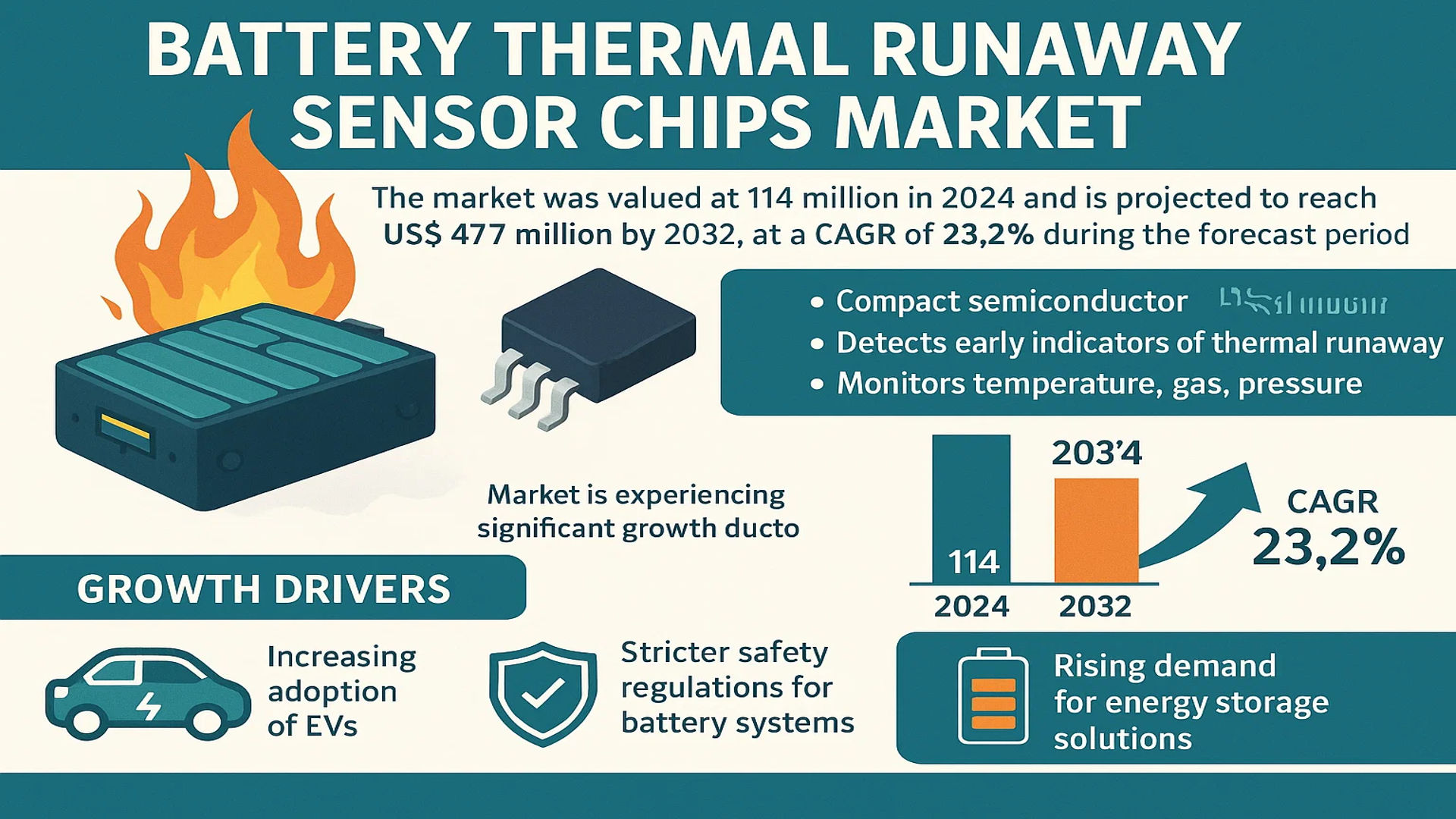
The global Battery Thermal Runaway Sensor Chips Market was valued at 114 million in 2024 and is projected to reach US$ 477 million by 2032, at a CAGR of 23.2% during the forecast period.
Battery thermal runaway sensor chips are compact semiconductor devices designed to detect early indicators of thermal runaway in battery systems. These chips monitor critical parameters such as temperature, gas emissions, and pressure changes to provide real-time alerts, enabling proactive safety measures. The technology is widely used in lithium-ion battery applications, particularly in electric vehicles (EVs) and energy storage systems, where thermal management is critical for operational safety.
The market is experiencing significant growth due to increasing adoption of EVs globally, stricter safety regulations for battery systems, and rising demand for energy storage solutions. While North America and Europe are key markets with established regulatory frameworks, Asia-Pacific is emerging as the fastest-growing region, driven by China’s dominant EV manufacturing sector. Key industry players such as Amphenol, NXP, and Infineon are expanding their product portfolios through technological innovations to address the growing demand for reliable thermal monitoring solutions.
MARKET DYNAMICS
MARKET DRIVERS
Rapid Expansion of Electric Vehicle Industry Propelling Thermal Runaway Sensor Adoption
The exponential growth of the electric vehicle market is creating unprecedented demand for battery safety solutions. With global EV sales surpassing 10 million units in 2022 and projected to reach 40 million by 2030, manufacturers are under intense pressure to ensure battery pack safety. Thermal runaway sensor chips have become critical components as they provide early detection of overheating conditions that could lead to catastrophic battery failures. These microdevices offer real-time monitoring capabilities that can prevent costly recalls and enhance consumer confidence in electrified transportation solutions.
Increasing Energy Storage Deployments Creating New Growth Avenues
Utility-scale energy storage installations are experiencing double-digit growth rates worldwide, driven by renewable energy integration needs. The global energy storage market is expected to expand at 20% CAGR through 2030, with lithium-ion batteries accounting for over 80% of new installations. This creates substantial opportunities for thermal management solutions as large battery banks require sophisticated monitoring to prevent cascading thermal events. Sensor chips capable of detecting early warning signs are becoming standard in grid-scale battery management systems, particularly in regions with ambitious clean energy targets.
Stringent Safety Regulations Accelerating Technology Adoption
Governments worldwide are implementing stricter battery safety standards following high-profile thermal incidents. New regulations now mandate multiple redundant safety systems in battery packs, including advanced thermal monitoring. These regulatory pressures are forcing manufacturers to integrate sophisticated sensor arrays that can detect minute changes in temperature, pressure and gas composition – precisely the capability provided by thermal runaway sensor chips. The technology is becoming essential for compliance with evolving international safety standards in both automotive and stationary storage applications.
MARKET RESTRAINTS
High Development Costs and Complex Certification Processes
While the need for thermal runaway detection is clear, developing sensor chips that meet automotive-grade reliability standards requires substantial investment. The certification process alone can exceed $1 million per sensor variant, creating significant barriers to entry. Additionally, the need to maintain extreme accuracy across wide temperature ranges (-40°C to +125°C) while withstanding vibration and moisture adds considerable development complexity. These challenges are particularly acute for smaller manufacturers attempting to compete with established semiconductor leaders.
Technical Limitations in Early Detection Capabilities
Current sensor technologies face fundamental limitations in detecting the earliest stages of thermal runaway. Most commercial solutions can only identify thermal events after temperatures exceed critical thresholds, leaving minimal time for intervention. The industry needs breakthroughs in multi-parameter sensing (combining temperature, gas composition and pressure changes) to achieve true early warning capabilities. Until these technical hurdles are overcome, adoption rates may be constrained in applications requiring the highest safety margins.
Supply Chain Vulnerabilities in Semiconductor Manufacturing
The global chip shortage has exposed vulnerabilities in the semiconductor supply chain that directly impact thermal sensor production. Specialized materials like silicon carbide substrates and high-purity sensor elements face allocation challenges, creating bottlenecks in sensor chip manufacturing. Additionally, the concentration of advanced semiconductor fabrication in specific geographic regions creates logistical challenges for sensor suppliers attempting to serve global battery manufacturers.
MARKET OPPORTUNITIES
Emerging AI-Powered Predictive Analytics Creating New Value Propositions
The integration of artificial intelligence with thermal sensor networks is opening exciting opportunities for predictive maintenance solutions. By analyzing historical sensor data patterns, machine learning algorithms can identify subtle precursors to thermal events long before traditional threshold-based systems trigger alarms. This capability could transform sensor chips from simple monitoring devices into intelligent prognostic systems, potentially creating premium pricing opportunities and expanding applications in critical infrastructure.
Expansion into New Battery Chemistries Driving Innovation
As battery technologies evolve beyond lithium-ion, new sensor solutions are required to address different thermal characteristics. Emerging chemistries like solid-state, lithium-sulfur and sodium-ion each present unique thermal profiles that require specialized monitoring approaches. Companies developing sensor chips adaptable to multiple chemistry types will gain first-mover advantages in these growing market segments.
Strategic Partnerships Across the Battery Value Chain
Vertical integration opportunities are emerging as battery manufacturers seek to secure reliable supplies of critical safety components. Several major automakers have recently announced joint development programs with sensor chip suppliers to create customized monitoring solutions. These partnerships allow for tighter integration between sensor capabilities and battery management systems while providing semiconductor firms with stable demand channels.
MARKET CHALLENGES
Balancing Sensitivity With False Alarm Rates Remains a Key Challenge
Sensor chip manufacturers face the difficult task of optimizing detection sensitivity while minimizing nuisance alarms. Overly sensitive sensors can trigger unnecessary system shutdowns that degrade user experience and reduce system reliability. Conversely, insufficient sensitivity risks missing genuine thermal events. Achieving this balance requires sophisticated algorithms and extensive real-world validation testing.
Miniaturization Pressures Versus Performance Requirements
As battery pack designs become more compact, sensor chips must shrink while maintaining or improving performance characteristics. This creates engineering challenges in heat dissipation, signal integrity and mechanical robustness. The industry is approaching physical limits for certain sensor types, requiring innovative packaging and material solutions.
Standardization Gaps in Detection Methodologies
The lack of unified standards for thermal runaway detection complicates sensor development and market adoption. Various manufacturers employ different detection criteria (temperature thresholds, rate-of-rise calculations, gas sensing methodologies) making performance comparisons difficult. Industry-wide standardization efforts are needed to establish common testing protocols and performance benchmarks.
BATTERY THERMAL RUNAWAY SENSOR CHIPS MARKET TRENDS
Rising Demand for Electric Vehicles Drives Market Growth
The global shift toward electric vehicles (EVs) is significantly accelerating the demand for battery thermal runaway sensor chips. With EV production projected to exceed 50 million units annually by 2030, the need for advanced battery safety solutions has never been higher. Thermal runaway incidents, which can lead to catastrophic battery failures, have prompted stricter safety regulations, forcing manufacturers to adopt sophisticated sensor technologies. Governments in key markets like the U.S., China, and Europe are implementing stringent safety standards, further propelling the adoption of these chips.
Other Trends
Integration of AI for Predictive Maintenance
Manufacturers are increasingly embedding artificial intelligence (AI) algorithms into thermal runaway sensors to enhance predictive maintenance capabilities. AI-driven sensor chips can analyze historical data patterns to predict potential thermal incidents before they occur, improving overall battery system reliability. Energy storage systems, particularly in grid-scale applications, are also adopting this technology to mitigate risks associated with large battery arrays. While the U.S. currently leads in AI integration, China is rapidly catching up, with chip suppliers like NOVOSENSE and Infineon rolling out AI-compatible sensors.
Technological Advancements in Multi-Parameter Sensing
Recent innovations in sensor technology have expanded the monitoring capabilities of battery thermal runaway chips beyond standard temperature detection. Leading suppliers now offer multi-parameter monitoring, including gas emission analysis, pressure changes, and voltage fluctuations, providing a more comprehensive safety solution. Companies like Amphenol and NXP are at the forefront of these developments, with their latest sensor chips delivering real-time alerts with over 95% detection accuracy. The ability to monitor multiple warning signs simultaneously is becoming a key differentiator, especially in high-performance EV and aerospace battery applications.
COMPETITIVE LANDSCAPE
Key Industry Players
Innovation and Strategic Expansion Shape Intensifying Market Competition
The global battery thermal runaway sensor chips market exhibits a dynamic competitive environment characterized by the presence of established semiconductor manufacturers and emerging regional players. Amphenol and NXP Semiconductors currently dominate the market, collectively holding a significant revenue share in 2024. Their leadership stems from extensive R&D investments and long-standing partnerships with automotive and energy storage system manufacturers.
While traditional semiconductor giants maintain strong positions, Chinese manufacturers like Shanghai Wangjie Electronic Technology and Datang Enzhipu Semiconductor are rapidly gaining traction through cost-competitive solutions tailored for Asia’s booming electric vehicle market. Their growth is further accelerated by government subsidies and local supply chain advantages in lithium-ion battery production.
The competitive landscape is witnessing three key developments: First, Infineon Technologies recently expanded its sensor chip portfolio with integrated pressure-temperature detection capabilities. Second, NOVOSENSE partnered with two major European electric vehicle manufacturers in Q2 2024 to co-develop next-generation thermal monitoring solutions. Third, multiple companies are transitioning from single-parameter BPS chips to multifunctional BAS chips to meet evolving safety standards.
Medium-sized players such as Jintianhong Technology and Zhongke Weigan are adopting differentiation strategies through specialized chips for niche applications, particularly in aerospace and grid-scale energy storage systems. This approach allows them to compete effectively despite smaller operational scales compared to industry leaders.
List of Key Battery Thermal Runaway Sensor Chip Manufacturers Profiled
- Amphenol Corporation (U.S.)
- NXP Semiconductors (Netherlands)
- Infineon Technologies (Germany)
- NOVOSENSE (China)
- Shanghai Wangjie Electronic Technology Co., Ltd. (China)
- Datang Enzhipu Semiconductor Technology Co. (China)
- Jintianhong Technology Co., Ltd. (China)
- Suzhou Nage Optoelectronic Technology Co. (China)
- Zhongke Weigan (Ningbo) Technology Co., Ltd. (China)
Segment Analysis:
By Type
BPS Chips Lead the Market Due to High Adoption in Predictive Battery Safety Monitoring
The market is segmented based on type into:
- BPS Chips
- Subtypes: Single-cell monitoring, multi-cell monitoring
- BAS Chips
- Subtypes: Gas detection, pressure sensing variations
- Others
By Application
Electric Vehicles Segment Dominates Owing to Stringent Safety Regulations and High Battery Density
The market is segmented based on application into:
- Energy Storage
- Subtypes: Grid storage, industrial power backup
- Electric Vehicles
- Subtypes: BEVs, PHEVs, HEVs
- Others
By Detection Method
Multi-Parameter Monitoring Gains Traction for Comprehensive Safety Analysis
The market is segmented based on detection method into:
- Temperature Monitoring
- Gas Emission Detection
- Pressure Change Detection
- Multi-Parameter Monitoring
By End User
Automotive OEMs Drive Market Growth Through Integration in Next-Gen Battery Systems
The market is segmented based on end user into:
- Automotive OEMs
- Battery Manufacturers
- Energy Storage System Providers
- Research Institutions
Regional Analysis: Battery Thermal Runaway Sensor Chips Market
Asia-Pacific
The Asia-Pacific region dominates the global Battery Thermal Runaway Sensor Chips market, driven by China’s aggressive electric vehicle (EV) adoption and battery manufacturing expansion. With over 60% of global lithium-ion battery production concentrated in China, Japan, and South Korea, the demand for safety monitoring chips is exceptionally high. Leading manufacturers such as Shanghai Wangjie Electronic Technology and Datang Enzhipu Semiconductor are innovating cost-effective sensor solutions tailored for high-volume EV production. However quality control remains a challenge in some markets as rapid industrialization sometimes outpaces regulatory oversight. Government initiatives like China’s New Energy Vehicle Industry Development Plan (2021-2035) provide long-term growth visibility.
North America
Stringent battery safety standards and premium EV adoption are driving innovation in North America’s sensor chip market. The U.S. accounts for over 80% of regional demand, with leading automakers integrating sophisticated thermal monitoring systems into their battery packs. Key players like Amphenol and NXP are pioneering multi-parameter detection chips that meet rigorous UL and SAE standards. Canada’s emerging battery supply chain creates additional opportunities, though market growth is tempered by higher production costs compared to Asian alternatives. The infrastructure bill’s $7.5 billion EV charging investment will indirectly boost sensor demand through expanded electrification.
Europe
Europe’s market is characterized by strict UNECE R100 battery safety regulations and ambitious CO2 reduction targets. Germany leads adoption with major automotive OEMs requiring advanced thermal runaway prevention systems. EU battery passport initiatives and circular economy policies are forcing supply chain transparency, benefiting established sensor providers like Infineon. While growth is steady, some manufacturers face margin pressures from energy costs and inflation. The region’s focus on second-life battery applications is creating new use cases for sensor chips in stationary storage systems.
South America
Market development in South America remains nascent but shows potential as regional EV adoption begins. Brazil represents over half of regional demand, though most sensor chips are currently imported. Local battery production is minimal, limiting direct market opportunities. Some progress emerges through Chinese automaker investments in regional EV manufacturing. Economic instability and lack of standardized battery regulations continue to hinder market maturation, but growing urban air quality concerns may accelerate policy changes supporting battery safety technologies.
Middle East & Africa
The market exhibits very early-stage characteristics, with isolated demand from telecom backup batteries and pilot EV projects in UAE and Saudi Arabia. Most sensor chips are imported through global supply chains serving industrial applications. While renewable energy storage deployments show long-term potential, current adoption is constrained by limited local battery production and competing infrastructure priorities. Regional partnerships with Chinese and European technology providers may facilitate future market development as energy transition strategies mature.
Report Scope
This market research report provides a comprehensive analysis of the global Battery Thermal Runaway Sensor Chips market, covering the forecast period 2025–2032. It offers detailed insights into market dynamics, technological advancements, competitive landscape, and key trends shaping the industry.
Key focus areas of the report include:
- Market Size & Forecast: Historical data and future projections for revenue, unit shipments, and market value across major regions and segments. The global market was valued at USD 114 million in 2024 and is projected to reach USD 477 million by 2032, growing at a CAGR of 23.2%.
- Segmentation Analysis: Detailed breakdown by product type (BPS Chips, BAS Chips, Others), application (Energy Storage, Electric Vehicles, Others), and end-user industry to identify high-growth segments and investment opportunities.
- Regional Outlook: Insights into market performance across North America, Europe, Asia-Pacific, Latin America, and the Middle East & Africa, including country-level analysis. The U.S. market is estimated at USD million in 2024, while China is projected to reach USD million by 2032.
- Competitive Landscape: Profiles of leading market participants, including their product offerings, R&D focus, manufacturing capacity, pricing strategies, and recent developments. Key players include Amphenol, NXP, Infineon, NOVOSENSE, Shanghai Wangjie Electronic Technology, among others.
- Technology Trends & Innovation: Assessment of emerging technologies in thermal runaway detection, integration of AI/IoT, semiconductor design trends, and evolving industry standards.
- Market Drivers & Restraints: Evaluation of factors driving market growth (increasing EV adoption, battery safety regulations) along with challenges (supply chain constraints, technical complexities).
- Stakeholder Analysis: Insights for battery manufacturers, OEMs, system integrators, investors, and policymakers regarding the evolving ecosystem and strategic opportunities.
Primary and secondary research methods are employed, including interviews with industry experts, data from verified sources, and real-time market intelligence to ensure the accuracy and reliability of the insights presented.
FREQUENTLY ASKED QUESTIONS:
What is the current market size of Global Battery Thermal Runaway Sensor Chips Market?
->Battery Thermal Runaway Sensor Chips market was valued at 114 million in 2024 and is projected to reach US$ 477 million by 2032, at a CAGR of 23.2% during the forecast period.
Which key companies operate in Global Battery Thermal Runaway Sensor Chips Market?
-> Key players include Amphenol, NXP, Infineon, NOVOSENSE, Shanghai Wangjie Electronic Technology, Datang Enzhipu Semiconductor, and Jintianhong Technology, among others.
What are the key growth drivers?
-> Key growth drivers include rising EV adoption, stringent battery safety regulations, and increasing energy storage deployments.
Which region dominates the market?
-> Asia-Pacific is the fastest-growing region, led by China’s EV battery production, while North America shows strong regulatory-driven demand.
What are the emerging trends?
-> Emerging trends include multi-parameter sensing chips, integration with BMS, and AI-powered predictive safety systems.

Get Sample Report PDF for Exclusive Insights
Report Sample Includes
- Table of Contents
- List of Tables & Figures
- Charts, Research Methodology, and more...