MARKET INSIGHTS
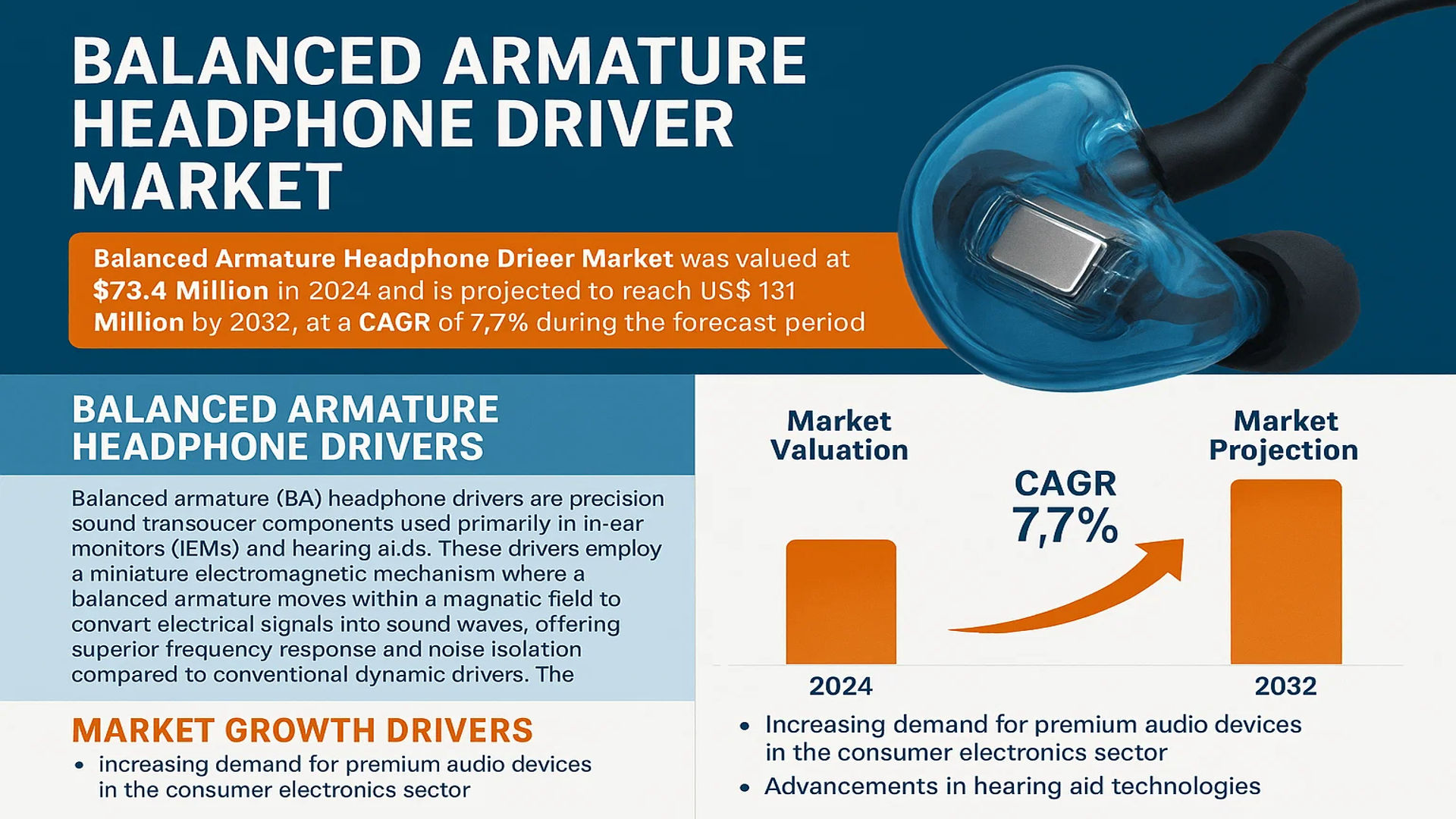
The global Balanced Armature Headphone Driver Market was valued at 73.4 million in 2024 and is projected to reach US$ 131 million by 2032, at a CAGR of 7.7% during the forecast period.
Balanced armature (BA) headphone drivers are precision sound transducer components used primarily in in-ear monitors (IEMs) and hearing aids. These drivers employ a miniature electromagnetic mechanism where a balanced armature moves within a magnetic field to convert electrical signals into sound waves, offering superior frequency response and noise isolation compared to conventional dynamic drivers. The technology enables multiple driver configurations (single, dual, or hybrid setups) to deliver high-fidelity audio across different frequency ranges.
Market growth is driven by increasing demand for premium audio devices in the consumer electronics sector and advancements in hearing aid technologies. However, the higher production costs compared to dynamic drivers presents a market challenge. Key industry players including Knowles, Sonion, and Sony Corporation are investing in driver miniaturization and multi-driver solutions to address evolving audio performance requirements across professional and consumer applications.
MARKET DYNAMICS
MARKET DRIVERS
Growing Demand for High-Fidelity Audio Devices to Fuel Market Expansion
The consumer audio industry is witnessing a surge in demand for premium sound quality, driving adoption of balanced armature (BA) drivers in headphones and in-ear monitors (IEMs). These miniature drivers deliver superior audio clarity and accuracy compared to traditional dynamic drivers, particularly in mid-to-high frequency ranges. As audiophiles and professional musicians increasingly seek precise sound reproduction, BA driver-equipped headphones have seen significant growth. The global market for premium headphones (above $200) grew by nearly 18% in 2023, with BA drivers capturing approximately 32% of this segment. This trend is expected to continue as consumers prioritize audio fidelity in both entertainment and professional applications.
Technological Advancements in Hearing Aid Applications to Accelerate Adoption
Medical applications represent another key growth area for BA driver technology. Modern hearing aids increasingly incorporate BA drivers due to their precise sound reproduction and compact size. The global hearing aid market, valued at over $7 billion in 2024, is projected to grow at 5.6% CAGR through 2030, with BA drivers accounting for approximately 40% of receiver-in-canal (RIC) hearing aid components. Recent innovations include multi-driver configurations that provide customized frequency responses for different hearing loss profiles. Furthermore, regulatory approvals for advanced hearing solutions in major markets are accelerating adoption of BA technology in medical applications.
Moreover, the aging population demographic in developed nations is creating sustained demand for hearing assistance devices. In the U.S. alone, nearly 15% of adults report some hearing difficulty, representing a significant addressable market for BA driver-equipped hearing solutions.
Military and Aviation Sector Adoption to Drive Niche Market Growth
BA drivers are finding increasing application in specialized communication equipment for military and aviation sectors. Their ability to provide clear audio in high-noise environments makes them ideal for tactical headsets and pilot communication systems. Defense budgets for advanced communication equipment have grown by approximately 12% annually in major economies, with BA driver-based solutions capturing an increasing share. Recent contracts for next-generation military headsets have incorporated multi-BA driver configurations to enhance situational awareness and speech intelligibility in challenging operational environments.
MARKET RESTRAINTS
High Production Costs and Complexity to Limit Market Penetration
While offering superior audio performance, BA drivers face significant cost barriers that limit their mass market adoption. The manufacturing process requires precision engineering and specialized materials, making BA drivers approximately 3-5 times more expensive to produce than comparable dynamic drivers. This cost differential is particularly evident in consumer headphones, where BA-equipped models typically retail for 2-3 times the price of dynamic driver alternatives. The complex assembly process, often requiring manual calibration, further increases production costs and limits manufacturing scalability.
Limited Low-Frequency Performance to Constrain Market Applications
BA drivers face inherent technical limitations in reproducing lower frequencies, often requiring hybrid configurations with dynamic drivers for full-range applications. This limitation affects their adoption in certain headphone segments where deep bass response is prioritized. Market research indicates that approximately 65% of consumer headphone purchases under $150 prioritize bass performance, creating a challenging environment for single-BA driver solutions. While multi-driver configurations can address this limitation, they significantly increase product costs and complexity, further restricting mass market accessibility.
Additionally, the need for precise acoustic chambers and specialized tuning further complicates product design, requiring additional R&D investment that many manufacturers find prohibitive for price-sensitive market segments.
MARKET OPPORTUNITIES
Expansion in Emerging Markets to Create New Growth Avenues
The growing middle class in developing economies presents significant opportunities for BA driver adoption. As disposable incomes rise in Asia-Pacific regions, demand for premium audio products is increasing at an annual rate of approximately 14%. Manufacturers are responding by developing cost-optimized BA solutions targeting these emerging markets. Recent product launches in China and India demonstrate successful strategies of offering entry-level BA-equipped IEMs at accessible price points, helping to educate consumers about the benefits of balanced armature technology while expanding the addressable market.
Customization and Personalization Trends to Drive Premium Segment Growth
The audio industry is seeing growing demand for personalized sound experiences, creating opportunities for advanced BA driver configurations. Custom in-ear monitors for musicians and audiophiles, which exclusively use BA drivers, represent a high-growth niche market expanding at approximately 20% annually. Furthermore, hearing aid customization and personalized audio profiles are becoming standard features in premium audio products, with BA drivers offering the precision required for such applications. Industry leaders are investing in modular driver designs that allow for tailored frequency responses, creating differentiation in crowded audio markets.
The integration of digital signal processing with BA driver technology opens additional opportunities for smart audio products that can adapt to various listening environments and individual hearing characteristics.
MARKET CHALLENGES
Intellectual Property Barriers to Hinder Market Entry
The BA driver market faces significant intellectual property challenges, with key patents controlled by a limited number of manufacturers. This creates barriers for new entrants seeking to develop competitive BA driver solutions. Patent litigation in the audio component sector has increased by nearly 30% over the past five years, particularly around multi-driver configurations and miniaturization technologies. Smaller manufacturers often face difficulties navigating this complex IP landscape, limiting innovation and competition in certain market segments.
Supply Chain Vulnerabilities to Impact Production Stability
BA driver manufacturing relies on specialized materials and components that are vulnerable to supply chain disruptions. The precision magnets and rare earth materials required for BA drivers face periodic shortages, with lead times increasing by 40-60% during recent global supply chain challenges. Additionally, the highly specialized nature of BA driver production means limited alternative suppliers exist, creating single-point-of-failure risks for manufacturers. These vulnerabilities have led to production delays and cost fluctuations that can significantly impact product availability and pricing in competitive audio markets.
The concentration of precision manufacturing capabilities in specific geographic regions further exacerbates these challenges, highlighting the need for diversified supply chain strategies in the BA driver sector.
BALANCED ARMATURE HEADPHONE DRIVER MARKET TRENDS
Rising Demand for High-Fidelity Audio to Drive Market Growth
The increasing consumer preference for high-fidelity audio experiences is significantly fueling the demand for balanced armature (BA) headphone drivers. These drivers are renowned for delivering superior sound clarity and precision, particularly in mid and high frequencies, making them ideal for professional audio applications and premium consumer headphones. The global market for BA headphone drivers was valued at $73.4 million in 2024 and is projected to reach $131 million by 2032, growing at a CAGR of 7.7% during the forecast period. The proliferation of high-resolution audio formats and the rising adoption of in-ear monitors (IEMs) in music production and gaming are key contributors to this trend. Additionally, advancements in miniaturization technology have enabled manufacturers to integrate multiple balanced armature drivers into compact designs, further enhancing sound quality.
Other Trends
Increasing Adoption in Medical and Hearing Aid Applications
Balanced armature drivers are gaining traction in medical electronics, particularly in hearing aids and assistive listening devices. Their compact size and ability to deliver precise sound reproduction make them ideal for applications requiring clarity and reliability. The growing prevalence of hearing impairments, coupled with increasing healthcare expenditures, is expected to accelerate market growth in this segment. By 2032, the medical electronics sector is anticipated to account for a substantial share of the BA driver market, driven by innovations in hearing aid technology and government initiatives promoting accessibility solutions.
Shift Toward Hybrid Headphone Designs
The introduction of hybrid headphone designs, combining balanced armature and dynamic drivers, is emerging as a dominant trend in the audio industry. These hybrid solutions leverage the strengths of both technologies—BA drivers for detailed highs and mids, and dynamic drivers for deep bass response. Leading manufacturers are investing in R&D to refine hybrid configurations, catering to audiophiles and professionals seeking a balanced sound profile. The dual balanced armature drivers segment is projected to witness strong growth, with an estimated CAGR of over 8% in the next six years, driven by increasing demand for premium audio products.
COMPETITIVE LANDSCAPE
Key Industry Players
Leading Manufacturers Invest in Advanced BA Driver Technology to Gain Competitive Edge
The global balanced armature headphone driver market features a mix of established audio component manufacturers and specialized BA driver producers. Knowles Corporation dominates the sector with approximately 38% market share in 2024, owing to its extensive patent portfolio and decades of experience in precision acoustic components. Their leadership stems from continuous innovation in driver miniaturization and frequency response optimization, particularly for high-end in-ear monitors and hearing aid applications.
Sonion A/S maintains strong second-place position with roughly 22% market share, benefiting from its vertical integration strategy and medical-grade manufacturing capabilities. The Danish company’s focus on hybrid driver systems combining BA and dynamic technologies has helped it secure contracts with major hearing aid manufacturers and premium IEM brands. Meanwhile, Sony Corporation has been gaining share through its proprietary balanced armature designs, capitalizing on its consumer electronics ecosystem and brand recognition in the audiophile segment.
Chinese manufacturer Bellsing represents the fastest growing competitor, having increased its market presence from 5% to nearly 12% between 2020-2024. The company’s cost-competitive multi-driver configurations appeal to mid-range headphone brands expanding into the BA segment. Smaller players are focusing on niche applications such as military communications and professional monitoring equipment, where specialized acoustic performance requirements create segmented opportunities.
Strategic developments in 2024 include Knowles’ acquisition of a MEMS microphone manufacturer to integrate hybrid transducer technologies, while Sonion partnered with three European universities for next-generation driver materials research. These moves indicate the industry’s direction toward multifunctional acoustic components with improved power efficiency and noise isolation capabilities.
List of Key Balanced Armature Headphone Driver Manufacturers
- Knowles Corporation (U.S.)
- Sonion A/S (Denmark)
- Sony Corporation (Japan)
- Bellsing (China)
- Zilltek Technology (Taiwan)
- Beyerdynamic GmbH (Germany)
- Goertek Inc. (China)
- AAC Technologies (China)
- Infinity Primus (U.S.)
Segment Analysis:
By Type
Dual Balanced Armature Drivers Lead the Market Due to Superior Audio Fidelity and Customization
The market is segmented based on type into:
- Dual Balanced Armature Drivers
- Subtypes: Single-driver configurations, multi-driver hybrid setups, and others
- Single Balanced Armature Drivers
- Others
By Application
Consumer Electronics Segment Dominates with High Demand for Premium Audio Devices
The market is segmented based on application into:
- Consumer Electronics
- Medical Electronics
- Military Electronics
- Others
By End User
Audiophiles Drive Growth Through Demand for High-Resolution Audio Solutions
The market is segmented based on end user into:
- Audiophiles
- Professional Musicians
- Healthcare Patients
- Military Personnel
- Others
Regional Analysis: Balanced Armature Headphone Driver Market
Asia-Pacific
The Asia-Pacific region dominates the global balanced armature (BA) headphone driver market, driven by rapid urbanization, increasing disposable income, and widespread adoption of audiophile-grade in-ear monitors (IEMs). China leads production and consumption, housing major BA driver manufacturers like Bellsing while serving as an electronics manufacturing hub. Japan and South Korea contribute significantly due to their advanced consumer electronics ecosystems. The growing middle-class population fuels demand for premium audio devices, with the medical electronics sector also adopting BA technology for hearing aids. Though cost sensitivity remains a factor, the shift toward high-fidelity audio solutions continues to accelerate across the region.
North America
North America is a key innovation center for balanced armature drivers, fueled by strong R&D investments and demand for advanced audio solutions in consumer and medical applications. The U.S. accounts for the largest market share, supported by leading manufacturers like Knowles and Sonion, which specialize in precision audio components. The region’s focus on hearing aid technology and high-end IEMs drives adoption, while audiophiles and professional musicians prefer BA drivers for their superior clarity. Regulatory standards for medical-grade devices further bolster market growth, ensuring consistent demand for reliable driver components.
Europe
Europe’s market thrives on audiophile culture and stringent regulations for hearing assistance devices. Countries like Germany and the U.K. are prominent consumers of high-performance BA drivers, driven by demand from premium headphone brands and medical device manufacturers. The region benefits from collaborations between audio engineering firms and component suppliers, fostering innovation in multi-driver configurations. Environmental regulations also encourage the development of energy-efficient designs, though cost constraints in some applications limit widespread adoption compared to dynamic drivers.
Middle East & Africa
The Middle East and Africa exhibit emerging demand for balanced armature drivers, primarily in the consumer electronics segment. High-value markets like the UAE and Saudi Arabia see growth due to luxury audio product adoption, while African nations experience gradual uptake through affordable IEMs. Limited local manufacturing and reliance on imports pose challenges, but increasing smartphone penetration and rising interest in premium audio present long-term opportunities. However, the market remains niche compared to other regions due to lower purchasing power and infrastructure constraints.
South America
South America’s BA driver market is developing, with Brazil and Argentina as focal points. Consumer electronics drive most demand, though economic volatility delays mass adoption. Local brands are increasingly incorporating BA technology into mid-range earphones, while imports dominate the high-end segment. The medical sector shows moderate growth potential, but regulatory complexities and budget limitations restrict faster expansion. Nonetheless, rising music production and gaming industries contribute to a gradual market upswing.
Report Scope
This market research report provides a comprehensive analysis of the Global Balanced Armature Headphone Driver Market, covering the forecast period 2024–2032. It offers detailed insights into market dynamics, technological advancements, competitive landscape, and key trends shaping the industry.
Key focus areas of the report include:
- Market Size & Forecast: Historical data and future projections for revenue, unit shipments, and market value across major regions and segments. The market was valued at USD 73.4 million in 2024 and is projected to reach USD 131 million by 2032, growing at a CAGR of 7.7%.
- Segmentation Analysis: Detailed breakdown by product type (Dual Balanced Armature Drivers, Single Balanced Armature Drivers, Others), application (Consumer Electronics, Medical Electronics, Military Electronics, Others), and end-user industry.
- Regional Outlook: Insights into market performance across North America (U.S., Canada, Mexico), Europe (Germany, France, U.K., Italy), Asia-Pacific (China, Japan, South Korea), and other regions.
- Competitive Landscape: Profiles of leading market participants including Knowles, Sonion, Sony Corporation, and Bellsing, covering their product portfolios, market share, and strategic developments.
- Technology Trends & Innovation: Assessment of emerging audio technologies, miniaturization trends, and integration with smart devices.
- Market Drivers & Restraints: Evaluation of factors driving market growth such as rising demand for premium audio devices and hearing aids, along with challenges like high production costs.
- Stakeholder Analysis: Strategic insights for manufacturers, suppliers, distributors, and investors in the Balanced Armature Headphone Driver ecosystem.
The research methodology combines primary interviews with industry experts and analysis of verified secondary data sources to ensure accuracy and reliability.
FREQUENTLY ASKED QUESTIONS:
What is the current market size of Global Balanced Armature Headphone Driver Market?
-> Balanced Armature Headphone Driver Market was valued at 73.4 million in 2024 and is projected to reach US$ 131 million by 2032, at a CAGR of 7.7% during the forecast period.
Which key companies operate in this market?
-> Key players include Knowles, Sonion, Sony Corporation, and Bellsing, collectively holding significant market share.
What are the key growth drivers?
-> Growth is driven by increasing demand for premium audio devices, growth in hearing aid adoption, and technological advancements in driver technology.
Which region dominates the market?
-> Asia-Pacific shows the fastest growth, while North America currently leads in market share.
What are the emerging trends?
-> Emerging trends include development of hybrid driver systems, miniaturization of components, and integration with IoT devices.

Get Sample Report PDF for Exclusive Insights
Report Sample Includes
- Table of Contents
- List of Tables & Figures
- Charts, Research Methodology, and more...