MARKET INSIGHTS
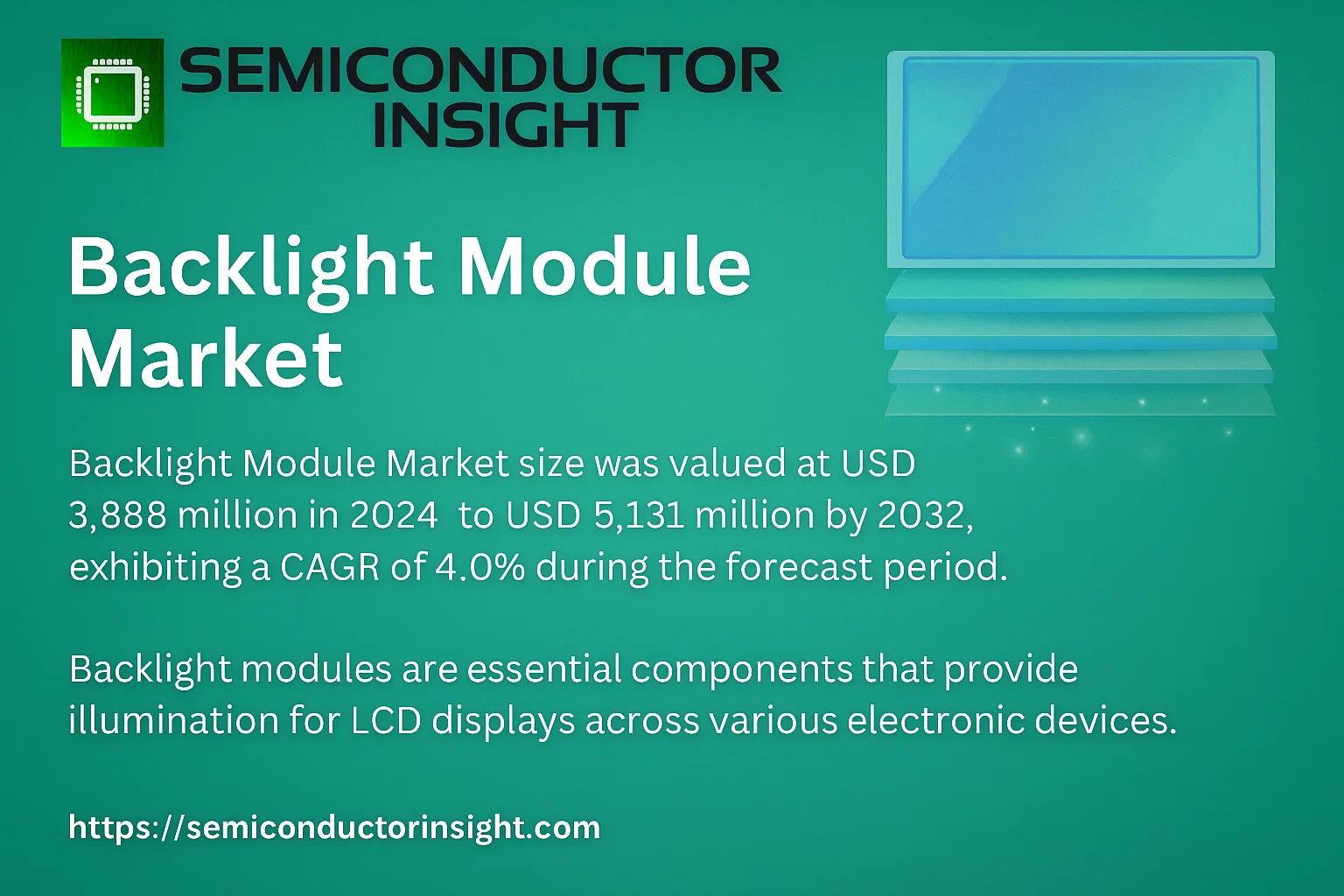
Global Backlight Module Market size was valued at USD 3,888 million in 2024 to USD 5,131 million by 2032, exhibiting a CAGR of 4.0% during the forecast period.
Backlight modules are essential components that provide illumination for LCD displays across various electronic devices. These modules consist of light sources such as LEDs, light guides, diffusers, and optical films that work together to distribute uniform lighting behind the display panel. Key product types include small and medium size modules and large size modules designed for different screen applications.
The market is experiencing steady growth due to several factors, including increasing demand for consumer electronics, technological advancements in display technologies, and rising adoption of automotive displays. Furthermore, the growing integration of LCD panels in medical equipment and industrial applications is contributing to market expansion. Initiatives by key players in the market are also expected to fuel growth. For instance, leading manufacturers like Radiant Opto-Electronics Corporation and Coretronic Corporation continue to innovate with energy-efficient LED backlight solutions for next-generation displays. Radiant Opto-Electronics Corporation, Sankyo Seiko Science & Technology Ltd., and Coretronic Corporation are some of the key players that operate in the market with extensive product portfolios.
MARKET DRIVERS
Proliferation of Large-Screen and High-Resolution Displays
The escalating consumer and enterprise demand for larger screen sizes and higher resolutions across devices such as televisions, monitors, and automotive displays is a primary driver. This trend necessitates more advanced backlight units (BLUs) with superior brightness, uniformity, and local dimming capabilities. The transition to 4K, 8K, and emerging ultra-high-definition standards directly increases the requirement for high-performance backlight modules to deliver optimal image quality.
Rising Adoption of LED Backlighting Technology
Light Emitting Diodes (LEDs) have overwhelmingly replaced Cold Cathode Fluorescent Lamps (CCFLs) as the dominant backlight source due to their superior energy efficiency, longer lifespan, slimmer form factor, and better color gamut. The continued cost reduction of LED components makes them economically viable for a broader range of applications, from premium TVs to budget smartphones, further accelerating market growth.
Additionally, the automotive industry’s shift towards digital Cockpits with multiple, larger displays is creating a significant new demand vector for robust and reliable backlight modules designed for harsh operating environments.
MARKET CHALLENGES
Intense Price Pressure and Slim Profit Margins
The Backlight Module Market is highly competitive and characterized by intense price competition, particularly for standard modules used in consumer electronics. Manufacturers face continuous pressure to reduce costs while maintaining quality, which squeezes profit margins. This is exacerbated by the purchasing power of large display panel makers who often drive hard bargains.
Other Challenges
Rapid Technological Obsolescence
The display industry evolves quickly, with new technologies like Mini-LED and Micro-LED emerging. Manufacturers must invest heavily in research and development to keep pace, but there is a constant risk that current production lines and expertise could become obsolete, leading to significant capital write-offs.
Complex Supply Chain Dynamics
The production of backlight modules relies on a complex global supply chain for components like LED chips, light guides, optical films, and drivers. Disruptions, as seen during recent global events, can lead to component shortages, production delays, and increased costs, posing a major operational challenge.
MARKET RESTRAINTS
Maturation and Slowdown in Key End-Use Segments
The smartphone and traditional LCD television markets, which are major consumers of backlight modules, are reaching saturation points in many developed regions. Growth in these segments has slowed to single-digit percentages, limiting the volume-driven expansion of the standard Backlight Module Market. This maturity forces suppliers to compete more aggressively on price rather than volume.
Competition from Emissive Display Technologies
The growing adoption of self-emissive display technologies, particularly OLED (Organic Light Emitting Diode), acts as a significant restraint. OLED displays do not require a separate backlight unit, as each pixel generates its own light. As OLED production costs decrease and its adoption expands into mid-range smartphones and televisions, it directly replaces the need for traditional LCD panels with backlight modules.
MARKET OPPORTUNITIES
Expansion into Niche and High-Growth Applications
Significant growth opportunities exist beyond traditional consumer electronics. The demand for backlight modules is rising in areas such as automotive displays (digital instrument clusters, center stack screens, head-up displays), medical monitors requiring high reliability, and industrial human-machine interfaces (HMIs). These applications often command higher margins due to their specialized performance requirements.
Innovation in Advanced Backlighting Solutions
The development and commercialization of advanced backlighting technologies like Mini-LED present a substantial opportunity. Mini-LED backlights, with their thousands of tiny LEDs, enable superior contrast ratios and HDR performance comparable to OLED, but often at a lower cost and without burn-in risks. This makes them an attractive solution for the high-end LCD market, creating a new, value-added segment for backlight module suppliers.
Backlight Module Market Trends
Sustained Growth Driven by Consumer Electronics Demand
Global Backlight Module market is demonstrating steady growth, with its valuation projected to rise from USD 3888 million in 2024 to USD 5131 million by 2032, representing a Compound Annual Growth Rate (CAGR) of 4.0%. This positive trajectory is primarily fueled by the consistent and robust demand from the consumer electronics sector, which currently accounts for approximately 64% of the total market application. The proliferation of smartphones, tablets, laptops, and televisions continues to be the most significant driver, requiring high-performance backlight modules for enhanced display quality and user experience.
Other Trends
Market Consolidation and Competitive Landscape
The market structure is characterized by a significant level of consolidation, where the top three players—Radiant Opto-Electronics Corporation, Sankyo Seiko Science & Technology Ltd., and Coretronic Corporation—collectively hold a dominant market share of over 38%. This concentration indicates a mature market where established players benefit from economies of scale, strong supply chains, and extensive research and development capabilities. The presence of other key companies, such as MinebeaMitsumi Inc. and Forward Electronics, ensures competitive dynamics focused on technological innovation and cost efficiency.
Product Type Segmentation
In terms of product segmentation, Small and Medium Size backlight modules are the largest category, commanding a substantial share of about 54% of the market. This segment’s dominance is directly linked to its critical application in the vast consumer electronics industry, particularly for devices like smartphones and tablets. Meanwhile, Large Size modules cater to applications in televisions and commercial displays, representing another significant segment within the market.
Regional Market Dynamics and Future Outlook
Geographically, Asia stands as the largest and most dynamic market for backlight modules, driven by major manufacturing hubs in China, Japan, and South Korea. The region benefits from a concentrated electronics manufacturing ecosystem and strong local demand. Looking forward, market trends are expected to be influenced by advancements in display technologies, such as mini-LED and micro-LED backlighting, which offer superior contrast and energy efficiency. However, the industry also faces challenges, including price pressures, supply chain volatility for raw materials, and the need for continuous innovation to meet evolving consumer expectations for thinner, brighter, and more energy-efficient displays.
COMPETITIVE LANDSCAPE
Key Industry Players
A Market Characterized by Strong Asian Manufacturing and Technological Specialization
Global Backlight Module Market is consolidated, with the top three players—Radiant Opto-Electronics Corporation, Sankyo Seiko Science & Technology Ltd., and Coretronic Corporation—collectively commanding over 38% of the market share. This concentration of power underscores the high entry barriers in this capital-intensive industry, driven by the need for advanced manufacturing capabilities, extensive R&D investment, and established supply chain relationships. These leaders have solidified their positions by catering primarily to the large consumer electronics segment, which accounts for approximately 64% of the market’s application. Their strategies are focused on innovation in efficiency and thinness, particularly for small and medium-sized modules that dominate the product landscape with a 54% share. The competitive dynamics are heavily influenced by price pressures from large display panel manufacturers and the continuous need to adapt to evolving display technologies.
Beyond the dominant trio, the market features a robust ecosystem of specialized and niche players, primarily based in Asia, particularly China and Taiwan. Companies such as MinebeaMitsumi Inc. bring significant scale and diversification from related component manufacturing, while numerous Chinese firms like Shenzhen Baoming Technology and Jiangxi Lianchuang Optoelectronic specialize in serving domestic and growing regional markets. These companies compete on factors like cost-efficiency, flexibility for smaller volume orders, and specialization in applications beyond consumer electronics, such as automotive, medical, and industrial displays. The competitive intensity is further shaped by regional expansion strategies and the pursuit of technological advancements in areas like mini-LED backlighting to secure a competitive edge in the evolving display supply chain.
List of Key Backlight Module Companies Profiled
- Radiant Opto-Electronics Corporation
- Sankyo Seiko Science & Technology Ltd.
- Coretronic Corporation
- Shenzhen Zhaoji Optoelectronics Co., Ltd.
- Highbroad Advanced Material (Hefei) Co., Ltd.
- WAICHI
- Shenzhen Baoming Technology Co.,Ltd.
- Shenzhen Longli Technology Co.,Ltd.
- Jiangxi Lianchuang Optoelectronic Science and Technology Co., Ltd.
- Ways Electron Co., Ltd.
- MinebeaMitsumi Inc.
- Xiamen Honghan Optoelectronic Technology Co., Ltd.
- Jingjiang Yong Sheng Optoelectronics Technology Co., Ltd.
- Shenzhen City Yamamoto photoelectric Co., Ltd.
- Antarctic Shenzhen Optoelectronic Technology Co., Ltd.
Segment Analysis:
| Segment Category | Sub-Segments | Key Insights |
| By Type |
|
Small and Medium Size modules represent the leading category, driven by immense and continuous demand from the consumer electronics sector for devices like smartphones, tablets, and notebooks. The innovation within this sub-segment is particularly focused on achieving higher brightness, lower power consumption, and thinner form factors to meet the specifications of modern portable gadgets. The manufacturing processes for these modules are highly optimized for mass production, contributing to their dominant market position. |
| By Application |
|
Consumer Electronics is the unequivocal leader in application segments, fueled by the global proliferation of display-centric devices such as televisions, monitors, laptops, and smartphones. The relentless pace of product refreshes and the consumer demand for enhanced visual experiences with features like HDR and high refresh rates create a consistent and substantial demand. This segment also benefits from the highest levels of technological innovation and economies of scale in production, making it the central focus for most leading manufacturers in the backlight module industry. |
| By End User |
|
Original Equipment Manufacturers (OEMs) constitute the leading end-user segment, as they are the primary customers integrating backlight modules directly into new products during the manufacturing process. These large-scale manufacturers, including major consumer electronics brands and automotive companies, demand high-volume, high-reliability modules, often through long-term supply contracts. This segment’s dominance is reinforced by the constant flow of new product launches and the critical need for consistent quality and supply chain integration that OEM partnerships provide. |
| By Technology |
|
LED Backlight technology is the dominant and leading segment, having almost entirely superseded older CCFL technology in most applications due to its superior energy efficiency, longer lifespan, smaller form factor, and superior color performance. The versatility of LED technology allows for advanced implementations like local dimming in high-end televisions, contributing to enhanced picture quality. Continuous advancements in mini-LED and micro-LED technologies represent the next frontier, promising even greater contrast and efficiency for future display products. |
| By Light Source Arrangement |
|
Edge-lit arrangement is the leading segment for a vast majority of consumer devices, particularly televisions and monitors, due to its ability to enable extremely thin and lightweight display profiles. This design places LEDs along the edges of the panel, which is highly cost-effective for mass production. However, the premium Full-Array Local Dimming segment is gaining significant traction in high-end markets because it offers superior picture quality with precise control over specific screen areas, resulting in much higher contrast ratios and deeper blacks, which is a key differentiator for premium home entertainment systems. |
Regional Analysis: Backlight Module Market
The region hosts the world’s most integrated supply chain for display components, from raw materials to finished modules. This vertical integration allows for tight control over quality, cost, and production timelines, making it the preferred sourcing destination for global brands. Local availability of materials minimizes logistics dependencies and enhances competitive pricing.
Massive manufacturing capacities for LCD and emerging display panels directly translate into high demand for backlight units. The sheer volume of production for consumer electronics enables economies of scale that are unmatched elsewhere, allowing manufacturers to invest in advanced, automated production lines for higher efficiency and consistency.
Leading display companies in South Korea, Japan, and China are at the forefront of developing advanced backlight technologies, such as Mini-LED and micro-LED. Strong government support and significant private investment in R&D centers foster a culture of continuous innovation, pushing the boundaries of brightness, contrast, and energy efficiency.
A vast and growing middle class with high disposable income drives robust domestic demand for devices utilizing backlight modules. This strong local consumption provides a stable market base for manufacturers, reducing reliance on exports and insulating them from global demand fluctuations to a certain extent.
North America
North America represents a significant market characterized by high demand for premium and large-sized displays. The region is a major hub for innovation, with strong demand from the automotive sector for advanced instrument clusters and center stack displays, and from the high-end consumer electronics market. The presence of leading technology companies and a well-developed retail sector drives the adoption of the latest display technologies. There is a notable focus on high-performance backlight modules that offer superior brightness, slim profiles, and enhanced reliability for professional and gaming monitors, as well as high-end televisions. The market is also influenced by stringent energy efficiency regulations, pushing manufacturers toward more advanced and eco-friendly backlighting solutions.
Europe
Europe’s Backlight Module Market is driven by strong demand from the automotive industry, high-end consumer electronics, and a growing medical display segment. German and French automotive manufacturers are key consumers, integrating sophisticated backlit displays into dashboards and infotainment systems. The region shows a pronounced preference for quality, durability, and energy efficiency, aligning with its strict environmental standards. There is healthy demand for modules used in industrial HMI (Human-Machine Interface) applications and professional monitors. While manufacturing is limited compared to Asia, Europe remains a critical market for high-value, specialized backlight modules, with a focus on design innovation and compliance with regional regulations like RoHS and REACH.
South America
The South American market for backlight modules is emerging, largely driven by the increasing penetration of consumer electronics like televisions and smartphones. Brazil is the largest market in the region, with local assembly operations for televisions creating steady demand. The market growth is supported by improving economic conditions and rising disposable incomes. However, the region faces challenges related to import dependencies for core components and fluctuations in currency values. Demand is primarily for cost-effective modules for mid-range consumer products, with slower adoption of premium technologies compared to more developed markets. The automotive sector also presents a gradual growth opportunity as vehicle production incorporates more digital displays.
Middle East & Africa
The Middle East and Africa region exhibits growing potential, albeit from a smaller base. The market is fueled by urbanization, infrastructure development, and increasing consumer spending on electronics. The Gulf Cooperation Council (GCC) countries, in particular, show demand for high-end displays in retail, hospitality, and commercial applications. Africa’s market is more fragmented, with growth driven by mobile phone adoption and the gradual expansion of television ownership. The region generally imports the majority of its backlight modules, with demand focused on durable and cost-competitive solutions suited to local climate conditions and price sensitivities. Long-term growth is tied to economic diversification and digitalization efforts across the region.
Report Scope
This market research report provides a comprehensive analysis of the Backlight Module Market , covering the forecast period 2025–2032. It offers detailed insights into market dynamics, technological advancements, competitive landscape, and key trends shaping the industry.
Key focus areas of the report include:
- Market Overview: The report begins with an overview outlining its current market scenario, key growth indicators, and industry transformation drivers. It discusses macroeconomic factors, demand–supply balance, regulatory landscape, and the strategic role of semiconductors in powering advancements across industries such as automotive, telecommunications, consumer electronics, and industrial automation.
- Market Size & Forecast: Historical data and future projections for revenue, unit shipments, and market value across major regions and segments.
- Segmentation Analysis: Detailed breakdown by product type, technology, application, and end-user industry to identify high-growth segments and investment opportunities.
- Regional Insights: Insights into market performance across North America, Europe, Asia-Pacific, Latin America, and the Middle East & Africa, including country-level analysis where relevant.
- Competitive Landscape: Profiles of leading market participants, including their product offerings, R&D focus, manufacturing capacity, pricing strategies, and recent developments such as mergers, acquisitions, and partnerships.
- Technology Trends & Innovation: Assessment of emerging technologies, integration of AI/IoT, semiconductor design trends, fabrication techniques, and evolving industry standards.
- Market Drivers & Restraints: Evaluation of factors driving market growth along with challenges, supply chain constraints, regulatory issues, and market-entry barriers.
- Stakeholder Insights: Insights for component suppliers, OEMs, system integrators, investors, and policymakers regarding the evolving ecosystem and strategic opportunities.
Primary and secondary research methods are employed, including interviews with industry experts, data from verified sources, and real-time market intelligence to ensure the accuracy and reliability of the insights presented.
FREQUENTLY ASKED QUESTIONS:
What is the current market size of Backlight Module Market?
-> Backlight Module Market size was valued at USD 3,888 million in 2024 to USD 5,131 million by 2032, exhibiting a CAGR of 4.0% during the forecast period.
Which key companies operate in Backlight Module Market?
-> Key players include Radiant Opto-Electronics Corporation, Sankyo Seiko Science & Technology Ltd., Coretronic Corporation, and others. The top three players hold a market share of over 38%.
What are the key growth drivers?
-> Key growth is driven by the expansion of the consumer electronics industry, increasing demand for advanced display technologies, and the proliferation of applications in sectors such as automotive, medical, and industrial equipment.
Which region dominates the market?
-> Asia is a dominant market, with significant contributions from countries including China, Japan, and South Korea.
What are the emerging trends?
-> Emerging trends include the increasing adoption of Small and Medium Size modules, which held the largest market share of about 54% in 2024, and innovation in backlighting solutions for high-resolution and energy-efficient displays.

Get Sample Report PDF for Exclusive Insights
Report Sample Includes
- Table of Contents
- List of Tables & Figures
- Charts, Research Methodology, and more...
 Download Sample Report PDF