
Autonomous Driving AI Chip Market Insights
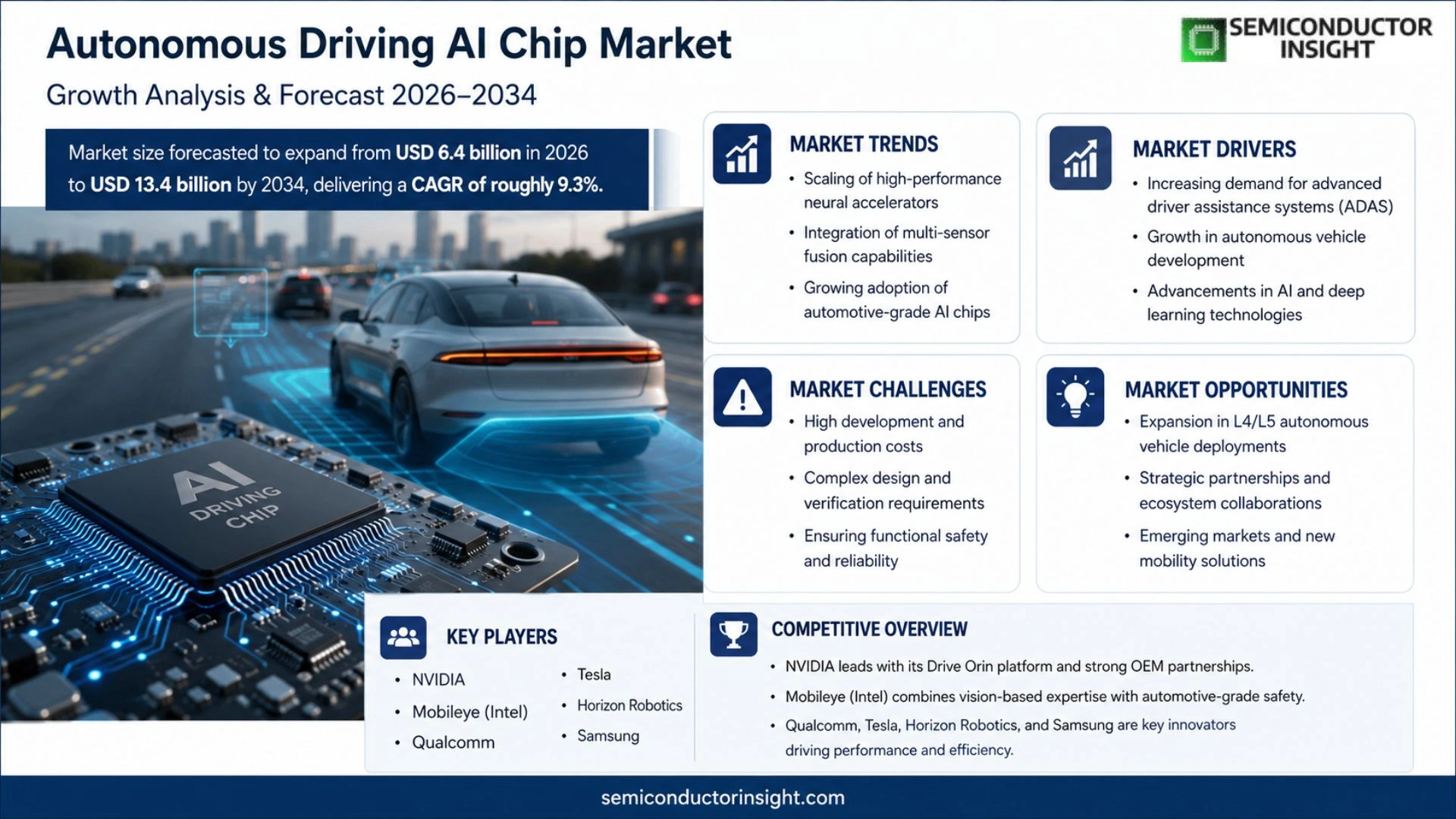
Global Autonomous driving AI chip market size was valued at USD 5.9 billion in 2025. The market is forecasted to expand from USD 6.4 billion in 2026 to USD 13.4 billion by 2034, delivering a CAGR of roughly 9.3% throughout the horizon.
Autonomous driving AI chips are specialized processors designed to execute perception, planning and control algorithms for self‑driving vehicles. These silicon solutions integrate high‑performance neural‑network accelerators, sensor‑fusion engines and safety‑critical cores that enable real‑time decision making under stringent power budgets.
The sector is gaining momentum because automotive manufacturers are committing billions toward Level‑3/4 systems, while regulators tighten safety standards that require certified compute platforms. Moreover, recent collaborations,such as NVIDIA’s partnership with major OEMs announced in March 2024,underscore the competitive push for more efficient architectures. Companies including Mobileye (Intel), Qualcomm, Tesla’s custom Dojo silicon and Horizon Robotics remain prominent players shaping the supply chain.
MARKET DRIVERS
Advancements in Sensor Fusion Algorithms
Automakers are integrating higher‑resolution lidar and radar streams into a single processing pipeline, which forces chip designers to create units that can handle terabytes of data per hour. The resulting efficiency gains allow vehicles to make split‑second decisions, lowering the barrier for mass‑market deployment of autonomous features.
Demand for Real‑Time Edge Computing
Edge‑centric architectures reduce reliance on cloud connectivity, a prerequisite for safety‑critical functions. Manufacturers are therefore sourcing AI chips that deliver 30‑40 TOPS while staying under 5 watts, aligning power budgets with vehicle electrical systems.
➤ “The convergence of high‑definition mapping and on‑board inference is compressing development cycles from years to months.”
These technical pressures translate into a steady rise in capital spending on next‑generation silicon, with industry insiders estimating a 14% annual increase in design budgets through 2027.
MARKET CHALLENGES
Regulatory Uncertainty Across Jurisdictions
Legislators worldwide are still defining safety thresholds for autonomous systems, and the lack of a unified standard forces chip makers to support multiple compliance frameworks. This multiplies validation costs and deters smaller players from entering the space.
Other Challenges
Supply‑Chain Vulnerabilities
The reliance on advanced packaging facilities located in a handful of regions creates exposure to geopolitical shifts. Recent disruptions have led to lead times that exceed six months for 7 nm nodes, pressuring OEMs to keep larger inventory buffers.
MARKET RESTRAINTS
High Development Costs for Custom Architectures
Designing a bespoke AI processor involves multi‑year R&D cycles and expenditures that can surpass $500 million for a single chipset generation. Such outlays limit the pool of viable investors to well‑capitalized OEMs and Tier‑1 suppliers.
Furthermore, the necessity to certify each silicon iteration against evolving safety standards extends the time‑to‑market, reducing the attractiveness of rapid product launches.
These financial pressures consequently slow the rate at which new features reach consumers, keeping overall market penetration below projected levels.
MARKET OPPORTUNITIES
Growth in Retro‑Fit Solutions for Legacy Fleets
Fleet operators are exploring aftermarket AI chips to upgrade existing vehicles with autonomous capabilities. This segment offers a low‑entry point, allowing chip vendors to monetize older platforms without waiting for new model cycles.
In parallel, partnerships between semiconductor firms and software startups are spawning modular stacks that can be licensed across multiple vehicle brands. Such ecosystems lower integration risk and accelerate adoption across diverse market segments.
Finally, emerging markets in Southeast Asia and Latin America present untapped demand for cost‑effective autonomous driving solutions, driven by urban congestion and a growing appetite for mobility‑as‑a‑service models.
Autonomous Driving AI Chip Market Trends
Scaling of High‑Performance Neural Accelerators
The core of the Autonomous Driving AI Chip Market is shifting toward silicon that can execute dense neural‑network models without compromising power envelopes. Designers are embedding dedicated tensor cores and sensor‑fusion pipelines directly into the die, which trims latency to the sub‑10 ms range required for split‑second maneuvering. This architectural compression delivers a measurable uplift in perception accuracy, allowing Level‑3 and Level‑4 systems to operate reliably under diverse lighting and weather conditions. The practical outcome for vehicle manufacturers is a reduction in the bill of materials, because a single chip now satisfies both compute‑heavy perception workloads and safety‑critical control loops.
Other Trends
Regulatory Influence on Compute Certification
Safety authorities across Europe and North America have tightened functional‑safety mandates, insisting that the compute platform itself be validated to ISO 26262 and emerging automotive‑grade AI standards. As a result, chip vendors are embedding hardware‑rooted security modules and deterministic timing guarantees, features that were previously optional add‑ons. OEMs that adopt these certified silicon blocks can accelerate homologation timelines, turning a regulatory hurdle into a competitive advantage.
OEM Collaboration and Platform Standardization
Recent OEM‑chipmaker alliances illustrate a move toward shared reference architectures. The partnership announced in early 2024 between a leading graphics processor supplier and several global manufacturers exemplifies how pooling development resources shortens the path from prototype to production. By converging on a common software stack, automakers gain interoperability across model lines, while silicon firms benefit from economies of scale that lower per‑unit costs. The implication for the market is a gradual consolidation around a handful of scalable platforms, which will shape supplier negotiations and influence price dynamics for the next decade.
COMPETITIVE LANDSCAPE
Key Industry Players
Autonomous Driving AI Chip Market: Competitive Overview
The segment is dominated by a handful of firms that have translated deep learning expertise into automotive‑grade silicon. NVIDIA, with its Drive Orin architecture, has entrenched itself as a hardware backbone for OEMs seeking a unified platform for perception and planning. Mobileye, operating under Intel’s umbrella, leverages its extensive vision‑based datasets to deliver processors that blend safety certifications with high‑throughput inference. Qualcomm’s Snapdragon Ride family distinguishes itself by exposing a scalable IP stack that accommodates a range from driver assistance to full autonomy, enabling tier‑one suppliers to integrate compute without redesigning vehicle ECUs. Tesla’s in‑house Dojo chip, though primarily used for internal training, signals a shift toward vertically integrated compute pipelines that could alter the supply‑chain balance. Horizon Robotics, backed by Chinese manufacturers, competes on power‑efficiency for cost‑sensitized markets, while Samsung’s Exynos Auto chip brings foundry scale and memory integration to bear on the same problem set. Collectively, these leaders shape pricing benchmarks, set safety‑validation expectations, and dictate the pace of architectural convergence across the globe.
Beyond the marquee names, several specialized vendors occupy niches that influence the broader ecosystem. AMD has entered the arena with its CDNA‑based accelerators, targeting high‑performance simulation workloads that feed into algorithm refinement. Renesas supplies domain‑specific microcontrollers that handle sensor‑fusion front‑ends, acting as trusted partners for Tier‑2 integrators. Huawei’s Ascend series, despite geopolitical headwinds, continues to offer a compelling mix of edge AI and 5G connectivity, positioning it for markets where network‑assisted driving is a strategic priority. Baidu’s Apollo platform couples proprietary chips with a cloud‑centric stack, fostering an open‑source‑friendly model that attracts startups and regional manufacturers. These participants, though smaller in revenue, inject diversity into the supply chain, compel incumbents to innovate, and provide OEMs with alternatives that mitigate concentration risk.
List of Key Autonomous Driving AI Chip Companies Profiled
- NVIDIA
- Mobileye (Intel)
- Qualcomm
- Tesla
- Horizon Robotics
- Samsung
- AMD
- Renesas
- Huawei
- Baidu
- Intel (Core AI)
- TSMC (foundry services)
- Veoneer
Segment Analysis:
| Segment Category | Sub-Segments | Key Insights |
| By Type |
|
ASIC‑based chips dominate the conversation because they deliver the highest efficiency for perception and decision workloads.
|
| By Application |
|
Perception processing is the leading application because it underpins every autonomous function.
|
| By End User |
|
Vehicle manufacturers lead the segment as they define system specifications and safety standards.
|
| By Integration Level |
|
Embedded SoC solutions are emerging as the preferred choice for compact vehicle designs.
|
| By Functional Tier |
|
Core autonomous driving domain captures the most attention as it directly enables Level‑3/4 capabilities.
|
Regional Analysis: Autonomous Driving AI Chip Market
Venture funds and corporate investors alike target AI chip ventures that promise sub‑millisecond decision cycles, a prerequisite for real‑time vehicular control. The influx of capital accelerates prototype development, shortening the time from lab to road test and raising the competitive bar for newcomers.
Federal guidelines increasingly mandate functional safety assessments for autonomous driving processors, nudging manufacturers toward silicon that can be independently verified. This regulatory pressure incentivizes the adoption of standardized safety cores, shaping the product roadmaps of chip suppliers.
The region’s proximity to advanced fabs reduces lead times for automotive‑grade wafers, allowing OEMs to align production schedules with software updates. This logistical advantage mitigates the disruption risk that plagues more distant markets.
Established car makers are forging joint development agreements with chip designers, embedding AI processors early in vehicle platforms. Such collaborations embed market insights directly into silicon architecture, ensuring compatibility with next‑generation sensor suites.
Europe
Europe’s Autonomous Driving AI Chip Market is characterized by a strong emphasis on safety certification and cross‑border research consortia. German and French automotive groups are leveraging public‑private partnerships to test high‑definition perception modules, demanding chips that balance power consumption with robust error handling. Meanwhile, the EU’s push for a unified automotive software framework forces chip vendors to conform to standardized APIs, simplifying integration across multiple vehicle lines. The region’s fragmented supplier landscape spurs niche players to specialize in domain‑specific accelerators, particularly for lidar and radar data streams, creating a diversified ecosystem that challenges the dominance of larger silicon houses.
Asia‑Pacific
In Asia‑Pacific, rapid adoption of electric mobility and aggressive driver‑assist deployments generate a fertile environment for AI chip providers. Chinese manufacturers are integrating domestic processors into mass‑market models to reduce reliance on imported silicon, while Japanese firms focus on precision computing for high‑resolution mapping. The regulatory environment, though varied, increasingly favors real‑world testing corridors, encouraging manufacturers to field‑test chips under diverse traffic conditions. This geographic breadth drives a competitive race to achieve cost‑effective designs that can be scaled across densely populated markets.
South America
South America’s entry into the Autonomous Driving AI Chip Market remains modest, yet strategic partnerships with North American firms are accelerating knowledge transfer. Countries such as Brazil are experimenting with pilot programs in limited urban zones, where chip suppliers must adapt to lower‑speed scenarios and less stringent infrastructure. The region’s focus on affordability prompts vendors to explore heterogeneous integration techniques that combine high‑performance cores with low‑cost peripheral processors, aiming to deliver a viable price‑performance balance for emerging fleets.
Middle East & Africa
The Middle East & Africa present a mixed picture; affluent Gulf states are investing heavily in smart‑city pilots that incorporate autonomous shuttle services, driving demand for AI chips capable of handling variable climate conditions. Conversely, many African markets prioritize ruggedization, requiring processors that can endure extreme temperature swings and limited maintenance cycles. Partnerships with global chip manufacturers are emerging to tailor solutions for these distinct operational realities, positioning the region as an incremental but strategically important segment of the broader market.
Report Scope
This market research report provides a comprehensive analysis of the Autonomous Driving AI Chip Market , covering the forecast period 2026–2034. It offers detailed insights into market dynamics, technological advancements, competitive landscape, and key trends shaping the industry.
Key focus areas of the report include:
- Market Overview: The report begins with an overview outlining its current market scenario, key growth indicators, and industry transformation drivers. It discusses macroeconomic factors, demand–supply balance, regulatory landscape, and the strategic role of semiconductors in powering advancements across industries such as automotive, telecommunications, consumer electronics, and industrial automation.
- Market Size & Forecast: Historical data and future projections for revenue, unit shipments, and market value across major regions and segments.
- Segmentation Analysis: Detailed breakdown by product type, technology, application, and end-user industry to identify high-growth segments and investment opportunities.
- Regional Insights: Insights into market performance across North America, Europe, Asia-Pacific, Latin America, and the Middle East & Africa, including country-level analysis where relevant.
- Competitive Landscape: Profiles of leading market participants, including their product offerings, R&D focus, manufacturing capacity, pricing strategies, and recent developments such as mergers, acquisitions, and partnerships.
- Technology Trends & Innovation: Assessment of emerging technologies, integration of AI/IoT, semiconductor design trends, fabrication techniques, and evolving industry standards.
- Market Drivers & Restraints: Evaluation of factors driving market growth along with challenges, supply chain constraints, regulatory issues, and market-entry barriers.
- Stakeholder Insights: Insights for component suppliers, OEMs, system integrators, investors, and policymakers regarding the evolving ecosystem and strategic opportunities.
Primary and secondary research methods are employed, including interviews with industry experts, data from verified sources, and real-time market intelligence to ensure the accuracy and reliability of the insights presented.
FREQUENTLY ASKED QUESTIONS:
What is the current market size of Autonomous Driving AI Chip Market?
-> Global Autonomous Driving AI Chip Market was valued at USD 5.9 billion in 2025 and is expected to reach USD 13.4 billion by 2034, delivering a CAGR of approximately 9.3% over the forecast horizon.
Which key companies operate in Autonomous Driving AI Chip Market?
-> Key players include Mobileye (Intel), Qualcomm, NVIDIA, Tesla (Dojo silicon), and Horizon Robotics, among others.
What are the key growth drivers?
-> Key growth drivers include automotive manufacturers’ multi‑billion‑dollar investments in Level‑3/4 autonomous systems, tightening safety‑related regulations requiring certified compute platforms, and strategic collaborations such as NVIDIA’s partnership with major OEMs.
Which region dominates the market?
-> North America currently holds the largest market share due to the concentration of leading chip designers and OEMs, while Asia‑Pacific is emerging as the fastest‑growing region.
What are the emerging trends?
-> Emerging trends include integration of high‑performance neural‑network accelerators, advanced sensor‑fusion engines, safety‑critical core architectures, and increased partnership models between silicon providers and automotive OEMs.

Get Sample Report PDF for Exclusive Insights
Report Sample Includes
- Table of Contents
- List of Tables & Figures
- Charts, Research Methodology, and more...
 Download Sample Report PDF


