
MARKET INSIGHTS
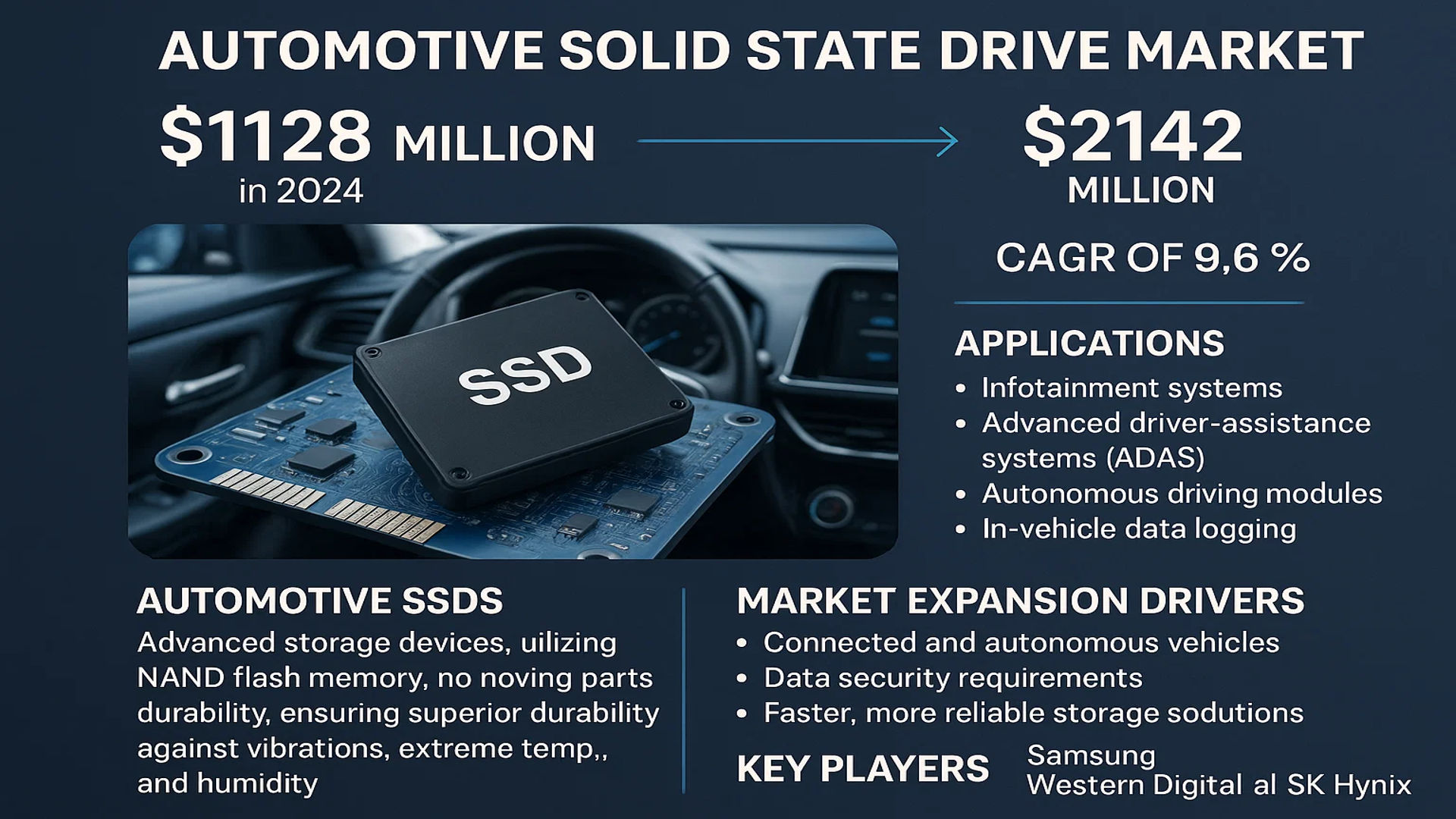
The global Automotive Solid State Drive Market was valued at 1128 million in 2024 and is projected to reach US$ 2142 million by 2032, at a CAGR of 9.6% during the forecast period.
Automotive SSDs are advanced storage devices specifically engineered for vehicle applications, leveraging NAND flash memory technology to deliver high-speed data processing and reliable performance in challenging automotive environments. Unlike conventional hard disk drives (HDDs), these SSDs feature no moving parts, ensuring superior durability against vibrations, extreme temperatures, and humidity—critical for automotive electronic systems. Their applications span across infotainment systems, advanced driver-assistance systems (ADAS), autonomous driving modules, and in-vehicle data logging, meeting stringent automotive-grade certifications.
The market expansion is driven by the increasing adoption of connected and autonomous vehicles, stringent data security requirements, and the growing demand for faster, more reliable storage solutions in modern automobiles. Key players such as Samsung, Western Digital, and SK Hynix dominate the market, collectively holding a significant revenue share in 2024. Technological advancements, including the transition to 3D TLC NAND flash, are further accelerating market growth, with this segment projected to witness the highest CAGR over the next six years.
MARKET DYNAMICS
MARKET DRIVERS
Accelerated Vehicle Digitalization and Connected Technologies Fueling SSD Demand
The automotive industry’s rapid shift toward digital cockpits, advanced infotainment systems, and vehicle-to-everything (V2X) communication is creating unprecedented demand for high-performance storage solutions. Modern vehicles now process over 25 gigabytes of data per hour in autonomous driving applications, requiring SSDs that offer superior read/write speeds compared to traditional HDDs. Major automakers are increasingly adopting SSDs with capacities ranging from 128GB to 1TB to handle complex operating systems, over-the-air (OTA) updates, and real-time sensor data processing. The growing integration of AI-powered features in vehicles, which demand low-latency data access, further cements SSDs as the storage medium of choice.
Stringent Automotive Safety Standards Driving Adoption of Robust Storage Solutions
Automotive SSDs are gaining traction due to their ability to meet rigorous AEC-Q100 and ISO 26262 certification requirements for vehicle components. Unlike consumer-grade SSDs, automotive variants demonstrate exceptional reliability in extreme temperatures (-40°C to 105°C) and withstand vibrations up to 20G. This durability is critical for safety-critical applications like autonomous driving systems, where data integrity cannot be compromised. The market has seen a 42% increase in demand for automotive-grade SSDs certified for ASIL-D (Automotive Safety Integrity Level D) applications since 2022, reflecting the industry’s emphasis on fail-safe operation.
Increasing Deployment of ADAS and Autonomous Vehicles Creating New Storage Paradigms
Level 3+ autonomous vehicles generate between 4TB to 20TB of data daily from LiDAR, radar, and camera systems. This data deluge requires SSDs with specialized features like power-fail protection and extended write endurance. The automotive SSD market is responding with solutions offering 3K-30K program/erase cycles and sustained write speeds exceeding 500MB/s. Tier 1 suppliers now prioritize SSDs with advanced wear-leveling algorithms and error-correction capabilities to ensure continuous operation throughout a vehicle’s 10-15 year lifespan. Recent advancements in 3D NAND technology enable these high-reliability SSDs while maintaining cost-effectiveness for mass production.
MARKET CHALLENGES
Extended Automotive Certification Cycles Create Adoption Barriers
The automotive industry’s stringent qualification processes present significant hurdles for SSD suppliers. Achieving full ASIL certification can take 18-24 months, with testing protocols that far exceed consumer electronics standards. Manufacturers must maintain separate production lines for automotive-grade components, increasing operational complexity. The recertification requirements for any flash memory die changes add further development costs, discouraging some NAND suppliers from entering the automotive space. These factors contribute to automotive SSDs carrying a 60-80% price premium over equivalent consumer models.
Technical Challenges in Harsh Operating Environments
Automotive SSDs face unique reliability concerns including data retention at extreme temperatures and charge leakage in advanced NAND nodes. The shift to 96-layer and 144-layer 3D NAND introduces new failure modes under automotive stress conditions. Thermal throttling becomes critical when operating near maximum temperature ratings, requiring sophisticated controller designs not needed in consumer applications.
Supply Chain Complexity
The automotive industry’s just-in-time manufacturing model conflicts with NAND flash’s cyclical supply patterns. Long-term supply agreements are challenging when NAND prices fluctuate 30-50% annually. Automakers’ insistence on 10-15 year product lifecycles creates inventory management challenges for components designed around shorter consumer electronics refresh cycles.
MARKET RESTRAINTS
Economic Pressures Delay Premium Vehicle Technology Adoption
Global economic uncertainties are causing automakers to scale back optional equipment packages containing SSD-based systems. Entry-level vehicles still predominantly use eMMC storage, with SSD adoption primarily limited to premium segments above $40,000 MSRP. The average bill of materials for automotive SSDs remains 3-5 times higher than traditional storage solutions, creating pricing pressure as manufacturers target cost-sensitive emerging markets. Chip shortages have further exacerbated this divide, with automoders prioritizing semiconductor allocation for critical ECUs over storage upgrades.
Competition from Alternative Memory Technologies
Emerging storage-class memory technologies like MRAM and ReRAM threaten to displace NAND-based SSDs in certain automotive applications. These alternatives offer superior endurance (10^12 cycles vs. 10^5 for NAND) and nanosecond-level access times, making them ideal for black box and safety-critical data logging. While currently more expensive, their superior performance in write-intensive applications could constrain SSD market growth in specific automotive use cases by 2026-2028.
MARKET OPPORTUNITIES
In-Vehicle AI Applications Create New Storage Requirements
The proliferation of edge AI in vehicles presents significant opportunities for specialized SSDs optimized for machine learning workloads. Next-generation vehicles require storage capable of handling massive neural network models with low-latency access. SSD manufacturers are developing products with enhanced random read performance (150K+ IOPS) and direct memory access capabilities to accelerate AI inference. The market for AI-optimized automotive SSDs is projected to grow at 28% CAGR as automakers implement more sophisticated driver monitoring and natural language processing systems.
Standardization of Vehicle Data Recorders Opens New Market Segments
Regulatory trends mandating standardized data recording for autonomous vehicles (similar to aircraft black boxes) will require ruggedized SSDs with guaranteed data retention. The European Union’s proposed eCall+ initiative and similar U.S. regulations are driving demand for crash-proof storage solutions with capacities of 256GB-1TB. These regulatory developments create opportunities for SSD vendors to develop specialized products featuring hardware-based data encryption, tamper-proof logging, and instant power-loss protection.
Regional Expansion in Emerging Automotive Hubs
The localization of electric vehicle production in Southeast Asia and Eastern Europe presents untapped potential for automotive SSD suppliers. Markets like Thailand, Poland, and Mexico are emerging as EV export hubs, with local content requirements encouraging storage solution partnerships. Regional suppliers can capitalize on these trends by offering cost-optimized SSD solutions meeting regional certification standards while avoiding import tariffs that add 15-25% to component costs.
AUTOMOTIVE SOLID STATE DRIVE MARKET TRENDS
Growth in Autonomous and Electric Vehicles Fuels Demand for Automotive SSDs
The automotive solid-state drive (SSD) market is witnessing significant growth driven by the expanding adoption of autonomous vehicles (AVs) and electric vehicles (EVs). With automakers increasingly integrating advanced driver-assistance systems (ADAS) and in-vehicle infotainment (IVI) systems, the need for high-speed, reliable data storage solutions has surged. SSDs, with their fast read/write speeds and enhanced durability, are becoming essential in processing large datasets from sensors, cameras, and AI-driven navigation systems. By 2032, the global 3D TLC NAND segment is projected to dominate with a CAGR of over 9%, reflecting the shift toward higher storage capacities in modern vehicles.
Other Trends
Expansion of Connected Car Ecosystems
The rise of 5G-enabled connected vehicles is accelerating SSD adoption, as real-time data analytics and seamless over-the-air (OTA) updates necessitate high-performance storage. Vehicles now require SSDs with capacities exceeding 512GB, particularly for telematics and autonomous functionalities. Additionally, the integration of vehicle-to-everything (V2X) communication is pushing automakers to prioritize SSDs that can withstand extreme temperatures (ranging from -40°C to 105°C) while maintaining data integrity. This trend is particularly strong in North America and Europe, where regulatory support for smart mobility solutions is robust.
Technological Advancements in NAND Flash Memory
Leading manufacturers like Samsung, Western Digital, and SK Hynix are investing heavily in 3D NAND and SLC flash technologies to meet automotive-grade reliability standards. Innovations such as wear-leveling algorithms and error-correction codes (ECC) are extending SSD lifespan beyond 1 million hours of operation, critical for safety-critical applications like autonomous driving. Meanwhile, China’s domestic suppliers, including Shanghai VEIGLO and Biwin, are capturing 15–20% of the Asia-Pacific market, driven by local EV production. The global Automotive SSD space remains competitive, with the top five players accounting for nearly 55% of revenue in 2024.
COMPETITIVE LANDSCAPE
Key Industry Players
Expanding Automotive Electronics Demand Drives SSD Market Competition
The global Automotive Solid State Drive (SSD) market features a dynamic competitive landscape with multinational tech giants competing alongside specialized storage solution providers. Samsung Electronics leads the sector with an estimated 22% market share in 2024, leveraging its vertically integrated NAND flash production and automotive-grade reliability testing facilities. The company’s recent partnerships with major automakers for infotainment systems have strengthened its position in this high-growth segment.
Western Digital and Micron Technology collectively hold approximately 28% of the market, with their focus on high-temperature endurance SSDs for ADAS applications proving particularly successful. Both companies have reported 35% year-over-year growth in automotive storage revenues, reflecting the industry’s rapid adoption of data-intensive vehicle systems.
Chinese manufacturers like YANSEN and Shanghai VEIGLO are gaining traction through cost-competitive offerings for mid-range vehicles, particularly in the Asia-Pacific market. These companies benefit from government subsidies supporting domestic semiconductor development and have captured nearly 15% of the regional market share.
The competitive environment continues to intensify as companies invest in next-generation 3D NAND technologies. SK Hynix recently announced a $150 million expansion of its automotive SSD production lines, while Biwin launched a new product line specifically designed for autonomous driving data recorders. Such strategic moves are reshaping market dynamics as automakers demand higher capacities and greater durability from storage solutions.
List of Key Automotive SSD Manufacturers Profiled
- Samsung Electronics (South Korea)
- Western Digital Corporation (U.S.)
- Micron Technology (U.S.)
- YANSEN (China)
- Shanghai VEIGLO Technology (China)
- Biwin Storage Technology (China)
- SK Hynix (South Korea)
- HIKSEMI Technology (China)
- Exascend (Taiwan)
- Innodisk Corporation (Taiwan)
- ATP Electronics (Taiwan)
- Transcend Information (Taiwan)
Segment Analysis:
By Type
3D TLC Segment Leads the Market Due to High Storage Capacity and Cost-Effectiveness
The market is segmented based on type into:
- 3D TLC (Triple-Level Cell)
- SLC (Single-Level Cell)
- MLC (Multi-Level Cell)
By Application
Central Control System Segment Dominates Owing to Integration with Advanced Automotive Infotainment
The market is segmented based on application into:
- Central Control System
- Driving Recorder
- Autopilot
- Position Tracker
- GPS
- Others
By Capacity
256GB – 512GB Segment Exhibits Strong Demand for Balanced Performance and Affordability
The market is segmented based on capacity into:
- Up to 128GB
- 256GB – 512GB
- 512GB – 1TB
- Above 1TB
By Vehicle Type
Passenger Vehicles Segment Accounts for Largest Share Due to Higher Technology Adoption
The market is segmented based on vehicle type into:
- Passenger Vehicles
- Commercial Vehicles
- Electric Vehicles
Regional Analysis: Automotive Solid State Drive Market
Asia-Pacific
The Asia-Pacific region dominates the global automotive SSD market, accounting for the largest revenue share in 2024. This leadership position is driven by China’s massive automotive production (over 27 million vehicles annually) and Japan’s technological advancements in automotive electronics. The region benefits from strong local SSD manufacturers like Samsung (South Korea), SK Hynix, and YANSEN (China), combined with rapid adoption of ADAS and in-vehicle infotainment systems. While price sensitivity remains a factor, the growing middle class and increasing vehicle electrification are accelerating premium feature adoption. Government initiatives supporting autonomous driving development in countries like China and South Korea further stimulate market growth.
North America
North America represents a high-growth market for automotive SSDs, characterized by early adoption of autonomous vehicle technologies and stringent data security requirements. The U.S. accounts for over 85% of regional demand, with major automakers incorporating SSD storage in premium vehicles. Key drivers include the proliferation of 4K in-vehicle cameras (generating enormous data volumes) and regulatory pushes for enhanced vehicle data recorders. However, the market faces challenges from trade tensions affecting semiconductor supply chains. Companies like Western Digital and Micron Technology lead in supplying automotive-grade SSDs that meet AEC-Q100 qualification standards.
Europe
Europe’s automotive SSD market is propelled by EU regulations mandating advanced driver monitoring systems and the region’s leadership in premium vehicle manufacturing. Germany’s automotive sector contributes nearly 30% of regional SSD demand, particularly for applications in digital cockpits and autonomous driving prototypes. The market shows strong preference for 3D TLC NAND flash due to its balance of endurance and cost. While environmental regulations have pushed for greener automotive components, SSD adoption faces competition from established eMMC storage solutions in entry-level vehicles. Continental and Bosch are actively collaborating with SSD manufacturers to develop next-generation storage solutions.
South America
The South American market remains in growth phase, with Brazil representing about 65% of regional automotive SSD demand. Growth is primarily driven by increasing installations of telematics systems in commercial fleets and insurance-mandated driving recorders. Economic volatility and currency fluctuations have limited OEM adoption, making aftermarket installations more prevalent. The market shows preference for cost-effective MLC SSDs over premium options. Local assembly of vehicles with basic connectivity features is creating gradual opportunities, though the lack of local SSD production keeps prices higher than in other regions.
Middle East & Africa
This emerging market shows potential through luxury vehicle imports and growing interest in vehicle connectivity, though overall penetration remains low. The UAE and Saudi Arabia account for most premium vehicle sales featuring SSD-based systems. Harsh climatic conditions make reliability-focused automotive SSDs particularly suitable, but cost remains a significant barrier. Some growth is observed in fleet management systems for oil/gas operations, which utilize ruggedized storage solutions. The absence of local manufacturing means all SSDs are imported, often through partnerships with Asian suppliers.
Report Scope
This market research report provides a comprehensive analysis of the Global Automotive Solid State Drive (SSD) Market, covering the forecast period 2024–2032. It offers detailed insights into market dynamics, technological advancements, competitive landscape, and key trends shaping the industry.
Key focus areas of the report include:
- Market Size & Forecast: Historical data and future projections for revenue, unit shipments, and market value across major regions and segments. The global market was valued at USD 1,128 million in 2024 and is projected to reach USD 2,142 million by 2032, growing at a CAGR of 9.6%.
- Segmentation Analysis: Detailed breakdown by product type (3D TLC, SLC, MLC), application (Central Control System, Driving Recorder, Autopilot, Position Tracker, GPS, Others), and end-user industry to identify high-growth segments.
- Regional Outlook: Insights into market performance across North America, Europe, Asia-Pacific, Latin America, and the Middle East & Africa. The U.S. and China are key markets, with Asia-Pacific showing the highest growth potential.
- Competitive Landscape: Profiles of leading market participants, including Samsung, Western Digital, Micron Technology, SK Hynix, and other key players, covering their product portfolios, R&D investments, and strategic initiatives.
- Technology Trends & Innovation: Assessment of emerging SSD technologies, integration with ADAS and autonomous driving systems, and advancements in NAND flash memory.
- Market Drivers & Restraints: Evaluation of factors such as increasing vehicle electrification, demand for in-vehicle data storage, along with challenges like high costs and supply chain constraints.
- Stakeholder Analysis: Strategic insights for automakers, tier-1 suppliers, SSD manufacturers, and investors regarding market opportunities and challenges.
The research employs both primary and secondary methodologies, including interviews with industry experts and analysis of verified market data, to ensure accuracy and reliability.
FREQUENTLY ASKED QUESTIONS:
What is the current market size of Global Automotive Solid State Drive Market?
-> Automotive Solid State Drive Market was valued at 1128 million in 2024 and is projected to reach US$ 2142 million by 2032, at a CAGR of 9.6% during the forecast period..
Which key companies operate in Global Automotive SSD Market?
-> Key players include Samsung, Western Digital, Micron Technology, SK Hynix, YANSEN, Shanghai VEIGLO, and Biwin, among others.
What are the key growth drivers?
-> Growth is driven by increasing adoption of ADAS, autonomous vehicles, and in-vehicle infotainment systems, along with demand for reliable storage in harsh automotive environments.
Which region dominates the market?
-> Asia-Pacific leads in market growth, driven by automotive production in China and South Korea, while North America remains a significant market for advanced automotive technologies.
What are the emerging trends?
-> Emerging trends include higher capacity SSDs for autonomous vehicles, improved thermal management solutions, and the development of automotive-grade NAND flash memory.

Get Sample Report PDF for Exclusive Insights
Report Sample Includes
- Table of Contents
- List of Tables & Figures
- Charts, Research Methodology, and more...
 Download Sample Report PDF



