
MARKET INSIGHTS
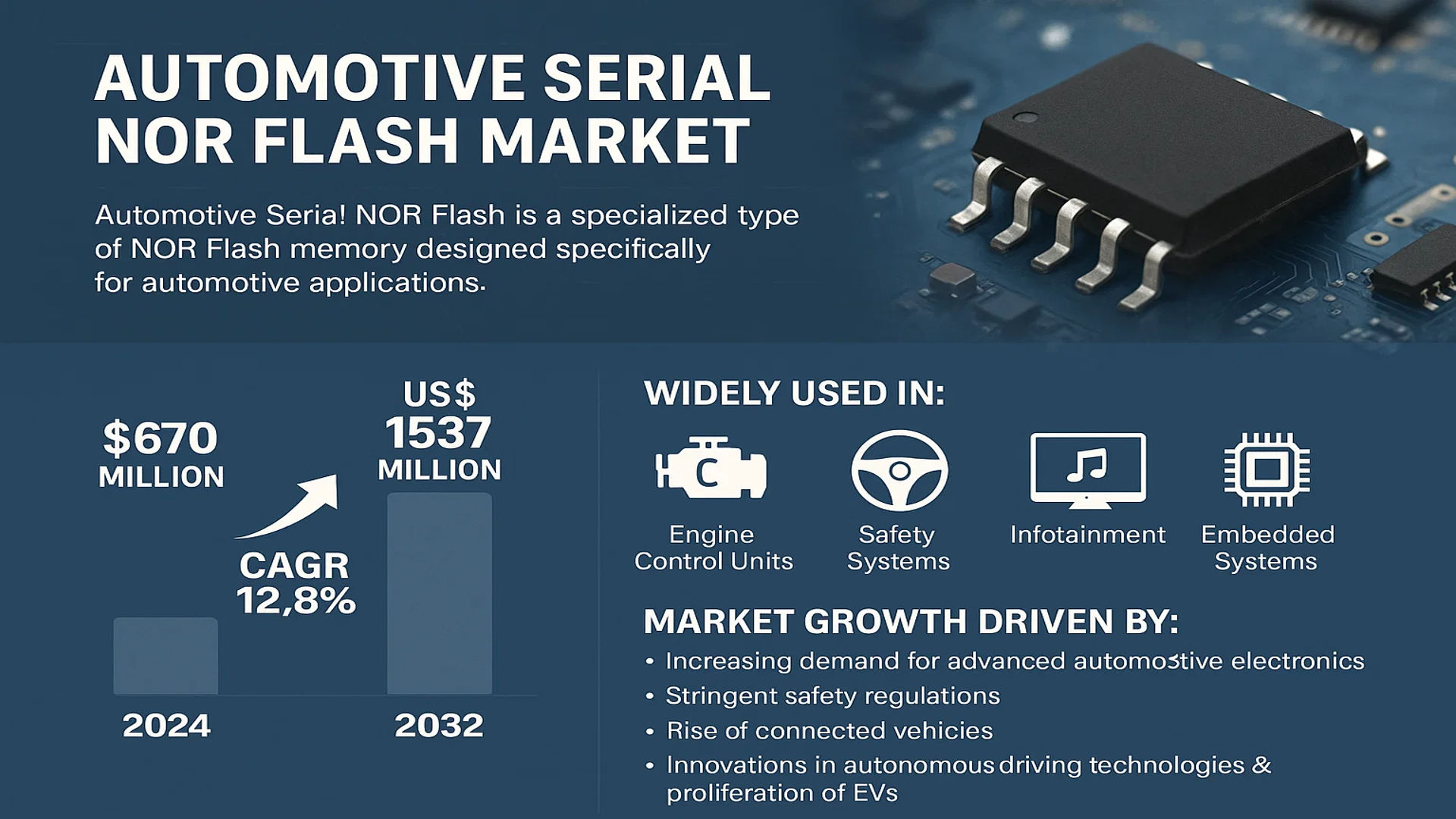
The global Automotive Serial NOR Flash Market was valued at 670 million in 2024 and is projected to reach US$ 1537 million by 2032, at a CAGR of 12.8% during the forecast period.
Automotive Serial NOR Flash is a specialized type of NOR Flash memory designed specifically for automotive applications. It integrates the benefits of NOR Flash—such as fast read speeds and high reliability—with a serial interface, making it ideal for space-constrained and power-sensitive environments. These components are widely used in automotive ECUs (Engine Control Units), safety systems (ADAS), infotainment units, and other embedded systems where robust performance is critical.
The market growth is driven by increasing demand for advanced automotive electronics, stringent safety regulations, and the rise of connected vehicles. Furthermore, innovations in autonomous driving technologies and the proliferation of electric vehicles (EVs) are accelerating adoption. Key players like Infineon Technologies, Micron, and Macronix dominate the market, collectively holding a significant revenue share in 2024. The 3.3V segment is expected to witness substantial growth due to its compatibility with modern automotive systems.
MARKET DRIVERS
Rising Demand for Advanced Automotive Electronics to Fuel Market Expansion
The global automotive industry is undergoing a significant transformation with the increasing adoption of advanced electronic systems such as infotainment, ADAS (Advanced Driver Assistance Systems), and autonomous driving technologies. Automotive Serial NOR Flash plays a critical role in these applications by providing reliable code storage and execution capabilities. The shift towards electric and connected vehicles, which require more sophisticated onboard computing systems, is projected to drive demand. By 2030, over 70% of new vehicles are expected to incorporate advanced telematics and infotainment systems, creating substantial opportunities for Serial NOR Flash manufacturers.
Stringent Automotive Safety Regulations Accelerate Adoption
Governments worldwide are implementing rigorous safety standards that mandate the use of fail-safe memory solutions in automotive applications. Regulatory frameworks such as ISO 26262 for functional safety require reliable data storage solutions that can withstand extreme conditions while maintaining data integrity. Automotive Serial NOR Flash meets these requirements with its high endurance (typically 100,000+ program/erase cycles) and data retention capabilities exceeding 20 years. The growing emphasis on vehicle safety, coupled with increasing electronic content per vehicle, positions NOR Flash as an essential component in modern automotive designs.
Technological Advancements in Memory Solutions Enhance Market Potential
Recent breakthroughs in Serial NOR Flash technology, including higher density offerings (up to 4Gb), improved read speeds (up to 400MB/s), and lower power consumption, are enabling more sophisticated automotive applications. Leading manufacturers are introducing innovative packaging solutions such as wafer-level chip scale packages that reduce footprint while improving thermal performance. These advancements allow automotive systems to achieve better performance metrics while meeting the stringent size and power constraints of modern vehicle architectures.
MARKET RESTRAINTS
Increasing Competition from Alternative Memory Technologies
While Automotive Serial NOR Flash offers several advantages for embedded applications, it faces growing competition from emerging memory technologies. NAND Flash solutions are becoming more attractive for certain automotive applications due to their higher density and lower cost per bit. Additionally, novel non-volatile memory technologies like MRAM and FRAM are gaining traction in automotive designs where ultra-high endurance and fast write speeds are required. This competitive pressure may limit the market share expansion of traditional NOR Flash solutions in some application segments.
Complex Supply Chain Dynamics Create Challenges
The automotive semiconductor industry continues to experience supply chain volatility, with lead times for certain components extending beyond 52 weeks. The specialized nature of automotive-grade Serial NOR Flash, which requires additional qualification steps and extended temperature range testing, exacerbates these challenges. Manufacturers must navigate complex multi-tier supply chains while maintaining the stringent quality standards required by automotive OEMs, potentially limiting production scalability during periods of high demand.
MARKET OPPORTUNITIES
Expansion of Autonomous Vehicle Development Creates New Avenues
The rapid advancement of autonomous vehicle technology presents a substantial growth opportunity for Automotive Serial NOR Flash. Autonomous systems require multiple layers of redundant, high-reliability memory to store critical firmware and safety algorithms. The increasing level of vehicle autonomy (from L2 to L4/L5) directly correlates with greater memory requirements, potentially tripling the Serial NOR Flash content per vehicle. Industry forecasts suggest the autonomous vehicle market could grow at a compound annual rate exceeding 30% through 2030, creating significant demand for specialized memory solutions.
Transition to Software-Defined Vehicles Opens New Possibilities
The automotive industry is shifting toward software-defined vehicle architectures that enable over-the-air updates and enhanced feature personalization. This transition requires robust memory solutions capable of supporting frequent firmware updates while maintaining system integrity. Automotive Serial NOR Flash, with its sector-erasable architecture and fast read speeds, is uniquely positioned to meet these emerging requirements. As OTA update capabilities become standard in new vehicles, the demand for reliable, high-performance NOR Flash solutions will likely increase substantially.
MARKET CHALLENGES
Component Quality and Reliability Requirements Increase Complexity
Automotive Serial NOR Flash solutions must meet exceptionally stringent quality standards, including AEC-Q100 qualification and compliance with automotive-grade temperature specifications (-40°C to +125°C). The extensive qualification process, which typically requires 12-18 months of rigorous testing, significantly extends product development cycles. Additionally, the need to maintain sub-10ppm failure rates throughout the product lifecycle poses substantial technical and operational challenges for manufacturers, potentially limiting market entry for new players.
Cost Pressure in Competitive Automotive Market
Automotive OEMs continuously demand higher performance at lower costs, creating significant pressure on component suppliers. While Serial NOR Flash offers technical advantages, the prevailing cost-per-bit paradigm in memory markets makes it challenging to justify premium pricing. Manufacturers must balance the development of higher-density, more advanced solutions with the need to maintain competitive pricing structures in this highly cost-sensitive industry segment.
AUTOMOTIVE SERIAL NOR FLASH MARKET TRENDS
Rising Demand for Advanced In-Vehicle Electronics to Drive Market Growth
The increasing adoption of sophisticated automotive electronics, including advanced driver-assistance systems (ADAS), infotainment units, and telematics, is propelling the demand for Automotive Serial NOR Flash solutions. As vehicles evolve toward higher levels of automation, the need for reliable, high-speed, and low-latency memory solutions grows significantly. Recent data indicates that the global Automotive Serial NOR Flash market was valued at $670 million in 2024 and is projected to reach $1,537 million by 2032, exhibiting a CAGR of 12.8% during this period. 3.3V devices, dominating the market, are anticipated to maintain strong growth, supported by their extensive use in power-efficient automotive microcontrollers.
Other Trends
Shift Toward Electric and Autonomous Vehicles
The rapid transition toward electric vehicles (EVs) and autonomous driving technologies is accelerating the demand for Serial NOR Flash in automotive applications. These vehicles require vast amounts of non-volatile memory to support over-the-air (OTA) updates, real-time data processing, and firmware storage. Furthermore, China is emerging as a critical market due to its aggressive push in EV adoption, with its Automotive Serial NOR Flash market expected to grow significantly over the next decade.
Expansion of Automotive Semiconductor Supply Chains
The automotive semiconductor industry is undergoing strategic reshoring and regional supply chain consolidation to mitigate disruptions caused by global chip shortages. Major manufacturers like Infineon Technologies, Micron, and Macronix are expanding production capacities to meet rising demand from automakers. Recent investments in 1.8V Serial NOR Flash technology highlight the market’s focus on power efficiency, particularly in battery-powered EV systems. Additionally, partnerships between memory suppliers and Tier-1 automotive electronics providers are fostering innovation in embedded storage solutions tailored for next-generation vehicles.
COMPETITIVE LANDSCAPE
Key Industry Players
Market Leaders Drive Innovation in Automotive Memory Solutions
The global Automotive Serial NOR Flash market is characterized by intense competition among established semiconductor manufacturers and emerging players. Infineon Technologies currently leads the market, leveraging its strong automotive-grade memory solutions portfolio and extensive partnerships with OEMs. The company’s focus on failure-resistant NOR Flash designs for safety-critical applications has solidified its position in advanced driver-assistance systems (ADAS) and electric vehicle controls.
Micron Technology and Macronix follow closely, collectively holding over 30% of market share in 2024. Micron’s strength lies in high-density NOR Flash solutions for infotainment systems, while Macronix specializes in cost-optimized memory for mid-range automotive applications. Both companies are aggressively expanding production capacity to meet growing demand from Asian automakers.
The competitive dynamics are further shaped by regional specialists like Winbond in Taiwan and GigaDevice in China, which compete effectively on price-performance ratios for entry-level vehicles. These players are accelerating R&D efforts to develop next-generation serial interfaces and improve write endurance characteristics – critical requirements for modern vehicle architectures.
Meanwhile, Microchip Technology is carving out a niche in the 1.8V segment, targeting ultra-low-power applications in electric vehicle battery management systems. The company’s recent acquisition of a Norwegian semiconductor firm has strengthened its position in Europe’s automotive supply chain.
List of Key Automotive Serial NOR Flash Manufacturers
- Infineon Technologies (Germany)
- Macronix International Co., Ltd. (Taiwan)
- Micron Technology, Inc. (U.S.)
- Winbond Electronics Corporation (Taiwan)
- GigaDevice Semiconductor (China)
- Ingenic Semiconductor (China)
- Microchip Technology Inc. (U.S.)
Segment Analysis:
By Type
3.3V Segment Leads the Market Due to Widespread Adoption in Automotive Electronics
The market is segmented based on voltage type into:
- 3.3V
- 1.8V
- Others
By Application
Passenger Cars Segment Dominates Owing to Increasing Demand for Advanced Infotainment Systems
The market is segmented based on application into:
- Passenger Cars
- Commercial Cars
By Memory Capacity
Mid-Range Capacity (16Mb-64Mb) Segment Shows Strong Growth for Embedded Systems
The market is segmented based on memory capacity into:
- Low Density (<16Mb)
- Mid-Range (16Mb-64Mb)
- High Density (>64Mb)
By Interface Type
SPI Interface Holds Majority Share Due to Compatibility with Automotive Microcontrollers
The market is segmented based on interface type into:
- SPI (Serial Peripheral Interface)
- Quad SPI
- Others
Regional Analysis: Automotive Serial NOR Flash Market
Asia-Pacific
The Asia-Pacific region currently dominates the global Automotive Serial NOR Flash market, driven by strong automotive production in China, Japan, and South Korea. With China accounting for approximately 30% of global vehicle production, demand for automotive memory solutions remains consistently high. The region benefits from established semiconductor manufacturing ecosystems and increasing adoption of advanced driver assistance systems (ADAS) in mid-range vehicles. Local manufacturers like GigaDevice and Ingenic Semiconductor are gaining market share by offering cost-competitive solutions tailored to regional OEM requirements. However, the market faces pricing pressures due to intense competition between global and domestic suppliers.
North America
North America represents a high-value market for Automotive Serial NOR Flash, characterized by stringent automotive safety standards and rapid adoption of connected vehicle technologies. The U.S. accounts for the majority of regional demand, with major automakers increasingly specifying higher-density NOR Flash for telematics and over-the-air update capabilities. The market is currently transitioning from 3.3V to more power-efficient 1.8V solutions to support next-generation electric vehicle architectures. Established suppliers like Micron and Microchip Technology maintain strong positions through technical partnerships with Tier 1 suppliers, though supply chain reconfiguration post-pandemic continues to impact delivery timelines.
Europe
European demand for Automotive Serial NOR Flash remains steady, supported by the region’s focus on automotive safety systems and premium vehicle production. German automakers in particular drive specifications for high-reliability memory solutions with extended temperature ranges. The market features strong competition between Infineon Technologies and other global suppliers, with increasing emphasis on functional safety certifications like ISO 26262. While electrification trends create new opportunities, slower overall vehicle production growth compared to Asia tempers market expansion. Recent EU regulations mandating advanced safety features in all new vehicles from 2024 onward are expected to provide a sustained demand driver.
Middle East & Africa
This emerging market shows gradual growth potential as regional automotive production expands, particularly in Turkey and South Africa. The aftermarket segment represents a significant portion of current demand, with suppliers focusing on replacement components for aging vehicle fleets. Luxury vehicle imports create niche opportunities for high-performance NOR Flash solutions, though the overall market remains constrained by limited local automotive electronics manufacturing capabilities. Recent investments in automotive testing facilities in the UAE signal growing regional capacity for advanced automotive components.
South America
The South American market for Automotive Serial NOR Flash remains relatively small but stable, with Brazil as the primary consumption center. Economic volatility continues to impact new vehicle sales, though the commercial vehicle segment shows resilience due to infrastructure development needs. Locally assembled vehicles predominantly use entry-level NOR Flash solutions, while imported premium vehicles drive demand for advanced memory configurations. The lack of domestic semiconductor production means the region remains dependent on imports, subject to currency fluctuations and trade policy changes.
Report Scope
This market research report provides a comprehensive analysis of the global Automotive Serial NOR Flash market, covering the forecast period 2024–2032. It offers detailed insights into market dynamics, technological advancements, competitive landscape, and key trends shaping the industry.
Key focus areas of the report include:
- Market Size & Forecast: Historical data and future projections for revenue, unit shipments, and market value across major regions and segments. The global market was valued at USD 670 million in 2024 and is projected to reach USD 1,537 million by 2032, growing at a CAGR of 12.8%.
- Segmentation Analysis: Detailed breakdown by product type (3.3V, 1.8V, Others), application (Passenger Cars, Commercial Cars), and end-user industry to identify high-growth segments.
- Regional Outlook: Insights into market performance across North America (U.S., Canada, Mexico), Europe (Germany, France, U.K.), Asia-Pacific (China, Japan, South Korea), and other regions.
- Competitive Landscape: Profiles of leading market participants including Infineon Technologies, Macronix, Micron, Winbond, and GigaDevice, covering their product portfolios, market share, and strategic initiatives.
- Technology Trends & Innovation: Assessment of evolving automotive memory solutions, integration with advanced driver-assistance systems (ADAS), and electrification trends.
- Market Drivers & Restraints: Analysis of factors such as increasing vehicle electronics content, automotive safety regulations, and supply chain challenges.
- Stakeholder Analysis: Strategic insights for semiconductor manufacturers, automotive OEMs, Tier-1 suppliers, and investors.
The research methodology combines primary interviews with industry experts and analysis of verified market data to ensure accuracy and reliability.
FREQUENTLY ASKED QUESTIONS:
What is the current market size of Global Automotive Serial NOR Flash Market?
-> Automotive Serial NOR Flash Market was valued at 670 million in 2024 and is projected to reach US$ 1537 million by 2032, at a CAGR of 12.8% during the forecast period.
Which key companies operate in Global Automotive Serial NOR Flash Market?
-> Key players include Infineon Technologies, Macronix, Micron, Winbond, GigaDevice, Ingenic Semiconductor, and Microchip Technology.
What are the key growth drivers?
-> Growth is driven by increasing vehicle electrification, advanced infotainment systems, stringent safety regulations, and the rise of autonomous driving technologies.
Which region dominates the market?
-> Asia-Pacific leads in both production and consumption, while North America shows strong growth in advanced automotive applications.
What are the emerging trends?
-> Emerging trends include higher density memory requirements, integration with AI processors, and development of automotive-grade memory solutions.

Get Sample Report PDF for Exclusive Insights
Report Sample Includes
- Table of Contents
- List of Tables & Figures
- Charts, Research Methodology, and more...
 Download Sample Report PDF


