Automotive Radar Semiconductor Market Insights
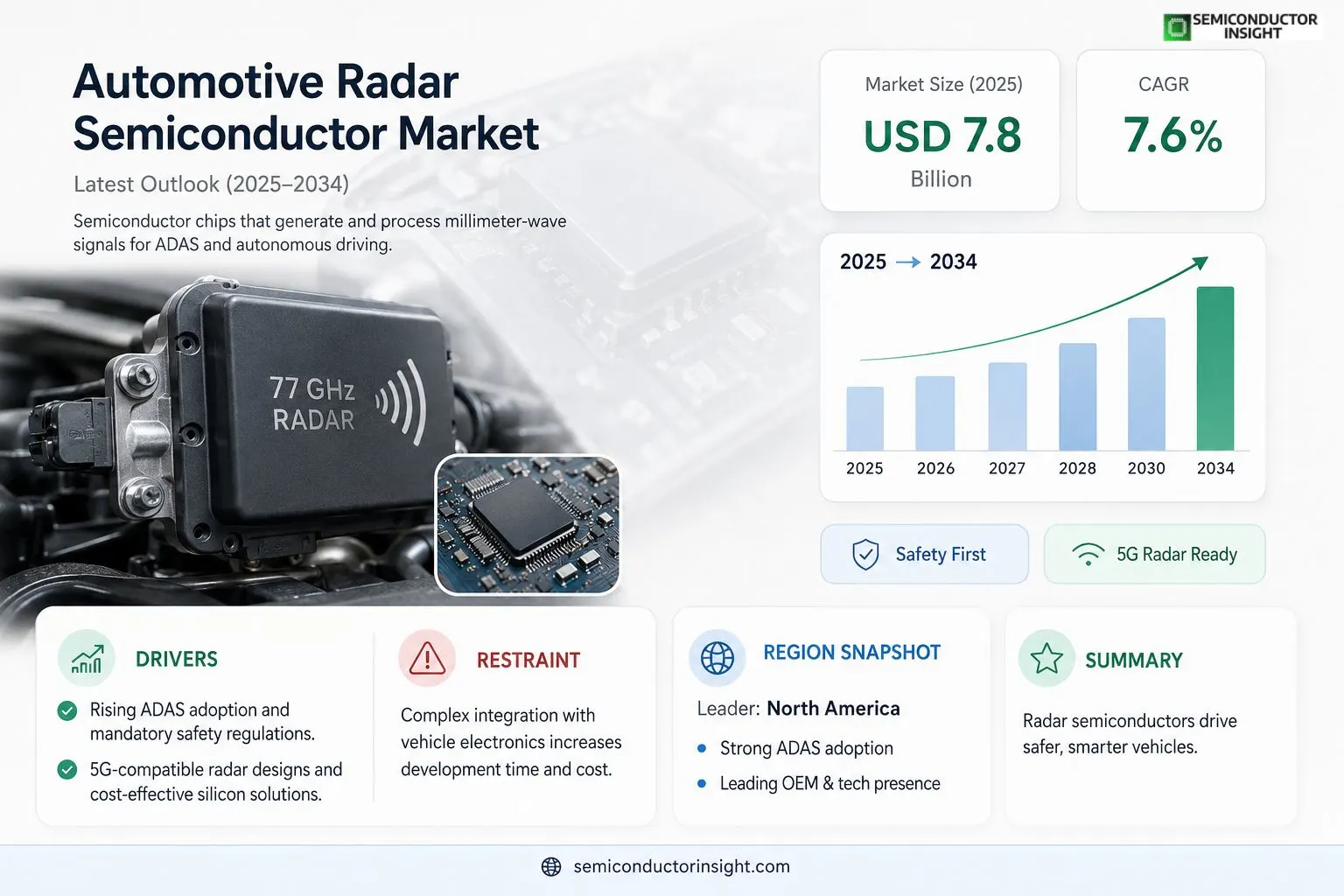
Global automotive radar semiconductor market size was valued at USD 7.8 billion in 2025. The market is projected to grow from USD 7.8 billion in 2025 to USD 15.2 billion by 2034, exhibiting a CAGR of 7.6% during the forecast period.
Automotive radar semiconductors are integrated circuits that generate, transmit, and receive millimeter‑wave signals used for collision‑avoidance, adaptive cruise control, and autonomous‑driving functions. These chips typically comprise RF front‑ends, mixers, power amplifiers and digital signal processors optimized for frequencies between 76 GHz and 81 GHz.The market is accelerating because vehicle manufacturers are mandated to equip new cars with advanced driver‑assistance systems (ADAS), while consumer demand for higher safety standards fuels volume growth. Furthermore, the rollout of 5G‑compatible radar architectures and cost reductions from silicon‑based solutions are expanding adoption across mid‑range models. Key players such as NXP Semiconductors, Infineon Technologies, Texas Instruments and Bosch are investing heavily in next‑generation radar IPs and strategic partnerships to capture this expanding opportunity.
MARKET DRIVERS
Increasing Adoption of Advanced Driver Assistance Systems (ADAS)
Automotive Radar Semiconductor Market is being propelled by the rapid integration of ADAS features such as adaptive cruise control and collision avoidance. Manufacturers are shifting to radar‑based sensors because they provide reliable detection in adverse weather, thereby boosting demand for high‑performance semiconductor components.
Regulatory Push for Safer Vehicles
Government regulations worldwide mandate minimum safety standards that include radar‑enabled braking and lane‑keeping assistance. This regulatory environment creates a predictable revenue stream for suppliers, encouraging significant investment in radar semiconductor R&D.
➤ Strategic partnerships between automotive OEMs and semiconductor firms are accelerating product roll‑outs, reducing time‑to‑market for next‑generation radar solutions.
Finally, the rise of electrified and autonomous vehicle platforms demands scalable radar architectures, further solidifying Automotive Radar Semiconductor Market’s growth trajectory.
MARKET CHALLENGES
High Cost of Advanced Radar Modules
Despite performance benefits, the high bill of materials for sophisticated radar chips remains a barrier for volume adoption, especially in emerging markets where price sensitivity is acute.
Other Challenges
Supply Chain Constraints
Global semiconductor shortages and limited wafer capacity have led to extended lead times, impeding timely production for automakers.
MARKET RESTRAINTS
Complex Integration with Vehicle Electronics
Integrating radar semiconductor modules with existing vehicle electronics architectures requires extensive validation and software calibration, increasing development cycles and cost.Furthermore, differing standards across regions force suppliers to customize designs, diluting economies of scale and limiting the speed of market penetration.Compatibility issues with legacy infotainment and control units also necessitate additional engineering resources, which can deter smaller OEMs from early adoption.
MARKET OPPORTUNITIES
Emerging 77‑GHz Radar Solutions for Autonomous Driving
The shift toward higher‑frequency 77‑GHz radar architectures opens new opportunities for compact, low‑power semiconductor designs, enabling broader deployment across vehicle segments and supporting the long‑term vision of fully autonomous driving.Advanced packaging techniques, such as system‑in‑package (SiP) and wafer‑level packaging, further enhance performance while reducing footprint, creating a compelling value proposition for next‑generation vehicle platforms.Lastly, the expansion of over‑the‑air (OTA) update capabilities allows radar firmware to be refined post‑sale, extending product lifecycles and opening recurring revenue streams for semiconductor providers.
Automotive Radar Semiconductor Market Trends
Regulatory Momentum for ADAS Deployment
Global vehicle manufacturers are now required to equip a growing share of new‑model fleets with advanced driver‑assistance systems. This regulatory pressure creates a steady pipeline for radar chips that operate in the 76‑81 GHz band, where millimeter‑wave signals deliver the resolution needed for collision‑avoidance and adaptive cruise control. Integrators are focusing on RF front‑ends, mixers, power amplifiers and digital signal processors that can be bundled into compact modules, enabling manufacturers to meet safety targets without major redesigns. The cumulative effect is a measurable lift in demand across both premium and mid‑range segments, reinforcing the long‑term outlook for Automotive Radar Semiconductor Market.
Other Trends
Silicon‑Based Radar Evolution
Cost pressures are prompting a shift from gallium‑arsenide to silicon‑on‑insulator (SOI) and bulk‑silicon processes. Silicon platforms support larger wafer sizes, lower material costs, and compatibility with existing CMOS fabs, which accelerates time‑to‑market for radar IP blocks. In parallel, 5G‑compatible architectures are being integrated, allowing radar units to share antenna arrays and signal‑processing resources with communication modules. This convergence reduces bill‑of‑materials and opens the technology to volume‑produced models, expanding the addressable base beyond high‑end vehicles.
Strategic Partnerships and IP Consolidation
Leading semiconductor companies are cementing alliances to pool radar IP, streamline verification, and co‑develop next‑generation signal‑processing algorithms. NXP Semiconductors, Infineon Technologies, Texas Instruments and Bosch have announced joint roadmaps that target higher integration densities and lower power consumption. These collaborations also facilitate rapid adoption of new antenna‑array designs and enable cross‑licensing of proprietary waveform techniques. As a result, the ecosystem is becoming more cohesive, shortening development cycles and reinforcing the competitive positioning of firms that can deliver turnkey radar solutions to automotive OEMs.
COMPETITIVE LANDSCAPEKey Industry Players
Automotive Radar Semiconductor Market: Competitive Landscape Overview
The automotive radar semiconductor segment is dominated by a handful of global leaders that combine deep RF expertise with strong automotive ASIC capabilities. NXP Semiconductors, Infineon Technologies, Texas Instruments and Bosch Sensortec collectively command a sizable share of the high‑volume market, leveraging 65 nm and emerging 28 nm CMOS processes to deliver integrated radar front‑ends, power amplifiers and digital signal processors across the 76–81 GHz band. Their extensive automotive program portfolios, strategic OEM alliances and substantial R&D investments enable them to set reference architectures for advanced driver‑assistance systems (ADAS) and early autonomous‑driving deployments. The market structure is therefore characterized by a tiered ecosystem where these incumbents supply foundational radar IP and reference designs, while downstream tier‑1 suppliers and OEMs integrate the chips into vehicle platforms, driving the market growth projected from USD 7.8 billion in 2025 to USD 15.2 billion by 2034.Beyond the primary tier, several niche but highly innovative players are expanding the competitive set. STMicroelectronics, Samsung Electronics, Qualcomm, Renesas Electronics and Analog Devices are accelerating their radar‑centric road‑maps through silicon‑based solutions and mixed‑signal integration. Companies such as Skyworks Solutions, Qorvo, Rohm Semiconductor, Melexis, ON Semiconductor and NXP’s former automotive radar spin‑off contribute specialized RF front‑ends, high‑efficiency power amplifiers and sensor‑fusion ASICs that target cost‑sensitive segments and emerging 5G‑compatible radar architectures. Their focused product launches and strategic partnerships with OEMs and Tier‑1 integrators diversify the supply chain, fostering faster technology adoption and creating a more competitive pricing environment across the automotive radar semiconductor landscape.
List of Key Automotive Radar Semiconductor Companies Profiled
- NXP Semiconductors
- Infineon Technologies
- Texas Instruments
- Bosch Sensortec
- STMicroelectronics
- Samsung Electronics
- Qualcomm
- Renesas Electronics
- Analog Devices
- Skyworks Solutions
- Qorvo
- Rohm Semiconductor
- Melexis
- ON Semiconductor
Segment Analysis:
| Segment Category | Sub-Segments | Key Insights |
| By Type |
|
FMCW Radar
|
| By Application |
|
Autonomous Driving
|
| By End User |
|
OEMs
|
| By Frequency Band |
|
77‑81 GHz
|
| By Integration Level |
|
Highly Integrated Radar SoCs
|
Regional Analysis: North America
North America
The integration of automotive radar semiconductors is central to the advancement of ADAS. These chips enable crucial functionalities such as object detection, range measurement, and velocity estimation, contributing significantly to improved safety and driver convenience. The increasing penetration of ADAS features across various vehicle segments is a primary driver for demand in this area.
The pursuit of fully autonomous vehicles is a major catalyst for growth in Automotive Radar Semiconductor Market. High-performance radar sensors are essential for providing reliable perception in diverse driving conditions, especially in scenarios where cameras may be limited. The development of more sophisticated radar architectures and signal processing algorithms is driving innovation in this domain.
The North American automotive radar semiconductor market is competitive, with key players including established semiconductor companies and specialized radar chip developers. Competition revolves around performance, cost-effectiveness, and integration capabilities. Strategic partnerships and collaborations are becoming increasingly important for maintaining a competitive edge in this rapidly evolving market.
Government regulations and safety standards play a significant role in shaping Automotive Radar Semiconductor Market. Stringent safety requirements necessitate the use of reliable and high-performance radar systems, driving innovation and market growth. Compliance with evolving regulations is a key consideration for manufacturers.
Europe
Europe represents the second-largest regional market for automotive radar semiconductors. The region’s strong focus on safety, coupled with increasing automotive electrification and the drive towards autonomous driving, are key growth drivers. European automotive manufacturers are actively incorporating advanced radar systems into their vehicles to meet stringent safety regulations and enhance driver assistance features. The presence of a well-established automotive industry and a supportive regulatory environment further contributes to market expansion.
Asia-Pacific
Asia-Pacific is emerging as a high-growth market for automotive radar semiconductors. The region’s robust automotive production, particularly in China and Japan, combined with increasing disposable incomes and rising demand for vehicle safety features, are fueling market expansion. Government initiatives promoting electric vehicles and autonomous driving are also contributing to the growth of Automotive Radar Semiconductor Market in this region. The increasing localization of automotive supply chains is also a significant trend.
South America
South America presents a relatively smaller but growing market for automotive radar semiconductors. Increasing vehicle production in countries like Brazil and Mexico, coupled with a growing awareness of vehicle safety, are driving demand. The adoption of advanced driver-assistance systems is gradually increasing, creating opportunities for radar semiconductor suppliers.
Middle East & Africa
The Middle East & Africa represents a nascent market for automotive radar semiconductors with significant growth potential. The increasing affordability of vehicles, coupled with growing infrastructure development and a focus on safety, are expected to drive market expansion in the coming years. The adoption of advanced driver-assistance systems is expected to accelerate as vehicle ownership increases in this region.
Report Scope
This market research report provides a comprehensive analysis of the Automotive Radar Semiconductor Market , covering the forecast period 2026–2034. It offers detailed insights into market dynamics, technological advancements, competitive landscape, and key trends shaping the industry.
Key focus areas of the report include:
- Market Overview: The report begins with an overview outlining its current market scenario, key growth indicators, and industry transformation drivers. It discusses macroeconomic factors, demand–supply balance, regulatory landscape, and the strategic role of semiconductors in powering advancements across industries such as automotive, telecommunications, consumer electronics, and industrial automation.
- Market Size & Forecast: Historical data and future projections for revenue, unit shipments, and market value across major regions and segments.
- Segmentation Analysis: Detailed breakdown by product type, technology, application, and end-user industry to identify high-growth segments and investment opportunities.
- Regional Insights: Insights into market performance across North America, Europe, Asia-Pacific, Latin America, and the Middle East & Africa, including country-level analysis where relevant.
- Competitive Landscape: Profiles of leading market participants, including their product offerings, R&D focus, manufacturing capacity, pricing strategies, and recent developments such as mergers, acquisitions, and partnerships.
- Technology Trends & Innovation: Assessment of emerging technologies, integration of AI/IoT, semiconductor design trends, fabrication techniques, and evolving industry standards.
- Market Drivers & Restraints: Evaluation of factors driving market growth along with challenges, supply chain constraints, regulatory issues, and market-entry barriers.
- Stakeholder Insights: Insights for component suppliers, OEMs, system integrators, investors, and policymakers regarding the evolving ecosystem and strategic opportunities.
Primary and secondary research methods are employed, including interviews with industry experts, data from verified sources, and real-time market intelligence to ensure the accuracy and reliability of the insights presented.
FREQUENTLY ASKED QUESTIONS:
What is the current market size of Automotive Radar Semiconductor Market?
-> Automotive Radar Semiconductor Market was valued at USD 7.8 billion in 2025 and is expected to reach USD 15.2 billion by 2034, exhibiting a CAGR of 7.6% during the forecast period.
Which key companies operate in Automotive Radar Semiconductor Market?
-> Key players include NXP Semiconductors, Infineon Technologies, Texas Instruments, and Bosch, among others.
What are the key growth drivers?
-> Key growth drivers include mandates for advanced driver‑assistance systems (ADAS), rising consumer demand for higher safety standards, the rollout of 5G‑compatible radar architectures, and cost reductions from silicon‑based solutions.
Which region dominates the market?
-> The provided reference does not specify a single dominant region; growth is being driven globally by automotive OEMs and suppliers.
What are the emerging trends?
-> Emerging trends include integration of 5G‑compatible radar designs, increased use of silicon‑based radar ICs to lower costs, and strategic partnerships focused on next‑generation radar IP development.
Get Sample Report PDF for Exclusive Insights
Report Sample Includes
- Table of Contents
- List of Tables & Figures
- Charts, Research Methodology, and more...
 Download Sample Report PDF