Automotive Projection Headlight Lighting Market Insights
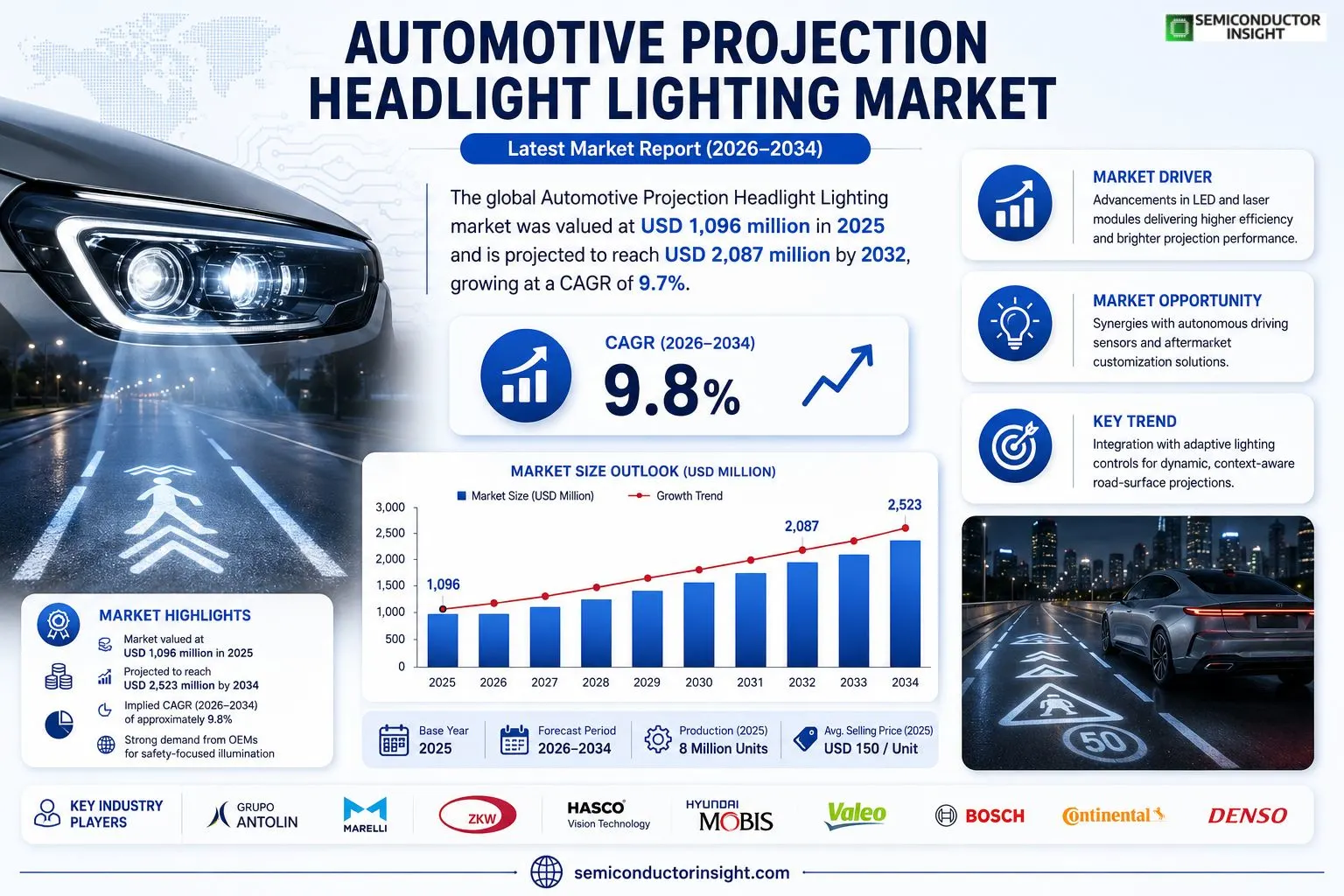
Automotive Projection Headlight Lighting market size was valued at USD 1,096 million in 2025. The market is set to climb from roughly USD 1,150 million in 2026 to USD 2,087 million by 2032, reflecting a compound annual growth rate of about 9.7% over that span. Extending the same growth trajectory suggests a valuation near USD 2,523 million by 2034, which corresponds to an implied CAGR of approximately 9.8% across nine years.
Automotive Projection Headlight Lighting is an automotive headlamp system that projects guidance symbols, warning patterns, or lane‑related cues onto the road surface through optical projection modules, thereby improving driver communication and nighttime situational awareness. Its principal benefits include enhanced human‑machine interaction, clearer hazard indication for pedestrians and surrounding traffic, and a differentiated brand experience when integrated with adaptive lighting control.The sector’s expansion stems from several converging forces: production reached eight million units in 2025 at an average price of USD 150 per unit; capacity utilization hovered around 55%, while gross margins averaged 40%. Upstream supply chains are anchored by high‑brightness automotive‑grade LED sources from firms such as ams OSRAM, Nichia and Lumileds. Midstream activities focus on optical architecture, thermal management and software integration that together dictate projection clarity and system reliability. Downstream demand is driven by major OEMsincluding Toyota, Volkswagen, BMW and BYDwho seek advanced illumination solutions for both passenger cars and commercial vehicles.
MARKET DRIVERS
Advancements in LED and Laser Modules
The shift from halogen to semiconductor‑based sources has cut power draw by roughly 30 % while delivering sharper cut‑off lines and deeper contrast. Automotive Projection Headlight Lighting Market participants that have mastered wafer‑scale integration are seeing faster adoption cycles, because OEMs can meet stricter energy‑efficiency targets without compromising illumination quality.
Regulatory Momentum for Road Safety
European Union directives now require a minimum luminous flux of 2,800 lumens for headlamp assemblies on new passenger cars. This mandate compels manufacturers to replace legacy units with projection‑type systems, creating a clear pathway for volume growth in Automotive Projection Headlight Lighting Market.
➤ “Projection technology bridges the gap between aesthetic ambition and compliance pressure, turning regulatory change into a commercial catalyst.”
Combined, the technology surge and policy pressure generate a virtuous loop: higher performance fuels brand differentiation, while compliance drives fleet‑wide retrofits, expanding both OEM and aftermarket demand.
MARKET CHALLENGES
Integration Complexity with Vehicle Electrical Architecture
Projection headlamps rely on high‑frequency drivers and tightly synchronized control units. As vehicle architectures move toward electrified powertrains, the electrical envelope becomes more fragmented, forcing suppliers to redesign harnesses and calibrate against multiple voltage rails. This engineering overhead can erode time‑to‑market advantages.
Other Challenges
Cost Premium
The semiconductor wafers and precision optics that enable narrow‑beam projection command price points that are 15 % higher than conventional LED modules. For price‑sensitive segments, this premium limits penetration despite the clear performance upside.Supply‑chain volatility for rare‑earth phosphors adds another layer of uncertainty. Fluctuations in raw‑material availability translate into production bottlenecks, compelling OEMs to hold larger inventories and inflating overall program costs.
MARKET RESTRAINTS
High Capital Expenditure for Tooling
Establishing a line capable of molding the micro‑lens arrays required for projection demands multi‑million‑dollar investments in clean‑room facilities and laser‑ablation equipment. Smaller suppliers often lack the financial bandwidth to enter the space, concentrating market power among a few large players.Material scarcity compounds the restraint. The sapphire substrates used for laser‑driven emitters face limited capacity, pushing lead times beyond six months for bulk orders. This delay discourages mid‑cycle vehicle refreshes that would otherwise incorporate the latest headlight designs.Consumer price sensitivity remains a persistent brake. While premium‑segment buyers readily accept higher sticker prices for advanced optics, mass‑market purchasers prioritize total cost of ownership, keeping adoption rates modest outside luxury brands.
MARKET OPPORTUNITIES
Synergies with Autonomous Driving Sensors
Projection headlamps can embed LiDAR emitters within their optical stack, allowing a single module to fulfil both illumination and perception roles. Vehicles targeting Level‑3 and higher automation are expected to standardize this dual‑function approach, opening a new revenue stream for Automotive Projection Headlight Lighting Market suppliers that can certify sensor‑grade performance.Aftermarket customization presents another growth vector. Owners of high‑performance cars increasingly seek bespoke lighting signatures that differentiate their vehicles at night. Modular projection kits, offering programmable beam patterns, meet this demand and generate recurring aftermarket sales beyond the OEM lifecycle.
Automotive Projection Headlight Lighting Market Trends
Projection Systems Coupled with Adaptive Lighting Controls
The convergence of optical projection modules with adaptive lighting algorithms has become a defining movement in Automotive Projection Headlight Lighting Market. Manufacturers are leveraging real‑time sensor feeds to modulate projected symbols, allowing drivers to receive contextual cuessuch as lane markings or hazard alertsexactly where they are needed. This approach not only raises perceived safety but also differentiates brand experience, prompting premium OEMs to embed projection units as standard equipment on new BEV platforms. The technical synergy reduces reliance on auxiliary displays, streamlining interior design while creating a new revenue tier for suppliers that can deliver calibrated, software‑driven projection suites.
Other Trends
Supply‑Chain Consolidation Around High‑Brightness LED Sources
Upstream, the market has witnessed a tightening of relationships with a core set of LED manufacturersams OSRAM, Nichia, Lumileds, and Cree LEDwhose high‑brightness automotive‑grade modules satisfy the luminous flux required for clear road‑surface projection. By aligning long‑term contracts and joint‑development programs, downstream system integrators are achieving higher capacity utilization, moving from the 55 % level recorded in 2025 toward a more efficient production footprint. The tighter supply chain also cushions price volatility, allowing OEMs to maintain the current average unit price of roughly USD 150 while preserving gross margins near 40 %.
Emergence of DLP and Micro‑LED Projection Segments
Within the product‑type segmentation, DLP projector headlamps and micro‑LED matrix headlamps are gaining traction as distinct pathways for performance improvement. DLP technology, with its ability to render high‑resolution patterns, is positioned to attract luxury manufacturers seeking intricate branding displays, whereas micro‑LED arrays promise longer lifespans and lower thermal loads, aligning with the durability targets of commercial‑vehicle fleets. The bifurcation encourages OEMs to adopt a mixed‑strategy portfolio, selecting the architecture that best matches vehicle architecture and cost constraints. Consequently, suppliers that can offer both formats are better placed to capture a broader share of the upcoming demand surge through 2032.
COMPETITIVE LANDSCAPE
Key Industry Players
Competitive Assessment of Projection Headlamp Suppliers
The market is anchored by a handful of vertically integrated firms that command both design expertise and deep OEM relationships. Grupo Antolin, Marelli and ZKW together capture roughly a third of revenue, leveraging scale in module assembly and a portfolio that spans DLP projector headlamps to micro‑LED matrix solutions. Their dominance stems from early adoption of adaptive optics and the ability to bundle projection systems with conventional lighting modules, a proposition that resonates with premium brands seeking differentiated styling cues. Meanwhile, HASCO Vision Technology and Hyundai Mobis have forged strategic alliances with Tier‑1 automotive manufacturers, securing long‑term supply contracts that reinforce barriers to entry. This concentration creates a competitive environment where incremental innovationsuch as higher‑resolution pattern projection and integrated thermal managementoffers the most viable path to market share gain.Beyond the headline players, a cadre of specialist suppliers shapes the upstream and midstream value chain. High‑brightness LED sources from ams OSRAM, Nichia, Lumileds, Cree, Sanan Optoelectronics and NationStar Optoelectronics underpin the optical efficiency of projection modules, while firms like MIND OPTOELECTRONICS and Appotronics Corporation focus on precision optics, calibration software and ruggedized sealing. Their niche capabilities attract OEMs that demand bespoke projection patterns for autonomous‑driving assistance or brand‑specific signage. The diffusion of these technologies into commercial‑vehicle platforms, coupled with rising adoption in electric‑powertrain models, is prompting smaller innovators to seek joint‑venture routes with established Tier‑1s, thereby expanding the competitive tapestry.
List of Key Automotive Projection Headlight Lighting Companies Profiled
- Grupo Antolin
- Marelli
- ZKW
- HASCO Vision Technology
- Changzhou Xingyu Automotive Lighting Systems
- MIND OPTOELECTRONICS
- Appotronics Corporation
- Hyundai Mobis
- ams OSRAM
- Nichia
- Lumileds
- Cree
- Sanan Optoelectronics
- NationStar Optoelectronics
- Valeo
- Bosch
- Continental
- Denso
Segment Analysis:
| Segment Category | Sub-Segments | Key Insights |
| By Type |
|
DLP Projector Headlamp is emerging as the leading technology because it delivers crisp projection patterns with reliable thermal management.
|
| By Application |
|
Passenger Cars dominate the application landscape as manufacturers seek to differentiate brand experience through visual communication.
|
| By End User |
|
OEM Partners are the primary decision makers, driving integration of projection headlamps early in vehicle architecture.
|
| By Powertrain |
|
Battery Electric Vehicles are gaining traction for projection lighting because the silent powertrain accentuates the need for visual communication.
|
| By Sales Channel |
|
Original Equipment Manufacturers (OEM) remain the dominant channel, shaping design specifications from concept to production.
|
Regional Analysis: Automotive Projection Headlight Lighting Market
North America
Federal standards such as FMVSS 108 have been updated to accommodate high‑intensity projection packages, compelling manufacturers to certify optical performance across diverse weather conditions. State‑level incentives for low‑emission vehicles further accelerate adoption, as projection headlights align with broader energy‑efficiency goals.
Laser‑driven projection units are outpacing LED counterparts in premium segments, delivering sharper beam shaping and longer range. Early‑stage integration of digital micromirror devices (DMD) hints at future headlamp systems that can reconfigure patterns in real time based on traffic flow.
The supply chain is increasingly consolidated around a handful of silicon wafer providers and optical‑coating specialists. Just‑in‑time logistics are essential, as projection modules are weight‑sensitive and often sourced from cross‑border facilities that must meet tight lead‑time targets.
Legacy lighting firms are acquiring niche start‑ups to embed projection expertise, while new entrants leverage software‑first approaches. The competitive battlefield is shifting from pure component pricing to bundled solutions that include firmware updates and remote diagnostics.
Europe
European manufacturers are leveraging the region’s strong tradition of precision optics to embed projection headlight systems within luxury sedans and sporty hatchbacks. EU directives emphasizing pedestrian safety have nudged OEMs toward dynamic light distribution, prompting collaborations between optical engineers and AI developers. Market participants that can navigate disparate certification processes across member states reap the advantage of a fragmented yet lucrative demand base.
Asia‑Pacific
In Asia‑Pacific, rapid urbanization and a burgeoning middle class create a fertile ground for advanced illumination solutions. While cost sensitivity remains high, manufacturers are experimenting with hybrid LED‑laser architectures to balance price and performance. The region’s sizable contract manufacturing sector is beginning to offer specialized assembly lines for projection modules, reducing dependence on imports and fostering local design capabilities.
South America
South American auto markets are still dominated by conventional halogen systems, yet rising environmental legislation is prompting a slow transition toward more efficient lighting. Early adopters, particularly in Brazil, are integrating projection headlights into fleet vehicles to enhance night‑time visibility on poorly lit highways. Supplier networks are adapting by establishing regional test facilities that validate performance under tropical temperature extremes.
Middle East & Africa
The Middle East and Africa present a niche but strategically important segment, where premium vehicle imports drive demand for high‑end projection headlights. Harsh desert conditions demand robust optics that resist sand ingress, leading manufacturers to develop sealed module designs. In African markets, off‑road utility vehicles are experimenting with projection lighting to improve safety on unpaved routes, opening a modest growth corridor for specialized component suppliers.
Report Scope
This market research report provides a comprehensive analysis of the Automotive Projection Headlight Lighting Market , covering the forecast period 2026–2034. It offers detailed insights into market dynamics, technological advancements, competitive landscape, and key trends shaping the industry.
Key focus areas of the report include:
- Market Overview: The report begins with an overview outlining its current market scenario, key growth indicators, and industry transformation drivers. It discusses macroeconomic factors, demand–supply balance, regulatory landscape, and the strategic role of semiconductors in powering advancements across industries such as automotive, telecommunications, consumer electronics, and industrial automation.
- Market Size & Forecast: Historical data and future projections for revenue, unit shipments, and market value across major regions and segments.
- Segmentation Analysis: Detailed breakdown by product type, technology, application, and end-user industry to identify high-growth segments and investment opportunities.
- Regional Insights: Insights into market performance across North America, Europe, Asia-Pacific, Latin America, and the Middle East & Africa, including country-level analysis where relevant.
- Competitive Landscape: Profiles of leading market participants, including their product offerings, R&D focus, manufacturing capacity, pricing strategies, and recent developments such as mergers, acquisitions, and partnerships.
- Technology Trends & Innovation: Assessment of emerging technologies, integration of AI/IoT, semiconductor design trends, fabrication techniques, and evolving industry standards.
- Market Drivers & Restraints: Evaluation of factors driving market growth along with challenges, supply chain constraints, regulatory issues, and market-entry barriers.
- Stakeholder Insights: Insights for component suppliers, OEMs, system integrators, investors, and policymakers regarding the evolving ecosystem and strategic opportunities.
Primary and secondary research methods are employed, including interviews with industry experts, data from verified sources, and real-time market intelligence to ensure the accuracy and reliability of the insights presented.
FREQUENTLY ASKED QUESTIONS:
What is the current market size of Automotive Projection Headlight Lighting Market?
-> Automotive Projection Headlight Lighting Market was valued at USD 1,096 million in 2025 and is expected to reach USD 2,087 million by 2032, at a CAGR of 9.7% during the forecast period.
Which key companies operate in Automotive Projection Headlight Lighting Market?
-> Key players include Grupo Antolin, Marelli, ZKW, HASCO Vision Technology, Changzhou Xingyu Automotive Lighting Systems, MIND OPTOELECTRONICS, Appotronics Corporation, Hyundai Mobis.
What are the key growth drivers?
-> Key growth drivers include enhanced human‑machine interaction, improved hazard indication for pedestrians and surrounding vehicles, differentiated brand experiences enabled by adaptive lighting control, and rising demand for safety‑focused illumination solutions.
Which region dominates the market?
-> Demand is strong across both North America and Asia, with major OEMs and vehicle production hubs driving significant sales; the report highlights that these two regions together account for a large share of the market, though specific dominance percentages are not disclosed in the excerpt.
What are the emerging trends?
-> Emerging trends include integration of projection headlamps with adaptive lighting systems, use of high‑brightness automotive‑grade LED modules for sharper projection clarity, and the incorporation of advanced driver‑assistance system (ADAS) data to enable dynamic, context‑aware road‑surface projections.
Get Sample Report PDF for Exclusive Insights
Report Sample Includes
- Table of Contents
- List of Tables & Figures
- Charts, Research Methodology, and more...
 Download Sample Report PDF