MARKET INSIGHTS
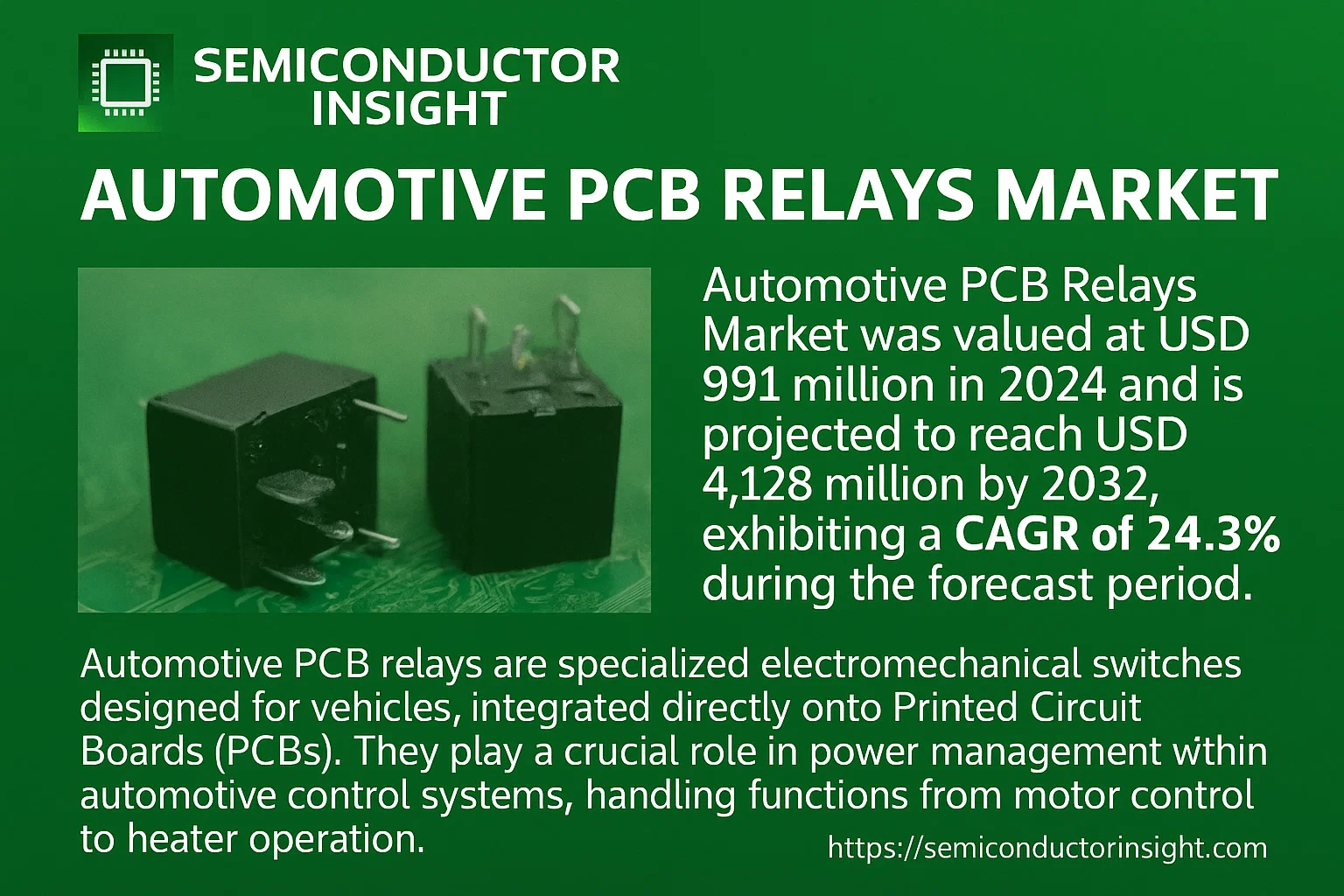
Global Automotive PCB Relays Market was valued at USD 991 million in 2024 and is projected to reach USD 4128 million by 2032, exhibiting a CAGR of 24.3% during the forecast period.
Automotive PCB relays are specialized electromechanical switches designed for vehicles, integrated directly onto Printed Circuit Boards (PCBs). They play a crucial role in power management within automotive control systems, handling functions from motor control to heater operation. These relays are essential for modern vehicles, enabling the automation of electrical components, contributing to safety features, and supporting the increasing demand for electrical conveniences.
The market is experiencing rapid growth due to several factors, including the global rise in vehicle production, particularly the shift towards electric vehicles (EVs) which require more electronic components. Additionally, the increasing integration of advanced driver-assistance systems (ADAS) and in-vehicle infotainment systems, which rely on these relays, is a significant driver. The market is also benefiting from the ongoing digital transformation in the automotive industry and the growing demand for energy-efficient components.
Regionally, Asia Pacific holds the largest market share, primarily due to high production volumes in China, Japan, and South Korea. North America and Europe also represent significant markets due to their advanced automotive industries and high adoption rates of new technologies. Market leaders include Hongfa, TE Connectivity, and Panasonic, among others, who are focusing on innovation and expanding their production capacities to meet the growing demand.
MARKET DRIVERS
Increasing Vehicle Electrification and Automation
The global push towards vehicle electrification is a primary driver for the automotive PCB relay market. The proliferation of electric vehicles (EVs) and hybrid electric vehicles (HEVs) necessitates a higher number of PCB relays per vehicle to manage low-voltage auxiliary systems, battery management, and power distribution. Furthermore, the advancement of autonomous driving features, such as Advanced Driver-Assistance Systems (ADAS), requires sophisticated electronic control units (ECUs) that rely on reliable PCB relays for signal switching and circuit protection. This trend is accelerating demand for compact, high-performance relays.
Stringent Safety and Emission Regulations
Governments worldwide are implementing stringent regulations concerning vehicle safety and emissions. Standards mandating features like automatic emergency braking, electronic stability control, and tire pressure monitoring systems directly increase the electronic content in vehicles. PCB relays are critical components in these safety-critical circuits, ensuring reliable operation. Simultaneously, emission norms are pushing automakers to improve engine efficiency, often through advanced electronic controls that depend on PCB relays for precise operation.
➤ The market for automotive PCB relays is projected to grow at a compound annual growth rate of approximately 6.5% over the next five years, fueled by these core drivers.
Additionally, the consumer demand for enhanced comfort and convenience features, such as power seats, advanced infotainment systems, and ambient lighting, further contributes to the increased adoption of PCB relays. The miniaturization of relays allows for their integration into space-constrained modules without compromising functionality.
MARKET CHALLENGES
Price Pressure and Intense Competition
The automotive PCB relay market is highly competitive, with numerous global and regional players. This creates significant price pressure, particularly from cost-sensitive segments and emerging markets. Automakers constantly seek to reduce bill-of-materials (BOM) costs, forcing relay manufacturers to optimize production processes and supply chains while maintaining high-quality standards and reliability, which is non-negotiable in automotive applications.
Other Challenges
Technical Complexities of Miniaturization
As electronic control units become more compact, there is a constant demand for smaller PCB relays with higher load-handling capabilities. This miniaturization presents engineering challenges related to heat dissipation, electrical isolation, and mechanical durability, requiring advanced materials and manufacturing techniques.
Supply Chain Vulnerabilities
The market remains susceptible to disruptions in the supply of raw materials, such as copper, silver, and plastics, and electronic components like integrated circuits. Geopolitical tensions and trade policies can also impact the stability and cost of the global supply chain, posing a significant challenge for consistent production.
MARKET RESTRAINTS
Transition to Solid-State Relays
A key restraint for the traditional electromechanical PCB relay market is the growing adoption of solid-state relays (SSRs) in certain automotive applications. SSRs offer advantages such as faster switching speeds, silent operation, and longer lifespan due to the absence of mechanical contacts. For applications requiring high-cycle durability, like LED lighting control or high-frequency switching, automakers are increasingly considering SSRs, which can limit the growth potential for electromechanical PCB relays in these niches.
Slower Growth in Conventional Vehicle Segments
While electrification is a strong driver, growth in the traditional internal combustion engine (ICE) vehicle market has plateaued or declined in several mature economies. Since ICE vehicles historically use a significant number of PCB relays, any stagnation or contraction in this segment acts as a restraint on the overall market growth, offsetting some of the gains from the electric vehicle sector.
MARKET OPPORTUNITIES
Expansion in Electric and Hybrid Vehicle Platforms
The most significant opportunity lies in the robust expansion of the electric vehicle market. Each new EV model represents a fresh platform requiring a complete set of PCB relays for various functions, from battery disconnect units to charging control systems. As EV penetration increases globally, the demand for specialized, high-reliability PCB relays is expected to surge, creating substantial growth avenues for manufacturers.
Innovation in Relay Technology
There is a clear opportunity for manufacturers who invest in R&D to develop next-generation PCB relays. Innovations focusing on higher switching capacity in smaller form factors, improved energy efficiency, and enhanced compatibility with 48-volt electrical systems used in mild-hybrid vehicles can create a competitive edge. Developing relays with advanced materials that offer better thermal performance and longer operational life will be key to capturing high-value segments.
Growth in Emerging Markets
Emerging economies in Asia Pacific, Latin America, and Africa present significant long-term opportunities. Rising disposable incomes, increasing vehicle production, and the gradual introduction of safety and emission regulations in these regions will drive the adoption of electronic components, including PCB relays. Establishing a strong distribution and manufacturing presence in these growth markets is a strategic opportunity for global players.
Automotive PCB Relays Market Trends
Accelerated Market Growth Driven by Vehicle Electrification
The Automotive PCB Relays market is experiencing a period of substantial expansion, with the global market valued at $991 million in 2024 and projected to reach $4,128 million by 2032, representing a compound annual growth rate (CAGR) of 24.3%. This aggressive growth trajectory is primarily fueled by the automotive industry’s rapid shift towards electrification. As vehicles incorporate more advanced electronic control units (ECUs), power management systems, and sophisticated comfort, convenience, and safety features, the demand for reliable, compact PCB-mounted relays has surged. These components are fundamental for managing higher electrical loads in modern vehicle architectures.
Other Trends
Consolidated Market Leadership and Regional Dynamics
The market is characterized by a high degree of consolidation, with the top three manufacturers—Hongfa, TE Connectivity, and Panasonic—collectively holding approximately 72% of the global market share. Hongfa dominates as the world’s largest manufacturer, controlling over 49% of the market. Geographically, North America, Europe, and China constitute the primary markets, accounting for more than 85% of global demand. China stands as the single largest market, holding a substantial 48% share, driven by its massive automotive production and adoption of electric vehicles.
Product Type and Application Segmentation
In terms of product segmentation, Power Relays are the dominant category, capturing more than 84% of the market. Their prevalence is due to their critical role in handling high-current applications within vehicles. When analyzed by application, the Power System segment leads, accounting for approximately 38% of the market. This is followed by systems for Lighting, Comfort and Convenience, and Safety and Protection, all of which rely heavily on the switching capabilities of PCB relays to function reliably.
Future Outlook and Competitive Strategies
The future of the Automotive PCB Relays market is intrinsically linked to the evolution of the automotive sector. The continuous development of electric vehicles (EVs), autonomous driving technologies, and advanced driver-assistance systems (ADAS) will require even more sophisticated and robust relay solutions. This technological progression presents both opportunities and challenges for manufacturers, who must innovate to produce relays that are more efficient, durable, and compact. Key players are focused on research and development to maintain competitiveness, with strategies centered on enhancing product performance and expanding production capacity to meet the escalating global demand.
COMPETITIVE LANDSCAPE
Key Industry Players
A Market Characterized by High Concentration and Technological Demands
The global market for Automotive PCB Relays is highly concentrated, with the top three manufacturers—Hongfa, TE Connectivity, and Panasonic—collectively holding a dominant share of approximately 72% of the market. Chinese manufacturer Hongfa is the undisputed global leader, commanding an overwhelming market share of more than 49%. This significant concentration is driven by economies of scale, extensive manufacturing capabilities, and strong relationships with major automotive OEMs. The competitive dynamics are heavily influenced by the technical requirements of modern vehicles, including the need for reliability, miniaturization, and the ability to handle higher electrical loads associated with advanced driver-assistance systems (ADAS) and electric vehicle powertrains. The Power Relay segment is the largest product category, accounting for over 84% of the market, underscoring the critical role these components play in managing substantial electrical currents.
Beyond the market leaders, several other significant players maintain strong positions by focusing on technological niches and regional strengths. Companies like Omron and EM Devices are recognized for their high-reliability components used in safety and protection systems. DENSO ELECTRONICS leverages its deep integration within the broader automotive supply chain of its parent company. Regional players such as BYD, Sanyou Relays, and Ningbo Huaguan Electronics hold considerable sway in the Asia-Pacific market, particularly in China, which is the world’s largest market for these components with a 48% share. These companies compete on factors such as price, customization, and the ability to meet the stringent quality and durability standards demanded by the automotive industry, often securing contracts for specific vehicle models or subsystems.
List of Key Automotive PCB Relays Companies Profiled
- Hongfa
- TE Connectivity
- Panasonic
- DENSO ELECTRONICS
- EM Devices
- Omron
- BYD
- Sanyou Relays
- Ningbo Huaguan Electronics
- IMO Precision Controls
- FCL Components
- Durakool
- Fujitsu Component Limited
- Sharp Microelectronics
Segment Analysis:
| Segment Category | Sub-Segments | Key Insights |
| By Type |
|
Power Relay stands as the clear market leader, driven by its critical function in handling high current loads for core vehicle operations like engine management and electric motor control. The increasing electrification of vehicle architectures, including the proliferation of electric vehicles, significantly boosts demand for robust power management solutions. Signal relays, while essential for low-power control circuits, cater to a more niche set of applications, making power relays the dominant force shaping product development and supply chain focus. |
| By Application |
|
Power System is the leading application segment, as PCB relays are fundamental components for reliable power distribution and management within a vehicle’s core electrical architecture. This segment’s dominance is reinforced by the critical need for fail-safe operation in systems controlling the engine, battery, and alternative power sources, especially in hybrid and electric vehicles. The Safety and Protection System segment is also a significant growth area, driven by the mandatory inclusion and increasing sophistication of advanced driver-assistance systems (ADAS) that require precise and reliable switching. |
| By End User |
|
Original Equipment Manufacturers (OEMs) represent the dominant end-user segment, as the vast majority of PCB relays are integrated into vehicles during initial production. This segment’s requirements dictate industry standards, focusing on high volume, reliability, and stringent quality certifications to meet automotive-grade specifications. The Electric Vehicle Specialists segment is emerging as a highly influential and fast-growing category, with unique demands for relays capable of handling higher voltages and more frequent switching cycles inherent to electric powertrains. |
| By Vehicle Type |
|
Passenger Vehicles constitute the largest segment by volume, driven by global production scales and the continuous integration of more electronic features in cars. However, the Electric Vehicles segment is the primary growth engine for the market, as their complex electrical systems require a significantly higher number of specialized PCB relays for battery management, power conversion, and motor control. Commercial vehicles also present a stable demand, with a focus on relays that offer extreme durability and reliability for demanding operational environments. |
| By Sales Channel |
|
Direct Sales (OEM Integration) is the leading channel, characterized by long-term supply agreements and just-in-time delivery models directly between relay manufacturers and automotive assembly plants. This channel demands high levels of coordination and quality assurance. The Distribution Network serves the aftermarket and smaller repair shops, requiring robust logistics for part availability. While Online Retail is a smaller segment, it is growing as a channel for hobbyists, specialized technicians, and for sourcing obsolete components, emphasizing the need for reliable authenticity and part information. |
Regional Analysis: Automotive PCB Relays Market
Asia-Pacific
The region benefits from an unparalleled electronics manufacturing ecosystem, with integrated supply chains that efficiently produce and supply PCB relays. Proximity to major semiconductor and PCB fabricators allows for rapid prototyping and volume production, giving automakers in the region a significant advantage in cost and speed to market for new vehicle models featuring advanced relay-dependent systems.
As the epicenter of global electric vehicle production, Asia-Pacific generates massive demand for specialized PCB relays used in battery management, powertrain control, and charging systems. Concurrently, the rapid adoption of ADAS and in-vehicle infotainment in the region’s premium and mass-market vehicles is pushing the need for more sophisticated, miniaturized, and reliable relay solutions.
A strong culture of innovation, supported by significant R&D investments from both automotive OEMs and component suppliers, keeps the region at the forefront of PCB relay technology. Development is focused on enhancing relay durability, reducing size, improving switching capabilities for high-voltage applications in EVs, and increasing integration with vehicle control units.
Favorable government policies promoting vehicle electrification, local manufacturing, and technological self-sufficiency create a highly conducive environment for the automotive PCB relay market. Incentives for EV adoption and stringent emissions regulations indirectly drive demand for the advanced electronic components, including relays, that are essential for modern, efficient vehicles.
North America
The North American market for Automotive PCB Relays is characterized by high demand for premium and technologically advanced vehicles, particularly in the United States and Canada. The region’s strong focus on vehicle safety, connectivity, and comfort features fuels the need for reliable relays used in ADAS, infotainment, and power distribution systems. The growing production of electric trucks and SUVs by domestic manufacturers is a key growth driver, requiring robust relay solutions for high-current applications. A mature automotive aftermarket also contributes to steady replacement demand. The market is highly competitive, with a focus on product innovation to meet the specific requirements of North American vehicle architectures and consumer preferences for feature-rich automobiles.
Europe
Europe is a significant and sophisticated market for Automotive PCB Relays, driven by the presence of premium automotive brands and stringent regulatory standards. The region’s strong push towards electrification, with ambitious targets for EV adoption, creates substantial demand for relays used in electric powertrains and charging infrastructure. German automotive engineering, in particular, demands high-performance, durable relays for luxury vehicles’ complex electrical systems. Safety regulations mandating advanced safety systems ensure a consistent baseline demand. The market is also influenced by a trend towards vehicle lightweighting and miniaturization of components, pushing relay manufacturers to develop more compact and efficient solutions that meet the high-quality standards of European OEMs.
South America
The South American market for Automotive PCB Relays is a developing landscape, with growth largely concentrated in Brazil and Argentina. The market dynamics are influenced by economic fluctuations which impact new vehicle sales and, consequently, the demand for OEM relays. There is a growing but gradual adoption of vehicles with more advanced electronic features, which is slowly increasing the demand for PCB relays beyond basic functionalities. The aftermarket plays a relatively important role due to the age of the vehicle fleet in some countries. The region presents potential for future growth as economic conditions stabilize and global automotive trends, such as increased electronic content per vehicle, gradually permeate the market.
Middle East & Africa
The Automotive PCB Relays market in the Middle East & Africa is diverse and emerging. The Gulf Cooperation Council (GCC) countries exhibit demand driven by high-end vehicle imports and a preference for luxury cars with advanced electronic systems. In contrast, other parts of the region have markets focused more on reliability and cost-effectiveness for basic vehicle functions, with demand tied to economic conditions and vehicle parc growth. The region’s harsh environmental conditions, including extreme heat and dust, place a premium on the durability and reliability of electronic components like PCB relays. The market potential is linked to overall economic development and the gradual modernization of the automotive sector across the continent.
Report Scope
This market research report provides a comprehensive analysis of the Automotive PCB Relays Market , covering the forecast period 2025–2032. It offers detailed insights into market dynamics, technological advancements, competitive landscape, and key trends shaping the industry.
Key focus areas of the report include:
- Market Overview: The report begins with an overview outlining its current market scenario, key growth indicators, and industry transformation drivers. It discusses macroeconomic factors, demand–supply balance, regulatory landscape, and the strategic role of semiconductors in powering advancements across industries such as automotive, telecommunications, consumer electronics, and industrial automation.
- Market Size & Forecast: Historical data and future projections for revenue, unit shipments, and market value across major regions and segments.
- Segmentation Analysis: Detailed breakdown by product type, technology, application, and end-user industry to identify high-growth segments and investment opportunities.
- Regional Insights: Insights into market performance across North America, Europe, Asia-Pacific, Latin America, and the Middle East & Africa, including country-level analysis where relevant.
- Competitive Landscape: Profiles of leading market participants, including their product offerings, R&D focus, manufacturing capacity, pricing strategies, and recent developments such as mergers, acquisitions, and partnerships.
- Technology Trends & Innovation: Assessment of emerging technologies, integration of AI/IoT, semiconductor design trends, fabrication techniques, and evolving industry standards.
- Market Drivers & Restraints: Evaluation of factors driving market growth along with challenges, supply chain constraints, regulatory issues, and market-entry barriers.
- Stakeholder Insights: Insights for component suppliers, OEMs, system integrators, investors, and policymakers regarding the evolving ecosystem and strategic opportunities.
Primary and secondary research methods are employed, including interviews with industry experts, data from verified sources, and real-time market intelligence to ensure the accuracy and reliability of the insights presented.
FREQUENTLY ASKED QUESTIONS:
What is the current market size of Automotive PCB Relays Market?
-> Global Automotive PCB Relays Market was valued at USD 991 million in 2024 and is projected to reach USD 4128 million by 2032, at a CAGR of 24.3% during the forecast period.
Which key companies operate in Automotive PCB Relays Market?
-> Key players include Hongfa, TE Connectivity, Panasonic, DENSO ELECTRONICS, EM Devices, Omron, BYD, Sanyou Relays, Ningbo Huaguan Electronics, IMO Precision Controls, FCL Components, and Durakool, among others.
What are the key growth drivers?
-> Key growth drivers include increasing vehicle electrification, demand for safety and comfort features, and the crucial role of relays in power management for modern automotive control systems.
Which region dominates the market?
-> China is the largest market, accounting for a 48% share, while North America and Europe are also major markets, collectively holding over 85% of the global market share with China.
What are the emerging trends?
-> Emerging trends include increasing integration in power systems, the dominance of power relays as a product segment, and the expansion of application areas within vehicle comfort, convenience, and safety systems.

Get Sample Report PDF for Exclusive Insights
Report Sample Includes
- Table of Contents
- List of Tables & Figures
- Charts, Research Methodology, and more...