Automotive MEMS Accelerometer Market Insights
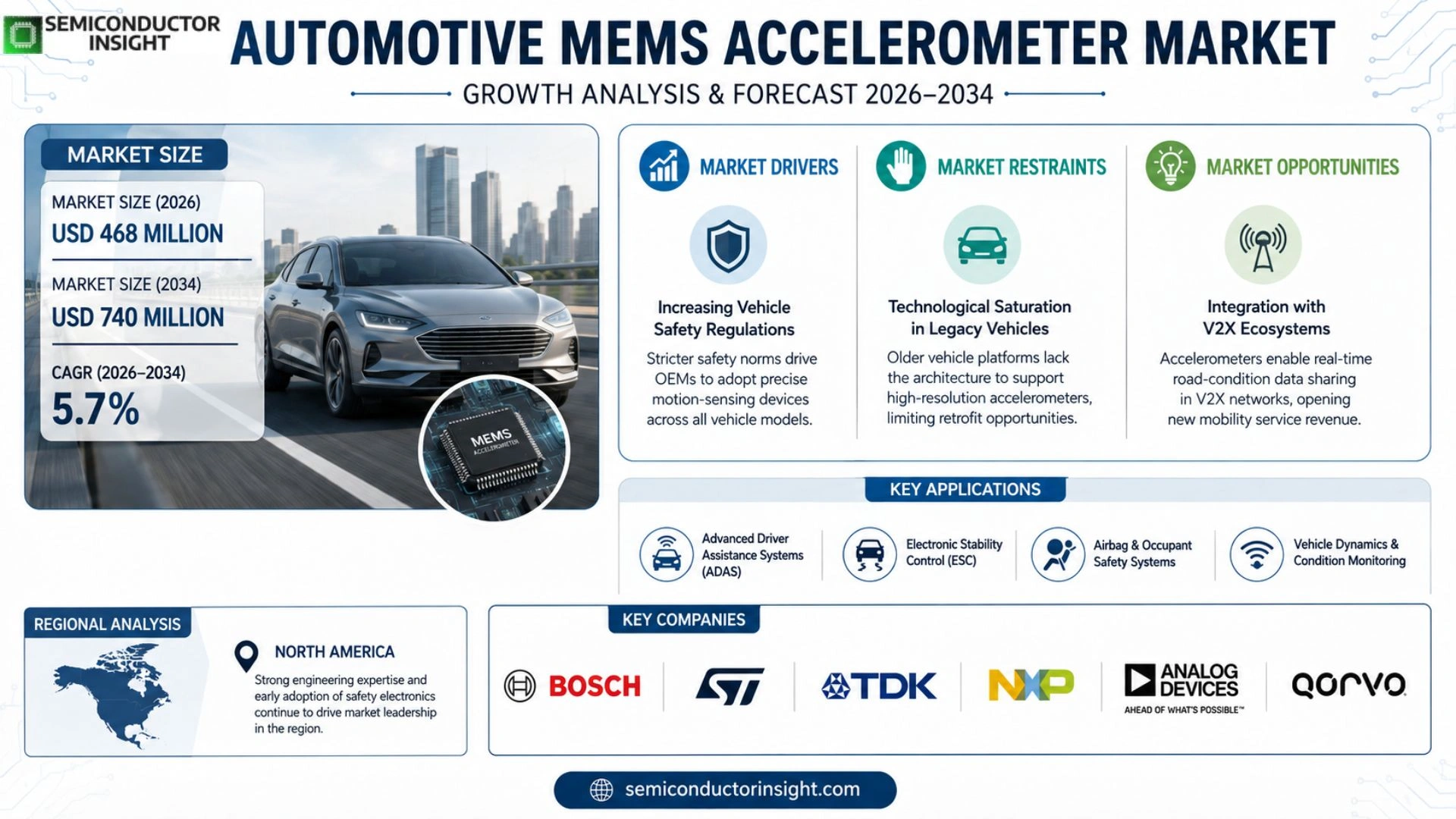
Automotive MEMS Accelerometer market was valued at USD 451 million in 2025 and will grow to approximately USD 740 million by 2034, implying an average annual growth rate of roughly 5.7% over the nine‑year horizon.
An automotive MEMS accelerometer is a vehicle‑grade motion sensor built on micro‑electro‑mechanical systems technology that measures linear acceleration, deceleration, vibration, shock and tilt, converting these forces into electrical signals for electronic control units that support safety, stability and vehicle‑dynamics functions.
The upward trajectory reflects expanding electronic content per vehicle as manufacturers embed accelerometers in airbag systems, electronic stability control and advanced driver‑assistance features; furthermore, the shift toward integrated inertial measurement units adds functional value while raising unit prices.
MARKET DRIVERS
Increasing Vehicle Safety Regulations
The tightening of safety standards across North America, Europe and China compels OEMs to embed more precise motion‑sensing devices. Automotive MEMS Accelerometer Market suppliers that can certify compliance see immediate demand because manufacturers must demonstrate crash‑worthiness and occupant protection in every new model.
Shift Toward Advanced Driver‑Assistance Systems (ADAS)
ADAS functions,such as electronic stability control, automated emergency braking and lane‑keeping,rely on accelerometers that translate vehicle dynamics into actionable data. Companies that integrate sensor fusion architectures gain a competitive edge as carmakers race to meet consumer expectations for semi‑autonomous capabilities.
➤ Manufacturers that pair MEMS accelerometers with AI‑driven calibration software can shorten development cycles by up to 30 %.
Beyond safety, the rise of shared‑mobility fleets drives a need for predictive maintenance. Accurate vibration monitoring allows fleet operators to schedule component replacement before failure, reducing downtime and total cost of ownership.
MARKET CHALLENGES
Cost Sensitivity in High‑Volume Platforms
While performance requirements are rising, price pressure remains intense for mass‑market segments. Suppliers that cannot achieve sub‑$0.50 unit cost risk exclusion from large‑scale program bids, forcing a trade‑off between feature richness and affordability.
Other Challenges
Supply‑Chain Volatility
Lead‑time fluctuations for silicon wafers and rare‑earth materials have introduced scheduling uncertainty. OEMs are increasingly demanding dual‑source strategies, which adds complexity for niche sensor makers.
Regulatory divergence between regions also creates engineering overhead. Aligning a single hardware design with differing crash‑test protocols can inflate validation budgets, discouraging smaller players from entering the space.
MARKET RESTRAINTS
Technological Saturation in Legacy Vehicles
Established vehicle platforms that were designed before the ADAS boom often lack the electronic architecture to support high‑resolution accelerometers. Retrofit solutions are costly, limiting upsell opportunities for sensor vendors in those fleets.
MARKET OPPORTUNITIES
Integration with Vehicle‑to‑Everything (V2X) Ecosystems
As automakers build V2X communication stacks, accelerometers become a data source for real‑time road‑condition sharing. Companies that offer open‑API sensor platforms can embed their devices into broader mobility services, unlocking new revenue streams beyond the traditional OEM supply model.
Automotive MEMS Accelerometer Market Trends
Electronic Content & Safety Integration
The surge in electronic architecture across passenger and commercial vehicles has turned Automotive MEMS Accelerometer market into a key enabler for safety‑critical functions. Modern platforms now embed multiple accelerometers to support airbag sequencing, electronic stability control, traction control and rollover detection. As regulations tighten on crash performance and multi‑airbag deployment, manufacturers are forced to add redundant sensors, inflating both unit counts and average selling price. The trend is especially pronounced in electric vehicles, where weight‑saving strategies and high‑voltage safety systems rely on precise motion detection. Consequently, suppliers that can guarantee automotive‑grade reliability under vibration and temperature extremes see larger contract volumes and stronger pricing power.
Other Trends
Multi‑Sensor Integration & Inertial Measurement Units
Beyond single‑function devices, the market is shifting toward compact modules that fuse accelerometers with gyroscopes, magnetometers and environmental sensors. This integration satisfies the data‑bandwidth demands of advanced driver‑assistance systems and emerging autonomous stacks, where centimeter‑level localization and chassis‑control algorithms depend on synchronized inertial data. OEMs are allocating engineering resources to system‑level validation, creating a niche for higher‑margin, calibrated IMU solutions. Suppliers that bundle sensor fusion software with hardware gain a competitive edge, as they can offer turnkey packages that reduce development time for Tier‑1 integrators.
Predictive Maintenance & Connected Vehicle Services
Vehicle health monitoring is increasingly driven by continuous vibration analysis captured by accelerometers. Fleet operators and ride‑hailing services leverage this data to predict bearing wear, suspension fatigue and other failure modes, enabling over‑the‑air diagnostics and usage‑based maintenance schedules. The commercial‑vehicle segment, with its high mileage and uptime requirements, is adopting these capabilities at a rapid pace, prompting sensor manufacturers to enhance durability specifications and integrate secure telemetry interfaces. The ripple effect is a steadier demand pipeline for robust accelerometer designs that can survive harsh operating environments while delivering consistent diagnostic signals.
COMPETITIVE LANDSCAPE
Key Industry Players
Automotive MEMS Accelerometer market – competitive positioning and strategic trends
Bosch remains the de‑facto anchor of the automotive MEMS accelerometer segment, leveraging its deep OEM relationships and extensive sensor portfolio to embed accelerometers across safety‑critical systems such as airbag control units and electronic stability programs. The firm’s ability to scale unit volumes while maintaining automotive‑grade reliability has entrenched it as the primary supplier for most global vehicle manufacturers. By aligning its roadmap with emerging ADAS and electric‑vehicle architectures, Bosch has shifted from selling discrete accelerometers to offering integrated inertial modules that combine acceleration, gyroscope and temperature sensing. This evolution not only raises the average selling price but also deepens Bosch’s bargaining power in tier‑1 contracts, reinforcing a market structure where a few large Tier‑1s dominate the high‑volume, high‑reliability slice, while niche innovators vie for specialist applications.
Beyond the dominant players, a cluster of technologically agile firms is reshaping the competitive set. STMicroelectronics and NXP Semiconductors have accelerated their MEMS roadmaps, targeting multi‑axis inertial measurement units that feed autonomous‑driving algorithms. Murata and TDK focus on miniaturized, low‑noise designs suited for electric‑vehicle power‑train vibration monitoring, while analog‑centric companies such as Analog Devices and Honeywell bring high‑precision signal‑conditioning expertise to the table. Smaller specialists,including Kistler, Meggitt Sensing Systems, Memsic, MiraMEMS, Safran, HBK, Kyowa Electronic Instruments, MT Microsystems, QST Corporation, XDLK Microsystem and Memsensing Microsystems,concentrate on niche verticals such as commercial‑vehicle predictive maintenance, heavy‑duty chassis diagnostics, and aftermarket retrofit solutions. Their collective presence injects diversity into the supply chain, pressuring incumbents to innovate on cost, integration and functional breadth.
List of Key Automotive MEMS Accelerometer Companies Profiled
- Bosch
- STMicroelectronics
- NXP Semiconductors
- Murata Manufacturing
- Analog Devices
- TDK
- ROHM Semiconductor
- Honeywell
- TE Connectivity
- Kistler
- Meggitt Sensing Systems
- Memsic
- MiraMEMS Sensing Technology
- Safran
- HBK
- Kyowa Electronic Instruments
- MT Microsystems
- QST Corporation
- XDLK Microsystem
- Memsensing Microsystems
Segment Analysis:
| Segment Category | Sub-Segments | Key Insights |
| By Type |
|
Capacitive Type is favored for its high sensitivity and low noise, supporting core safety functions such as airbag deployment and ESC. – Enables reliable detection of rapid deceleration events in crash scenarios. – Provides stable performance across wide temperature ranges typical of automotive environments. – Facilitates integration with multi‑sensor fusion architectures for advanced driver assistance. |
| By Application |
|
Passenger Vehicle drives the majority of accelerometer integration, linked to safety and comfort features. – Supports airbag systems, electronic stability control, and rollover detection. – Provides essential data for active chassis control and ride‑quality management. – Serves as a platform for integrating emerging ADAS and autonomous functionalities. |
| By End User |
|
OEMs command strategic importance, embedding accelerometers early in vehicle architecture. – Require stringent compliance with automotive safety standards and long‑term reliability. – Influence sensor specification through vehicle platform design and safety regulations. – Drive demand for integrated modules that combine accelerometers with other inertial sensors. |
| By Axis |
|
Multi‑axis accelerometers are increasingly adopted for richer motion profiling. – Enable comprehensive detection of vehicle dynamics across three dimensions. – Support higher‑level functions such as precise localization, vibration diagnostics, and predictive maintenance. – Align with the industry shift toward integrated inertial measurement units (IMUs) for autonomous driving platforms. |
| By Structure |
|
Closed‑loop structures dominate premium applications where precision and stability are paramount. – Offer superior linearity and temperature compensation, essential for safety‑critical systems. – Provide enhanced signal integrity for integration with vehicle‑wide sensor networks. – Align with the trend of multi‑sensor modules that require accurate, low‑drift inertial data. |
Regional Analysis: Automotive MEMS Accelerometer Market
North America
Safety legislation in the United States and Canada increasingly references electronic stability functions, prompting vehicle designers to integrate accelerometers that can detect minute changes in longitudinal and lateral motion. These rules shape supplier road‑maps, as compliance becomes a prerequisite for market entry rather than an optional feature.
Major manufacturers allocate substantial R&D budgets toward sensor fusion platforms, recognising that precision accelerometers are a cornerstone of advanced driver‑assistance and fully autonomous concepts. Their procurement strategies favour partners that can demonstrate design‑for‑manufacturability and long‑term reliability.
Universities and research institutes across the Midwest and West Coast maintain strong programs in micro‑electromechanical systems, feeding a pipeline of engineers who specialise in high‑g accelerometer design. This talent concentration lowers hiring friction for firms seeking to expand sensor capabilities.
Drivers increasingly expect vehicles to anticipate road irregularities and adjust suspension settings in real time. Accelerometers that deliver granular vibration data enable these comfort‑focused features, reinforcing brand differentiation in a competitive market.
Europe
European carmakers balance stringent type‑approval standards with a strong push toward electrification, creating a fertile ground for accelerometer integration in both conventional and electric powertrains. The EU’s emphasis on vehicle‑to‑infrastructure communication encourages sensor suites that can relay motion data to external traffic management systems. Manufacturers such as Germany’s premium brands leverage this requirement to differentiate their safety portfolios, while French and Italian firms explore lightweight MEMS solutions to offset the weight penalties of larger battery packs. Supplier alliances across the continent focus on modular designs that can be scaled across multiple vehicle segments, ensuring that the European market remains a hotbed for cross‑functional sensor innovation.
Asia‑Pacific
In Asia‑Pacific, rapid urbanisation and a burgeoning middle class drive demand for vehicles equipped with advanced safety assists. Chinese and Indian manufacturers, in particular, are scaling production volumes while seeking cost‑effective MEMS accelerometers that do not compromise on performance. Local government initiatives that promote smart‑city infrastructure indirectly boost the need for vehicle sensors capable of interacting with connected roadways. Meanwhile, Japan’s established automotive supply chain continues to push the envelope on sensor precision, feeding both domestic and export markets. The region’s diverse regulatory landscape forces suppliers to adopt flexible design approaches that can satisfy a range of compliance regimes.
South America
South American markets exhibit a growing awareness of vehicle safety, spurred by rising consumer expectations and incremental regulatory tightening. While overall vehicle sales volumes remain modest compared with larger regions, manufacturers are increasingly standardising electronic stability control systems, which rely on accurate accelerometer inputs. Local OEMs and importers favour suppliers that can provide robust devices capable of handling the region’s varied road conditions, from smooth urban arteries to rugged rural routes. Partnerships between regional tier‑one firms and multinational players are emerging, aiming to tailor sensor solutions that reflect both cost sensitivities and performance demands.
Middle East & Africa
The Middle East & Africa present a mixed landscape where luxury vehicle adoption coexists with developing automotive sectors. In wealthier Gulf states, premium brands integrate high‑resolution accelerometers to support advanced driver‑assistance suites that cater to discerning buyers. Conversely, in many African markets, the focus lies on durable, low‑cost sensor options that can survive extreme temperature fluctuations and challenging road surfaces. Governments across the region are beginning to introduce safety regulations that reference active electronic controls, nudging manufacturers toward broader adoption of accelerometer technology. This dual‑track demand encourages suppliers to diversify product portfolios, balancing premium performance with rugged affordability.
Report Scope
This market research report provides a comprehensive analysis of the Automotive MEMS Accelerometer Market , covering the forecast period 2026–2034. It offers detailed insights into market dynamics, technological advancements, competitive landscape, and key trends shaping the industry.
Key focus areas of the report include:
- Market Overview: The report begins with an overview outlining its current market scenario, key growth indicators, and industry transformation drivers. It discusses macroeconomic factors, demand–supply balance, regulatory landscape, and the strategic role of semiconductors in powering advancements across industries such as automotive, telecommunications, consumer electronics, and industrial automation.
- Market Size & Forecast: Historical data and future projections for revenue, unit shipments, and market value across major regions and segments.
- Segmentation Analysis: Detailed breakdown by product type, technology, application, and end-user industry to identify high-growth segments and investment opportunities.
- Regional Insights: Insights into market performance across North America, Europe, Asia-Pacific, Latin America, and the Middle East & Africa, including country-level analysis where relevant.
- Competitive Landscape: Profiles of leading market participants, including their product offerings, R&D focus, manufacturing capacity, pricing strategies, and recent developments such as mergers, acquisitions, and partnerships.
- Technology Trends & Innovation: Assessment of emerging technologies, integration of AI/IoT, semiconductor design trends, fabrication techniques, and evolving industry standards.
- Market Drivers & Restraints: Evaluation of factors driving market growth along with challenges, supply chain constraints, regulatory issues, and market-entry barriers.
- Stakeholder Insights: Insights for component suppliers, OEMs, system integrators, investors, and policymakers regarding the evolving ecosystem and strategic opportunities.
Primary and secondary research methods are employed, including interviews with industry experts, data from verified sources, and real-time market intelligence to ensure the accuracy and reliability of the insights presented.
FREQUENTLY ASKED QUESTIONS:
What is the current market size of Automotive MEMS Accelerometer Market?
-> Automotive MEMS Accelerometer market will grow to approximately USD 740 million by 2034, implying an average annual growth rate of roughly 5.7%
Which key companies operate in Automotive MEMS Accelerometer Market?
-> Key players include Bosch, NXP Semiconductors, STMicroelectronics, Murata Manufacturing, PCB Piezotronics, Analog Devices, TDK, ROHM Semiconductor, Honeywell, TE Connectivity, Kistler, Meggitt Sensing Systems, Memsic, MiraMEMS Sensing Technology, Safran, HBK, Kyowa Electronic Instruments, MT Microsystems, QST Corporation, XDLK Microsystem, Memsensing Microsystems.
What are the key growth drivers?
-> Key growth drivers include Growing electronic content and safety‑system integration in vehicles, shift toward multi‑sensor integration and advanced inertial measurement units, and rising demand for predictive maintenance and condition monitoring in connected vehicles.
Which region dominates the market?
-> Asia‑Pacific leads Automotive MEMS Accelerometer market, driven by high vehicle production volumes, rapid EV adoption, and extensive safety‑system deployments, while Europe and North America remain significant contributors.
What are the emerging trends?
-> Emerging trends include integration of MEMS accelerometers into multi‑sensor modules for ADAS and autonomous driving, increased use in condition‑monitoring platforms for predictive maintenance, and expanding applications in electric vehicles and connected car ecosystems.

Get Sample Report PDF for Exclusive Insights
Report Sample Includes
- Table of Contents
- List of Tables & Figures
- Charts, Research Methodology, and more...
 Download Sample Report PDF