
Automotive Memory Market Insights
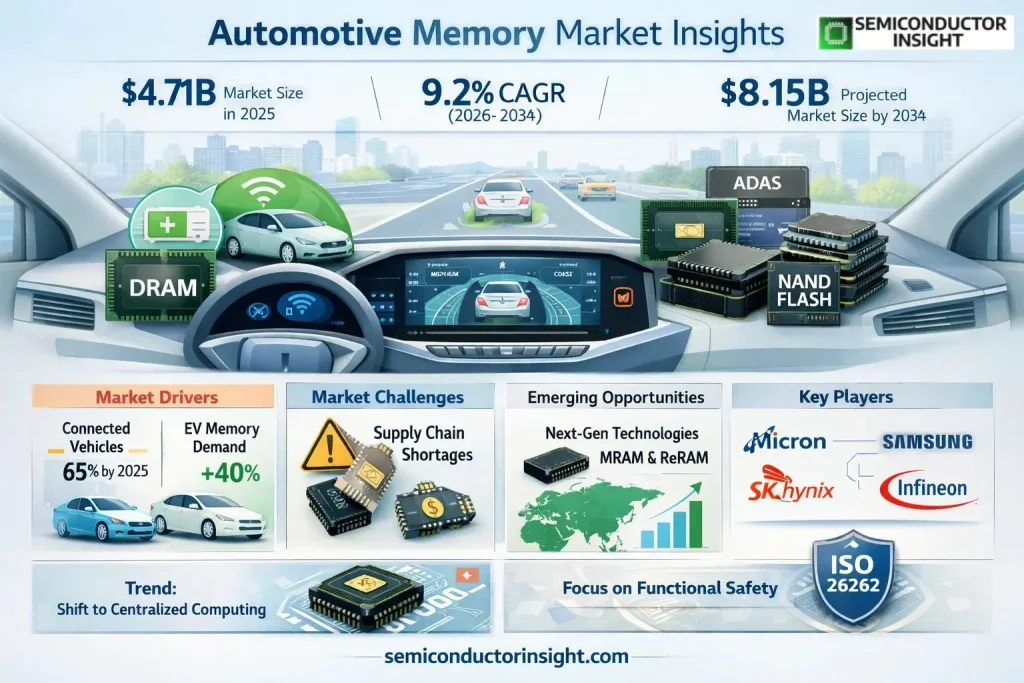
The global automotive memory market size was valued at USD 4.71 billion in 2025. The market is projected to grow from USD 5.12 billion in 2026 to USD 8.15 billion by 2034, exhibiting a CAGR of 9.2% during the forecast period.
Automotive memory, also known as semiconductor memory, utilizes semiconductor circuits as storage media for binary data and is a critical component in modern digital systems. With advancements in vehicle intelligence and connectivity, the demand for high-performance memory chips has surged due to increased processing requirements for video, voice, and sensor data. In 2025, global production reached 2.16 billion units, with an average selling price of USD 2.39 per unit.
The shift toward smart cockpits, autonomous driving systems, and centralized computing architectures is accelerating the need for higher-bandwidth DRAM and robust storage solutions like eMMC, UFS, and SSD. However, supply chain constraints driven by competition from AI server markets pose challenges for automotive-grade memory availability.
MARKET DRIVERS
Advancements in Connected Vehicle Technologies
The automotive memory market is experiencing significant growth due to the rapid adoption of connected vehicle technologies. With over 65% of new vehicles expected to feature embedded connectivity by 2025, demand for high-performance memory solutions like DDR4 and LPDDR5 is surging. Automotive memory chips are critical for processing real-time data from advanced driver-assistance systems (ADAS).
Electric Vehicle Boom Driving Demand
The global shift toward electric vehicles is creating new opportunities for automotive memory manufacturers, as EVs require 40% more memory capacity than traditional vehicles for battery management and powertrain control systems. Market projections indicate a 22% CAGR for memory solutions in EV applications through 2030.
The integration of AI-powered infotainment systems is expected to triple the per-vehicle memory requirements by 2027.
Memory-intensive applications like autonomous driving and over-the-air updates continue to push the boundaries of automotive memory market capabilities, with leading manufacturers developing specialized solutions for extreme temperature operation.
MARKET CHALLENGES
Supply Chain Disruptions Impacting Production
The automotive memory market faces serious challenges from ongoing semiconductor shortages, with lead times for critical components extending beyond 40 weeks in some cases. Automakers are forced to redesign systems to accommodate available memory solutions, creating compatibility issues.
Other Challenges
Temperature and Reliability Requirements
Developing memory solutions that meet automotive-grade temperature ranges (-40°C to 125°C) while maintaining data integrity presents significant technical hurdles for manufacturers.
Cybersecurity Concerns
As vehicles become more connected, the automotive memory market must address growing vulnerabilities to cyber threats, requiring additional investment in secure memory architectures.
MARKET RESTRAINTS
High Development Costs Limiting Innovation
The automotive memory market is constrained by the substantial R&D investments required to develop ASIL-compliant solutions. Certification processes for automotive-grade memory can add 25-30% to development costs, creating barriers for smaller players.
MARKET OPPORTUNITIES
Emerging Memory Technologies
Next-generation memory solutions like MRAM and ReRAM are poised to transform the automotive memory market, offering non-volatile storage with faster access times and lower power consumption. Market analysts predict these technologies will capture 18% of the automotive memory segment by 2028.
Regional Expansion in Asia-Pacific
With automotive production in Asia-Pacific growing at 7.5% annually, memory manufacturers are investing heavily in local production facilities to serve automakers in China, South Korea, and Japan, creating significant growth potential for the automotive memory market.
Automotive Memory Market Trends
Transition to Core Computing Resource
Automotive memory is evolving from a peripheral component to a critical computing resource in vehicles. The shift is driven by increasing demand for high-performance memory to process data from advanced driver-assistance systems (ADAS), infotainment, and autonomous driving functions. Modern vehicles now require DRAM with higher bandwidth and NAND flash with greater endurance to handle real-time sensor fusion and AI-based decision making.
Other Trends
Supply Chain Constraints
The automotive memory market faces cyclical availability due to competing demand from AI servers and consumer electronics. Suppliers prioritize advanced memory production for higher-margin segments, leading OEMs to implement long-term agreements and dual-sourcing strategies. Regionalization of supply chains is accelerating as automakers seek to mitigate geopolitical risks.
Technology Diversification
Memory architectures are diversifying to meet varied automotive requirements – from low-power SRAM for sensor nodes to high-bandwidth GDDR6 for AI accelerators. The market sees growing adoption of UFS 3.1 and automotive SSDs for centralized compute platforms, while maintaining legacy support for EEPROM in ECU applications. Thermal management solutions are becoming critical for reliable operation in harsh environments.
Functional Safety Standards
Compliance with ISO 26262 functional safety standards is increasingly influencing memory design choices. Suppliers are developing ASIL-rated memory solutions with built-in error correction, wear-leveling algorithms and extended temperature tolerance (-40°C to 125°C) to meet automotive reliability requirements over 10+ year vehicle lifecycles.
Regional Production Shifts
Asia-Pacific dominates automotive memory production with 68% market share, led by South Korean and Japanese manufacturers. Europe and North America are investing in localized memory supply chains to support domestic automotive industries. Emerging memory technologies like MRAM are gaining traction for niche applications requiring radiation hardness and instant-on capability.
COMPETITIVE LANDSCAPEKey Industry Players
Automotive Memory Market Sees Intensifying Competition Amid Rising Demand
The automotive memory market is dominated by major semiconductor manufacturers with established automotive qualification systems and broad product portfolios. Micron Technology leads the market with comprehensive DRAM and NAND solutions for infotainment and ADAS applications, followed closely by Samsung and SK Hynix Semiconductor who leverage their advanced memory manufacturing capabilities. Specialized automotive suppliers like ISSI (acquired by SinoMCU) and Cypress (Infineon) maintain strong positions through focus on reliability and long lifecycle support.
Emerging competition comes from memory specialists expanding into automotive, such as KIOXIA with its UFS solutions, and controller vendors integrating memory solutions. Chinese players like GigaDevice and Giantec Semiconductor are gaining traction through local OEM partnerships, while traditional players like Winbond and Macronix maintain strong positions in NOR flash for critical automotive applications. The market is seeing increased vertical integration as Tier 1s and OEMs seek to secure supply chains.
List of Key Automotive Memory Companies Profiled
- Micron Technology
- Samsung
- SK Hynix Semiconductor
- ISSI (Integrated Silicon Solution Inc.)
- KIOXIA
- STMicroelectronics
- Cypress (Infineon)
- Western Digital
- onsemi
- Nanya Technology
- Winbond
- GigaDevice
- Macronix
- Giantec Semiconductor
Segment Analysis:
| Segment Category | Sub-Segments | Key Insights |
| By Type |
|
NAND Flash dominates due to high capacity requirements for infotainment and ADAS systems
|
| By Application |
|
ADAS Applications show fastest growth trajectory driving high-performance memory needs
|
| By End User |
|
OEM Direct Procurement is becoming more prevalent with memory strategic importance
|
| By Vehicle Type |
|
Electric Vehicles demonstrate highest memory content per vehicle
|
| By Architecture |
|
Domain Controllers are reshaping memory requirements
|
Regional Analysis: Global Automotive Memory Market
Asia-Pacific
China’s automotive memory sector thrives through strategic partnerships between domestic automakers and semiconductor firms, focusing on secure memory architectures for connected vehicles. The government’s semiconductor self-sufficiency push accelerates development of NAND flash solutions for automotive applications.
Japanese memory manufacturers lead in developing rugged, temperature-resistant automotive memory solutions. Their expertise in high-reliability flash memory supports advanced vehicle ECUs and AI processing in autonomous driving systems, with strong collaboration across the keiretsu network.
South Korea’s memory leaders are pioneering automotive-grade DRAM solutions for AI-powered vehicle systems. Their cutting-edge memory technologies enable real-time processing for autonomous driving, with strong integration across the automotive supply chain from semiconductors to finished vehicles.
Asia-Pacific benefits from integrated memory supply chains supporting automotive OEMs, with specialized foundries producing automotive-grade memory chips. This ecosystem enables rapid prototyping and implementation of memory solutions tailored to regional vehicle architectures and safety standards.
North America
The North American automotive memory market is propelled by demand for autonomous and electric vehicles, particularly in the U.S. Tech giants and automotive OEMs collaborate on specialized memory architectures for AI-driven vehicle systems. The region leads in flash memory adoption for over-the-air updates and cybersecurity applications. Memory suppliers are developing solutions meeting stringent automotive safety standards while supporting the computational needs of next-generation vehicle platforms. Regional innovation focuses on memory solutions for vehicle-to-everything (V2X) communication and edge computing applications.
Europe
Europe’s automotive memory market emphasizes safety-critical applications and energy-efficient designs. German automakers work closely with memory suppliers to develop ASIL-compliant solutions for advanced driver systems. The region shows strong adoption of NOR flash memory for critical vehicle functions and emerging interest in non-volatile memory for automotive AI applications. EU regulations on vehicle data processing and cybersecurity are shaping memory architecture requirements, with manufacturers developing secure memory solutions for connected car ecosystems.
South America
South America’s automotive memory market is growing gradually as vehicle electrification expands across Brazil and Argentina. The region focuses on cost-effective memory solutions for entry-level connected vehicle features. Local production of memory-intensive infotainment systems drives demand for automotive-grade DRAM. Market growth is supported by regional trade agreements facilitating technology transfer in automotive electronics, with increasing adoption of flash memory for basic telematics applications.
Middle East & Africa
The MEA automotive memory market is emerging, with premium vehicle segments driving initial adoption of advanced memory solutions. Regional development focuses on memory technologies supporting vehicle connectivity in harsh environmental conditions. Gulf Cooperation Council countries are investing in smart mobility infrastructure, creating demand for reliable automotive memory solutions. Local manufacturers prioritize rugged memory products capable of withstanding extreme temperatures prevalent in the region.
Report Scope
This market research report provides a comprehensive analysis of the Automotive Memory Market, covering the forecast period 2025–2034. It offers detailed insights into market dynamics, technological advancements, competitive landscape, and key trends shaping the industry.
Key focus areas of the report include:
- Market Overview: The report begins with an overview outlining its current market scenario, key growth indicators, and industry transformation drivers. It discusses macroeconomic factors, demand–supply balance, regulatory landscape, and the strategic role of semiconductors in powering advancements across industries such as automotive, telecommunications, consumer electronics, and industrial automation.
- Market Size & Forecast: Historical data and future projections for revenue, unit shipments, and market value across major regions and segments.
- Segmentation Analysis: Detailed breakdown by product type, technology, application, and end-user industry to identify high-growth segments and investment opportunities.
- Regional Insights: Insights into market performance across North America, Europe, Asia-Pacific, Latin America, and the Middle East & Africa, including country-level analysis where relevant.
- Competitive Landscape: Profiles of leading market participants, including their product offerings, R&D focus, manufacturing capacity, pricing strategies, and recent developments such as mergers, acquisitions, and partnerships.
- Technology Trends & Innovation: Assessment of emerging technologies, integration of AI/IoT, semiconductor design trends, fabrication techniques, and evolving industry standards.
- Market Drivers & Restraints: Evaluation of factors driving market growth along with challenges, supply chain constraints, regulatory issues, and market-entry barriers.
- Stakeholder Insights: Insights for component suppliers, OEMs, system integrators, investors, and policymakers regarding the evolving ecosystem and strategic opportunities.
Primary and secondary research methods are employed, including interviews with industry experts, data from verified sources, and real-time market intelligence to ensure the accuracy and reliability of the insights presented.
FREQUENTLY ASKED QUESTIONS:
What is the current market size of Automotive Memory Market?
-> Global Automotive Memory Market was valued at USD 4713 million in 2025 and is projected to reach USD 8152 million by 2034, at a CAGR of 9.2% during the forecast period.
Which key companies operate in Automotive Memory Market?
-> Key players include Micron Technology, Samsung, SK Hynix Semiconductor, ISSI (Integrated Silicon Solution Inc.), KIOXIA, STMicroelectronics, Cypress (Infineon), Western Digital, onsemi, Nanya Technology, Winbond, GigaDevice, Macronix, and Giantec Semiconductor.
What are the key growth drivers?
-> Key growth drivers include increasing demand for vehicle intelligence and connectivity, proliferation of multi-screen smart cockpits, rising need for on-device AI applications, and shift toward domain controllers and centralized computing architectures.
Which region dominates the market?
-> Asia-Pacific is the fastest-growing region, driven by automotive production and technological adoption in countries like China, Japan, and South Korea.
What are the emerging trends?
-> Emerging trends include automotive-grade reliability requirements, compute-memory co-optimization, data tiering and compression technologies, and local supplier qualification acceleration.

Get Sample Report PDF for Exclusive Insights
Report Sample Includes
- Table of Contents
- List of Tables & Figures
- Charts, Research Methodology, and more...
 Download Sample Report PDF