Automotive Low-side Gate Drivers Market Insights
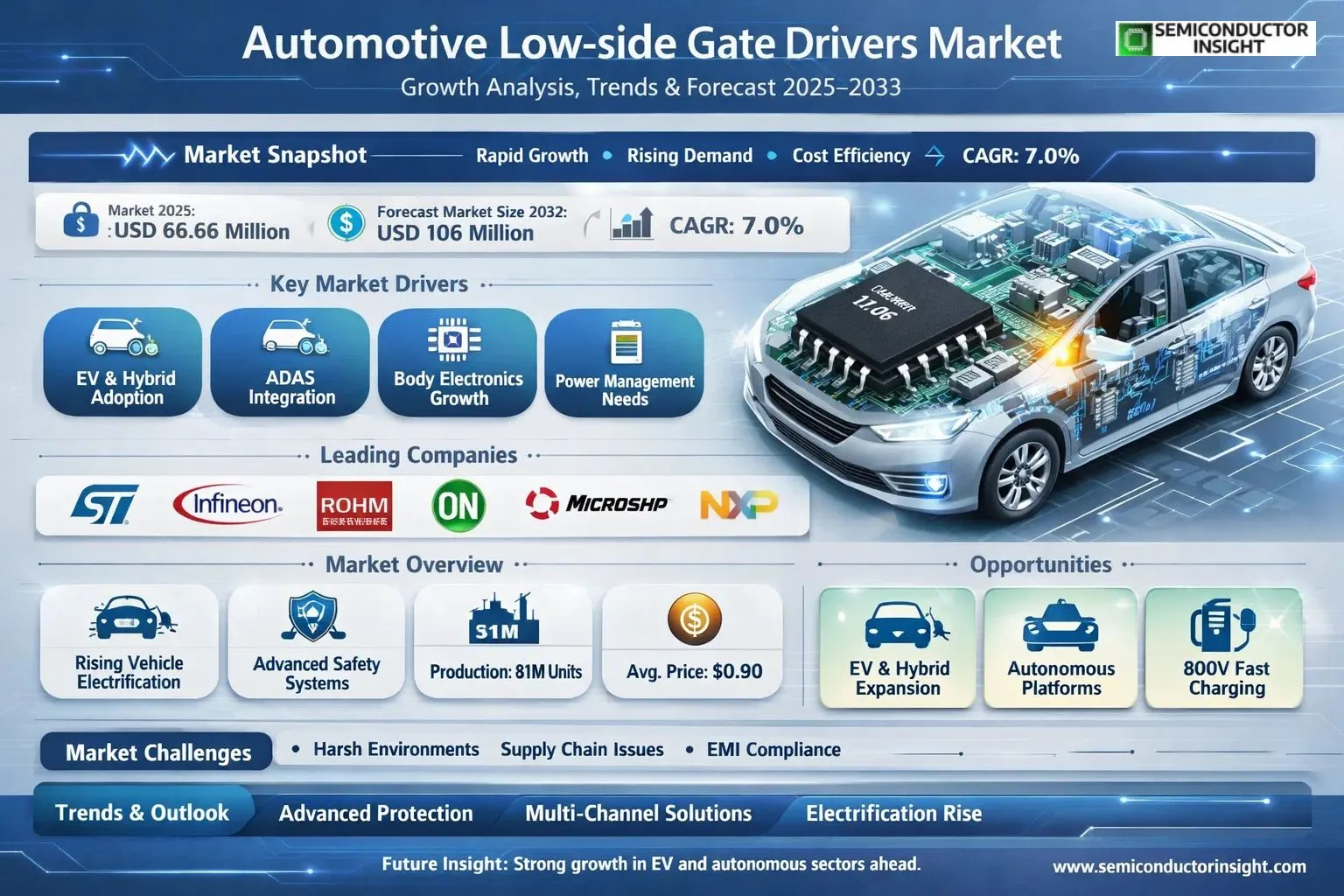
Global Automotive Low-side Gate Drivers market size was valued at USD 66.66 million in 2025. The market is projected to reach USD 106 million by 2032, exhibiting a CAGR of 7.0% during the forecast period.
Automotive Low-side Gate Drivers are automotive-grade ICs that drive low-side power transistors, delivering fast and stable gate control with integrated protection to ensure efficient switching and reliable load actuation in vehicle power and actuator systems. In 2025, production was about 81 million units and the average price was USD 0.9 per unit. The industry’s capacity utilization rate in 2025 was about 60% and the average gross margin was around 45%.
The market is experiencing robust growth due to the steady rise of electrical loads and power-domain complexity in modern vehicles. While high-volume platforms pressure costs, automakers value drivers that reduce system losses, simplify wiring, and enhance reliability under harsh conditions. Initiatives by key players, including new designs and supply chain optimizations, further fuel expansion. STMicroelectronics, Infineon, Rohm Semiconductor, ON Semiconductor, Microchip Technology, Renesas Electronics, and NXP Semiconductors are prominent with strong portfolios supporting passenger cars and commercial vehicles.
MARKET DRIVERS
Electrification of Automotive Powertrains
Automotive Low-side Gate Drivers Market is propelled by the rapid shift toward electric vehicles (EVs), where efficient power management is essential. Low-side gate drivers enable precise control of MOSFETs in battery management systems and DC-DC converters, improving energy efficiency by up to 20% in high-voltage applications. With global EV sales projected to reach 17 million units annually by 2025, demand for robust drivers in automotive power electronics continues to surge.
Integration in ADAS and Infotainment
Advanced Driver Assistance Systems (ADAS) and infotainment units rely on low-side gate drivers for stable power distribution in sensor arrays and actuators. These drivers support fast switching frequencies above 100 kHz, reducing electromagnetic interference (EMI) in compact modules. Automotive Low-side Gate Drivers Market benefits from stringent AEC-Q100 qualification standards, ensuring reliability in automotive environments.
➤ Key growth factor: EV battery systems require low-side drivers for bidirectional current control, boosting market expansion at a CAGR of 9.2% through 2030.
Additionally, the push for 48V mild-hybrid architectures amplifies adoption, as these systems demand high-current handling capabilities from low-side gate drivers to optimize fuel efficiency and reduce emissions in conventional vehicles transitioning to hybrids.
MARKET CHALLENGES
Harsh Environmental Demands
Automotive Low-side Gate Drivers Market faces significant hurdles due to extreme automotive conditions, including temperatures from -40°C to 150°C and high vibration levels. Ensuring long-term reliability under these stresses requires advanced packaging, which complicates design and increases testing cycles. Failure rates must stay below 10 PPM to meet automotive safety integrity levels (ASIL).
Other Challenges
Supply Chain Disruptions
Semiconductor shortages have delayed production of low-side gate drivers, impacting OEM timelines for next-gen vehicles. Dependence on specialized silicon carbide (SiC) substrates exacerbates vulnerabilities in global supply networks.
EMI Compliance Issues
Balancing high-speed switching with EMI regulations like CISPR 25 remains challenging, often necessitating additional filtering that raises system costs by 15-20%.Integration with system-on-chip (SoC) solutions for space-constrained applications further strains engineering resources in Automotive Low-side Gate Drivers Market.
MARKET RESTRAINTS
High Development and Certification Costs
Elevated R&D expenses for Automotive Low-side Gate Drivers Market participants stem from rigorous qualification processes under ISO 26262 functional safety standards. Developing drivers tolerant to automotive transients up to 200V adds substantial costs, limiting entry for smaller players and consolidating market share among top-tier suppliers.Cost pressures from OEMs demanding price reductions of 5-7% annually restrain innovation, as margins for advanced features like integrated protection circuits remain thin. This dynamic slows the pace of technology upgrades in power stages for inverters and converters.Regulatory hurdles, including evolving EMC directives across regions, impose additional validation burdens, extending time-to-market by 12-18 months for new Automotive Low-side Gate Drivers Market products.Competition from integrated power modules (IPMs) that bundle drivers with switches further caps standalone driver growth, pushing manufacturers toward full-system solutions.
MARKET OPPORTUNITIES
Expansion in EV and Hybrid Ecosystems
Automotive Low-side Gate Drivers Market holds strong potential in scaling EV powertrains, particularly for onboard chargers and traction inverters requiring efficient low-side control. With SiC MOSFET adoption rising, drivers optimized for 650V-1200V ratings can capture a projected 25% market share increase by 2028.Opportunities emerge in 800V architectures for ultra-fast charging, where low-side gate drivers enable precise phase-leg control to minimize losses. This aligns with automakers’ goals for 500 km range in under 20-minute charges.Growth in autonomous driving platforms offers avenues for multi-channel drivers supporting redundant power domains, enhancing system safety and reliability in level 4+ vehicles.Emerging markets in Asia-Pacific, driven by local EV production hubs, present untapped demand, with Automotive Low-side Gate Drivers Market expected to grow at 11% CAGR in the region through 2030.
Automotive Low-side Gate Drivers Market Trends
Integration of Advanced Protection and Diagnostics
Automotive Low-side Gate Drivers Market is witnessing a strong push toward devices that provide fast and stable gate control for low-side power transistors, with integrated protection features ensuring efficient switching and reliable load actuation in vehicle systems. Production reached about 81 million units in 2025 at an average price of USD 0.9 per unit, reflecting capacity utilization around 60% and gross margins near 45%. This trend underscores how suppliers secure profitability through high-volume design wins, platform reuse across models, and manufacturing quality that minimizes field failures and qualification rework, positioning Automotive Low-side Gate Drivers Market for sustained growth amid rising electrical loads in modern vehicles.
Other Trends
Shift Toward Multi-Channel and Voltage Flexibility
Demand in Automotive Low-side Gate Drivers Market is shifting toward dual-channel configurations alongside single-channel options, supporting both 12V and 24V systems to meet diverse power needs in passenger cars and commercial vehicles. Packaging advancements like SOIC and TSSOP formats enhance compactness and thermal performance, aiding integration into body electronics, chassis control, and auxiliary power management. This flexibility allows suppliers like STMicroelectronics, Infineon, and Rohm Semiconductor to address automaker requirements for simplified wiring, reduced system losses, and faster validation cycles.
Rise in Electrification and Regional Expansion
As vehicle electrification accelerates, Automotive Low-side Gate Drivers Market benefits from increased adoption in power-domain architectures, where robust fault handling, EMC compliance, and lifetime reliability are paramount. Key customers including Toyota, Volkswagen, Ford, and BYD prioritize suppliers offering stable quality, design-in support, and supply assurance. Upstream reliance on silicon wafers from Shin-Etsu Chemical and SUMCO, paired with midstream focus on analog design and automotive qualification, drives midstream innovations. Regionally, Asia’s dominance with China, Japan, and South Korea leads, while Europe and North America see growth in commercial vehicle applications. Profitability hinges on embedding these drivers into long-lifecycle platforms and balancing cost with integration depth, as competitors like NXP Semiconductors and Microchip Technology vie for share through recent developments in protection integration and volume test strategies.
COMPETITIVE LANDSCAPE
Key Industry Players
Dominant Leaders and Strategic Challengers in Automotive Low-side Gate Drivers
Automotive Low-side Gate Drivers Market is dominated by a few semiconductor powerhouses, with STMicroelectronics and Infineon Technologies leading due to their extensive automotive-grade IC portfolios, high-volume production capabilities, and deep integration into vehicle power systems. These frontrunners leverage platform reuse across OEM platforms from Toyota to Volkswagen, securing design wins that support stable pricing and gross margins near 45% amid 60% capacity utilization. Their focus on fast switching, integrated protection, and AEC-Q100 qualification positions them strongly in a market projected to grow from $66.66 million in 2025 to $106 million by 2032 at 7.0% CAGR, driven by rising electrical loads in body electronics and chassis control.
Supporting the leaders are specialized players like Rohm Semiconductor, ON Semiconductor, Microchip Technology, Renesas Electronics, and NXP Semiconductors, which excel in niche segments such as single/dual-channel drivers for 12V/24V systems in SOIC and TSSOP packages. These firms differentiate through cost-competitive solutions, enhanced EMC robustness, and application support for passenger cars and commercial vehicles, targeting OEMs like Ford, BYD, and Geely. Smaller contenders including Power Integrations, Analog Devices, Skyworks, IXYS, and Diodes Incorporated contribute via innovative fault handling and reliability features, fostering a competitive ecosystem where mid-tier innovation challenges top-tier scale.
List of Key Automotive Low-side Gate Drivers Companies Profiled
- STMicroelectronics
- Infineon Technologies
- Rohm Semiconductor
- ON Semiconductor
- Microchip Technology
- Renesas Electronics
- NXP Semiconductors
- Power Integrations
- Analog Devices
- Skyworks Solutions
- IXYS Corporation
- Diodes Incorporated
Segment Analysis:
| Segment Category | Sub-Segments | Key Insights |
| By Type |
|
Single-Channel
|
| By Application |
|
Passenger Cars
|
| By End User |
|
Body Electronics
|
| By Voltage |
|
12V
|
| By Package |
|
SOIC Package
|
Regional Analysis: Automotive Low-side Gate Drivers Market
Asia-Pacific
The shift toward EVs in Asia-Pacific intensifies demand for low-side gate drivers in traction inverters and onboard chargers. High-volume production of battery electric vehicles creates opportunities for optimized driver ICs with enhanced protection features against overcurrent and short circuits, improving overall powertrain efficiency and vehicle range.
Robust semiconductor ecosystems in the region support localized production of gate drivers, reducing lead times and costs. Proximity to automotive OEMs facilitates just-in-time delivery, while advancements in silicon carbide integration elevate performance in high-voltage applications critical for premium EV models.
R&D centers in Japan and Taiwan pioneer compact, high-frequency low-side drivers for ADAS and infotainment systems. Cross-industry collaborations drive fault-tolerant designs, ensuring reliability in safety-critical automotive functions and accelerating market penetration.
Government incentives for green mobility in China and India promote widespread adoption of advanced gate drivers. Emission standards and subsidies for EV infrastructure bolster Automotive Low-side Gate Drivers Market, encouraging supplier diversification and technological upgrades.
North America
North America exhibits strong growth in Automotive Low-side Gate Drivers Market, driven by premium electric vehicle development and advanced driver-assistance systems (ADAS). Leading automakers prioritize high-performance power electronics for next-gen SUVs and trucks, where low-side gate drivers ensure precise control in bidirectional converters and auxiliary motor drives. A mature semiconductor industry supports custom solutions tailored to rugged automotive conditions, emphasizing electromagnetic compatibility and thermal resilience. Investments in domestic chip fabrication mitigate supply risks, fostering innovation in integrated driver modules for 800V architectures. Regulatory emphasis on fuel efficiency and autonomous driving technologies further propels demand, positioning the region as a key player in high-end Automotive Low-side Gate Drivers Market segments.
Europe
Europe maintains a competitive edge in Automotive Low-side Gate Drivers Market through stringent environmental regulations and a focus on sustainable mobility. The push for battery electric and plug-in hybrid vehicles integrates efficient low-side drivers into onboard power systems, optimizing energy management and regenerative braking. Collaborative initiatives among OEMs and suppliers in Germany and France advance silicon-based and wide-bandgap driver technologies for compact inverters. Emphasis on cybersecurity and functional safety standards drives development of robust, isolated gate drivers suited for connected vehicles. This region excels in premium passenger cars, where superior switching speeds enhance drivetrain performance and compliance with Euro emission norms.
South America
South America is an emerging market for Automotive Low-side Gate Drivers, with Brazil and Mexico leading adoption amid vehicle electrification efforts. Local production of light-duty trucks and sedans incorporates these drivers in cost-sensitive powertrains, focusing on reliability for diverse terrains. Government biofuels and EV incentives spur transitions from internal combustion engines, creating demand for versatile gate drivers in mild hybrids. Supply chain localization reduces import dependencies, while partnerships with global players introduce advanced features like overvoltage protection. Automotive Low-side Gate Drivers Market here benefits from growing middle-class vehicle ownership and infrastructure investments.
Middle East & Africa
The Middle East & Africa region shows nascent potential in Automotive Low-side Gate Drivers Market, transitioning from oil-reliant fleets to electrified transport. Gulf countries invest in EV charging networks and smart city projects, integrating low-side drivers in fleet electrification for buses and logistics. Harsh climate adaptations prioritize thermally efficient designs for desert conditions. African markets focus on affordable hybrids, where durable gate drivers support basic power conversion needs. International collaborations accelerate technology transfer, gradually expanding Automotive Low-side Gate Drivers Market amid urbanization and energy diversification trends.
Report Scope
This market research report provides a comprehensive analysis of Automotive Low-side Gate Drivers Market, covering the forecast period 2026–2034. It offers detailed insights into market dynamics, technological advancements, competitive landscape, and key trends shaping the industry.
Key focus areas of the report include:
- Market Overview: The report begins with an overview outlining its current market scenario, key growth indicators, and industry transformation drivers. It discusses macroeconomic factors, demand–supply balance, regulatory landscape, and the strategic role of semiconductors in powering advancements across industries such as automotive, telecommunications, consumer electronics, and industrial automation.
- Market Size & Forecast: Historical data and future projections for revenue, unit shipments, and market value across major regions and segments.
- Segmentation Analysis: Detailed breakdown by product type, technology, application, and end-user industry to identify high-growth segments and investment opportunities.
- Regional Insights: Insights into market performance across North America, Europe, Asia-Pacific, Latin America, and the Middle East & Africa, including country-level analysis where relevant.
- Competitive Landscape: Profiles of leading market participants, including their product offerings, R&D focus, manufacturing capacity, pricing strategies, and recent developments such as mergers, acquisitions, and partnerships.
- Technology Trends & Innovation: Assessment of emerging technologies, integration of AI/IoT, semiconductor design trends, fabrication techniques, and evolving industry standards.
- Market Drivers & Restraints: Evaluation of factors driving market growth along with challenges, supply chain constraints, regulatory issues, and market-entry barriers.
- Stakeholder Insights: Insights for component suppliers, OEMs, system integrators, investors, and policymakers regarding the evolving ecosystem and strategic opportunities.
Primary and secondary research methods are employed, including interviews with industry experts, data from verified sources, and real-time market intelligence to ensure the accuracy and reliability of the insights presented.
FREQUENTLY ASKED QUESTIONS:
What is the current market size of Automotive Low-side Gate Drivers Market?
-> Global Automotive Low-side Gate Drivers Market was valued at USD 66.66 million in 2025 and is projected to reach USD 106 million by 2032, at a CAGR of 7.0% during the forecast period.
Which key companies operate in Automotive Low-side Gate Drivers Market?
-> Key players include STMicroelectronics, Infineon, Rohm Semiconductor, ON Semiconductor, Microchip Technology, Renesas Electronics, NXP Semiconductors, among others.
What are the key growth drivers?
-> Key growth drivers include steady rise of electrical loads and power-domain complexity in modern vehicles, integration of body electronics, chassis control, and auxiliary power management systems.
Which region dominates the market?
-> Asia dominates the market, driven by major OEMs such as Toyota, BYD, SAIC Motor, and Geely Auto.
What are the emerging trends?
-> Emerging trends include robust protection, diagnostics, fault tolerance, reduced system losses, simplified wiring architectures, and high-volume design wins with platform reuse.

Get Sample Report PDF for Exclusive Insights
Report Sample Includes
- Table of Contents
- List of Tables & Figures
- Charts, Research Methodology, and more...
 Download Sample Report PDF