Automotive IC Market Insights
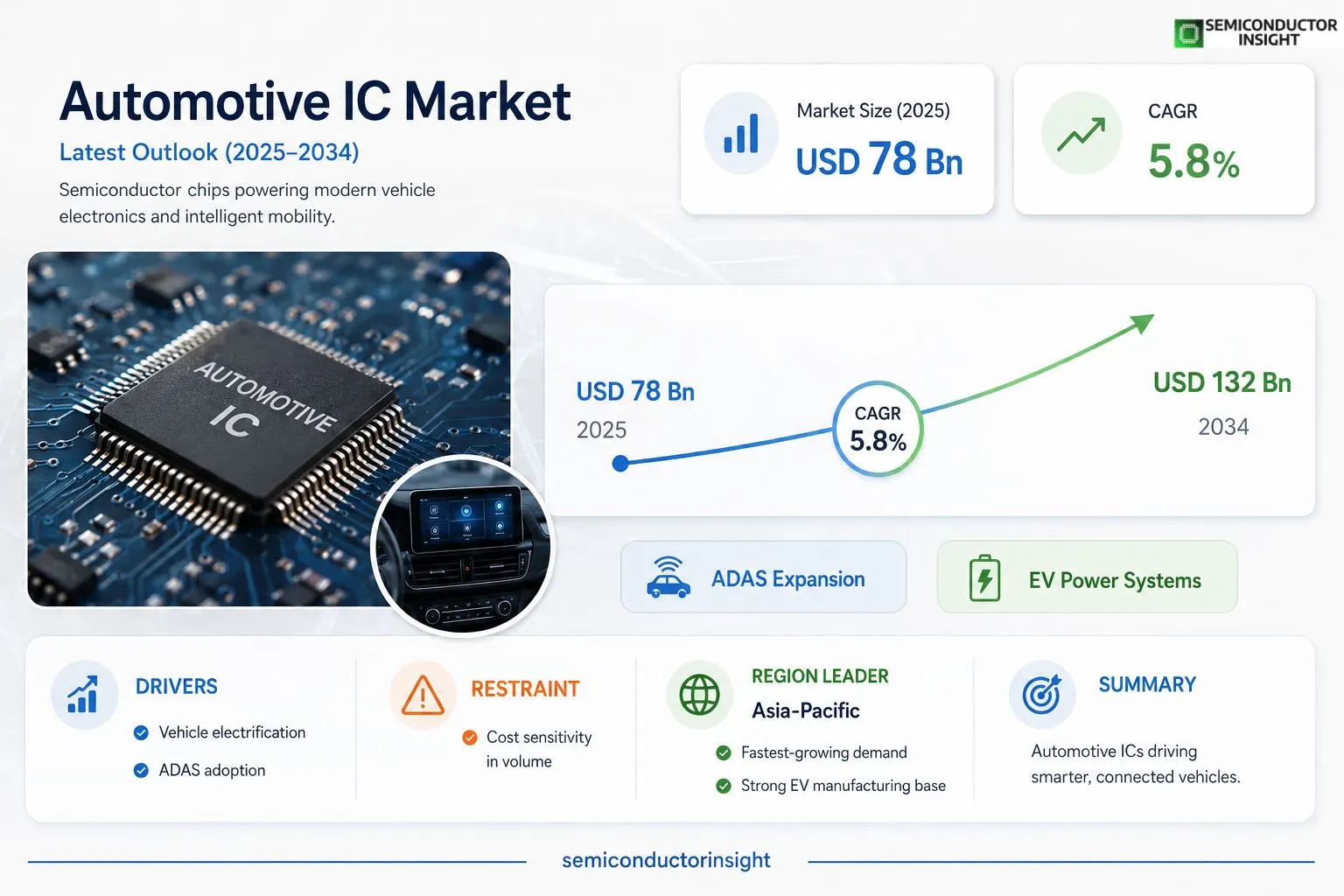
Global automotive IC market size was valued at USD 78 billion in 2025. The market is projected to grow from USD 78 billion in 2025 to USD 132 billion by 2034, exhibiting a CAGR of 5.8% during the forecast period.
Automotive integrated circuits (ICs) are semiconductor components that control and manage electronic functions within vehicles, ranging from powertrain control units and infotainment processors to advanced driver‑assistance system (ADAS) sensors and electric‑vehicle battery management systems.The market is accelerating because of rapid electrification, increasing adoption of ADAS and autonomous driving technologies, and stringent emissions regulations that demand smarter power management. Furthermore, rising consumer expectations for connected car experiences are spurring higher demand for high‑performance microcontrollers and communication chips. Key players such as NXP Semiconductors, Infineon Technologies, Texas Instruments, Renesas Electronics and STMicroelectronics are expanding their portfolios through strategic partnerships and R&D investments to capture this growth.
MARKET DRIVERS
Electrification and Advanced Driver Assistance Systems
Rapid adoption of electric vehicles (EVs) is compelling automakers to integrate higher‑performance microcontrollers and power management ICs. Automotive IC Market benefits from a steady rise in battery‑monitoring and motor‑control solutions, which are essential for extending driving range and improving safety.
Connectivity and Over‑the‑Air Updates
Vehicle‑to‑everything (V2X) communication, telematics, and OTA software upgrades demand robust wireless transceivers and secure microprocessors. These trends drive demand for ICs that can handle high‑bandwidth data exchange while maintaining low latency, reinforcing growth in Automotive IC Market.
➤ In 2024, more than 60 % of new vehicle platforms incorporated at least one dedicated AI accelerator chip, underscoring the shift toward intelligent processing on board.
Regulatory pressure for stricter emissions standards also accelerates the deployment of efficient engine‑control units, further expanding the scope of Automotive IC Market across global regions.
MARKET CHALLENGES
Supply‑Chain Volatility
Semiconductor shortages continue to ripple through automotive production lines, causing lead‑time extensions that strain inventory planning. While demand remains robust, manufacturers must navigate limited wafer capacity and unpredictable allocation policies.
Other Challenges
Complex Qualification Processes
Automotive safety standards such as ISO 26262 require extensive validation cycles, increasing development costs and time‑to‑market for new IC designs.
MARKET RESTRAINTS
Cost Sensitivity in Volume Production
While premium segments adopt cutting‑edge chips, mass‑market vehicles remain highly price‑driven. The need to balance advanced functionality with unit‑cost constraints can limit the pace at which newer IC architectures are introduced, restraining overall market expansion.
MARKET OPPORTUNITIES
AI‑Enabled Perception Systems
Emerging perception stacks that combine lidar, radar, and camera inputs rely on high‑density signal‑processing ICs. Companies that can deliver low‑power AI accelerators tailored for automotive safety applications stand to capture significant market share as autonomous driving levels progress.
Automotive IC Market Trends
Electrification and Power‑Management Trends
Automotive IC Market is being reshaped by the rapid shift toward electric powertrains. Integrated circuits that manage battery‑cell balancing, thermal regulation, and high‑voltage conversion are now core components in every new electric vehicle. Manufacturers are prioritizing silicon that delivers higher efficiency while reducing footprint, because tighter energy budgets directly affect vehicle range. As a result, the design cycle for power‑management ICs has shortened, encouraging suppliers to adopt modular architectures that can be reused across multiple models. This trend not only accelerates time‑to‑market but also supports global emissions targets by enabling more precise control of energy flow throughout the vehicle.
Other Trends
Advanced Driver‑Assistance Systems (ADAS)
ADAS functionality relies heavily on sensor‑fusion processors, radar‑and‑lidar front‑ends, and real‑time image‑signal processors. Automotive IC Market has responded with a wave of heterogeneous integration, where analog front‑ends, digital signal processors, and artificial‑intelligence accelerators are combined on a single die. This consolidation reduces latency and improves reliability—critical factors for safety‑critical applications such as automatic emergency braking and lane‑keeping assistance. Leading firms are expanding their ADAS portfolios through joint development agreements with automotive OEMs, ensuring that silicon design aligns closely with evolving vehicle‑level software stacks.
Connected Vehicles and Software Integration
Connectivity continues to drive demand for high‑speed transceivers, secure communication modules, and over‑the‑air update capable microcontrollers. In Automotive IC Market, the push toward fully networked cabins means that infotainment processors must handle multiple wireless standards while maintaining low power consumption. At the same time, automotive‑grade security ICs protect vehicle‑to‑cloud interfaces against emerging cyber threats. Suppliers are increasingly offering end‑to‑end solutions that include both hardware and cloud‑enabled software services, allowing OEMs to roll out new features without physical redesigns. This model enhances customer experience and creates recurring revenue streams for semiconductor vendors.
COMPETITIVE LANDSCAPEKey Industry Players
Automotive Integrated Circuit Market – Competitive Overview
The automotive IC sector is anchored by a few global powerhouses that together command roughly 65 % of total revenue. NXP Semiconductors, Infineon Technologies, Texas Instruments, Renesas Electronics and STMicroelectronics lead the portfolio mix, covering power‑train control, ADAS sensors, infotainment processors and battery‑management solutions. Their competitive edge stems from deep automotive‑grade silicon libraries, extensive validation programs, and strategic alliances with OEMs and Tier‑1 suppliers. These firms invest heavily in R&D, expand foundry capacity, and pursue acquisitions to broaden functional coverage, reinforcing a market structure that favors scale, long‑term reliability, and comprehensive safety‑critical certifications. The projected CAGR of 5.8 % through 2034 incentivizes these leaders to secure long‑term OEM contracts and diversify into electric‑vehicle power‑train ICs.Beyond the tier‑one cohort, a diverse set of niche and emerging players enriches the ecosystem. ON Semiconductor and Microchip Technology focus on cost‑effective microcontrollers and power modules for entry‑level vehicles. Qualcomm and MediaTek leverage their mobile‑chip expertise to supply high‑performance connectivity and AI‑driven perception engines for next‑generation ADAS. Samsung Electronics and Analog Devices bring advanced memory, sensor, and mixed‑signal expertise, while Rohm Semiconductor and Maxim Integrated (now part of Analog Devices) address specialized power‑conversion needs. Intel’s Mobileye unit adds vision‑processing capabilities, and Broadcom supplies Ethernet and automotive networking solutions. The combined effort of these specialized firms accelerates functional‑safety compliance and reduces time‑to‑market for autonomous‑driving features.
List of Key Automotive IC Companies Profiled
- NXP Semiconductors
- Infineon Technologies
- Texas Instruments
- Renesas Electronics
- STMicroelectronics
- ON Semiconductor
- Microchip Technology
- Qualcomm
- MediaTek
- Samsung Electronics
- Analog Devices
- Rohm Semiconductor
- Maxim Integrated
- Intel (Mobileye)
- Broadcom
Segment Analysis:
| Segment Category | Sub-Segments | Key Insights |
| By Type |
|
Microcontrollers dominate this category because they serve as the computational core for virtually every electronic function in modern vehicles.
|
| By Application |
|
ADAS emerges as the leading application segment, driven by growing expectations for safety and autonomy.
|
| By End User |
|
Electric Vehicles are the dominant end‑user segment, influencing IC design priorities across the board.
|
| By Power Management |
|
Battery Management Systems lead this category, reflecting the strategic importance of energy storage in modern vehicles.
|
| By Connectivity & Infotainment |
|
Telematics & Infotainment dominate this segment, driven by consumer expectations for seamless digital experiences.
|
Regional Analysis: North America
North America
The demands in powertrain electronics are strong, driven by the shift towards electric and hybrid vehicles. Integrated circuits for battery management systems, motor control, and power semiconductors are experiencing rapid growth, with a continuing push for greater efficiency and range.
The proliferation of advanced driver-assistance systems (ADAS) like automatic emergency braking, lane keeping assist, and adaptive cruise control is significantly boosting the demand for Automotive ICs. High-performance sensors, image processors, and control units are at the core of these systems.
The automotive infotainment market is evolving rapidly, with increasing demand for connected car services, navigation systems, and advanced multimedia capabilities. This necessitates sophisticated processors, displays, and connectivity modules.
The increasing complexity of modern vehicles necessitates robust vehicle networking solutions, with a rising demand for Automotive ICs used in communication protocols such as CAN, Ethernet, and V2X (Vehicle-to-Everything) communication.
Europe
Europe is a significant player in Automotive IC Market, characterized by stringent environmental regulations and a strong focus on sustainable mobility. The region is witnessing a rapid transition towards electric vehicles, making it a key market for power electronics and battery management systems. Moreover, Europe’s commitment to autonomous driving technologies is driving demand for advanced sensor systems and processing power. Automotive IC Market in Europe is closely tied to governmental policies promoting electrification and connectivity.
Asia-Pacific
Asia-Pacific is the largest and fastest-growing Automotive IC market globally. Driven by rapid industrialization, increasing vehicle production, and a growing middle class, the region presents enormous opportunities for IC suppliers. China is the dominant force, followed by Japan, South Korea, and India. The focus here is intensely concentrated on cost-effective solutions that meet increasingly stringent quality requirements.
South America
South America’s Automotive IC market is characterized by moderate growth, primarily driven by the expanding automotive manufacturing sector in Brazil and Argentina. The region is witnessing a gradual increase in demand for advanced features and connectivity, but affordability remains a key consideration for consumers.
Middle East & Africa
The Middle East & Africa region presents a relatively small but growing Automotive IC market. Growth is fueled by increasing vehicle ownership, particularly in countries like Saudi Arabia and the UAE. The focus remains on basic automotive functions and cost-effective solutions, with increasing interest in connected car technologies.
Report Scope
This market research report provides a comprehensive analysis of the Automotive IC Market , covering the forecast period 2026–2034. It offers detailed insights into market dynamics, technological advancements, competitive landscape, and key trends shaping the industry.
Key focus areas of the report include:
- Market Overview: The report begins with an overview outlining its current market scenario, key growth indicators, and industry transformation drivers. It discusses macroeconomic factors, demand–supply balance, regulatory landscape, and the strategic role of semiconductors in powering advancements across industries such as automotive, telecommunications, consumer electronics, and industrial automation.
- Market Size & Forecast: Historical data and future projections for revenue, unit shipments, and market value across major regions and segments.
- Segmentation Analysis: Detailed breakdown by product type, technology, application, and end-user industry to identify high-growth segments and investment opportunities.
- Regional Insights: Insights into market performance across North America, Europe, Asia-Pacific, Latin America, and the Middle East & Africa, including country-level analysis where relevant.
- Competitive Landscape: Profiles of leading market participants, including their product offerings, R&D focus, manufacturing capacity, pricing strategies, and recent developments such as mergers, acquisitions, and partnerships.
- Technology Trends & Innovation: Assessment of emerging technologies, integration of AI/IoT, semiconductor design trends, fabrication techniques, and evolving industry standards.
- Market Drivers & Restraints: Evaluation of factors driving market growth along with challenges, supply chain constraints, regulatory issues, and market-entry barriers.
- Stakeholder Insights: Insights for component suppliers, OEMs, system integrators, investors, and policymakers regarding the evolving ecosystem and strategic opportunities.
Primary and secondary research methods are employed, including interviews with industry experts, data from verified sources, and real-time market intelligence to ensure the accuracy and reliability of the insights presented.
FREQUENTLY ASKED QUESTIONS:
What is the current market size of Automotive IC Market?
-> Automotive IC Market was valued at USD 78 billion in 2025 and is expected to reach USD 132 billion by 2034, reflecting a CAGR of 5.8% over the forecast period.
Which key companies operate in Automotive IC Market?
-> Key players include NXP Semiconductors, Infineon Technologies, Texas Instruments, Renesas Electronics, and STMicroelectronics, among others.
What are the key growth drivers?
-> Key growth drivers include rapid electrification of vehicles, expanding adoption of ADAS and autonomous driving technologies, stringent emissions regulations, and rising consumer demand for connected‑car experiences.
Which region dominates the market?
-> The source does not specify a single dominant region; however, Asia‑Pacific is noted for fast growth while Europe remains a significant market.
What are the emerging trends?
-> Emerging trends include advanced driver‑assistance systems, electric‑vehicle battery management solutions, high‑performance microcontrollers, and new communication chip architectures for connected vehicles.

Get Sample Report PDF for Exclusive Insights
Report Sample Includes
- Table of Contents
- List of Tables & Figures
- Charts, Research Methodology, and more...
 Download Sample Report PDF