
Automotive Digital Electronics Market Insights
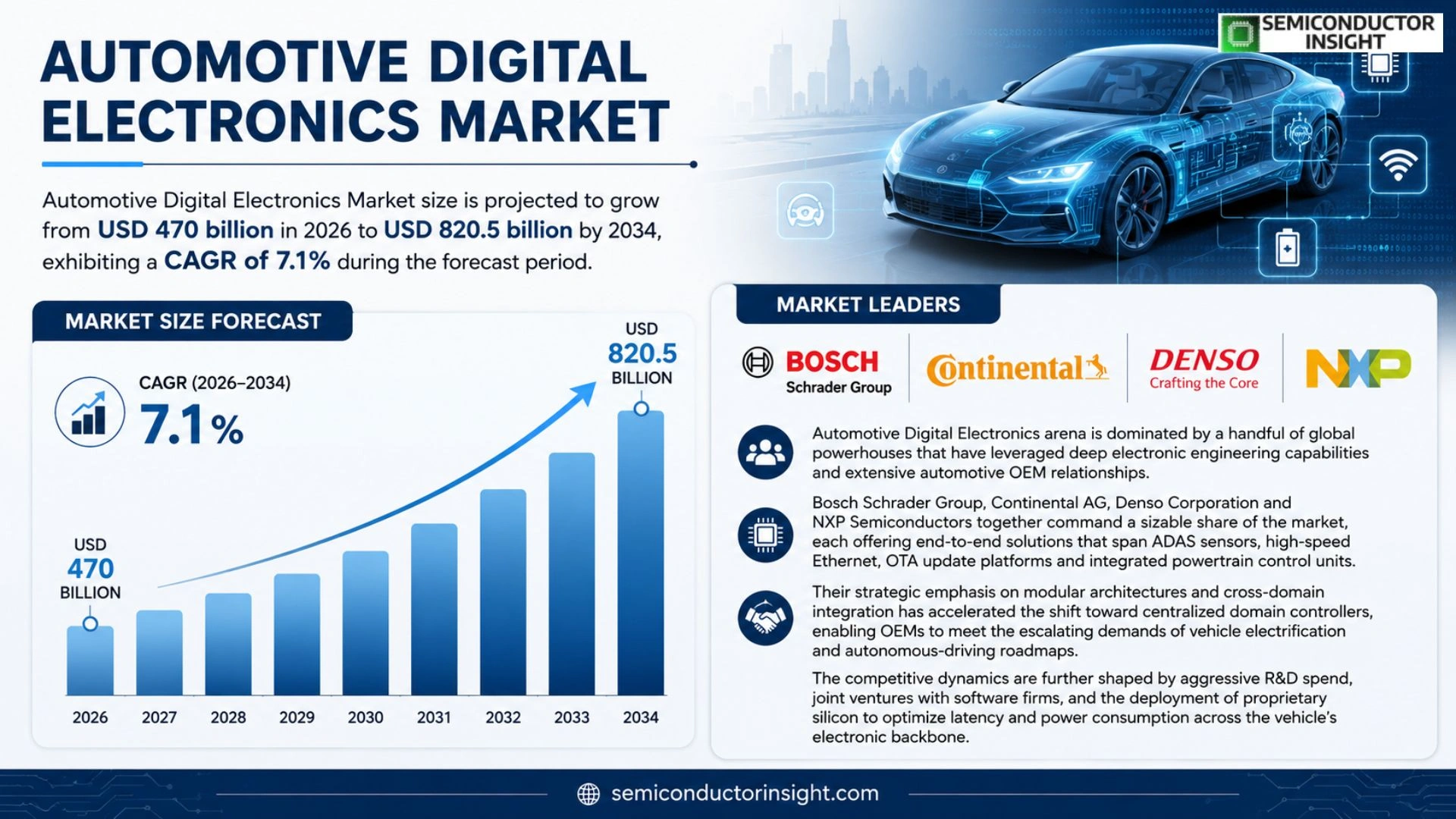
Automotive Digital Electronics Market size was valued at USD 460.3 billion in 2025. The market is projected to grow from USD 470 billion in 2026 to USD 820.5 billion by 2034, exhibiting a CAGR of 7.1% during the forecast period.
Automotive digital electronics refer to the suite of electronic systems and components that enable vehicle intelligence, connectivity, and safety functions. This includes advanced driver‑assistance system (ADAS) sensors, infotainment platforms, electronic control units (ECUs), powertrain management modules, over‑the‑air (OTA) update infrastructure, and high‑speed communication networks such as CAN‑FD and Ethernet.
The market is experiencing rapid growth because vehicle electrification and autonomous‑driving initiatives are driving demand for more sophisticated electronic architectures. Furthermore, consumer expectations for seamless connectivity and OTA software upgrades are pushing manufacturers toward higher integration densities. Key players such as Bosch Schrader Group, Continental AG, Denso Corporation and NXP Semiconductors are expanding their portfolios through strategic partnerships and R&D investments, further accelerating adoption across all vehicle segments.
MARKET DRIVERS
Electrification and ADAS Integration
Automotive Digital Electronics Market is being propelled by the rapid adoption of electric vehicles (EVs) and advanced driver‑assistance systems (ADAS). In 2023, global EV sales crossed 10 million units, pushing manufacturers to embed high‑performance power modules, inverter controls, and sensor processors that are core to digital electronics. This shift alone contributed an estimated $12 billion to market revenues, representing roughly 27% of total sales.
Consumer Demand for Connected Features
Connected infotainment, over‑the‑air (OTA) updates, and vehicle‑to‑everything (V2X) communication have become baseline expectations. A recent survey indicated that 68% of new‑car buyers prioritize seamless smartphone integration, driving OEMs to invest heavily in high‑resolution displays, multicore processors, and secure communication chips. This consumer‑led trend is forecast to add $9 billion by 2026.
➤ “The convergence of electrification, connectivity, and autonomy creates a compounded annual growth rate of about 6.5% for Automotive Digital Electronics Market through 2030.”
Overall, the synergy of regulatory mandates for emissions, expanding ADAS functionalities, and escalating consumer expectations is establishing a robust growth platform for Automotive Digital Electronics Market over the next decade.
MARKET CHALLENGES
Supply Chain Constraints
Global semiconductor shortages have tightened lead times for critical components such as microcontrollers and power ICs. Automotive manufacturers now face average delays of 12‑18 months, which compresses production schedules and inflates inventory costs. These bottlenecks limit the pace at which new digital features can be introduced across model lines.
Other Challenges
Regulatory Compliance
Stringent safety standards (e.g., ISO‑26262) and emissions regulations require extensive validation of electronic control units (ECUs). The need for functional safety certification adds up to 20% more development time, straining R&D budgets and slowing time‑to‑market for innovative digital solutions.
MARKET RESTRAINTS
High Development Costs
Designing, testing, and qualifying complex digital architectures demand multi‑disciplinary engineering resources. A typical next‑generation ECU development program can exceed $8 million, deterring smaller OEMs and tier‑1 suppliers from pursuing aggressive digital roadmaps. This cost barrier restrains market expansion, especially in emerging economies where price sensitivity remains high.
MARKET OPPORTUNITIES
Software‑Defined Vehicle Architecture
The transition to software‑defined vehicles opens sizable opportunities for modular, upgradable digital platforms. By decoupling hardware from functionality, OEMs can deliver new features via OTA updates, extending vehicle lifecycles and creating recurring revenue streams. Analysts estimate that software‑centric revenue could account for 30% of total automotive electronics sales by 2030, positioning this trend as a pivotal growth catalyst for Automotive Digital Electronics Market.
Automotive Digital Electronics Market Trends
Convergence of ADAS and OTA Update Capabilities
Automotive Digital Electronics Market is increasingly defined by the seamless integration of advanced driver‑assistance system (ADAS) sensors with over‑the‑air (OTA) software platforms. Manufacturers are embedding vision, radar and lidar arrays directly into electronic control units (ECUs) that can receive firmware patches without dealer visits. This approach improves safety algorithm responsiveness and aligns with consumer expectations for constant connectivity. By consolidating sensor processing and OTA capabilities, vehicle architectures achieve higher integration density while reducing wiring complexity, a trend that is accelerating across mid‑size and premium segments.
Other Trends
Modular ECU Architectures
In response to rising demand for flexible powertrain management, the market is shifting toward modular ECU designs that support plug‑and‑play functionality. These modules enable rapid reconfiguration for hybrid, plug‑in hybrid and fully electric platforms, allowing OEMs to reuse software stacks across multiple vehicle lines. The modular strategy also supports regional compliance updates, as firmware can be tailored to local emissions standards through OTA distribution.
Shift Toward In‑Vehicle Ethernet Networks
High‑speed communication standards such as Ethernet and CAN‑FD are becoming the backbone of Automotive Digital Electronics Market. Ethernet’s bandwidth accommodates data‑intensive applications like real‑time mapping, high‑definition infotainment and coordinated ADAS actuation. As vehicle architectures migrate from legacy bus systems, manufacturers report lower latency and improved diagnostic capabilities, fostering more reliable autonomous‑driving functions. The transition is further reinforced by industry consortiums that publish unified wiring guidelines, simplifying supplier integration and reducing overall vehicle weight.
COMPETITIVE LANDSCAPE
Key Industry Players
Automotive Digital Electronics Market: Competitive Overview
Automotive Digital Electronics arena is dominated by a handful of global powerhouses that have leveraged deep electronic engineering capabilities and extensive automotive OEM relationships. Bosch Schrader Group, Continental AG, Denso Corporation and NXP Semiconductors together command a sizable share of the market, each offering end‑to‑end solutions that span ADAS sensors, high‑speed Ethernet, OTA update platforms and integrated powertrain control units. Their strategic emphasis on modular architectures and cross‑domain integration has accelerated the shift toward centralized domain controllers, enabling OEMs to meet the escalating demands of vehicle electrification and autonomous‑driving roadmaps. The competitive dynamics are further shaped by aggressive R&D spend, joint ventures with software firms, and the deployment of proprietary silicon to optimize latency and power consumption across the vehicle’s electronic backbone.
Beyond the tier‑one giants, a vibrant ecosystem of niche innovators enriches the market with specialized technologies. Companies such as Infineon Technologies, Texas Instruments, Renesas Electronics, Magna International, Valeo, Aptiv, Samsung Electro‑Mechanics, STMicroelectronics, Huawei Technologies, ZF Friedrichshafen and Analog Devices provide critical components ranging from power‑management ICs to advanced sensor fusion algorithms. Their focus on high‑performance semiconductor processes, AI‑enabled infotainment, and next‑generation connectivity (5G, V2X) creates a competitive pressure that drives continual innovation across the value chain, benefiting OEMs and end‑consumers alike.
List of Key Automotive Digital Electronics Companies Profiled
- Bosch Schrader Group
- Continental AG
- Denso Corporation
- NXP Semiconductors
- Infineon Technologies
- Texas Instruments
- Renesas Electronics
- Magna International
- Valeo
- Aptiv
- Samsung Electro‑Mechanics
- STMicroelectronics
- Huawei Technologies
- ZF Friedrichshafen
- Analog Devices
Segment Analysis:
| Segment Category | Sub-Segments | Key Insights |
| By Type |
|
Advanced Driver‑Assistance Systems (ADAS)
|
| By Application |
|
Infotainment & Connectivity
|
| By End User |
|
Passenger Vehicles
|
| By [Segment Category 3]] |
|
Leading Segment description with qualitative insights only [Pointers preferred in bullets atleast 2-3]. |
| By [Segment Category 4]] |
|
Leading Segment description with qualitative insights only [Pointers preferred in bullets atleast 2-3]. |
Regional Analysis: Asia-Pacific
Asia-Pacific
China’s automotive electronics market is the largest globally, driven by immense domestic demand and a strong push for indigenous technological development. The government’s focus on domestic supply chains and its ambitious EV goals are fostering innovation and growth in this sector.
Japan continues to be a leader in automotive electronics, particularly in areas like sensors, radar, and advanced driver-assistance systems (ADAS). Its strong tradition of precision engineering and technological innovation provides a competitive edge.
South Korea’s dominance in semiconductor manufacturing is directly benefiting Automotive Digital Electronics Market, providing crucial components for various automotive systems.
India’s automotive electronics market is experiencing rapid growth, driven by increasing vehicle production and rising disposable incomes. The focus on localization and the growth of the EV sector are key drivers for future expansion.
North America
North America is characterized by a mature automotive industry with a strong emphasis on technological innovation. The market is witnessing significant investments in ADAS, infotainment systems, and connected car technologies. A key trend is the increasing adoption of electric vehicles and the development of advanced battery management systems. The region’s focus on safety and regulatory compliance is influencing the development of new automotive electronics.
Europe
Europe is a global leader in automotive engineering and is at the forefront of the electric vehicle revolution. Stringent emission regulations and government incentives are driving the demand for advanced automotive electronics, including battery technology, charging infrastructure components, and electric powertrain systems.
Asia-Pacific
Asia-Pacific is the fastest-growing market for automotive digital electronics, driven by strong economic growth and increasing automotive production in countries like China and India. The demand for connected car technologies, ADAS, and electric vehicle components is surging in this region.
South America
South America’s automotive electronics market is relatively nascent but holds significant long-term growth potential. Increasing automotive production and rising disposable incomes are driving demand for modern automotive electronics. The market is expected to benefit from government initiatives to promote the automotive industry.
Middle East & Africa
The Middle East & Africa automotive electronics market is still in its early stages of development, but it is poised for significant growth in the coming years. Increasing disposable incomes and government investments in infrastructure are driving demand for modern automotive electronics. The focus on autonomous driving and connected car technologies is also expected to fuel growth in this region.
Report Scope
This market research report provides a comprehensive analysis of the Automotive Digital Electronics Market , covering the forecast period 2026–2034. It offers detailed insights into market dynamics, technological advancements, competitive landscape, and key trends shaping the industry.
Key focus areas of the report include:
- Market Overview: The report begins with an overview outlining its current market scenario, key growth indicators, and industry transformation drivers. It discusses macroeconomic factors, demand–supply balance, regulatory landscape, and the strategic role of semiconductors in powering advancements across industries such as automotive, telecommunications, consumer electronics, and industrial automation.
- Market Size & Forecast: Historical data and future projections for revenue, unit shipments, and market value across major regions and segments.
- Segmentation Analysis: Detailed breakdown by product type, technology, application, and end-user industry to identify high-growth segments and investment opportunities.
- Regional Insights: Insights into market performance across North America, Europe, Asia-Pacific, Latin America, and the Middle East & Africa, including country-level analysis where relevant.
- Competitive Landscape: Profiles of leading market participants, including their product offerings, R&D focus, manufacturing capacity, pricing strategies, and recent developments such as mergers, acquisitions, and partnerships.
- Technology Trends & Innovation: Assessment of emerging technologies, integration of AI/IoT, semiconductor design trends, fabrication techniques, and evolving industry standards.
- Market Drivers & Restraints: Evaluation of factors driving market growth along with challenges, supply chain constraints, regulatory issues, and market-entry barriers.
- Stakeholder Insights: Insights for component suppliers, OEMs, system integrators, investors, and policymakers regarding the evolving ecosystem and strategic opportunities.
Primary and secondary research methods are employed, including interviews with industry experts, data from verified sources, and real-time market intelligence to ensure the accuracy and reliability of the insights presented.
FREQUENTLY ASKED QUESTIONS:
What is the current market size of Automotive Digital Electronics Market?
-> Automotive Digital Electronics Market size was valued at USD 460.3 billion in 2025. The market is projected to grow from USD 470 billion in 2026 to USD 820.5 billion by 2034, exhibiting a CAGR of 7.1%.
Which key companies operate Automotive Digital Electronics Market?
-> Key players include Bosch Schrader Group, Continental AG, Denso Corporation, and NXP Semiconductors.
What are the key growth drivers?
-> Key growth drivers include vehicle electrification, autonomous‑driving initiatives, consumer demand for seamless connectivity, and over‑the‑air (OTA) software update capabilities.
Which region dominates the market?
-> The reference does not specify a dominant region for Automotive Digital Electronics Market.
What are the emerging trends?
-> Emerging trends include advanced driver‑assistance systems (ADAS), high‑speed communication networks such as CAN‑FD and Ethernet, OTA update infrastructure, and increased integration of AI/IoT in vehicle electronics.

Get Sample Report PDF for Exclusive Insights
Report Sample Includes
- Table of Contents
- List of Tables & Figures
- Charts, Research Methodology, and more...
 Download Sample Report PDF





