Automotive Current Sensing Precision Resistors Market Insights
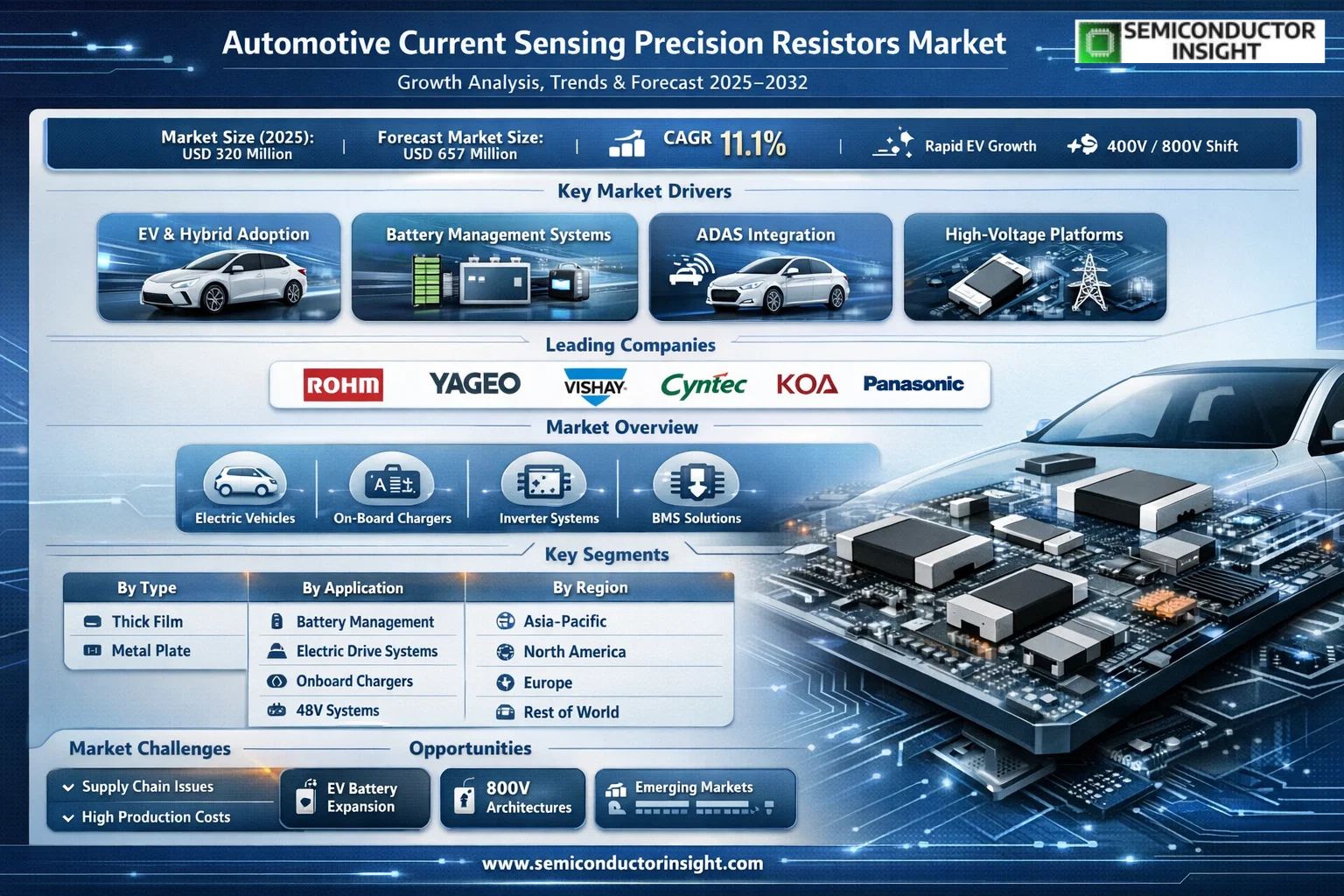
Global Automotive Current Sensing Precision Resistors market size was valued at USD 320 million in 2025. The market is projected to reach USD 657 million by 2032, exhibiting a CAGR of 11.1% during the forecast period.
Automotive current sensing precision resistors are high-accuracy resistors designed for use in automotive electronic systems to detect and measure current variations within circuits. These precision resistors maintain stable performance under extreme conditions, such as temperature and vibration, making them suitable for applications in battery management systems (BMS), electric drive systems, onboard chargers, and 48V electrical systems, providing precise current data to ensure system safety and stability.
The market is experiencing rapid growth due to surging demand for electric vehicles (EVs) and hybrid electric vehicles (HEVs), where accurate current sensing is vital for BMS, inverters, and motor control units. Furthermore, advancements in advanced driver assistance systems (ADAS) and the shift to high-voltage platforms like 400V/800V are key drivers. Metal plate types dominate high-current applications with low TCR as low as ±15ppm/°C. Key players including Rohm Semiconductor, YAGEO Corporation, Vishay, KOA Corporation, and Panasonic are innovating with AEC-Q200-qualified components to meet stringent automotive standards.
MARKET DRIVERS
Electrification of Vehicles Fuels Demand
The rapid shift toward electric vehicles (EVs) is a primary driver for Automotive Current Sensing Precision Resistors Market. These components are essential in battery management systems (BMS) and power electronics, providing accurate current measurement for optimal performance and safety. With global EV sales projected to reach 17 million units by 2025, demand for high-precision resistors with low temperature coefficients has surged, enabling efficient power distribution in high-voltage environments.
Advanced Driver Assistance Systems (ADAS) Integration
Integration of ADAS and autonomous driving technologies further propels the market, as precision resistors ensure reliable current sensing in motor control units and sensor arrays. Automotive manufacturers prioritize components that withstand harsh conditions while maintaining tolerances below 0.1%, driving innovation in materials like thin-film resistors. This trend supports the market’s growth at a CAGR of approximately 8% through 2030.
➤ Regulatory mandates for fuel efficiency and emissions reduction worldwide are accelerating adoption of current sensing precision resistors in hybrid and full EV powertrains.
Additionally, the push for lightweighting and miniaturization in automotive designs enhances the role of compact precision resistors, contributing to overall system efficiency and reducing energy losses in inverters and converters.
MARKET CHALLENGES
Supply Chain Vulnerabilities
Persistent supply chain disruptions, particularly for specialized materials like nickel-chromium alloys used in precision resistors, pose significant challenges to Automotive Current Sensing Precision Resistors Market. Automotive OEMs face delays in production scaling for EVs due to raw material shortages, impacting lead times and costs amid geopolitical tensions.
Other Challenges
High Manufacturing Complexity
Achieving ultra-low TCR values under 5 ppm/°C requires advanced deposition techniques, increasing defect rates and yields challenges in high-volume automotive production. Balancing precision with cost-effectiveness remains a hurdle as competition intensifies from Asian suppliers.
Intensifying competition and rapid technological shifts in semiconductor integration further complicate standardization efforts across global automotive platforms.
MARKET RESTRAINTS
Elevated Production Costs
High production costs associated with stringent automotive-grade qualifications, such as AEC-Q200 standards, restrain broader adoption in Automotive Current Sensing Precision Resistors Market. These resistors demand cleanroom environments and rigorous testing, elevating prices by 20-30% compared to industrial-grade alternatives, limiting penetration in cost-sensitive segments.
Volatility in raw material prices, including precious metals, adds financial pressure on manufacturers, slowing investment in capacity expansion despite growing EV demand.
Moreover, the complexity of integrating these precision components into diverse vehicle architectures creates design bottlenecks, particularly for legacy internal combustion engine transitions.
Intellectual property barriers and patent thickets around low-ohm, high-power designs further impede new entrants, consolidating market share among established players.
MARKET OPPORTUNITIES
Expansion in EV Battery Systems
Burgeoning EV battery ecosystem presents substantial opportunities for Automotive Current Sensing Precision Resistors Market, with next-generation solid-state batteries requiring even higher precision for state-of-charge monitoring. Market projections indicate a 12% CAGR, driven by investments exceeding $500 billion in global battery production by 2030.
Advancements in 800V architectures for ultra-fast charging underscore the need for resistors capable of handling extreme currents, opening avenues for innovation in shunt-based sensing solutions.
Emerging markets in Asia-Pacific, particularly India and Southeast Asia, offer untapped potential as local EV manufacturing ramps up, favoring suppliers with scalable, cost-optimized precision resistor portfolios.
Automotive Current Sensing Precision Resistors Market Trends
Increasing Adoption in Electric Vehicles and Hybrids
Automotive Current Sensing Precision Resistors Market is experiencing robust growth driven by the surge in electric vehicles (EVs) and hybrid electric vehicles (HEVs). These resistors are essential in battery management systems (BMS), on-board chargers (OBC), inverters, and motor control units, delivering accurate current measurements crucial for safety, performance, and energy efficiency. In new energy vehicles, particularly those with high-voltage platforms, precision resistors ensure stable performance amid temperature fluctuations and vibrations, supporting precise current monitoring for charge/discharge cycles and thermal management.
Other Trends
Shift Toward Metal Plate Resistors
Metal plate types are gaining prominence in high-current applications like EV BMS and inverters due to superior power handling, low temperature coefficient of resistance (TCR as low as ±15ppm/°C), and tight tolerances down to 1mΩ. Thick film resistors continue to serve cost-sensitive areas such as automotive lighting and infotainment, but the market favors metal plate for demanding EV environments requiring high reliability and low contact resistance.
Expansion in ADAS and High-Voltage Systems
Advanced driver assistance systems (ADAS) and the transition to 400V/800V platforms alongside fast-charging infrastructure are propelling demand for high-power, AEC-Q200-qualified precision resistors. Key applications include DC-DC converters and radar/camera modules, where superior thermal stability is vital. Regionally, China dominates due to its EV production scale, while Japanese firms like ROHM, KOA, and Panasonic lead in high-accuracy components. Future directions point to ultra-low resistance values, higher power ratings, thinner packages, and integrated solutions combining resistors with Hall effect sensors, enhancing Automotive Current Sensing Precision Resistors Market’s evolution.
COMPETITIVE LANDSCAPE
Key Industry Players
Global Leaders in Automotive Current Sensing Precision Resistors
Automotive Current Sensing Precision Resistors Market features a competitive landscape dominated by established Japanese and global electronics giants, with ROHM Semiconductor, KOA Corporation, and Panasonic leading due to their expertise in high-accuracy metal plate resistors suited for EV battery management systems (BMS), inverters, and onboard chargers. These top players leverage advanced low TCR (as low as ±15ppm/°C) technologies and AEC-Q200 qualification, capturing significant market share amid rising demand from new energy vehicles and 48V systems. The market structure is moderately concentrated, with the top five companies—ROHM, Vishay, YAGEO, KOA, and Panasonic—collectively holding over 50% of global revenues in 2025, driven by their robust supply chains in Asia, particularly China and Japan, where EV production surges fuel growth at a projected CAGR of 11.1% through 2032.
Beyond the frontrunners, niche players like Isabellenhütte, Cyntec, Viking Tech, and Walsin Technology excel in specialized high-power, low-resistance shunts for ADAS radar modules, DC-DC converters, and high-voltage platforms (400V/800V), offering tight tolerances down to 1mΩ. Emerging Asian suppliers such as Bourns, Susumu, TT Electronics, Ohmite, and Cbeureka are intensifying competition through cost-effective thick film variants and integrated solutions combining resistors with Hall sensors, targeting passenger cars and commercial vehicles. Korean firms align closely with battery giants like LG and Samsung SDI, while North American and European demand bolsters Vishay and Ohmite in premium segments, fostering innovation in thermal stability and ultra-low resistance amid challenges like supply chain disruptions and raw material costs.
List of Key Automotive Current Sensing Precision Resistors Companies Profiled
- Rohm Semiconductor
- YAGEO Corporation
- Vishay
- Cyntec
- Isabellenhütte
- Viking Tech
- KOA Corporation
- Walsin Technology
- Cbeureka
- Ohmite
- TT Electronics
- Bourns
- Susumu
- Panasonic
Segment Analysis:
| Segment Category | Sub-Segments | Key Insights |
| By Type |
|
Metal Plate Type
|
| By Application |
|
Passenger Cars
|
| By End User |
|
Electric Vehicle Manufacturers
|
| By Powertrain Type |
|
Battery Electric Vehicles (BEVs)
|
| By Voltage Platform |
|
400V Platforms
|
Regional Analysis: Automotive Current Sensing Precision Resistors Market
Asia-Pacific
Robust EV adoption and semiconductor integration propel demand for precision current sensing resistors. Local manufacturing hubs enable rapid prototyping and scaling, supported by government incentives for green technologies. Automotive OEMs prioritize high-reliability components to meet electrification goals, fostering ecosystem synergies that enhance market expansion.
Industry giants from Japan and South Korea lead with advanced resistor designs featuring low TCR and high power ratings. Strategic partnerships with Chinese assemblers drive volume production, while R&D focuses on miniaturization for compact EV architectures, strengthening regional competitive edges.
Integration of current sensing precision resistors in ADAS and infotainment systems gains traction. Shift toward wide-bandgap semiconductors demands compatible resistors, with trends emphasizing predictive maintenance via embedded sensing for optimized power distribution in next-gen vehicles.
Supply chain vulnerabilities pose hurdles, yet opportunities arise from localization efforts. Rising focus on sustainable materials opens avenues for eco-friendly resistors, balancing performance needs with regulatory compliance in a high-growth automotive landscape.
North America
North America exhibits steady growth in Automotive Current Sensing Precision Resistors Market, fueled by surging electric vehicle initiatives and advanced manufacturing resurgence. U.S.-based OEMs emphasize precision components for sophisticated battery packs and inverter controls, where accurate current measurement ensures optimal performance and thermal management. The region’s innovation hubs drive development of resistors tailored for harsh climates, supporting ADAS and autonomous driving technologies. Collaborative ventures between domestic suppliers and tech firms accelerate adoption of high-precision shunt resistors, enhancing energy efficiency in hybrid powertrains. Regulatory emphasis on safety and emissions further bolsters demand, positioning North America as a key innovator despite import dependencies.
Europe
Europe advances prominently in Automotive Current Sensing Precision Resistors Market, propelled by rigorous emission standards and premium vehicle electrification. German and French automakers integrate advanced resistors into power modules for precise motor control and regenerative braking systems. The focus on sustainable mobility fosters demand for low-inductance, high-stability components resilient to automotive rigors. Strong R&D networks and EU-funded projects spur innovations in current sensing for next-generation EVs, emphasizing compactness and integration. Supply chain diversification efforts mitigate risks, enabling consistent quality for luxury and commercial fleets.
South America
South America shows promising potential in Automotive Current Sensing Precision Resistors Market, driven by expanding local assembly and biofuel-hybrid transitions. Brazilian manufacturers prioritize cost-effective precision resistors for engine management and mild-hybrid applications, adapting to regional fuel mixes. Growing middle-class demand for safer vehicles boosts integration in safety systems like ABS and stability controls. Partnerships with international suppliers enhance technology transfer, while infrastructure investments support EV pilots, gradually elevating current sensing requirements amid economic volatilities.
Middle East & Africa
Middle East & Africa emerge as nascent yet dynamic players in Automotive Current Sensing Precision Resistors Market, with fleet modernization and oil-to-EV diversification at the forefront. Gulf nations invest in premium imports for luxury SUVs, demanding robust resistors for climate-resilient electronics. African markets focus on affordable aftermarket solutions for current monitoring in commercial vehicles. Regional assembly plants gradually incorporate precision components, spurred by urbanization and logistics growth, laying groundwork for broader adoption despite infrastructural challenges.
Report Scope
This market research report provides a comprehensive analysis of Automotive Current Sensing Precision Resistors Market, covering the forecast period 2025–2032. It offers detailed insights into market dynamics, technological advancements, competitive landscape, and key trends shaping the industry.
Key focus areas of the report include:
- Market Overview: The report begins with an overview outlining its current market scenario, key growth indicators, and industry transformation drivers. It discusses macroeconomic factors, demand–supply balance, regulatory landscape, and the strategic role of current sensing precision resistors in powering advancements across industries such as electric vehicles (EVs), hybrid electric vehicles (HEVs), battery management systems (BMS), and advanced driver assistance systems (ADAS).
- Market Size & Forecast: Historical data and future projections for revenue, unit shipments, and market value across major regions and segments.
- Segmentation Analysis: Detailed breakdown by product type, technology, application, and end-user industry to identify high-growth segments and investment opportunities.
- Regional Insights: Insights into market performance across North America, Europe, Asia-Pacific, Latin America, and the Middle East & Africa, including country-level analysis where relevant.
- Competitive Landscape: Profiles of leading market participants, including their product offerings, R&D focus, manufacturing capacity, pricing strategies, and recent developments such as mergers, acquisitions, and partnerships.
- Technology Trends & Innovation: Assessment of emerging technologies, integration of AI/IoT, semiconductor design trends, fabrication techniques, and evolving industry standards.
- Market Drivers & Restraints: Evaluation of factors driving market growth along with challenges, supply chain constraints, regulatory issues, and market-entry barriers.
- Stakeholder Insights: Insights for component suppliers, OEMs, system integrators, investors, and policymakers regarding the evolving ecosystem and strategic opportunities.
Primary and secondary research methods are employed, including interviews with industry experts, data from verified sources, and real-time market intelligence to ensure the accuracy and reliability of the insights presented.
FREQUENTLY ASKED QUESTIONS:
What is the current market size of Automotive Current Sensing Precision Resistors Market?
-> Automotive Current Sensing Precision Resistors Market was valued at USD 320 million in 2025 and is expected to reach USD 657 million by 2032, at a CAGR of 11.1% during the forecast period.
Which key companies operate in Automotive Current Sensing Precision Resistors Market?
-> Key players include Rohm Semiconductor, YAGEO Corporation, Vishay, Cyntec, Isabellenhütte, KOA Corporation, and Panasonic, among others.
What are the key growth drivers?
-> Key growth drivers include demand from EV BMS modules, expansion of electric vehicles (EVs), on-board chargers (OBC), and the shift to 400V/800V high-voltage platforms.
Which region dominates the market?
-> China leads the market due to dominant EV production, while Asia-Pacific is the fastest-growing region.
What are the emerging trends?
-> Emerging trends include ultra-low resistance values, higher power-rated AEC-Q200-qualified components, thinner packages, and integrated current sensing solutions with Hall effect sensors.

Get Sample Report PDF for Exclusive Insights
Report Sample Includes
- Table of Contents
- List of Tables & Figures
- Charts, Research Methodology, and more...
 Download Sample Report PDF