Automotive 6-Axis IMU Market Insights
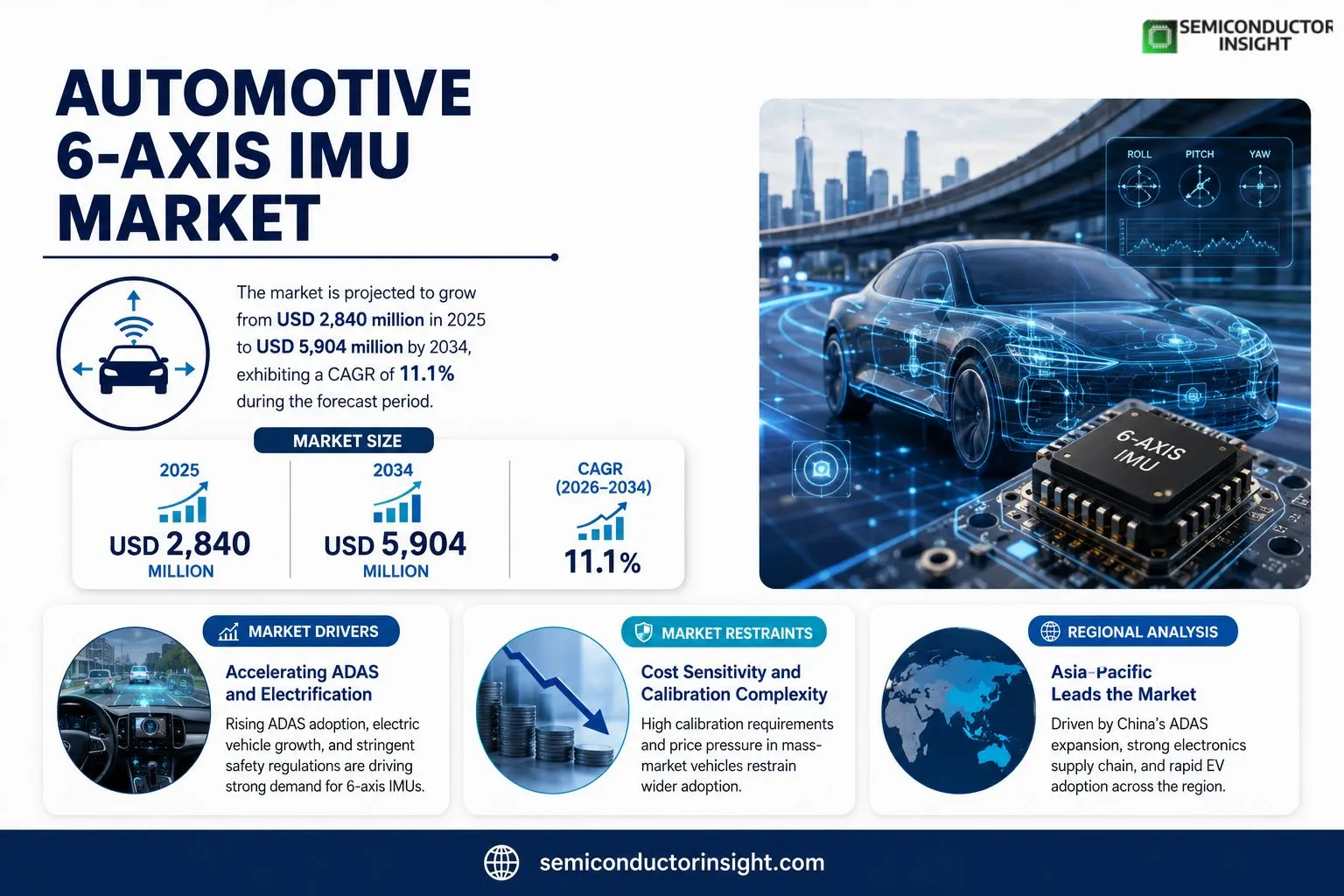
Automotive 6-Axis IMU market size was valued at USD 2840 million in 2025. The market is estimated to increase to USD 5904 million by 2034, reflecting a compound annual growth rate of 11.1 % over the forecast horizon.
An automotive‑grade six‑axis inertial measurement unit combines a three‑axis accelerometer with a three‑axis gyroscope inside a single rugged package. It supplies stable angular‑rate and linear‑acceleration data when GNSS signals are unavailable or vehicle attitude changes rapidly, thereby supporting dead‑reckoning, attitude estimation, body control, vehicle safety functions and sensor‑fusion for autonomous driving.The expansion of this segment stems from broader adoption of advanced driver‑assistance systems, stricter safety regulations in the EU and China since 2024–2025, and growing demand for reliable motion reference in heavy‑duty and off‑highway equipment. Manufacturers such as Bosch, STMicroelectronics and TDK continue to offer low‑power chip solutions for navigation and telematics, while Murata, Quectel, Aceinna and Honeywell are targeting higher‑value scenarios like GNSS fusion and central vehicle IMUs. Recent activities include Murata’s launch of a factory‑calibrated module supporting CAN FD and automotive Ethernet in early 2024, and Aceinna’s partnership with a Tier‑1 supplier to integrate redundancy features for automated driving platforms.
MARKET DRIVERS
Accelerating Vehicle Electrification
The shift toward electric powertrains has amplified the need for precise motion sensing. Automotive 6-Axis IMU Market players are witnessing a surge in integration requests because modern electric drivetrains rely on real‑time orientation data to optimize torque distribution and regenerative braking. Manufacturers that embed high‑resolution IMUs can extract efficiency gains of up to 4% per vehicle, a margin that directly improves range competitiveness.
Advanced Driver‑Assistance Systems (ADAS) Evolution
ADAS algorithms increasingly demand multi‑axis inertial measurements to calibrate camera and radar stacks. The industry’s move from lane‑keep assist to higher‑level autonomy has pushed suppliers to prioritize six‑axis units that combine gyroscope and accelerometer data in a single package. This consolidation trims wiring complexity and lowers overall system cost, a factor that OEMs cite when selecting tier‑1 partners.
➤ “Integrating 6‑axis IMUs has become a non‑negotiable baseline for Level‑3 autonomous prototypes, cutting development cycles by roughly 18%,”
Regulatory pressure on crash safety also fuels demand. New safety standards require continuous monitoring of vehicle dynamics during impact events. Six‑axis sensors provide the granularity needed to reconstruct crash vectors, enabling manufacturers to demonstrate compliance more efficiently and avoid costly redesigns.
MARKET CHALLENGES
Cost Sensitivity in Volume Production
While high‑performance IMUs deliver clear technical advantages, their bill‑of‑materials remains a hurdle for mass‑market models. OEMs targeting sub‑$30,000 price points often cap sensor spend at $5 per unit, forcing suppliers to balance performance with aggressive price compression. This tension slows the rollout of premium sensor features in entry‑level vehicles.
Other Challenges
Supply Chain Volatility
The semiconductor components underpinning six‑axis units are subject to fab capacity constraints. Recent wafer shortages have extended lead times by 30‑45 days, compelling automakers to adopt safety stock strategies that inflate inventory costs.
MARKET RESTRAINTS
Stringent Calibration Requirements
Accurate six‑axis data hinges on meticulous factory calibration and periodic field verification. The additional engineering effort translates into higher upfront R&D expense, which can deter smaller OEMs lacking dedicated sensor teams. Moreover, the need for specialized calibration equipment limits the pool of qualified suppliers, constraining market expansion.
MARKET OPPORTUNITIES
Integration with Vehicle‑to‑Everything (V2X) Platforms
The convergence of IMU data with V2X communication opens avenues for predictive safety functions. By fusing inertial measurements with external traffic signals, manufacturers can anticipate hazardous maneuvers several seconds ahead, creating a differentiator for premium models. Early adopters that embed six‑axis IMUs into V2X stacks are positioned to capture a measurable share of the forthcoming safety‑technology premium.
Automotive 6-Axis IMU Market Trends
From Component to In‑Vehicle Motion Platform
Automotive 6-Axis IMU Market is moving beyond a simple sensor offering. OEMs now treat the 6‑axis unit as a foundational motion reference that feeds chassis control, advanced driver assistance, and autonomous‑driving stacks. This shift is driven by the need for continuous, high‑integrity data when GNSS signals are obstructed or vehicle dynamics change abruptly. As a result, manufacturers are bundling low‑noise chips with factory‑calibrated modules, rugged packages, and time‑synchronisation features that align with automotive Ethernet or CAN FD. The added value lies in reducing integration effort, shortening validation cycles, and guaranteeing functional‑safety compliance across the vehicle’s electronic‑architecture.
Other Trends
System‑Level Competition Supersedes Pure Sensor Specs
Suppliers such as Murata, Quectel, and Aceinna are no longer competing solely on gyroscope range or bias stability. Their product narratives emphasize out‑of‑the‑box firmware, configurable parameters, and guaranteed redundancy that match tier‑1 integration timelines. This approach translates into faster adoption by domain‑controller vendors, who can pull a calibrated IMU directly into a multi‑sensor fusion pipeline without extensive customisation. Companies that master the combined challenge of low noise, wide‑temperature reliability, and seamless interface adaptation are positioning themselves as platform providers rather than component vendors, a distinction that reshapes purchasing decisions across the supply chain.
Regulatory Push and Application Diversification
Legislation in the EU, China, and the United States is tightening safety‑related performance thresholds for ADAS and automated‑driving functions. While the rules do not dictate a specific sensor, they raise the bar for fault‑tolerant, calibrated inertial data, prompting automakers to embed higher‑grade IMUs across passenger, commercial, and off‑highway fleets. Concurrently, the expansion of heavy‑duty, agricultural, and warehousing vehicles creates demand for ruggedised modules that survive harsh vibration and temperature swings. This broadened application set means revenue growth will be sourced from a mix of passenger‑car electrification, commercial‑vehicle safety upgrades, and specialty equipment, cushioning the market against a slowdown in any single segment.
COMPETITIVE LANDSCAPEKey Industry Players
Automotive 6‑Axis IMU Competitive Overview
In the current ecosystem, three manufacturers dominate the high‑volume, cost‑sensitive segment. Bosch, STMicroelectronics and TDK leverage mature MEMS foundry capabilities to deliver low‑power chips that feed mass‑produced navigation and telematics modules. Their product portfolios stress bias stability, low noise, and broad temperature ranges, which keep price points attractive for OEMs targeting entry‑level ADAS and fleet‑management solutions. The supply chain around these incumbents is layered: silicon foundries, calibration houses, and system integrators form a well‑established pipeline that sustains steady margins while leaving room for incremental innovation in interface diversity (SPI, CAN FD, automotive Ethernet). This tier anchors the market’s baseline and shapes the pricing floor for any new entrant.Beyond the base tier, a second cohort of firms is steering the market toward higher‑value, safety‑critical applications. Murata positions its calibrated modules as central‑vehicle inertial references, emphasizing factory‑trimmed bias, functional‑safety certifications, and time‑synchronization features that simplify integration for autonomous‑driving stacks. Quectel and Aceinna extend the concept with firmware‑configurable packages that accommodate GNSS fusion and heavy‑duty off‑highway use cases, often embedding redundancy and ruggedized enclosures. Honeywell and Panasonic focus on rugged packaged IMUs for construction machinery and aerospace‑grade platforms, providing extended temperature warranties and J1939‑compatible interfaces. Companies such as Infineon, NXP, Analog Devices, Sensata, Renesas, and QST round out the competitive field, each carving niche strengths around specific interface standards or industry certifications. Their collective thrust toward turnkey modules, calibration services, and software toolkits raises the bar for system‑level integration and reflects OEMs’ preference for components that cut validation cycles and support functional‑safety audits.
List of Key Automotive 6‑Axis IMU Companies Profiled
- Robert Bosch GmbH
- STMicroelectronics N.V.
- TDK Corporation
- Murata Manufacturing Co., Ltd.
- QST Corporation Limited
- Quectel Wireless Solutions Co., Ltd.
- ACEINNA, Inc.
- Panasonic Holdings Corporation
- Honeywell International Inc.
- Infineon Technologies AG
- NXP Semiconductors N.V.
- Analog Devices, Inc.
- Sensata Technologies Holding N.V.
- Renesas Electronics Corporation
Segment Analysis:
| Segment Category | Sub-Segments | Key Insights |
| By Type |
|
Factory‑Calibrated Module
|
| By Application |
|
ADAS & Automated Driving
|
| By End User |
|
OEMs & Tier‑1 System Integrators
|
| By Technical Direction |
|
Low Noise & Bias Stability
|
| By Delivery Form |
|
Calibrated Module
|
Regional Analysis: Automotive 6-Axis IMU Market
North America
North America continues to dominate Automotive 6-Axis IMU Market, driven by a confluence of advanced vehicle architectures and aggressive safety legislation. Automakers in the United States and Canada have embedded multi‑axis inertial sensors across a widening array of models, from premium sedans to commercial trucks, to meet precise stability‑control and autonomous‑driving requirements. The region’s deep engineering talent pool fuels a steady pipeline of sensor‑fusion algorithms that extract richer motion data from existing hardware, effectively extending the value proposition of each unit. OEMs are also leveraging partnerships with semiconductor firms that specialize in low‑noise MEMS designs, thereby reducing the trade‑off between cost and performance.Over the past few years, regulatory bodies such as NHTSA have tightened tolerances for lane‑keeping assistance and rollover protection, compelling manufacturers to adopt higher‑resolution IMUs. This pressure has cascaded into the supplier ecosystem, where a handful of firms have scaled production capacities while simultaneously tightening quality controls to meet automotive‑grade reliability standards. The financial health of the sector benefits from the high margin associated with these high‑spec components, encouraging reinvestment in next‑generation designs that incorporate temperature‑compensation and self‑calibration features.
End‑user expectations have also evolved; consumers now regard seamless digital experiences and advanced driver‑assist features as baseline, not premium. As a result, Tier‑1 suppliers are integrating 6‑axis IMUs into modular electronic control units that can be reused across multiple vehicle platforms, creating economies of scale that reinforce North America’s leadership position. The overall environment suggests continued preference for domestically sourced, highly vetted sensor solutions, reinforcing the region’s status as the benchmark for quality and innovation in Automotive 6-Axis IMU Market.
The North American supply chain is anchored by a few large Tier‑1 manufacturers that control both design and volume production. Their ability to negotiate volume discounts on silicon wafers and to align forecast cycles with automaker production schedules creates a resilient network that can absorb short‑term demand spikes without excessive lead‑time inflation.
Federal safety standards increasingly reference sensor precision, prompting manufacturers to certify their IMU‑based systems under stricter test protocols. Compliance demands have spurred early‑stage collaboration between automakers and suppliers, compressing development timelines and fostering shared risk management.
Silicon Valley and the Detroit corridor host a dense cluster of start‑ups focused on AI‑enhanced sensor fusion. Their proximity to major automakers accelerates proof‑of‑concept trials, allowing rapid iteration on algorithms that translate raw motion data into actionable vehicle control inputs.
Fleet operators are prioritizing vehicles with robust stability systems, pressuring OEMs to standardize 6‑axis IMUs across mixed fleets. This shift toward operational efficiency in logistics and ride‑sharing amplifies the need for reliable, low‑drift motion sensing.
Europe
European manufacturers have embraced Automotive 6-Axis IMU Market as part of broader electrification and autonomous‑driving agendas. The EU’s emphasis on carbon‑neutral mobility has prompted automakers to integrate sophisticated motion‑control modules that optimize regenerative braking and energy recuperation. Meanwhile, stringent type‑approval processes across member states demand meticulous validation of sensor performance, nudging suppliers toward higher reliability benchmarks. A notable trend is the emergence of cross‑border collaborative research programs, linking German engineering firms with French semiconductor specialists to co‑develop low‑power IMU architectures. These initiatives aim to reduce vehicle weight and extend electric‑range, reinforcing Europe’s strategic focus on efficiency without compromising safety. The regional market benefits from a mature supplier base that values long‑term contracts and regulatory compliance, positioning Europe as a strong contender for premium IMU applications.
Asia-Pacific
The Asia‑Pacific region is witnessing a surge in demand for automotive 6-axis IMUs, propelled by rapid growth in both traditional and emerging automotive segments. China’s aggressive rollout of electric vehicles, coupled with government incentives for advanced driver‑assist systems, has amplified the need for precise motion sensing. In Japan and South Korea, legacy automakers are retrofitting existing platforms with next‑generation IMU modules to stay competitive against up‑and‑coming Chinese brands. Supply constraints are gradually easing as local semiconductor fabs expand capacity, yet the market still relies on imported MEMS technologies for the highest performance tiers. Consumer expectations for seamless connectivity and over‑the‑air updates are influencing OEMs to adopt modular sensor packages that can be upgraded post‑sale, a practice that is beginning to reshape product planning across the region.
South America
South American automakers are cautiously expanding their adoption of 6-axis IMUs, primarily as part of safety‑enhancement programs mandated by regional traffic authorities. Brazil’s recent guidelines on electronic stability control have created a modest but growing market for high‑accuracy motion sensors. Suppliers are focusing on cost‑effective designs that balance performance with the price sensitivity of local fleets. Additionally, the region’s push toward renewable‑fuel vehicles is encouraging manufacturers to integrate IMUs that can fine‑tune engine‑management systems for alternative‑fuel combustion dynamics. While the overall volume remains lower than in more mature markets, strategic partnerships with North American vendors are enabling technology transfer and establishing a foundation for future growth.
Middle East & Africa
In the Middle East and Africa, Automotive 6-Axis IMU Market is still in its infancy, yet it is gaining relevance as luxury vehicle penetration rises and sovereign wealth funds invest in autonomous‑vehicle pilots. Gulf countries, especially the United Arab Emirates, are experimenting with sensor‑rich platforms for smart‑city transportation projects, where precise motion data is essential for coordinated traffic management. African markets, meanwhile, are focusing on rugged IMU solutions capable of withstanding harsh climate conditions, reflecting the region’s infrastructural realities. Partnerships with European and Asian suppliers are facilitating access to proven technologies, while local engineering teams are beginning to develop customized calibration routines to suit regional operating environments. This nascent activity suggests a gradual, opportunity‑laden trajectory for Automotive 6-Axis IMU Market across the Middle East and Africa.
Report Scope
This market research report provides a comprehensive analysis of the Automotive 6-Axis IMU Market , covering the forecast period 2026–2034. It offers detailed insights into market dynamics, technological advancements, competitive landscape, and key trends shaping the industry.
Key focus areas of the report include:
- Market Overview: The report begins with an overview outlining its current market scenario, key growth indicators, and industry transformation drivers. It discusses macroeconomic factors, demand–supply balance, regulatory landscape, and the strategic role of semiconductors in powering advancements across industries such as automotive, telecommunications, consumer electronics, and industrial automation.
- Market Size & Forecast: Historical data and future projections for revenue, unit shipments, and market value across major regions and segments.
- Segmentation Analysis: Detailed breakdown by product type, technology, application, and end-user industry to identify high-growth segments and investment opportunities.
- Regional Insights: Insights into market performance across North America, Europe, Asia-Pacific, Latin America, and the Middle East & Africa, including country-level analysis where relevant.
- Competitive Landscape: Profiles of leading market participants, including their product offerings, R&D focus, manufacturing capacity, pricing strategies, and recent developments such as mergers, acquisitions, and partnerships.
- Technology Trends & Innovation: Assessment of emerging technologies, integration of AI/IoT, semiconductor design trends, fabrication techniques, and evolving industry standards.
- Market Drivers & Restraints: Evaluation of factors driving market growth along with challenges, supply chain constraints, regulatory issues, and market-entry barriers.
- Stakeholder Insights: Insights for component suppliers, OEMs, system integrators, investors, and policymakers regarding the evolving ecosystem and strategic opportunities.
Primary and secondary research methods are employed, including interviews with industry experts, data from verified sources, and real-time market intelligence to ensure the accuracy and reliability of the insights presented.
FREQUENTLY ASKED QUESTIONS:
What is the current market size of Automotive 6-Axis IMU Market?
-> Automotive 6-Axis IMU Market was valued at USD 2840 million in 2025 and is expected to reach USD 5904 million by 2034, representing a CAGR of 11.1% during the forecast period.
Which key companies operate in Automotive 6-Axis IMU Market?
-> Key players include Robert Bosch GmbH, STMicroelectronics, TDK Corporation, Murata Manufacturing, Quectel Wireless Solutions, ACEINNA, Inc., Honeywell International, Panasonic Holdings Corporation, among others.
What are the key growth drivers?
-> Key growth drivers include tightening vehicle‑safety regulations, expanding ADAS and automated‑driving deployments, increasing demand for reliable dead‑reckoning and sensor‑fusion solutions, and the need for functional‑safety‑qualified inertial platforms in passenger, commercial and off‑highway vehicles.
Which region dominates the market?
-> Asia‑Pacific currently holds the largest share, driven primarily by China’s rapid adoption of ADAS and automated‑driving programs, followed closely by Europe and North America where OEMs and Tier‑1 suppliers are advancing functional‑safety‑grade IMU integration.
What are the emerging trends?
-> Emerging trends include factory‑calibrated modules, ruggedized packaged IMUs for off‑highway applications, integration of automotive Ethernet and CAN FD interfaces, multi‑sensor time‑synchronization, and the shift toward IMUs as foundational motion‑reference platforms supporting GNSS‑fusion and higher‑level vehicle control algorithms.

Get Sample Report PDF for Exclusive Insights
Report Sample Includes
- Table of Contents
- List of Tables & Figures
- Charts, Research Methodology, and more...
 Download Sample Report PDF