
Automobile Seat Control Unit Market Insights
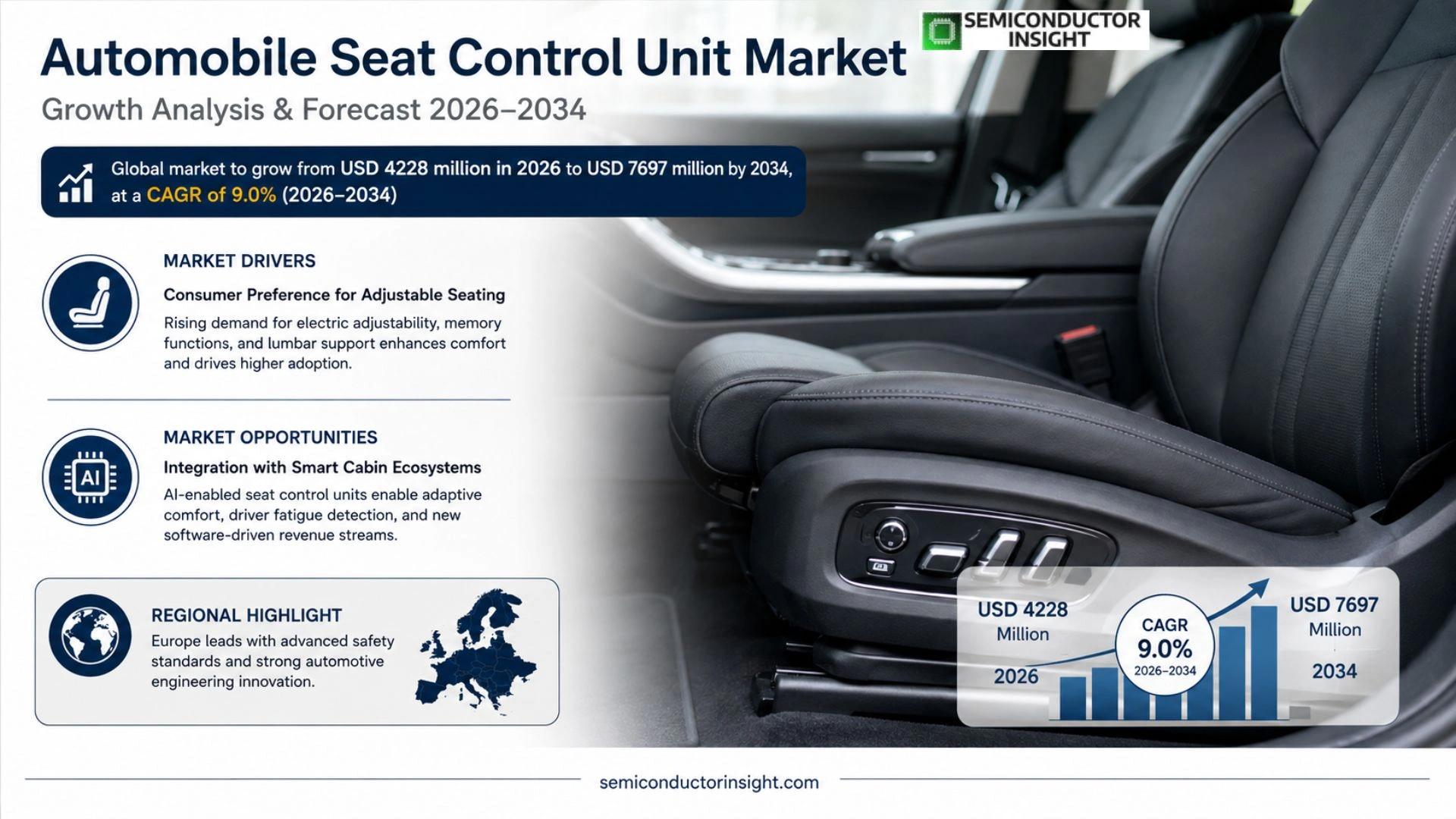
Global Automobile Seat Control Unit market forecasts indicate growth from USD 4228 million in 2026 to USD 7697 million by 2034, reflecting a CAGR of 9.0% over the period.
Automobile Seat Control Units (SCUs) are electronic control units integrated into vehicle seat systems that manage adjustment and comfort functions such as positioning, memory settings, heating, ventilation and massage. They receive commands from driver inputs or vehicle networks and actuate motors, heaters and fans through communication protocols including LIN and CAN.
The expansion of the SCU segment stems from rising vehicle electrification and an increasing emphasis on cabin personalization. Higher content per vehicle,particularly in SUVs and electric models,pushes advanced seat functions into mid‑range offerings. Integration with human‑machine interfaces further broadens functional scope. Leading suppliers such as Adient, Magna International, Lear, Continental, Forvia, Hyundai Transys, Toyota Boshoku, Brose, Bosch and Yanfeng Global Automotive Interiors are actively enhancing product portfolios and pursuing cost‑efficiency initiatives.
MARKET DRIVERS
Consumer Preference for Adjustable Seating
Buyers in premium and mid‑range segments increasingly view seat adjustability as a differentiator for comfort and ergonomics. Manufacturers that integrate electric motors, memory functions, and lumbar‑support sensors are witnessing higher attachment rates, because the feature aligns with a broader shift toward personalized cabin experiences. This demand is especially strong in markets where long‑distance commuting dominates daily travel patterns.
Regulatory Push for Safety Features
Legislation in several regions now mandates that seat positioning systems must cooperate with airbags and occupant‑detection technologies. Automobile Seat Control Unit Market players that can certify seamless communication between seat controllers and safety modules enjoy a competitive edge, as OEMs prefer solutions that simplify compliance testing. The regulatory impetus therefore translates into a tangible boost in unit shipments.
➤ Vehicle electrification, while primarily focused on powertrains, also accelerates the adoption of sophisticated electronic seat controllers because the same electrical architecture can support higher‑voltage, faster‑response actuators.
Beyond comfort and compliance, automakers are leveraging seat control data to feed advanced driver‑assistance systems. Telemetry derived from seat position sensors helps refine occupant monitoring and can trigger pre‑collision seat adjustments, adding another layer of value to the control unit ecosystem.
MARKET CHALLENGES
Cost Sensitivity in Tier‑2 Segments
While high‑end models readily absorb the price premium of advanced seat modules, volume‑driven brands operating on thin margins face pressure to keep unit costs low. The cost of miniaturized motor assemblies and high‑precision Hall‑effect sensors remains a barrier, prompting some OEMs to postpone full‑electric seat integration until economies of scale materialize.
Other Challenges
Supply Chain Constraints
The semiconductor shortage that rattled the broader automotive industry also affects microcontroller chips used in seat control units. Lead times for qualified parts have lengthened, forcing manufacturers to allocate inventory strategically and, in some cases, to qualify secondary suppliers,a process that can erode product reliability.
Furthermore, the integration complexity of seat controllers with legacy CAN‑bus networks often requires extensive software re‑writes, adding hidden engineering costs that can deter rapid rollout in cost‑focused vehicle programs.
MARKET RESTRAINTS
Technical Compatibility with Legacy Platforms
Many existing vehicle architectures rely on analog or low‑speed digital interfaces, making the insertion of modern seat control units a non‑trivial upgrade. Retrofit projects often encounter hurdles such as insufficient wiring harness capacity and limited ECU processing headroom, which can dissuade manufacturers from pursuing comprehensive seat‑control solutions on older platforms.
Weight and Energy Consumption Concerns
Electric and hybrid powertrains demand stringent energy budgets. Adding actuators and control electronics to seats introduces incremental weight and draws additional power, which can marginally affect vehicle range calculations. Design teams therefore must balance comfort upgrades against efficiency targets, a trade‑off that sometimes results in slower adoption rates.
MARKET OPPORTUNITIES
Integration with Smart Cabin Ecosystems
The convergence of infotainment, climate control, and occupancy sensing creates a fertile ground for seat control units that act as data hubs. Automobile Seat Control Unit Market participants that embed AI‑enabled algorithms can offer features such as automatic seat‑recline based on driver fatigue detection, opening new revenue streams through software‑as‑a‑service models.
Growth in Autonomous Vehicle Prototypes
Prototype autonomous shuttles and Level‑4 test fleets increasingly incorporate fully adjustable seats to enhance passenger comfort during longer rides. Suppliers that can certify high‑reliability, low‑latency control units for these applications are positioned to capture early contracts, which can later translate into volume orders as autonomous tech reaches commercial deployment.
Automobile Seat Control Unit Market Trends
Electrification and In‑Cabin Comfort as Growth Engines
The surge in electric vehicle (EV) adoption reshapes seat‑control strategies. Power‑train simplification in EVs creates space for additional electronic functions, prompting OEMs to equip more models with multi‑way adjustment, heating, ventilation, and massage features. Because these functions are directly linked to perceived comfort, buyers increasingly expect them even in mid‑range EVs, thereby expanding the addressable volume of control units. The ripple effect is evident in the rising per‑vehicle content: a typical sedan now ships with at least two SCUs, compared with a single unit five years ago. Manufacturers that can deliver modular, software‑defined SCUs reap the benefit of recurring revenue from feature upgrades and over‑the‑air updates.
Other Trends
Margin Management Through Platform Standardization
Basic seat control modules continue to generate modest gross margins of roughly 15 %–25 %. In contrast, feature‑rich platforms that embed diagnostics, user‑profile management, and adaptive algorithms push margins into the 20 %–35 % band. The divergence stems from the cost structure: advanced units spread development expense across a larger volume base and capitalize on economies of scale. However, OEM pricing pressure remains intense, especially in high‑volume segments. Suppliers that harmonize hardware families across vehicle lines and negotiate long‑term architecture contracts are better positioned to protect profitability while still meeting OEM demand for cost efficiency.
Convergence With Vehicle‑Wide Communication Networks
Modern vehicle architectures rely on LIN, CAN, and increasingly Ethernet to orchestrate cabin functions. Seat control units are evolving from isolated actuators to networked nodes that exchange data with climate control, infotainment, and driver‑assist systems. This integration enables personalized seat settings that adjust automatically based on occupancy detection, climate preferences, and even fatigue monitoring. For suppliers, the shift creates a dual opportunity: first, to sell higher‑priced, software‑centric SCUs; second, to secure recurring service contracts tied to firmware updates and security patches. The strategic implication is clear,players that embed robust cybersecurity and OTA capabilities into their SCU portfolios will command stronger negotiating leverage with OEMs seeking future‑proof solutions.
COMPETITIVE LANDSCAPE
Key Industry Players
Automobile Seat Control Unit Market Competitive Overview
The seat‑control segment is dominated by a handful of tier‑one suppliers whose breadth of electronics expertise allows them to embed SCUs within larger interior architectures. Adient, Magna International and Lear Corporation leverage extensive OEM relationships to supply both basic motor‑driven units and highly integrated modules that coexist with HMI and vehicle‑wide networks. Continental and Bosch supplement their chassis‑and‑powertrain legacies with robust software stacks, enabling features such as memory profiles, climate control and vibration‑reduction. Their scale affords cost advantages that keep gross margins within the 15‑35 % range despite OEM pricing pressure. The competitive hierarchy is shaped by the ability to co‑develop platform‑level solutions, secure long‑term supply contracts, and roll out firmware updates that keep the hardware relevant across multiple model generations.
Beyond the dominant tier‑one firms, a cohort of specialist manufacturers is carving out valuable niches. Forvia (formerly Faurecia) and Hyundai Transys focus on premium‑segment seating where multi‑motor actuation and massage functions differentiate brand perception. Yanfeng Global Automotive Interiors, Xiamen Intretech and Ningbo Tuopu Group excel in cost‑effective, single‑motor controllers for high‑volume compact cars. Beijing Jingwei Hirain Technologies and Hella emphasize integration with electric‑vehicle power‑train communications, positioning themselves for the rapid uptake of EVs. Valeo, Denso and Toyota Boshoku round out the field, each bringing proprietary sensor suites or lightweight material expertise that enhance overall seat‑system efficiency and regulatory compliance.
List of Key Automobile Seat Control Unit Companies Profiled
- Adient, Magna International, Lear Corporation, Continental AG, Bosch, Forvia (Faurecia), Hyundai Transys, Yanfeng Global Automotive Interiors, Xiamen Intretech, Ningbo Tuopu Group
- Adient, Bosch, Hella, Valeo, Denso, Toyota Boshoku, Beijing Jingwei Hirain Technologies
- Volkswagen Group Components, Samsung Electro-Mechanics, Fujitsu Automotive, JTEKT, Johnson Controls Automotive Interiors
Segment Analysis:
| Segment Category | Sub-Segments | Key Insights |
| By Type |
|
Front Seat Control Unit
|
| By Application |
|
Passenger Cars
|
| By End User |
|
OEMs
|
| By Electrical Architecture |
|
Integrated
|
| By Controlled Object |
|
System‑level Controller
|
Regional Analysis: Automobile Seat Control Unit Market
Europe
The EU’s “General Safety Regulation” mandates real‑time monitoring of occupant posture, prompting seat manufacturers to embed higher‑resolution position sensors. Compliance pressures push suppliers toward modular designs that can be validated across multiple vehicle platforms, reducing time‑to‑market while preserving safety integrity.
Proximity of component producers in the automotive corridor,from electronic miniaturization hubs in the Netherlands to precision machining in Poland,creates a seamless logistics loop. This geographic density cuts lead times, allowing OEMs to iterate seat‑control software in sync with drivetrain updates.
Adaptive algorithms that adjust lumbar support based on driver fatigue metrics are gaining traction in premium models. European firms are piloting machine‑learning platforms that fuse temperature, pressure, and vibration data, delivering a nuanced comfort profile that rivals traditional luxury interiors.
Major brands are allocating capital to joint‑venture labs focused on seat‑control electronics. These investments aim to harmonize hardware specifications across model lines, achieving economies of scale while preserving brand‑specific customization options.
North America
In North America, Automobile Seat Control Unit Market reflects a distinct consumer‑centric dynamic. U.S. drivers prioritize connectivity, prompting manufacturers to embed voice‑activated seat adjustments that synchronize with infotainment ecosystems. Canadian firms, meanwhile, emphasize durability for harsher climates, leading to sealed actuator mechanisms. The competitive landscape is marked by aggressive pricing strategies from tier‑1 suppliers seeking to capture volume in fleet applications, especially for ride‑sharing vehicles where rapid seat reconfiguration drives operational efficiency.
Asia‑Pacific
Asia‑Pacific exhibits a rapid upscale of vehicle interiors, with Chinese and Indian automakers integrating cost‑effective seat‑control modules into mass‑market models. Local suppliers capitalize on large‑scale production capabilities, delivering economies of scale that keep component prices low. Meanwhile, Japan’s premium segment pushes for ultra‑quiet motor technologies, aligning with consumer expectations for refined cabin acoustics. The region’s mixed approach,budget‑driven volume alongside high‑end innovation,creates divergent pathways for market participants.
South America
South American markets are characterized by a gradual shift from conventional mechanical seat controls to electronic solutions, spurred by recent regulatory incentives for fuel‑efficient vehicles. Brazilian manufacturers are experimenting with lightweight seat‑control units that contribute to overall vehicle weight reduction, a factor increasingly linked to emission compliance. Market growth is tempered by economic volatility, yet strategic partnerships with European firms are introducing advanced control algorithms that gradually raise the regional product baseline.
Middle East & Africa
In the Middle East & Africa, luxury vehicle adoption fuels demand for sophisticated seat‑control experiences, particularly in the United Arab Emirates and Saudi Arabia where high‑end sedans dominate. Suppliers are focusing on heat‑resistant materials and robust cooling circuits to address extreme temperature conditions. African markets, still nascent, are seeing entry of affordable electronic seat solutions through joint ventures, positioning the region for modest yet steady expansion as urbanization drives new vehicle purchases.
Report Scope
This market research report provides a comprehensive analysis of the Automobile Seat Control Unit Market , covering the forecast period 2026–2034. It offers detailed insights into market dynamics, technological advancements, competitive landscape, and key trends shaping the industry.
Key focus areas of the report include:
- Market Overview: The report begins with an overview outlining its current market scenario, key growth indicators, and industry transformation drivers. It discusses macroeconomic factors, demand–supply balance, regulatory landscape, and the strategic role of semiconductors in powering advancements across industries such as automotive, telecommunications, consumer electronics, and industrial automation.
- Market Size & Forecast: Historical data and future projections for revenue, unit shipments, and market value across major regions and segments.
- Segmentation Analysis: Detailed breakdown by product type, technology, application, and end-user industry to identify high-growth segments and investment opportunities.
- Regional Insights: Insights into market performance across North America, Europe, Asia-Pacific, Latin America, and the Middle East & Africa, including country-level analysis where relevant.
- Competitive Landscape: Profiles of leading market participants, including their product offerings, R&D focus, manufacturing capacity, pricing strategies, and recent developments such as mergers, acquisitions, and partnerships.
- Technology Trends & Innovation: Assessment of emerging technologies, integration of AI/IoT, semiconductor design trends, fabrication techniques, and evolving industry standards.
- Market Drivers & Restraints: Evaluation of factors driving market growth along with challenges, supply chain constraints, regulatory issues, and market-entry barriers.
- Stakeholder Insights: Insights for component suppliers, OEMs, system integrators, investors, and policymakers regarding the evolving ecosystem and strategic opportunities.
Primary and secondary research methods are employed, including interviews with industry experts, data from verified sources, and real-time market intelligence to ensure the accuracy and reliability of the insights presented.
FREQUENTLY ASKED QUESTIONS:
What is the current market size of Automobile Seat Control Unit Market?
-> Automobile Seat Control Unit market forecasts indicate growth from USD 4228 million in 2026 to USD 7697 million by 2034, reflecting a CAGR of 9.0%
Which key companies operate in Automobile Seat Control Unit Market?
-> Key players include Adient, Magna International, Lear, Continental, Forvia, Hyundai Transys, Toyota Boshoku, Brose, Bosch, Yanfeng Global Automotive Interiors, Xiamen Intretech, Ningbo Tuopu Group, Beijing Jingwei Hirain Technologies, FORVIA HELLA.
What are the key growth drivers?
-> Key growth drivers include increasing vehicle electrification, rising demand for in‑cabin comfort and personalization, higher seat‑function content per vehicle, expansion of advanced features (multi‑way adjustment, heating, ventilation, massage) from premium to mid‑range models, and integration with human‑machine interface (HMI) systems.
Which region dominates the market?
-> Asia-Pacific is the largest and fastest‑growing region, driven by high vehicle production volumes, rapid EV adoption, and strong demand for advanced seat comfort features.
What are the emerging trends?
-> Emerging trends include deeper integration of seat control units with vehicle HMI platforms, software‑defined seat functions, AI‑enabled personalization, and the development of modular, system‑level controllers that support massage, climate control, and safety‑critical adjustments.
Get Sample Report PDF for Exclusive Insights
Report Sample Includes
- Table of Contents
- List of Tables & Figures
- Charts, Research Methodology, and more...
