MARKET INSIGHTS
The global Automobile Airbag Transceiver ICs Market size was valued at US$ 342.6 million in 2024 and is projected to reach US$ 523.8 million by 2032, at a CAGR of 6.2% during the forecast period 2025-2032. The market expansion is primarily driven by stringent automotive safety regulations and growing vehicle production, particularly in emerging economies.
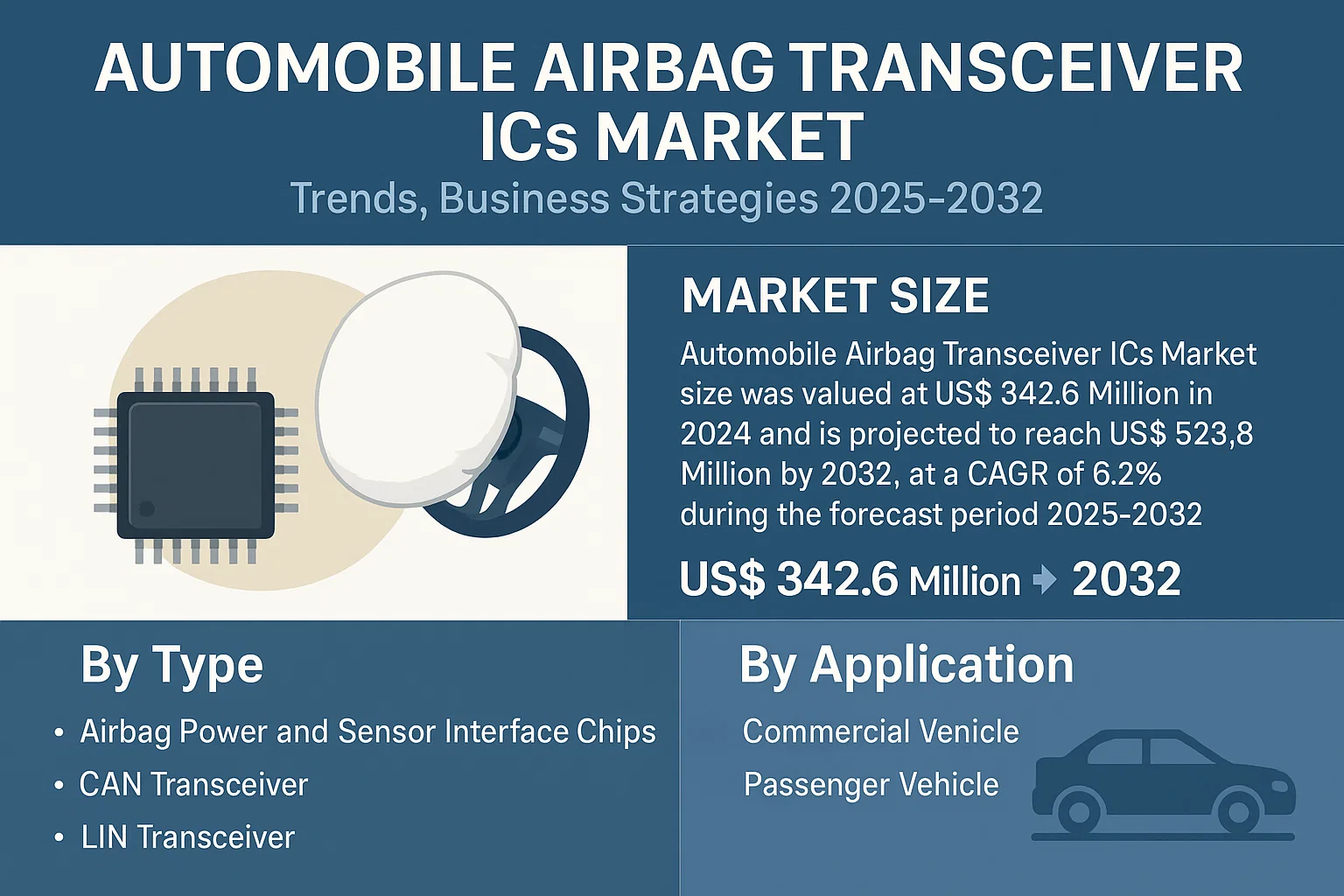
Automobile airbag transceiver ICs are specialized integrated circuits that facilitate communication between airbag sensors and electronic control units (ECUs) in vehicles. These components play a critical role in vehicle safety systems by enabling rapid signal processing during collisions. The technology includes key product types such as airbag power and sensor interface chips, CAN transceivers, and LIN transceivers, each serving distinct functions in modern airbag deployment systems.
The market growth is further propelled by increasing adoption of advanced driver assistance systems (ADAS) and rising consumer awareness about vehicle safety. With global passenger vehicle production reaching 61.6 million units in 2023 according to industry reports, the demand for these safety-critical components continues to rise. Key market players like Bosch, NXP, and Infineon are investing heavily in miniaturization and power efficiency improvements to meet evolving automotive safety standards.
MARKET DYNAMICS
MARKET DRIVERS
Stringent Vehicle Safety Regulations Fueling Market Expansion
The global automobile airbag transceiver IC market is experiencing substantial growth due to increasingly strict vehicle safety regulations worldwide. Governments across major automotive markets have mandated advanced safety features, including multi-airbag systems, to reduce road fatalities. For instance, regulations now require a minimum of six airbags in passenger vehicles across several regions. This regulatory push directly increases demand for reliable airbag control systems where transceiver ICs play a critical role in signal transmission between sensors and deployment modules. The technology enables faster, more accurate crash detection and airbag deployment, helping manufacturers comply with evolving 5-star safety rating requirements.
Rising Vehicle Production in Emerging Economies Accelerating Demand
Asia’s automotive boom represents a significant growth driver, with the region accounting for 56% of global vehicle production. Countries like China and India are witnessing rapid urbanization and middle-class expansion, resulting in increased vehicle ownership. Passenger vehicle sales in these markets grew at a compound annual rate of approximately 4-6% over the past five years. This production surge directly correlates with higher airbag transceiver IC adoption, as these components are now standard even in entry-level vehicles. Manufacturers are also localizing supply chains to reduce costs, creating new opportunities for IC suppliers to establish production facilities in these high-growth regions.
Technological Advancements in Airbag Systems Creating New Opportunities
Modern airbag systems are evolving beyond basic front-impact protection to include multi-point and predictive deployment systems. This technological shift requires more sophisticated transceiver ICs capable of handling complex sensor inputs and rapid decision-making. Current generation ICs now incorporate advanced features like CAN FD (Flexible Data Rate) communication, enabling faster data transfer crucial for split-second deployment timing. The development of integrated airbag control units combining power management, sensor interfaces and communication protocols into single-chip solutions is reducing system complexity while improving reliability. These innovations are prompting automakers to upgrade existing platforms, driving replacement demand.
➤ Leading automotive semiconductor companies have recently introduced new transceiver IC families supporting data rates up to 5Mbps while reducing power consumption by 30% compared to previous generations.
MARKET RESTRAINTS
Semiconductor Supply Chain Disruptions Impacting Market Stability
The automobile airbag transceiver IC market faces significant challenges from ongoing semiconductor supply chain volatility. The automotive chip shortage crisis caused production delays affecting millions of vehicles globally, with safety system components being particularly impacted. These supply constraints have led to extended lead times of 40-50 weeks for specialized automotive-grade ICs. While the situation has improved from peak shortage periods, the market remains vulnerable to geopolitical tensions and raw material availability issues. This instability forces automotive manufacturers to maintain higher inventory levels, increasing overall system costs.
High Development and Certification Costs Limiting Market Entry
Developing automotive-grade ICs involves substantial investments in design, testing and certification to meet stringent industry standards like AEC-Q100. The qualification process alone can take 12-18 months and cost millions, creating significant barriers for new market entrants. Additionally, the need for specialized manufacturing processes capable of withstanding harsh automotive environments further increases production costs. These financial hurdles concentrate the market among a few established semiconductor players with necessary resources, potentially limiting innovation and competition in the sector.
Additional Restraints
Design Complexity
Modern airbag systems require transceiver ICs to interface with an increasing number of sensors and modules, complicating circuit designs. Maintaining signal integrity while minimizing electromagnetic interference becomes progressively challenging as system architectures grow more sophisticated.
Long Product Lifecycles
Automotive platforms typically remain in production for 5-7 years, creating mismatches with the rapid innovation cycles in semiconductor technology. This disconnect can delay adoption of newer, more efficient IC designs in vehicle production.
MARKET CHALLENGES
Ensuring Functional Safety Compliance in Complex Systems
Meeting ISO 26262 functional safety requirements represents a major technical challenge for airbag transceiver IC manufacturers. These standards mandate rigorous fault detection and fail-safe mechanisms to ensure reliable operation under all conditions. Implementing these safety features increases IC complexity by 20-30% compared to conventional designs, requiring additional silicon area and validation effort. The need for safety documentation and process certification throughout the supply chain further compounds development timelines and costs. As autonomous driving features advance, these safety requirements will only become more stringent, presenting ongoing challenges for IC designers.
Balancing Performance with Power Efficiency Constraints
Modern vehicles demand transceiver ICs that deliver high-speed communication capabilities while minimizing power consumption. This balance is particularly critical for electric vehicles where energy efficiency directly impacts range. Current generation ICs must maintain sub-100µA standby currents while being capable of instant activation and high-bandwidth communication during crash events. Achieving this performance spectrum requires innovative circuit design techniques and advanced semiconductor processes, often at the expense of higher development costs. The transition to 40nm and smaller process nodes, while beneficial for power reduction, introduces new reliability challenges in automotive environments.
Emerging Challenges
Cybersecurity Threats
As vehicles become more connected, airbag systems face potential cybersecurity risks that could lead to false deployments or system failures. Implementing robust security features without compromising real-time performance remains an ongoing challenge for IC developers.
Material Shortages
Specialized materials required for automotive-grade semiconductors, such as high-purity silicon wafers and packaging compounds, face periodic shortages that can disrupt production schedules and impact delivery commitments.
MARKET OPPORTUNITIES
Integration with Advanced Driver Assistance Systems (ADAS) Creating New Applications
The convergence of airbag systems with ADAS platforms presents significant growth opportunities for transceiver IC suppliers. Modern vehicles increasingly treat safety systems as integrated networks rather than isolated components. This trend enables ICs that can serve dual purposes – handling both conventional crash detection and predictive safety functions. The market for such multipurpose ICs is projected to grow substantially as automakers seek to simplify vehicle electrical architectures while adding advanced safety features. Companies developing ICs with configurable architectures capable of supporting these diverse applications stand to benefit most from this architectural shift.
Emerging Markets Present Untapped Growth Potential
While mature automotive markets show steady growth, developing regions represent largely untapped opportunities for airbag transceiver IC suppliers. Countries in Southeast Asia, Latin America and Africa are implementing new vehicle safety regulations that will mandate advanced airbag systems. These markets currently have airbag penetration rates below 50% in entry-level vehicles, compared to near 100% in developed regions. As local production increases and safety standards align with global benchmarks, demand for associated electronic components is expected to grow at above-market rates. IC manufacturers establishing early relationships with regional automakers and Tier 1 suppliers can secure long-term positions in these high-growth markets.
Vehicle Electrification Driving Component Innovation
The transition to electric vehicles creates unique opportunities for airbag transceiver IC innovation. EV-specific requirements include optimized power management for high-voltage systems and enhanced electromagnetic compatibility in electrically noisy environments. ICs designed specifically for EV platforms can command premium pricing while helping automakers address unique safety challenges posed by high-voltage batteries. Additionally, the architectural differences in EV platforms allow for reimagined safety system topologies where transceiver ICs can play expanded roles beyond traditional airbag applications. Suppliers investing in EV-oriented IC development are well-positioned to capitalize on this transformative shift in automotive technology.
AUTOMOBILE AIRBAG TRANSCEIVER ICS MARKET TRENDS
Increasing Vehicle Safety Regulations Drive Market Growth
The global automotive industry is witnessing a surge in demand for advanced safety technologies, directly impacting the automobile airbag transceiver ICs market. Regulatory bodies worldwide have implemented stringent safety norms requiring vehicles to be equipped with sophisticated airbag systems. The European New Car Assessment Programme (Euro NCAP) and the National Highway Traffic Safety Administration (NHTSA) mandate multiple airbags in vehicles, accelerating the adoption of transceiver ICs that enable seamless communication between airbag control units and sensors. With over 90% of passenger vehicles now incorporating electronic airbag systems, manufacturers are prioritizing high-performance ICs that ensure rapid, error-free signal transmission during collisions.
Other Trends
Shift Towards Autonomous Vehicles
The development of autonomous driving technologies is reshaping airbag system requirements, creating opportunities for advanced transceiver ICs. Semi-autonomous vehicles (Level 2-3 autonomy) currently represent 15-20% of new vehicle sales globally, with projections indicating this could reach 35% by 2030. These vehicles demand even faster response times from safety systems, pushing manufacturers to develop ICs with ultra-low latency communication capabilities. Furthermore, the integration of airbag systems with autonomous driving sensors requires transceiver ICs with enhanced electromagnetic compatibility to prevent signal interference.
Technological Advancements in Airbag Communication Protocols
Innovation in automotive networking protocols continues to transform the airbag transceiver IC landscape. The transition from conventional PSI5 and DSIs interfaces to high-speed CAN FD and automotive Ethernet protocols enables faster, more reliable communication critical for advanced airbag deployment strategies. Major manufacturers reported that implementing these protocols improves system response time by 30-40% compared to legacy systems. Additionally, the integration of artificial intelligence for predictive crash detection demands ICs capable of processing multiple sensor inputs simultaneously while maintaining robust error-checking mechanisms.
COMPETITIVE LANDSCAPE
Key Industry Players
Leading Suppliers Intensify R&D Investments to Maintain Market Dominance
The global automobile airbag transceiver ICs market features an oligopolistic structure dominated by semiconductor giants with specialized automotive solutions. Robert Bosch GmbH commands a leading position, leveraging its deep integration with automotive safety systems and strong relationships with major OEMs worldwide. The company holds approximately 28% of the market share for airbag control units as of 2024.
Infineon Technologies and NXP Semiconductors follow closely, collectively accounting for nearly 40% of the market. Their strength lies in robust CAN and LIN transceiver solutions that meet stringent automotive safety standards like ISO 26262. These companies have significantly expanded production capacity in Asia to serve the region’s booming automobile sector.
Market leaders are aggressively pursuing technological advancements, such as integrated airbag power management ICs that combine multiple functions into single-chip solutions. While Infineon recently unveiled its next-generation AURIX microcontroller family tailored for safety applications, NXP strengthened its position through the acquisition of automotive networking specialist Freescale.
Meanwhile, STMicroelectronics and Continental AG are countering market consolidation through strategic partnerships with Chinese automakers. Their focus on cost-optimized solutions for emerging markets complements the premium offerings of European counterparts, creating a balanced competitive dynamic.
List of Major Automobile Airbag Transceiver IC Manufacturers
- Robert Bosch GmbH (Germany)
- Infineon Technologies AG (Germany)
- NXP Semiconductors N.V. (Netherlands)
- STMicroelectronics (Switzerland)
- Continental AG (Germany)
- Renesas Electronics Corporation (Japan)
- Texas Instruments Incorporated (U.S.)
- ON Semiconductor (U.S.)
Segment Analysis:
By Type
Airbag Power and Sensor Interface Chips Segment Leads Due to Critical Role in Airbag Deployment Systems
The market is segmented based on type into:
- Airbag Power and Sensor Interface Chips
- CAN Transceiver
- LIN Transceiver
By Application
Passenger Vehicle Segment Dominates Owing to Higher Safety Regulations and Production Volumes
The market is segmented based on application into:
- Commercial Vehicle
- Passenger Vehicle
By Technology
Wired Communication Interfaces Remain Prevalent for Reliability in Safety-Critical Systems
The market is segmented based on technology into:
- Wired Communication
- Subtypes: CAN, LIN, and others
- Wireless Communication
By Vehicle Electrification
Conventional ICs Maintain Strong Position Despite Growing EV Demand
The market is segmented based on vehicle electrification into:
- Internal Combustion Engine (ICE) Vehicles
- Electric Vehicles (EVs)
- Hybrid Electric Vehicles (HEVs)
Regional Analysis: Automobile Airbag Transceiver ICs Market
North America
The North American automobile airbag transceiver IC market benefits from stringent vehicle safety regulations and high adoption of advanced automotive electronics. With the U.S. accounting for approximately 16% of global vehicle production and regulatory bodies like NHTSA mandating advanced safety features, demand for reliable airbag components remains strong. While OEMs such as General Motors and Ford prioritize high-performance transceiver ICs, cost pressures and supply chain disruptions pose challenges. Recent investments in autonomous driving technologies further drive innovation in airbag safety systems, with semiconductor players like NXP and Texas Instruments expanding their regional footprint.
Europe
Europe’s mature automotive sector maintains strict Euro NCAP safety standards, creating consistent demand for airbag ICs. German automakers including BMW and Volkswagen lead in integrating sophisticated safety electronics, with the region contributing roughly 20% of global vehicle production. However, the shift toward electric vehicles has redirected some R&D budgets, potentially slowing airbag IC innovation cycles. The presence of semiconductor giants like Infineon and STMicroelectronics ensures steady technology advancement, though compliance with evolving EU data privacy and cybersecurity regulations adds complexity to product development.
Asia-Pacific
As the world’s largest automotive production hub (56% of global output), Asia-Pacific dominates airbag transceiver IC demand. China’s booming domestic market and Japan’s export-focused auto industry drive volume needs, while India emerges as a growth hotspot. Price sensitivity leads to strong competition among IC suppliers, with local players gaining share through cost-optimized solutions. The region benefits from integrated semiconductor supply chains but struggles with quality consistency in some markets. Recent expansions by Bosch and Continental in Southeast Asia signal confidence in long-term market potential.
South America
South America’s automotive recovery post-pandemic fuels gradual airbag IC market growth, with Brazil as the regional leader. Economic instability and currency fluctuations limit technology adoption pace, causing automakers to prioritize affordability over advanced features. While safety regulation enforcement remains inconsistent, Mercosur trade agreements facilitate component imports from major suppliers. Local assembly plants increasingly source transceiver ICs through regional distributors rather than direct OEM contracts, creating a fragmented but opportunity-rich aftermarket segment.
Middle East & Africa
This developing market shows promise through growing vehicle ownership and gradual safety standard adoption, particularly in GCC countries. Low localized production capacity means most airbag ICs are imported, with supply chains vulnerable to global disruptions. While premium vehicle segments demonstrate willingness to pay for advanced safety systems, mass-market applications face budget constraints. Partnerships between regional distributors and global semiconductor firms are slowly improving product availability, though the market remains years behind other regions in technology adoption curves.
Report Scope
This market research report provides a comprehensive analysis of the global and regional Automobile Airbag Transceiver ICs markets, covering the forecast period 2025–2032. It offers detailed insights into market dynamics, technological advancements, competitive landscape, and key trends shaping the industry.
Key focus areas of the report include:
- Market Size & Forecast: Historical data and future projections for revenue, unit shipments, and market value across major regions and segments.
- Segmentation Analysis: Detailed breakdown by product type (Airbag Power and Sensor Interface Chips, CAN Transceiver, LIN Transceiver), application (Commercial Vehicle, Passenger Vehicle), and region to identify high-growth segments.
- Regional Outlook: Insights into market performance across North America, Europe, Asia-Pacific, Latin America, and the Middle East & Africa, with country-level analysis for key markets like China, US, Germany and Japan.
- Competitive Landscape: Profiles of leading market participants including Bosch, ST, NXP, Infineon, and Continental, covering their product portfolios, market shares, and strategic developments.
- Technology Trends & Innovation: Assessment of emerging semiconductor technologies, integration of advanced safety systems, and evolving automotive electronics standards.
- Market Drivers & Restraints: Evaluation of factors such as increasing vehicle safety regulations, growing automotive production, along with challenges like supply chain disruptions and semiconductor shortages.
- Stakeholder Analysis: Strategic insights for semiconductor manufacturers, automotive OEMs, suppliers, and investors regarding market opportunities and challenges.
The research methodology combines primary interviews with industry experts and secondary data from verified sources to ensure accuracy and reliability of market insights.
FREQUENTLY ASKED QUESTIONS:
What is the current market size of Global Automobile Airbag Transceiver ICs Market?
-> Automobile Airbag Transceiver ICs Market size was valued at US$ 342.6 million in 2024 and is projected to reach US$ 523.8 million by 2032, at a CAGR of 6.2% during the forecast period 2025-2032.
Which key companies operate in this market?
-> Major players include Bosch, STMicroelectronics, NXP Semiconductors, Infineon Technologies, and Continental AG, collectively holding over 65% market share.
What are the key growth drivers?
-> Key drivers include stringent vehicle safety regulations, increasing adoption of advanced driver assistance systems (ADAS), and growing automotive production in emerging markets.
Which region dominates the market?
-> Asia-Pacific leads the market with 48% share in 2024, driven by China’s automotive manufacturing dominance, followed by Europe and North America.
What are the emerging trends?
-> Emerging trends include integration of AI in safety systems, development of multi-channel transceiver ICs, and increasing demand for electric vehicles with advanced safety features.

Get Sample Report PDF for Exclusive Insights
Report Sample Includes
- Table of Contents
- List of Tables & Figures
- Charts, Research Methodology, and more...
 Download Sample Report PDF