MARKET INSIGHTS
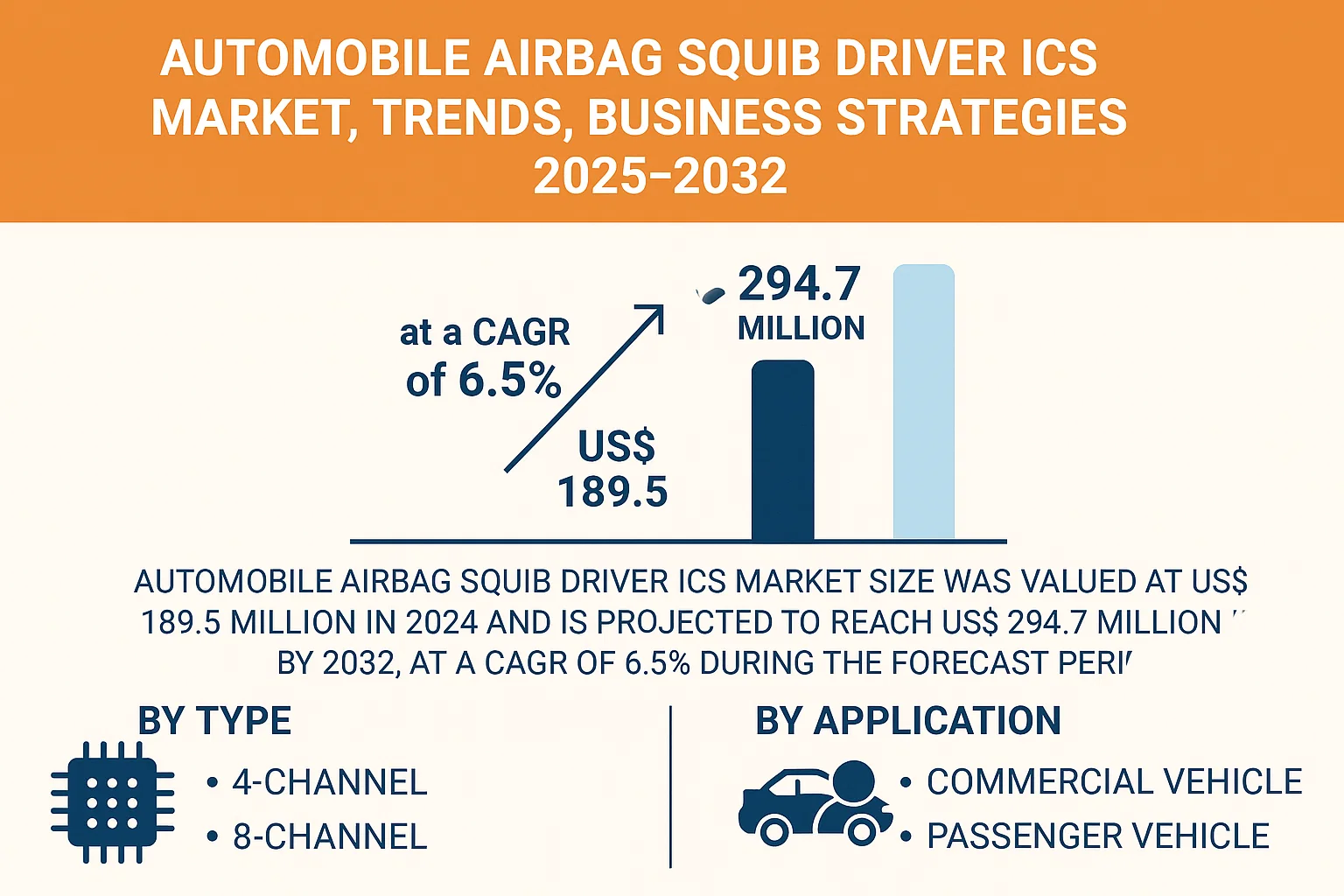
The global Automobile Airbag Squib Driver ICs Market size was valued at US$ 189.5 million in 2024 and is projected to reach US$ 294.7 million by 2032, at a CAGR of 6.5% during the forecast period 2025-2032.
Automobile Airbag Squib Driver ICs are critical semiconductor components that control the ignition timing of airbag inflators during vehicle collisions. These integrated circuits ensure precise deployment of airbags by managing electrical signals to squibs (pyrotechnic devices), forming part of the vehicle’s Supplemental Restraint System (SRS). The market primarily offers 4-channel and 8-channel IC variants, with the latter gaining traction for supporting advanced multi-airbag configurations.
While the automotive industry remains the primary growth driver, airbag IC adoption faces challenges from electric vehicle safety redesigns. The market expansion correlates with global vehicle production trends – Asia dominates with 56% share, led by China (32% of global output) and Japan (leading exporter with 3.5 million units in 2022). Recent regulatory mandates like Euro NCAP 2023 protocols requiring advanced occupant protection systems are accelerating technological upgrades in airbag ICs. Key players including Bosch, Infineon, and NXP are investing in ASIL-D compliant designs to meet evolving functional safety standards.
MARKET DYNAMICS
MARKET DRIVERS
Stringent Safety Regulations Fueling Airbag Squib Driver IC Adoption
Global automotive safety regulations continue to become more rigorous, with many countries mandating multi-airbag systems even in entry-level vehicles. This regulatory push is driving adoption of airbag squib driver ICs, which are essential for precise airbag deployment timing. The European Union’s updated General Safety Regulation now requires advanced safety systems for all new vehicles, while emerging markets like India and Brazil are implementing stricter crash test standards. These mandates have created a robust demand environment, with over 95% of new passenger vehicles globally now equipped with at least dual front airbags as standard.
Technological Advancements in Smart Airbag Systems Creating New Demand
The evolution from conventional to smart airbag systems is generating significant growth opportunities. Modern airbag control units now integrate machine learning algorithms that analyze crash severity in real-time, requiring more sophisticated squib driver ICs with higher channel counts. The market is transitioning from traditional 4-channel ICs to advanced 8-channel solutions capable of handling complex sensor inputs. Recent developments include ICs with built-in self-diagnostics and redundancy features that comply with ASIL-D safety standards. Leading automakers are adopting these intelligent systems, with over 35% of 2024 vehicle models featuring smart airbag technology.
Growing Electric Vehicle Production Boosting Specialized IC Demand
The electric vehicle revolution is creating unique requirements for airbag control systems. EV battery packs alter crash dynamics and require modified deployment algorithms, driving demand for specialized squib driver ICs. Many EV manufacturers are now specifying ICs with enhanced EMI protection and lower power consumption profiles. With global EV production expected to reach 40 million units annually by 2030, this represents a substantial growth vector. Recent product launches include ICs specifically optimized for high-voltage EV architectures, with built-in safeguards against electromagnetic interference common in electric powertrains.
MARKET RESTRAINTS
Automotive Production Volatility Impacts Market Stability
The automotive industry’s cyclical nature creates challenges for squib driver IC suppliers. Global light vehicle production declined by over 20 million units between 2019-2022 due to semiconductor shortages and economic factors. Such production swings make inventory planning difficult for IC manufacturers who operate on long lead times. While the market is recovering, ongoing supply chain uncertainties continue to create unpredictability in component demand patterns. Tier 1 suppliers report that automakers are increasingly requesting flexible order quantities, making production scheduling complex for IC manufacturers.
Intense Cost Pressure from Automakers Squeezes Margins
Automakers facing their own profitability challenges are aggressively pushing for cost reductions throughout the supply chain. Squib driver IC manufacturers report annual price reduction demands of 3-5% from major OEMs. This pricing pressure comes while R&D costs are increasing to develop more advanced IC versions. The conflict between rising development expenses and falling unit prices creates significant margin pressure, particularly for smaller IC suppliers who lack economies of scale. Some manufacturers are responding by consolidating production into larger fabs and reducing package variations to control costs.
MARKET OPPORTUNITIES
Emerging Markets Present Significant Untapped Potential
While developed markets have high airbag penetration rates, many emerging economies are just beginning to mandate advanced safety systems. Countries representing over 60% of global population still have basic safety requirements, creating a substantial upgrade opportunity. Southeast Asia and Africa in particular are seeing regulatory shifts that will drive airbag adoption. IC manufacturers who develop cost-optimized solutions for these price-sensitive markets can establish early leadership. Some suppliers are already introducing value-tier IC families with reduced functionality but full safety certification for emerging market applications.
Integration With Advanced Driver Assistance Systems Opens New Frontiers
The convergence of passive and active safety systems is creating opportunities for more sophisticated squib driver ICs. Next-generation ICs are being designed to interface directly with ADAS controllers, enabling coordinated responses between crash avoidance and occupant protection systems. This integration requires ICs with faster communication interfaces and enhanced processing capabilities. Suppliers developing these system-aware solutions can command premium pricing while improving vehicle safety performance. Recent industry collaborations have produced ICs capable of receiving pre-crash signals from radar and camera systems to optimize airbag inflation timing.
MARKET CHALLENGES
Component Shortages Continue to Disrupt Supply Chains
The semiconductor industry’s recovery from pandemic-era shortages remains uneven, particularly for automotive-grade components. Squib driver ICs require specialized wafer processes and packaging technologies that have limited production capacity. Lead times for certain IC variants still exceed 40 weeks, forcing automakers to maintain elevated inventory levels. The situation is complicated by the automotive industry’s exacting quality requirements, which limit the ability to quickly qualify alternative suppliers. Many IC manufacturers are investing in additional cleanroom capacity, but these facilities take years to become operational.
Increasing Design Complexity Stretches Development Timelines
Modern squib driver IC development has become markedly more complex as functionality requirements grow. Each new generation must incorporate additional safety features, diagnostic capabilities, and interface options while meeting tighter power budgets. This complexity extends development cycles and increases engineering costs. Recent IC projects report average development times of 28-36 months from specification to production release. The extended timelines create challenges in keeping pace with automakers’ vehicle development schedules, requiring closer synchronization between IC suppliers and their automotive customers throughout the design process.
AUTOMOBILE AIRBAG SQUIB DRIVER ICS MARKET TRENDS
Integration of Advanced Safety Features Driving Market Growth
The global automobile airbag squib driver ICs market is experiencing significant growth, fueled by the increasing integration of advanced safety features in vehicles. With rising awareness about passenger safety and stringent government regulations mandating airbag installations, demand for squib driver ICs—critical components that trigger airbag deployment—has surged. Modern vehicles now incorporate multiple airbag systems, including front, side, and curtain airbags, necessitating more sophisticated driver ICs capable of precise and instantaneous response. The market is projected to grow at a CAGR of 4.8% from 2024 to 2032, with Asia-Pacific leading due to high automotive production volumes. Furthermore, the shift toward autonomous vehicles is expected to accelerate adoption, as these systems require redundant safety mechanisms to ensure reliability even in complex driving scenarios.
Other Trends
Rise in Electric Vehicle Production
The rapid expansion of the electric vehicle (EV) market is another key driver for airbag squib driver ICs. As EV adoption grows—projected to account for 30% of global vehicle sales by 2030—manufacturers are focusing on optimizing safety systems to meet the unique requirements of high-voltage environments. Squib driver ICs in EVs must comply with stringent electromagnetic compatibility (EMC) standards and integrate seamlessly with the vehicle’s electronic architecture. This has led to innovations in IC design, such as enhanced noise immunity and fault diagnostics, ensuring reliable airbag deployment in electrified powertrains. Additionally, the lightweighting trend in EVs is pushing the development of compact, energy-efficient driver ICs that contribute to overall vehicle weight reduction.
Technological Advancements in IC Design
Continuous advancements in semiconductor technology are transforming squib driver ICs, enabling higher precision and reliability. Modern ICs now incorporate features like built-in self-diagnostics, which monitor system integrity in real time to prevent false deployments—a critical requirement given the increasing complexity of automotive electronics. The integration of artificial intelligence (AI) for predictive safety systems is also gaining traction, with some manufacturers developing ICs that can analyze crash data milliseconds before impact to optimize airbag deployment timing and force. Furthermore, the shift to 40nm and smaller process nodes is allowing for lower power consumption and improved thermal performance, addressing key challenges in automotive environments where operational temperatures can range from -40°C to 125°C.
COMPETITIVE LANDSCAPE
Key Industry Players
Automotive Safety Leaders Drive Innovation in Airbag Squib Driver ICs
The global automobile airbag squib driver ICs market features a highly consolidated competitive landscape, dominated by established semiconductor and automotive electronics giants. Bosch leads the market with a significant share, owing to its vertically integrated automotive safety solutions and strong relationships with OEMs across Europe and Asia. The company’s recent investment in smart airbag systems integrating AI-driven collision prediction further strengthens its position.
Infineon Technologies and NXP Semiconductors hold substantial market positions, particularly in North America and China, where their advanced ASIC designs for airbag systems have become industry standards. These companies benefit from their semiconductor manufacturing expertise, enabling them to deliver highly reliable driver ICs that meet stringent automotive safety requirements.
The competitive intensity is increasing as manufacturers strive to develop more compact and energy-efficient solutions. While traditional 4-channel ICs still dominate commercial vehicle applications, companies like STMicroelectronics are gaining traction in the passenger vehicle segment with their 8-channel solutions that support advanced airbag configurations.
Meanwhile, Continental AG is differentiating itself through integrated safety system solutions that combine squib driver ICs with sensor fusion technology. This approach allows for more precise airbag deployment timing, particularly important as vehicle architectures become more complex with the rise of electric and autonomous vehicles.
List of Key Automobile Airbag Squib Driver IC Companies
- Bosch (Germany)
- STMicroelectronics (Switzerland)
- NXP Semiconductors (Netherlands)
- Infineon Technologies (Germany)
- Continental AG (Germany)
- Renesas Electronics (Japan)
- ON Semiconductor (U.S.)
- ROHM Semiconductor (Japan)
- Toshiba Electronic Devices & Storage (Japan)
Segment Analysis:
By Type
4-Channel Squib Driver ICs Dominate Due to Widespread Adoption in Mid-Range Vehicles
The market is segmented based on type into:
- 4-Channel
- 8-Channel
- Others
By Application
Passenger Vehicle Segment Leads Owing to Higher Safety Standard Requirements
The market is segmented based on application into:
- Commercial Vehicle
- Passenger Vehicle
By Technology
Smart Airbag Systems Drive Adoption of Advanced Driver ICs
The market is segmented based on technology into:
- Conventional Airbag Systems
- Smart Airbag Systems
By Vehicle Type
Electric Vehicles Emerge as Key Growth Segment
The market is segmented based on vehicle type into:
- Internal Combustion Engine (ICE) Vehicles
- Electric Vehicles
- Hybrid Vehicles
Regional Analysis: Automobile Airbag Squib Driver ICs Market
North America
The North American market for Automobile Airbag Squib Driver ICs is driven by stringent vehicle safety regulations and the presence of leading automotive OEMs. The U.S. accounts for over 75% of regional demand, supported by high vehicle production volumes and mandatory airbag deployment systems in all new vehicles. Key players like Bosch and Continental dominate the supply chain, focusing on advanced IC designs that comply with FMVSS 208 standards. While the market is mature, electric vehicle adoption and autonomous driving technologies present new growth opportunities. However, rising semiconductor supply chain challenges and pricing pressures may hinder short-term expansion.
Europe
Europe represents one of the most technologically advanced markets for airbag electronics, with German automakers setting global benchmarks in safety systems. The EU’s General Safety Regulation (GSR) mandates advanced occupant protection systems, creating consistent demand for squib driver ICs. France and Germany collectively account for nearly 50% of regional consumption. While established suppliers like Infineon and STMicroelectronics maintain strong positions, growing preference for multi-channel ICs in premium vehicles is reshaping product development strategies. The region’s strict environmental regulations also drive innovation in low-power IC designs, though Brexit-related trade complexities continue to impact component availability.
Asia-Pacific
As the world’s largest automotive production hub, Asia-Pacific dominates the airbag IC market with over 60% global share. China’s rapid automotive electrification fuels demand, with domestic suppliers increasingly competing against international brands. India’s expanding passenger vehicle market shows the fastest growth rate in the region at 12% CAGR. While 4-channel ICs remain prevalent in economy vehicles, Japanese and Korean manufacturers are accelerating adoption of 8-channel solutions for premium models. The region faces unique challenges including price sensitivity and counterfeit components, prompting suppliers to develop cost-optimized designs without compromising safety performance.
South America
South America’s market growth is constrained by economic instability but shows gradual recovery post-pandemic. Brazil leads regional demand, accounting for 65% of airbag IC consumption, driven by new safety regulations implemented in 2020. Most vehicles still utilize basic airbag systems, creating opportunities for entry-level IC solutions. Local assembly of vehicles by major OEMs has increased component demand, though reliance on imported ICs remains high due to limited semiconductor manufacturing capabilities. Currency fluctuations and inflationary pressures continue to impact pricing strategies for suppliers targeting this price-sensitive market.
Middle East & Africa
This emerging market shows potential with increasing vehicle safety awareness and regulatory developments. GCC countries, particularly Saudi Arabia and UAE, drive premium vehicle demand requiring advanced airbag systems. Africa’s market remains underpenetrated but growing, with South Africa serving as the manufacturing hub for regional vehicle assembly. The lack of local IC production results in complete import dependency, creating supply chain vulnerabilities. While market volumes are currently small, long-term prospects are positive as regional new car assessment programs (NCAPs) gain traction and consumer safety expectations rise.
Report Scope
This market research report provides a comprehensive analysis of the global and regional Automobile Airbag Squib Driver ICs market, covering the forecast period 2025–2032. It offers detailed insights into market dynamics, technological advancements, competitive landscape, and key trends shaping the industry.
Key focus areas of the report include:
- Market Size & Forecast: Historical data and future projections for revenue, unit shipments, and market value across major regions and segments. The global market was valued at US$ 189.5 million in 2024 and is projected to reach US$ 294.7 million by 2032 at a CAGR of 6.5%.
- Segmentation Analysis: Detailed breakdown by product type (4-Channel, 8-Channel, Others), application (Commercial Vehicle, Passenger Vehicle), and end-user industry to identify high-growth segments and investment opportunities.
- Regional Outlook: Insights into market performance across North America, Europe, Asia-Pacific, Latin America, and the Middle East & Africa. Asia-Pacific dominates with 58% market share due to high automotive production.
- Competitive Landscape: Profiles of leading market participants including Bosch, ST, NXP, Infineon, and Continental, covering their product portfolios, R&D investments, and strategic initiatives.
- Technology Trends & Innovation: Assessment of emerging technologies like integrated safety systems, AI-powered crash detection, and advanced semiconductor fabrication techniques.
- Market Drivers & Restraints: Evaluation of factors such as increasing vehicle safety regulations and challenges like semiconductor supply chain disruptions.
- Stakeholder Analysis: Strategic insights for automotive OEMs, tier-1 suppliers, IC manufacturers, and investors regarding market opportunities and challenges.
The research employs primary and secondary methodologies, including interviews with industry experts and analysis of verified market data from regulatory bodies and trade associations.
FREQUENTLY ASKED QUESTIONS:
What is the current market size of Global Automobile Airbag Squib Driver ICs Market?
->Automobile Airbag Squib Driver ICs Market size was valued at US$ 189.5 million in 2024 and is projected to reach US$ 294.7 million by 2032, at a CAGR of 6.5% during the forecast period 2025-2032.
Which key companies operate in this market?
-> Key players include Bosch, STMicroelectronics, NXP Semiconductors, Infineon Technologies, and Continental.
What are the key growth drivers?
-> Growth is driven by stringent vehicle safety regulations, increasing airbag deployment in emerging markets, and technological advancements in automotive safety systems.
Which region dominates the market?
-> Asia-Pacific holds the largest share (58%), followed by Europe and North America, due to high automotive production in China, Japan, and South Korea.
What are the emerging trends?
-> Emerging trends include integration of multiple safety functions in single ICs, development of failsafe systems, and adoption of advanced node semiconductor technologies.

Get Sample Report PDF for Exclusive Insights
Report Sample Includes
- Table of Contents
- List of Tables & Figures
- Charts, Research Methodology, and more...
 Download Sample Report PDF