Automobile Airbag Microcontroller Market, Trends, Business Strategies 2025-2032

Automobile Airbag Microcontroller Market size was valued at US$ 156.2 million in 2024 and is projected to reach US$ 238.9 million by 2032, at a CAGR of 6.2% during the forecast period 2025-2032

PDF Icon Download Sample Report PDF
  • Quick Dispatch

    All Orders

  • Secure Payment

    100% Secure Payment

Price range: $1,500.00 through $4,250.00

Clear

MARKET INSIGHTS

The global Automobile Airbag Microcontroller Market size was valued at US$ 156.2 million in 2024 and is projected to reach US$ 238.9 million by 2032, at a CAGR of 6.2% during the forecast period 2025-2032.
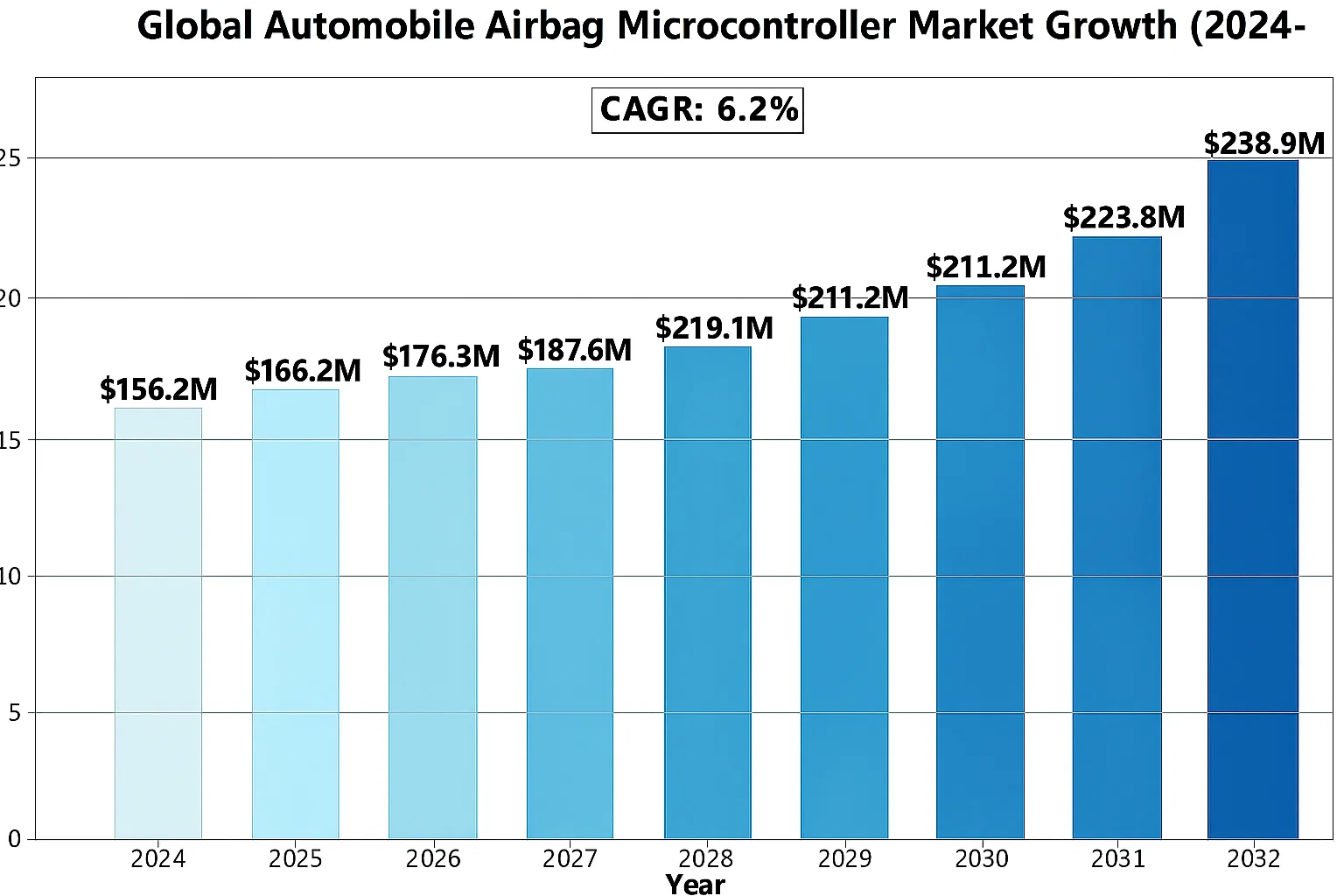
Airbag Microcontroller Market Growth

Automobile airbag microcontrollers are specialized semiconductor devices that control the deployment timing and sequence of vehicle airbag systems. These microcontrollers process crash sensor data at millisecond speeds to determine optimal airbag activation, featuring built-in safety mechanisms like self-diagnostics and redundancy checks. The market primarily consists of 16-bit and 32-bit microcontroller units (MCUs), with growing adoption of system-on-chip (SoC) designs integrating sensor interfaces and power management.

The market growth is driven by stringent automotive safety regulations mandating multi-airbag systems and technological advancements in crash detection algorithms. However, supply chain disruptions in semiconductor production created challenges in 2022-2023, with lead times exceeding 40 weeks for some microcontroller variants. Key players like Bosch and Infineon are addressing this through capacity expansions, with Bosch announcing a new 300mm wafer fab in Dresden scheduled for 2025 production.

MARKET DYNAMICS

MARKET DRIVERS

Growing Vehicle Safety Regulations to Accelerate Airbag Microcontroller Demand

Stringent government regulations mandating advanced safety features in automobiles are driving significant growth in the airbag microcontroller market. Over 70 countries have adopted United Nations vehicle safety standards requiring at least dual front airbags in new passenger vehicles, creating a baseline demand for these critical components. The push for enhanced occupant protection systems has led to mandatory inclusion of 6-10 airbags in many premium vehicles, with this standard now filtering down to mass-market models. Recent regulatory developments in major automotive markets like India and Brazil have accelerated adoption timelines, compressing implementation cycles and forcing faster technology upgrades.

Rising Premiumization Trend in Automotive Sector to Boost Market Expansion

The global automotive industry is witnessing a strong premiumization wave, with consumers increasingly willing to pay for advanced safety and comfort features. Airbag systems have evolved from basic restraint systems to sophisticated protection networks, with modern vehicles incorporating up to 18 strategic airbag placements. This trend is particularly pronounced in emerging markets where GDP growth rates exceeding 5% are creating new vehicle-buying segments with higher disposable income. The microcontroller content per vehicle has consequently increased by over 300% in the last decade, as modern airbag systems require dedicated processing units for each zone alongside sophisticated sensor fusion capabilities.

Technological Advancements in Crash Detection Systems to Fuel Growth

Recent breakthroughs in predictive crash detection algorithms and multi-sensor fusion technologies are creating new market opportunities. Next-generation airbag systems now incorporate machine learning capabilities that can predict collision severity up to 500 milliseconds before impact, allowing microcontrollers to optimize deployment parameters in real-time. The shift from conventional accelerometer-based systems to integrated sensor hubs combining radar, camera, and lidar inputs has dramatically increased the computational requirements for airbag control units. This technological evolution is driving a rapid transition from 16-bit to 32-bit microcontroller architectures across all vehicle segments.

MARKET RESTRAINTS

Semiconductor Supply Chain Constraints to Limit Market Potential

The automotive microcontroller market continues to face significant supply chain challenges, with lead times for certain semiconductor components extending beyond 52 weeks. Airbag systems require specialized ASIL-D certified microcontrollers that combine high reliability with real-time performance characteristics, creating a constrained supplier ecosystem. Recent disruptions in the global semiconductor supply chain have particularly impacted the availability of 40nm and older process node chips that form the backbone of many current airbag control units. These constraints are forcing automakers to delay new model launches or implement temporary feature deletions in some markets.

Increasing System Complexity to Drive Up Development Costs

Modern airbag control systems have evolved into complex safety-critical networks requiring extensive validation and certification. The development cost for a comprehensive airbag electronic control unit has increased by approximately 40% over the past five years due to growing software content and functional safety requirements. Each new vehicle platform now requires over 2000 crash test scenarios to validate airbag performance, with microcontroller firmware undergoing rigorous ASIL-D certification processes. These escalating development costs are creating significant barriers to entry for smaller suppliers and potentially limiting innovation in the market.

MARKET CHALLENGES

Balancing Performance and Power Consumption in EV Applications

The rapid electrification of vehicle architectures presents unique challenges for airbag microcontroller designers. Electric vehicles demand ultra-low power consumption from all electronic systems to preserve battery range, while simultaneously requiring faster response times due to higher crash energies inherent in heavy battery packs. Modern airbag microcontrollers must achieve wake-up times under 50 microseconds from standby mode while maintaining power draws below 100 microamps. These competing requirements are pushing the limits of current semiconductor technologies and forcing innovative architectural approaches to power management.

Cybersecurity Risks in Connected Safety Systems

The integration of airbag control units into vehicle communication networks has introduced new cybersecurity vulnerabilities that were absent in traditional standalone systems. Recent demonstrations have shown the potential for malicious actors to trigger false deployments or disable safety systems remotely through network access. Securing these safety-critical systems requires hardware-level security modules and real-time intrusion detection capabilities that add complexity and cost to microcontroller designs. The industry faces the challenge of implementing robust security measures while maintaining the deterministic response times required for life-saving applications.

MARKET OPPORTUNITIES

Next-Generation Integrated Safety Domain Controllers to Create New Revenue Streams

The automotive industry’s shift toward domain-centralized architectures presents significant opportunities for advanced microcontroller solutions. Modern vehicle designs are consolidating safety functions into comprehensive domain controllers that manage airbags, seatbelts, and other passive safety systems through a single computing platform. This architectural shift enables powerful new features like coordinated multi-system response to complex crash scenarios but requires microcontrollers with significantly higher processing capabilities. Suppliers that can deliver these integrated solutions stand to capture substantial portions of the rapidly evolving safety electronics market.

Emerging Markets Present Untapped Growth Potential

While developed markets approach saturation for basic airbag systems, emerging economies represent a significant growth frontier. Countries implementing Bharat NCAP and similar localized safety rating systems are creating regulatory pull for advanced safety technologies. The price-performance ratio of airbag microcontrollers has reached inflection points that enable their deployment in entry-level vehicles, opening vast new market segments. Manufacturers able to offer cost-optimized solutions without compromising critical safety functions are well-positioned to capitalize on this demand surge across Southeast Asia, Latin America, and African markets.

AUTOMOBILE AIRBAG MICROCONTROLLER MARKET TRENDS

Increasing Vehicle Safety Regulations to Boost Demand for Airbag Microcontrollers

The global automobile airbag microcontroller market is experiencing steady growth, driven by stringent safety regulations implemented worldwide. Governments and regulatory bodies are mandating the inclusion of advanced safety features, including multiple airbags, in both passenger and commercial vehicles. For instance, the European Union’s General Safety Regulation (GSR) requires all new vehicles to be equipped with advanced safety technologies, including intelligent airbag systems. This regulatory push has significantly increased the adoption of high-performance microcontrollers capable of handling complex airbag deployment algorithms. North America and Europe lead in regulatory compliance, while emerging markets in Asia-Pacific are rapidly catching up, further propelling market expansion.

Other Trends

Shift Towards 32-bit MCUs for Enhanced Processing Capabilities

The automotive industry is witnessing a gradual shift from 16-bit to 32-bit microcontrollers (MCUs) due to their superior processing power and ability to handle multiple safety systems simultaneously. These MCUs are essential for modern vehicles equipped with sophisticated airbag systems that require real-time decision-making in crash scenarios. The transition is particularly evident in luxury and electric vehicles, where safety standards are even more stringent. With automotive manufacturers prioritizing redundancy and fail-safe mechanisms, 32-bit MCUs now account for over 60% of the airbag controller market share, a figure expected to grow as autonomous driving technologies advance.

Growing Integration of AI and Machine Learning in Airbag Systems

Artificial Intelligence (AI) and machine learning are transforming airbag deployment systems, making microcontrollers smarter and more adaptable. Advanced algorithms now analyze crash data in real-time, adjusting airbag deployment force based on passenger size, seat position, and collision severity. This technological leap not only enhances passenger safety but also reduces unnecessary airbag deployments, minimizing repair costs. Automakers such as Tesla and BMW are already implementing AI-driven airbag systems in their latest models, setting a benchmark for the industry. Furthermore, the emergence of neural network-based predictive crash detection systems is expected to further elevate the demand for high-speed, low-latency microcontrollers.

COMPETITIVE LANDSCAPE

Key Industry Players

Leading Suppliers Invest in Advanced Safety Technologies to Capture Market Share

The global automobile airbag microcontroller market is characterized by intense competition among established semiconductor manufacturers and automotive suppliers. Bosch currently leads the market with an estimated 28% revenue share in 2024, owing to its integrated safety system solutions and strong partnerships with major automakers. The company’s continued dominance stems from its SP40 family of airbag control units which combine microcontrollers with sophisticated crash detection algorithms.

Infineon Technologies and NXP Semiconductors collectively account for approximately 35% of the market, benefiting from their semiconductor expertise in automotive-grade MCUs. Both companies have recently launched new 32-bit microcontroller platforms specifically optimized for next-generation airbag systems, featuring enhanced processing speeds and lower power consumption.

Meanwhile, STMicroelectronics maintains a strong position in the microcontroller market, particularly in Europe, where it supplies several premium automotive brands. The company’s focus on functional safety certification (ISO 26262) for its microcontroller lines has become a key differentiator as vehicle safety standards become more stringent.

The competitive intensity is further amplified by Continental AG’s vertical integration strategy. As both a tier-1 supplier and technology developer, Continental has been incorporating proprietary microcontroller designs into its complete restraint control modules, creating system-level advantages that smaller component suppliers cannot easily match.

List of Key Automobile Airbag Microcontroller Companies

The market has seen increased collaboration between semiconductor firms and automotive safety system integrators to develop application-specific microcontroller solutions. Recent partnerships focus on integrating machine learning capabilities for predictive crash detection while maintaining the real-time response requirements critical for airbag deployment systems.

Looking forward, competition is expected to intensify around power efficiency and miniaturization as electric vehicles demand more compact safety systems. Suppliers who can balance these technical requirements with stringent automotive reliability standards will likely gain competitive advantage in this growing market segment.

Segment Analysis:

By Type

32-bit MCU Segment Leads the Market Due to Enhanced Processing Capabilities

The market is segmented based on type into:

  • 16-bit MCU
  • 32-bit MCU
  • Others

By Application

Passenger Vehicle Segment Dominates Due to Higher Safety Regulation Compliance

The market is segmented based on application into:

  • Commercial Vehicle
  • Passenger Vehicle

By Technology

Embedded Airbag Systems Drive Adoption of Advanced Microcontrollers

The market is segmented based on technology into:

  • Frontal Airbag Systems
  • Side Impact Airbag Systems
  • Knee Airbag Systems
  • Curtain Airbag Systems

By Vehicle Propulsion

Electric Vehicles Segment Shows Strong Growth Potential

The market is segmented based on vehicle propulsion into:

  • Internal Combustion Engine Vehicles
  • Electric Vehicles
  • Hybrid Vehicles

Regional Analysis: Automobile Airbag Microcontroller Market

North America
The North American market for automobile airbag microcontrollers remains highly sophisticated, driven by stringent vehicle safety regulations and superior adoption of advanced automotive technologies. The U.S. alone accounted for over 80% of regional demand in 2024, with major OEMs increasingly integrating 32-bit MCUs for enhanced crash detection accuracy. While traditional airbag systems still dominate, new safety mandates—such as the inclusion of side-impact airbags in all new vehicles by 2030—are accelerating R&D investments. However, market saturation and declining vehicle production have tempered growth compared to emerging regions. Canada and Mexico show slower adoption rates but benefit from spillover demand from U.S. auto manufacturers.

Europe
European manufacturers lead in sophisticated airbag microcontroller solutions, leveraging stringent EU safety standards (ECE R94/R95) as key market drivers. Germany’s prominence in premium automotive manufacturing has made it the region’s largest consumer, with Bosch and Infineon supplying nearly 60% of local MCUs. The shift toward autonomous vehicles has intensified demand for multi-sensor airbag control units, though Euro 7 emission standards have temporarily redirected OEM budgets from safety to emission systems. Eastern European markets show promise but lag in technology adoption due to cost sensitivity and preference for imported vehicles equipped with pre-installed safety systems.

Asia-Pacific
As the largest and fastest-growing market, Asia-Pacific dominates with China contributing 45% of global MCU demand due to scale of automobile production. While Japanese manufacturers prioritize high-performance 32-bit chips, China and India still rely heavily on cost-effective 16-bit solutions, creating a bifurcated market. Recent regulatory changes—particularly India’s Bharat NCAP safety ratings—are accelerating transitions to advanced airbag systems. However, the prevalence of budget vehicles and local semiconductor supply chain limitations continue to challenge premium MCU adoption. South Korea and Japan remain technology leaders, exporting high-end MCUs globally while Southeast Asia emerges as a key manufacturing hub.

South America
Market development in South America faces structural hurdles, including volatile currency exchange rates and inconsistent regulatory enforcement. Brazil—the largest regional market—relies predominantly on imported MCUs due to limited local semiconductor capabilities, while Argentina shows unexpected demand growth from revived auto manufacturing. Recent economic stabilization has enabled some OEMs to expand safety feature offerings, though airbag microcontroller adoption remains well below global averages. The prevalence of older vehicle fleets and thriving gray market for counterfeit safety components further restrain legitimate market expansion.

Middle East & Africa
This region presents nascent opportunities through premium vehicle imports and localized assembly plants in Morocco and South Africa. GCC countries exhibit strong replacement demand for luxury vehicle MCUs, but weak regulatory oversight on vehicle safety standards hampers broader market penetration. The lack of domestic semiconductor production necessitates complete reliance on imports, making the market susceptible to global supply chain disruptions. However, infrastructure development initiatives—particularly Saudi Arabia’s $50 billion automotive sector investment—suggest long-term potential for safety system adoption as local manufacturing capabilities mature.

Report Scope

This market research report provides a comprehensive analysis of the Global Automobile Airbag Microcontroller Market, covering the forecast period 2024–2032. It offers detailed insights into market dynamics, technological advancements, competitive landscape, and key trends shaping the industry.

Key focus areas of the report include:

  • Market Size & Forecast: Historical data and future projections for revenue, unit shipments, and market value across major regions and segments. The market was valued at US$ 156.2 million in 2024 and is projected to reach US$ 238.9 million by 2032, growing at a CAGR of 6.2%.
  • Segmentation Analysis: Detailed breakdown by product type (16-bit MCU, 32-bit MCU, Others), application (Commercial Vehicle, Passenger Vehicle), and technology to identify high-growth segments.
  • Regional Outlook: Insights into market performance across North America, Europe, Asia-Pacific, Latin America, and the Middle East & Africa. Asia-Pacific currently dominates with 58% market share.
  • Competitive Landscape: Profiles of leading market participants including Bosch, ST, NXP, Infineon, and Continental, covering their product portfolios, market strategies, and recent developments.
  • Technology Trends & Innovation: Assessment of emerging technologies including AI integration, advanced sensor fusion, and next-generation safety systems in airbag control units.
  • Market Drivers & Restraints: Evaluation of factors such as increasing vehicle safety regulations, growing automotive production, and semiconductor supply chain challenges.
  • Stakeholder Analysis: Strategic insights for automotive OEMs, tier-1 suppliers, semiconductor manufacturers, and investors.

The research methodology includes primary interviews with industry experts, analysis of financial reports, and validation through multiple secondary sources to ensure data accuracy.

FREQUENTLY ASKED QUESTIONS:

What is the current market size of Global Automobile Airbag Microcontroller Market?

-> Automobile Airbag Microcontroller Market size was valued at US$ 156.2 million in 2024 and is projected to reach US$ 238.9 million by 2032, at a CAGR of 6.2% during the forecast period 2025-2032

Which key companies operate in Global Automobile Airbag Microcontroller Market?

-> Key players include Bosch, STMicroelectronics, NXP Semiconductors, Infineon Technologies, and Continental.

What are the key growth drivers?

-> Key growth drivers include stringent vehicle safety regulations, increasing automotive production in emerging markets, and technological advancements in airbag systems.

Which region dominates the market?

-> Asia-Pacific dominates with 58% market share, driven by automotive production in China, Japan, and South Korea.

What are the emerging trends?

-> Emerging trends include integration of AI in airbag control systems, multi-stage airbag deployment technologies, and advanced sensor fusion techniques.

Automobile Airbag Microcontroller Market, Trends, Business Strategies 2025-2032

Get Sample Report PDF for Exclusive Insights

Report Sample Includes

  • Table of Contents
  • List of Tables & Figures
  • Charts, Research Methodology, and more...

PDF Icon Download Sample Report PDF

Table of Content

1 Introduction to Research & Analysis Reports
1.1 Automobile Airbag Microcontroller Market Definition
1.2 Market Segments
1.2.1 Segment by Type
1.2.2 Segment by Application
1.3 Global Automobile Airbag Microcontroller Market Overview
1.4 Features & Benefits of This Report
1.5 Methodology & Sources of Information
1.5.1 Research Methodology
1.5.2 Research Process
1.5.3 Base Year
1.5.4 Report Assumptions & Caveats
2 Global Automobile Airbag Microcontroller Overall Market Size
2.1 Global Automobile Airbag Microcontroller Market Size: 2024 VS 2032
2.2 Global Automobile Airbag Microcontroller Market Size, Prospects & Forecasts: 2020-2032
2.3 Global Automobile Airbag Microcontroller Sales: 2020-2032
3 Company Landscape
3.1 Top Automobile Airbag Microcontroller Players in Global Market
3.2 Top Global Automobile Airbag Microcontroller Companies Ranked by Revenue
3.3 Global Automobile Airbag Microcontroller Revenue by Companies
3.4 Global Automobile Airbag Microcontroller Sales by Companies
3.5 Global Automobile Airbag Microcontroller Price by Manufacturer (2020-2025)
3.6 Top 3 and Top 5 Automobile Airbag Microcontroller Companies in Global Market, by Revenue in 2024
3.7 Global Manufacturers Automobile Airbag Microcontroller Product Type
3.8 Tier 1, Tier 2, and Tier 3 Automobile Airbag Microcontroller Players in Global Market
3.8.1 List of Global Tier 1 Automobile Airbag Microcontroller Companies
3.8.2 List of Global Tier 2 and Tier 3 Automobile Airbag Microcontroller Companies
4 Sights by Product
4.1 Overview
4.1.1 Segment by Type – Global Automobile Airbag Microcontroller Market Size Markets, 2024 & 2032
4.1.2 16-bit MCU
4.1.3 32-bit MCU
4.1.4 Others
4.2 Segment by Type – Global Automobile Airbag Microcontroller Revenue & Forecasts
4.2.1 Segment by Type – Global Automobile Airbag Microcontroller Revenue, 2020-2025
4.2.2 Segment by Type – Global Automobile Airbag Microcontroller Revenue, 2026-2032
4.2.3 Segment by Type – Global Automobile Airbag Microcontroller Revenue Market Share, 2020-2032
4.3 Segment by Type – Global Automobile Airbag Microcontroller Sales & Forecasts
4.3.1 Segment by Type – Global Automobile Airbag Microcontroller Sales, 2020-2025
4.3.2 Segment by Type – Global Automobile Airbag Microcontroller Sales, 2026-2032
4.3.3 Segment by Type – Global Automobile Airbag Microcontroller Sales Market Share, 2020-2032
4.4 Segment by Type – Global Automobile Airbag Microcontroller Price (Manufacturers Selling Prices), 2020-2032
5 Sights by Application
5.1 Overview
5.1.1 Segment by Application – Global Automobile Airbag Microcontroller Market Size, 2024 & 2032
5.1.2 Commercial Vehicle
5.1.3 Passenger Vehicle
5.2 Segment by Application – Global Automobile Airbag Microcontroller Revenue & Forecasts
5.2.1 Segment by Application – Global Automobile Airbag Microcontroller Revenue, 2020-2025
5.2.2 Segment by Application – Global Automobile Airbag Microcontroller Revenue, 2026-2032
5.2.3 Segment by Application – Global Automobile Airbag Microcontroller Revenue Market Share, 2020-2032
5.3 Segment by Application – Global Automobile Airbag Microcontroller Sales & Forecasts
5.3.1 Segment by Application – Global Automobile Airbag Microcontroller Sales, 2020-2025
5.3.2 Segment by Application – Global Automobile Airbag Microcontroller Sales, 2026-2032
5.3.3 Segment by Application – Global Automobile Airbag Microcontroller Sales Market Share, 2020-2032
5.4 Segment by Application – Global Automobile Airbag Microcontroller Price (Manufacturers Selling Prices), 2020-2032
6 Sights by Region
6.1 By Region – Global Automobile Airbag Microcontroller Market Size, 2024 & 2032
6.2 By Region – Global Automobile Airbag Microcontroller Revenue & Forecasts
6.2.1 By Region – Global Automobile Airbag Microcontroller Revenue, 2020-2025
6.2.2 By Region – Global Automobile Airbag Microcontroller Revenue, 2026-2032
6.2.3 By Region – Global Automobile Airbag Microcontroller Revenue Market Share, 2020-2032
6.3 By Region – Global Automobile Airbag Microcontroller Sales & Forecasts
6.3.1 By Region – Global Automobile Airbag Microcontroller Sales, 2020-2025
6.3.2 By Region – Global Automobile Airbag Microcontroller Sales, 2026-2032
6.3.3 By Region – Global Automobile Airbag Microcontroller Sales Market Share, 2020-2032
6.4 North America
6.4.1 By Country – North America Automobile Airbag Microcontroller Revenue, 2020-2032
6.4.2 By Country – North America Automobile Airbag Microcontroller Sales, 2020-2032
6.4.3 United States Automobile Airbag Microcontroller Market Size, 2020-2032
6.4.4 Canada Automobile Airbag Microcontroller Market Size, 2020-2032
6.4.5 Mexico Automobile Airbag Microcontroller Market Size, 2020-2032
6.5 Europe
6.5.1 By Country – Europe Automobile Airbag Microcontroller Revenue, 2020-2032
6.5.2 By Country – Europe Automobile Airbag Microcontroller Sales, 2020-2032
6.5.3 Germany Automobile Airbag Microcontroller Market Size, 2020-2032
6.5.4 France Automobile Airbag Microcontroller Market Size, 2020-2032
6.5.5 U.K. Automobile Airbag Microcontroller Market Size, 2020-2032
6.5.6 Italy Automobile Airbag Microcontroller Market Size, 2020-2032
6.5.7 Russia Automobile Airbag Microcontroller Market Size, 2020-2032
6.5.8 Nordic Countries Automobile Airbag Microcontroller Market Size, 2020-2032
6.5.9 Benelux Automobile Airbag Microcontroller Market Size, 2020-2032
6.6 Asia
6.6.1 By Region – Asia Automobile Airbag Microcontroller Revenue, 2020-2032
6.6.2 By Region – Asia Automobile Airbag Microcontroller Sales, 2020-2032
6.6.3 China Automobile Airbag Microcontroller Market Size, 2020-2032
6.6.4 Japan Automobile Airbag Microcontroller Market Size, 2020-2032
6.6.5 South Korea Automobile Airbag Microcontroller Market Size, 2020-2032
6.6.6 Southeast Asia Automobile Airbag Microcontroller Market Size, 2020-2032
6.6.7 India Automobile Airbag Microcontroller Market Size, 2020-2032
6.7 South America
6.7.1 By Country – South America Automobile Airbag Microcontroller Revenue, 2020-2032
6.7.2 By Country – South America Automobile Airbag Microcontroller Sales, 2020-2032
6.7.3 Brazil Automobile Airbag Microcontroller Market Size, 2020-2032
6.7.4 Argentina Automobile Airbag Microcontroller Market Size, 2020-2032
6.8 Middle East & Africa
6.8.1 By Country – Middle East & Africa Automobile Airbag Microcontroller Revenue, 2020-2032
6.8.2 By Country – Middle East & Africa Automobile Airbag Microcontroller Sales, 2020-2032
6.8.3 Turkey Automobile Airbag Microcontroller Market Size, 2020-2032
6.8.4 Israel Automobile Airbag Microcontroller Market Size, 2020-2032
6.8.5 Saudi Arabia Automobile Airbag Microcontroller Market Size, 2020-2032
6.8.6 UAE Automobile Airbag Microcontroller Market Size, 2020-2032
7 Manufacturers & Brands Profiles
7.1 Bosch
7.1.1 Bosch Company Summary
7.1.2 Bosch Business Overview
7.1.3 Bosch Automobile Airbag Microcontroller Major Product Offerings
7.1.4 Bosch Automobile Airbag Microcontroller Sales and Revenue in Global (2020-2025)
7.1.5 Bosch Key News & Latest Developments
7.2 ST
7.2.1 ST Company Summary
7.2.2 ST Business Overview
7.2.3 ST Automobile Airbag Microcontroller Major Product Offerings
7.2.4 ST Automobile Airbag Microcontroller Sales and Revenue in Global (2020-2025)
7.2.5 ST Key News & Latest Developments
7.3 NXP
7.3.1 NXP Company Summary
7.3.2 NXP Business Overview
7.3.3 NXP Automobile Airbag Microcontroller Major Product Offerings
7.3.4 NXP Automobile Airbag Microcontroller Sales and Revenue in Global (2020-2025)
7.3.5 NXP Key News & Latest Developments
7.4 Infineon
7.4.1 Infineon Company Summary
7.4.2 Infineon Business Overview
7.4.3 Infineon Automobile Airbag Microcontroller Major Product Offerings
7.4.4 Infineon Automobile Airbag Microcontroller Sales and Revenue in Global (2020-2025)
7.4.5 Infineon Key News & Latest Developments
7.5 Continental
7.5.1 Continental Company Summary
7.5.2 Continental Business Overview
7.5.3 Continental Automobile Airbag Microcontroller Major Product Offerings
7.5.4 Continental Automobile Airbag Microcontroller Sales and Revenue in Global (2020-2025)
7.5.5 Continental Key News & Latest Developments
8 Global Automobile Airbag Microcontroller Production Capacity, Analysis
8.1 Global Automobile Airbag Microcontroller Production Capacity, 2020-2032
8.2 Automobile Airbag Microcontroller Production Capacity of Key Manufacturers in Global Market
8.3 Global Automobile Airbag Microcontroller Production by Region
9 Key Market Trends, Opportunity, Drivers and Restraints
9.1 Market Opportunities & Trends
9.2 Market Drivers
9.3 Market Restraints
10 Automobile Airbag Microcontroller Supply Chain Analysis
10.1 Automobile Airbag Microcontroller Industry Value Chain
10.2 Automobile Airbag Microcontroller Upstream Market
10.3 Automobile Airbag Microcontroller Downstream and Clients
10.4 Marketing Channels Analysis
10.4.1 Marketing Channels
10.4.2 Automobile Airbag Microcontroller Distributors and Sales Agents in Global
11 Conclusion
12 Appendix
12.1 Note
12.2 Examples of Clients
12.3 DisclaimerList of Tables
Table 1. Key Players of Automobile Airbag Microcontroller in Global Market
Table 2. Top Automobile Airbag Microcontroller Players in Global Market, Ranking by Revenue (2024)
Table 3. Global Automobile Airbag Microcontroller Revenue by Companies, (US$, Mn), 2020-2025
Table 4. Global Automobile Airbag Microcontroller Revenue Share by Companies, 2020-2025
Table 5. Global Automobile Airbag Microcontroller Sales by Companies, (K Units), 2020-2025
Table 6. Global Automobile Airbag Microcontroller Sales Share by Companies, 2020-2025
Table 7. Key Manufacturers Automobile Airbag Microcontroller Price (2020-2025) & (US$/Unit)
Table 8. Global Manufacturers Automobile Airbag Microcontroller Product Type
Table 9. List of Global Tier 1 Automobile Airbag Microcontroller Companies, Revenue (US$, Mn) in 2024 and Market Share
Table 10. List of Global Tier 2 and Tier 3 Automobile Airbag Microcontroller Companies, Revenue (US$, Mn) in 2024 and Market Share
Table 11. Segment by Type – Global Automobile Airbag Microcontroller Revenue, (US$, Mn), 2024 & 2032
Table 12. Segment by Type – Global Automobile Airbag Microcontroller Revenue (US$, Mn), 2020-2025
Table 13. Segment by Type – Global Automobile Airbag Microcontroller Revenue (US$, Mn), 2026-2032
Table 14. Segment by Type – Global Automobile Airbag Microcontroller Sales (K Units), 2020-2025
Table 15. Segment by Type – Global Automobile Airbag Microcontroller Sales (K Units), 2026-2032
Table 16. Segment by Application – Global Automobile Airbag Microcontroller Revenue, (US$, Mn), 2024 & 2032
Table 17. Segment by Application – Global Automobile Airbag Microcontroller Revenue, (US$, Mn), 2020-2025
Table 18. Segment by Application – Global Automobile Airbag Microcontroller Revenue, (US$, Mn), 2026-2032
Table 19. Segment by Application – Global Automobile Airbag Microcontroller Sales, (K Units), 2020-2025
Table 20. Segment by Application – Global Automobile Airbag Microcontroller Sales, (K Units), 2026-2032
Table 21. By Region – Global Automobile Airbag Microcontroller Revenue, (US$, Mn), 2025-2032
Table 22. By Region – Global Automobile Airbag Microcontroller Revenue, (US$, Mn), 2020-2025
Table 23. By Region – Global Automobile Airbag Microcontroller Revenue, (US$, Mn), 2026-2032
Table 24. By Region – Global Automobile Airbag Microcontroller Sales, (K Units), 2020-2025
Table 25. By Region – Global Automobile Airbag Microcontroller Sales, (K Units), 2026-2032
Table 26. By Country – North America Automobile Airbag Microcontroller Revenue, (US$, Mn), 2020-2025
Table 27. By Country – North America Automobile Airbag Microcontroller Revenue, (US$, Mn), 2026-2032
Table 28. By Country – North America Automobile Airbag Microcontroller Sales, (K Units), 2020-2025
Table 29. By Country – North America Automobile Airbag Microcontroller Sales, (K Units), 2026-2032
Table 30. By Country – Europe Automobile Airbag Microcontroller Revenue, (US$, Mn), 2020-2025
Table 31. By Country – Europe Automobile Airbag Microcontroller Revenue, (US$, Mn), 2026-2032
Table 32. By Country – Europe Automobile Airbag Microcontroller Sales, (K Units), 2020-2025
Table 33. By Country – Europe Automobile Airbag Microcontroller Sales, (K Units), 2026-2032
Table 34. By Region – Asia Automobile Airbag Microcontroller Revenue, (US$, Mn), 2020-2025
Table 35. By Region – Asia Automobile Airbag Microcontroller Revenue, (US$, Mn), 2026-2032
Table 36. By Region – Asia Automobile Airbag Microcontroller Sales, (K Units), 2020-2025
Table 37. By Region – Asia Automobile Airbag Microcontroller Sales, (K Units), 2026-2032
Table 38. By Country – South America Automobile Airbag Microcontroller Revenue, (US$, Mn), 2020-2025
Table 39. By Country – South America Automobile Airbag Microcontroller Revenue, (US$, Mn), 2026-2032
Table 40. By Country – South America Automobile Airbag Microcontroller Sales, (K Units), 2020-2025
Table 41. By Country – South America Automobile Airbag Microcontroller Sales, (K Units), 2026-2032
Table 42. By Country – Middle East & Africa Automobile Airbag Microcontroller Revenue, (US$, Mn), 2020-2025
Table 43. By Country – Middle East & Africa Automobile Airbag Microcontroller Revenue, (US$, Mn), 2026-2032
Table 44. By Country – Middle East & Africa Automobile Airbag Microcontroller Sales, (K Units), 2020-2025
Table 45. By Country – Middle East & Africa Automobile Airbag Microcontroller Sales, (K Units), 2026-2032
Table 46. Bosch Company Summary
Table 47. Bosch Automobile Airbag Microcontroller Product Offerings
Table 48. Bosch Automobile Airbag Microcontroller Sales (K Units), Revenue (US$, Mn) and Average Price (US$/Unit) & (2020-2025)
Table 49. Bosch Key News & Latest Developments
Table 50. ST Company Summary
Table 51. ST Automobile Airbag Microcontroller Product Offerings
Table 52. ST Automobile Airbag Microcontroller Sales (K Units), Revenue (US$, Mn) and Average Price (US$/Unit) & (2020-2025)
Table 53. ST Key News & Latest Developments
Table 54. NXP Company Summary
Table 55. NXP Automobile Airbag Microcontroller Product Offerings
Table 56. NXP Automobile Airbag Microcontroller Sales (K Units), Revenue (US$, Mn) and Average Price (US$/Unit) & (2020-2025)
Table 57. NXP Key News & Latest Developments
Table 58. Infineon Company Summary
Table 59. Infineon Automobile Airbag Microcontroller Product Offerings
Table 60. Infineon Automobile Airbag Microcontroller Sales (K Units), Revenue (US$, Mn) and Average Price (US$/Unit) & (2020-2025)
Table 61. Infineon Key News & Latest Developments
Table 62. Continental Company Summary
Table 63. Continental Automobile Airbag Microcontroller Product Offerings
Table 64. Continental Automobile Airbag Microcontroller Sales (K Units), Revenue (US$, Mn) and Average Price (US$/Unit) & (2020-2025)
Table 65. Continental Key News & Latest Developments
Table 66. Automobile Airbag Microcontroller Capacity of Key Manufacturers in Global Market, 2023-2025 (K Units)
Table 67. Global Automobile Airbag Microcontroller Capacity Market Share of Key Manufacturers, 2023-2025
Table 68. Global Automobile Airbag Microcontroller Production by Region, 2020-2025 (K Units)
Table 69. Global Automobile Airbag Microcontroller Production by Region, 2026-2032 (K Units)
Table 70. Automobile Airbag Microcontroller Market Opportunities & Trends in Global Market
Table 71. Automobile Airbag Microcontroller Market Drivers in Global Market
Table 72. Automobile Airbag Microcontroller Market Restraints in Global Market
Table 73. Automobile Airbag Microcontroller Raw Materials
Table 74. Automobile Airbag Microcontroller Raw Materials Suppliers in Global Market
Table 75. Typical Automobile Airbag Microcontroller Downstream
Table 76. Automobile Airbag Microcontroller Downstream Clients in Global Market
Table 77. Automobile Airbag Microcontroller Distributors and Sales Agents in Global Market

List of Figures
Figure 1. Automobile Airbag Microcontroller Product Picture
Figure 2. Automobile Airbag Microcontroller Segment by Type in 2024
Figure 3. Automobile Airbag Microcontroller Segment by Application in 2024
Figure 4. Global Automobile Airbag Microcontroller Market Overview: 2024
Figure 5. Key Caveats
Figure 6. Global Automobile Airbag Microcontroller Market Size: 2024 VS 2032 (US$, Mn)
Figure 7. Global Automobile Airbag Microcontroller Revenue: 2020-2032 (US$, Mn)
Figure 8. Automobile Airbag Microcontroller Sales in Global Market: 2020-2032 (K Units)
Figure 9. The Top 3 and 5 Players Market Share by Automobile Airbag Microcontroller Revenue in 2024
Figure 10. Segment by Type – Global Automobile Airbag Microcontroller Revenue, (US$, Mn), 2024 & 2032
Figure 11. Segment by Type – Global Automobile Airbag Microcontroller Revenue Market Share, 2020-2032
Figure 12. Segment by Type – Global Automobile Airbag Microcontroller Sales Market Share, 2020-2032
Figure 13. Segment by Type – Global Automobile Airbag Microcontroller Price (US$/Unit), 2020-2032
Figure 14. Segment by Application – Global Automobile Airbag Microcontroller Revenue, (US$, Mn), 2024 & 2032
Figure 15. Segment by Application – Global Automobile Airbag Microcontroller Revenue Market Share, 2020-2032
Figure 16. Segment by Application – Global Automobile Airbag Microcontroller Sales Market Share, 2020-2032
Figure 17. Segment by Application -Global Automobile Airbag Microcontroller Price (US$/Unit), 2020-2032
Figure 18. By Region – Global Automobile Airbag Microcontroller Revenue, (US$, Mn), 2025 & 2032
Figure 19. By Region – Global Automobile Airbag Microcontroller Revenue Market Share, 2020 VS 2024 VS 2032
Figure 20. By Region – Global Automobile Airbag Microcontroller Revenue Market Share, 2020-2032
Figure 21. By Region – Global Automobile Airbag Microcontroller Sales Market Share, 2020-2032
Figure 22. By Country – North America Automobile Airbag Microcontroller Revenue Market Share, 2020-2032
Figure 23. By Country – North America Automobile Airbag Microcontroller Sales Market Share, 2020-2032
Figure 24. United States Automobile Airbag Microcontroller Revenue, (US$, Mn), 2020-2032
Figure 25. Canada Automobile Airbag Microcontroller Revenue, (US$, Mn), 2020-2032
Figure 26. Mexico Automobile Airbag Microcontroller Revenue, (US$, Mn), 2020-2032
Figure 27. By Country – Europe Automobile Airbag Microcontroller Revenue Market Share, 2020-2032
Figure 28. By Country – Europe Automobile Airbag Microcontroller Sales Market Share, 2020-2032
Figure 29. Germany Automobile Airbag Microcontroller Revenue, (US$, Mn), 2020-2032
Figure 30. France Automobile Airbag Microcontroller Revenue, (US$, Mn), 2020-2032
Figure 31. U.K. Automobile Airbag Microcontroller Revenue, (US$, Mn), 2020-2032
Figure 32. Italy Automobile Airbag Microcontroller Revenue, (US$, Mn), 2020-2032
Figure 33. Russia Automobile Airbag Microcontroller Revenue, (US$, Mn), 2020-2032
Figure 34. Nordic Countries Automobile Airbag Microcontroller Revenue, (US$, Mn), 2020-2032
Figure 35. Benelux Automobile Airbag Microcontroller Revenue, (US$, Mn), 2020-2032
Figure 36. By Region – Asia Automobile Airbag Microcontroller Revenue Market Share, 2020-2032
Figure 37. By Region – Asia Automobile Airbag Microcontroller Sales Market Share, 2020-2032
Figure 38. China Automobile Airbag Microcontroller Revenue, (US$, Mn), 2020-2032
Figure 39. Japan Automobile Airbag Microcontroller Revenue, (US$, Mn), 2020-2032
Figure 40. South Korea Automobile Airbag Microcontroller Revenue, (US$, Mn), 2020-2032
Figure 41. Southeast Asia Automobile Airbag Microcontroller Revenue, (US$, Mn), 2020-2032
Figure 42. India Automobile Airbag Microcontroller Revenue, (US$, Mn), 2020-2032
Figure 43. By Country – South America Automobile Airbag Microcontroller Revenue Market Share, 2020-2032
Figure 44. By Country – South America Automobile Airbag Microcontroller Sales, Market Share, 2020-2032
Figure 45. Brazil Automobile Airbag Microcontroller Revenue, (US$, Mn), 2020-2032
Figure 46. Argentina Automobile Airbag Microcontroller Revenue, (US$, Mn), 2020-2032
Figure 47. By Country – Middle East & Africa Automobile Airbag Microcontroller Revenue, Market Share, 2020-2032
Figure 48. By Country – Middle East & Africa Automobile Airbag Microcontroller Sales, Market Share, 2020-2032
Figure 49. Turkey Automobile Airbag Microcontroller Revenue, (US$, Mn), 2020-2032
Figure 50. Israel Automobile Airbag Microcontroller Revenue, (US$, Mn), 2020-2032
Figure 51. Saudi Arabia Automobile Airbag Microcontroller Revenue, (US$, Mn), 2020-2032
Figure 52. UAE Automobile Airbag Microcontroller Revenue, (US$, Mn), 2020-2032
Figure 53. Global Automobile Airbag Microcontroller Production Capacity (K Units), 2020-2032
Figure 54. The Percentage of Production Automobile Airbag Microcontroller by Region, 2024 VS 2032
Figure 55. Automobile Airbag Microcontroller Industry Value Chain
Figure 56. Marketing Channels