Market Insights
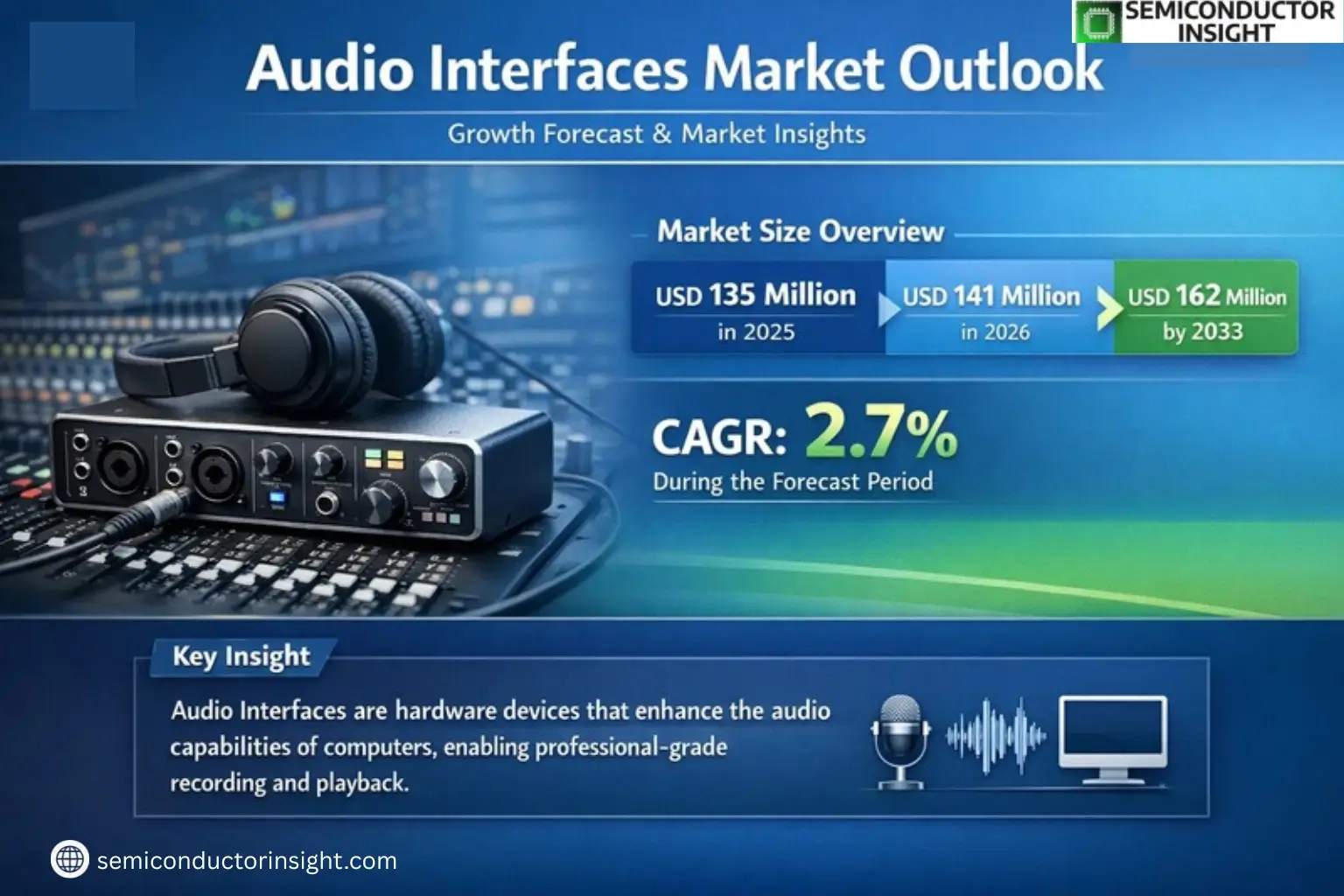
Global Audio Interfaces Market size was valued at USD 135 million in 2025. The market is projected to grow from USD 141 million in 2026 to USD 162 million by 2033, exhibiting a CAGR of 2.7% during the forecast period.
Audio Interfaces are hardware devices that enhance the audio capabilities of computers, enabling professional-grade recording and playback. These devices allow users to connect microphones, instruments, and other audio sources to a computer while providing high-quality signal conversion and low-latency monitoring. Key types include USB, Thunderbolt, and other connectivity options such as MIDI and Firewire.
The market is driven by increasing demand for home studios, podcasting, and content creation, alongside advancements in digital audio technology. USB interfaces dominate the market with over 60% share due to their affordability and ease of use. Professional applications account for approximately 70% of the market, reflecting strong adoption in music production and broadcasting. Leading players such as Focusrite plc., Universal Audio, Inc., and PreSonus Audio Electronics, Inc. continue to innovate with feature-rich solutions to cater to evolving consumer needs.
MARKET DRIVERS
Rising Demand for High-Quality Audio Production
Audio Interfaces Market is experiencing significant growth due to increasing demand for professional-grade audio solutions in music production, podcasting, and live streaming. Advances in USB and Thunderbolt connectivity have made these devices more accessible to content creators and home studios. Nearly 68% of independent musicians now rely on external audio interfaces for recording.
Growth of Digital Content Creation
The explosion of podcasting and streaming platforms has created a 42% increase in demand for audio interfaces over the past three years. Professional creators require low-latency monitoring and high-resolution audio capture, driving innovation in the Audio Interfaces Market. Manufacturers are responding with compact, portable devices featuring studio-grade preamps.
The democratization of music production tools has expanded the Audio Interfaces Market to include hobbyists and aspiring producers, with entry-level units accounting for 35% of total sales.
MARKET CHALLENGES
Intense Price Competition Pressure
Audio Interfaces Market faces margin compression as established brands compete with low-cost alternatives from Asia. While professional studios maintain brand loyalty, the consumer segment shows price sensitivity, with average selling prices declining 18% since 2020.
Other Challenges
Compatibility Issues
The proliferation of operating systems and DAW platforms requires manufacturers to maintain extensive driver support, increasing R&D costs in the Audio Interfaces Market.
MARKET RESTRAINTS
Supply Chain Disruptions Impacting Production
Global chip shortages continue to constrain the Audio Interfaces Market, with lead times for key components extending to 52 weeks. This has forced manufacturers to revise product roadmaps and prioritize high-margin professional models over entry-level units.
MARKET OPPORTUNITIES
Integration with Cloud-Based Workflows
Audio Interfaces Market stands to benefit from growing demand for devices that seamlessly connect to cloud collaboration platforms. Next-generation interfaces incorporating direct streaming capabilities and network connectivity are projected to capture 25% of the professional segment by 2026.
Audio Interfaces Market Trends
Steady Growth Driven by Professional Applications
Global Audio Interfaces Market continues to expand, with valuations reaching USD 135 million in 2025 and projected growth to USD 162 million by 2033 at a 2.7% CAGR. This steady expansion reflects increasing demand in professional audio production environments. The professional segment dominates with 70% market share, as studios and content creators require high-quality interfaces for recording and streaming applications.
Other Trends
USB Dominance in Interface Connectivity
USB audio interfaces maintain market leadership, holding over 60% share due to their plug-and-play compatibility and affordability. Thunderbolt interfaces are gaining traction in high-end studios for their low-latency performance, though adoption remains limited by higher costs and specialized hardware requirements.
Regional Market Concentration
North America and Europe collectively account for approximately 80% of global Audio Interface sales, reflecting well-established music production industries and higher adoption of professional recording equipment. Industry leaders Focusrite and PreSonus control over 30% of the global market, with their reputations for reliable prosumer and professional-grade interfaces.
Expanding Features in Mid-Range Products
Manufacturers are increasingly incorporating premium features like high-resolution converters, onboard DSP processing, and multi-channel configurations into mid-priced interfaces. This trend responds to growing demand from home studios and mobile content creators seeking professional capabilities at accessible price points.
Shift Toward Hybrid Work Environments
Audio Interfaces Market is adapting to hybrid work models, with increased demand for portable interfaces that support both studio recording and remote collaboration. Manufacturers are focusing on compact form factors without compromising audio quality, particularly in the USB interface category.
COMPETITIVE LANDSCAPE
Key Industry Players
Market Dominance by Established Audio Technology Leaders
Focusrite plc. and PreSonus Audio Electronics, Inc. collectively command over 30% of the global Audio Interfaces Market, showcasing strong brand recognition in professional audio equipment. The market structure remains moderately concentrated with North America and Europe constituting 80% of global demand. USB interfaces dominate with 60% market share due to their universal compatibility, while professional applications account for 70% of usage across recording studios and broadcast facilities.
Niche players like Antelope Audio and Universal Audio compete through premium digital signal processing technologies, while Roland and MOTU maintain strong positions in hybrid studio/live performance segments. Emerging competition comes from Asian manufacturers like Zoom Corporation and Tascam, leveraging cost-competitive manufacturing. The market sees increasing integration of DSP effects and network connectivity as key differentiation strategies among competitors.
List of Key Audio Interfaces Companies Profiled
- Focusrite plc.
- Universal Audio, Inc.
- Antelope Audio
- PreSonus Audio Electronics, Inc.
- Zoom Corporation
- MOTU
- Behringer (Music Group)
- Mackie (LOUD Technologies Inc.)
- Roland
- M-Audio
- IK Multimedia
- Audient Ltd.
- RME
- Tascam (TEAC Corporation)
- Steinberg Media Technologies GmbH (Yamaha)
Segment Analysis:
| Segment Category | Sub-Segments | Key Insights |
| By Type |
|
USB Interfaces dominate due to universal compatibility and affordability:
|
| By Application |
|
Professional Segment drives premium product demand:
|
| By End User |
|
Home Studios represent the fastest-growing segment:
|
| By Connectivity |
|
Wired Interfaces maintain reliability preference:
|
| By Channel Count |
|
4-8 Channel Segment offers optimal versatility:
|
Regional Analysis: Audio Interfaces Market
Professional studios continue upgrading to high-channel-count interfaces, while project studios increasingly adopt compact USB models. Broadcast facilities are transitioning to Dante-enabled interfaces for network audio workflows.
Thunderbolt 4 adoption accelerates among pro users, while USB-C becomes standard for mid-range interfaces. Cloud collaboration features are being integrated into interface control software by major brands.
Podcasters and streamers increasingly using audio interfaces with built-in DSP for real-time processing. Educational institutions are incorporating interface-based setups in audio engineering curricula.
Online retailers capture growing share of sales, though specialty audio stores maintain importance for high-end interfaces. Manufacturer direct sales increase through branded e-commerce platforms.
Europe
Europe represents the second-largest market for audio interfaces, with Germany and UK leading in professional adoption. The region shows strong demand for high-quality preamps and low-latency performance. Classical music recording traditions sustain premium interface sales, while electronic music producers drive innovation in compact solutions. EU regulations on electronic waste are influencing product designs toward repairability. Southern European markets show growing interest in budget USB interfaces for home recording. Major trade shows like Musikmesse remain important platforms for new interface launches.
Asia-Pacific
The Asia-Pacific Audio Interfaces Market grows rapidly, led by Japan and emerging markets like China and South Korea. Japanese manufacturers pioneer compact interface designs with mobile compatibility. Streaming platform growth in Southeast Asia boosts entry-level interface sales. India shows potential with expanding music production education. Regional manufacturers focus on cost-effective solutions while global brands target premium segments. Localized software integration becomes crucial as Chinese DAWs gain popularity.
South America
Brazil dominates South America’s Audio Interfaces Market, with professional studios concentrated in São Paulo. Economic factors drive demand for durable, serviceable interfaces across the region. USB interfaces gain popularity for home studios, while professional markets prefer rackmount solutions. Regional music genres influence preferred features, with strong demand for vocal processing capabilities. Gray market imports remain a challenge for authorized distributors.
Middle East & Africa
The MEA Audio Interfaces Market grows steadily, led by Gulf countries with advanced media infrastructure. Dubai emerges as a regional hub for professional audio equipment. South Africa shows diverse demand from traditional studios to mobile setups. Religious and cultural content production drives specific interface needs. Limited local distribution networks create challenges, though e-commerce expansion improves accessibility. Budget-conscious buyers prioritize fundamental features over advanced specs.
Report Scope
This market research report provides a comprehensive analysis of the Audio Interfaces Market, covering the forecast period 2026–2033. It offers detailed insights into market dynamics, technological advancements, competitive landscape, and key trends shaping the industry.
Key focus areas of the report include:
- Market Overview: The report begins with an overview outlining its current market scenario, key growth indicators, and industry transformation drivers. It discusses macroeconomic factors, demand–supply balance, regulatory landscape, and the strategic role of audio interfaces in professional and amateur audio production.
- Market Size & Forecast: Historical data and future projections for revenue, unit shipments, and market value across major regions and segments.
- Segmentation Analysis: Detailed breakdown by product type, connectivity, application, and end-user to identify high-growth segments and investment opportunities.
- Regional Insights: Insights into market performance across North America, Europe, Asia, South America, and Middle East & Africa, including country-level analysis where relevant.
- Competitive Landscape: Profiles of leading market participants, including their product offerings, R&D focus, manufacturing capacity, pricing strategies, and recent developments such as mergers, acquisitions, and partnerships.
- Technology Trends & Innovation: Assessment of emerging technologies, integration of advanced audio processing, and evolving industry standards.
- Market Drivers & Restraints: Evaluation of factors driving market growth along with challenges, supply chain constraints, regulatory issues, and market-entry barriers.
- Stakeholder Insights: Insights for component suppliers, OEMs, system integrators, investors, and policymakers regarding the evolving ecosystem and strategic opportunities.
Primary and secondary research methods are employed, including interviews with industry experts, data from verified sources, and real-time market intelligence to ensure the accuracy and reliability of the insights presented.
FREQUENTLY ASKED QUESTIONS:
What is the current market size of Audio Interfaces Market?
-> Audio Interfaces Market size was valued at USD 135 million in 2025. The market is projected to grow from USD 141 million in 2026 to USD 162 million by 2033, exhibiting a CAGR of 2.7% during the forecast period.
Which key companies operate in Audio Interfaces Market?
-> Key players include Focusrite plc., Universal Audio, Inc., PreSonus Audio Electronics, Inc., Zoom Corporation, MOTU, Behringer (Music Group), Roland, and M-Audio, among others. The top 2 players occupy over 30% of the global market.
What are the key growth drivers?
-> Key growth drivers include increasing demand for professional audio production, growth in home recording studios, and technological advancements in audio interfaces.
Which region dominates the market?
-> North America and Europe are the main markets, occupying about 80% of the global market share.
What are the emerging trends?
-> Emerging trends include USB interface dominance (60% market share), increasing professional application (70% share), and integration with advanced audio processing technologies.

Get Sample Report PDF for Exclusive Insights
Report Sample Includes
- Table of Contents
- List of Tables & Figures
- Charts, Research Methodology, and more...
 Download Sample Report PDF