Artificial Intelligence (AI) Camera Market, Trends, Business Strategies 2025-2032

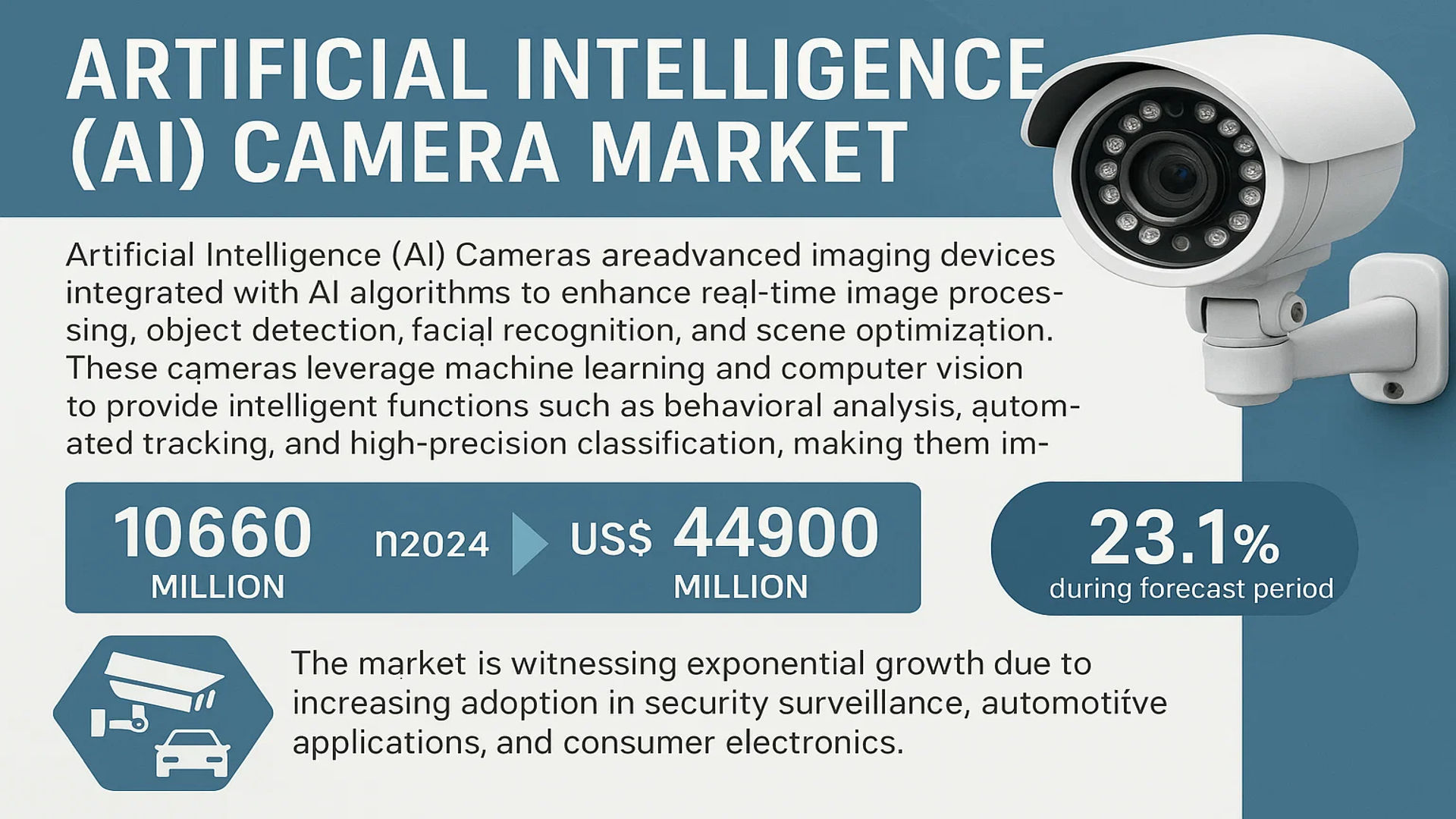
Artificial Intelligence (AI) Camera Market was valued at 10660 million in 2024 and is projected to reach US$ 44900 million by 2032, at a CAGR of 23.1% during the forecast period.


PDF Icon Download Sample Report PDF
  • Quick Dispatch

    All Orders

  • Secure Payment

    100% Secure Payment

Price range: $1,500.00 through $4,250.00

Clear

MARKET INSIGHTS

The global Artificial Intelligence (AI) Camera Market was valued at 10660 million in 2024 and is projected to reach US$ 44900 million by 2032, at a CAGR of 23.1% during the forecast period.

Artificial Intelligence (AI) Cameras are advanced imaging devices integrated with AI algorithms that enhance real-time image processing, object detection, facial recognition, and scene optimization. These cameras leverage machine learning and computer vision to provide intelligent functions such as behavioral analysis, automated tracking, and high-precision classification, making them indispensable across various industries.

The market is witnessing exponential growth due to increasing adoption in security surveillance, automotive applications, and consumer electronics. The rising demand for smart home devices and advancements in AI-powered smartphone cameras are key growth drivers. Furthermore, the integration of AI cameras in industrial automation and retail analytics is expanding their applications. Leading players like Canon Inc., Sony Corporation, and Samsung Electronics Co., Ltd. are investing heavily in AI-driven camera innovations to maintain competitive advantage.
Artificial Intelligence (AI) Camera Market

MARKET DYNAMICS

MARKET DRIVERS

Surge in Smart City Deployments Accelerating AI Camera Adoption

The rapid urbanization and smart city initiatives across major economies are driving significant demand for AI-powered surveillance cameras. Governments worldwide are investing heavily in intelligent video analytics to enhance public safety, traffic management and urban planning. The spending on smart city technologies has grown consistently, with AI cameras forming a critical infrastructure component. These systems enable real-time monitoring of crowded areas, license plate recognition for traffic enforcement, and predictive analytics for emergency response – functionalities impossible with conventional CCTV systems. The ability to process large video datasets through edge AI has made such deployments scalable across urban centers.

Advancements in Edge Computing Expanding Application Scenarios

The evolution of edge computing architectures has removed critical bottlenecks for AI camera implementations. Earlier solutions requiring centralized cloud processing faced latency issues that made them impractical for time-sensitive applications. Modern AI cameras now incorporate powerful neural processing units (NPUs) capable of running complex computer vision algorithms locally. This allows facial recognition at 200+ frames per second with accuracy exceeding 99% in controlled environments – performance metrics that were unattainable just three years ago. Manufacturers have successfully reduced the power consumption of these edge AI chips by over 60% since 2021, enabling their deployment in battery-powered and solar-operated surveillance units.

The retail analytics segment has particularly benefited from these advancements, with AI camera installations growing 87% year-over-year for customer tracking and heat mapping applications.

Growing Security Concerns Boosting Institutional Adoption

Escalating security threats across commercial and public sectors have created robust demand for intelligent surveillance solutions. Critical infrastructure facilities including airports, power plants and transportation hubs now mandate AI-enhanced video surveillance systems capable of threat detection and anomaly recognition. The commercial sector accounts for over 45% of current AI camera deployments, with industries prioritizing loss prevention and workplace safety. Educational institutions and healthcare facilities are also adopting these systems for access control and emergency response coordination. The ability to integrate AI cameras with existing security infrastructure while maintaining regulatory compliance has significantly lowered adoption barriers across these verticals.

MARKET RESTRAINTS

Privacy Regulations Creating Adoption Hurdles Across Regions

Stringent data protection laws are emerging as significant barriers to AI camera deployments in several markets. The European Union’s GDPR and similar regulations in other regions impose strict limitations on biometric data collection and processing. Many jurisdictions now require explicit consent for facial recognition systems in public spaces – a requirement that makes many security applications impractical. Some cities have enacted complete bans on certain AI surveillance technologies, forcing manufacturers to develop region-specific product variants. These regulatory challenges are particularly acute for public sector deployments, where approval processes can delay implementations by 12-18 months.

Technical and Operational Challenges
Implementing AI camera systems at scale presents multiple technical hurdles that restrain market growth. Achieving consistent accuracy across diverse lighting conditions and camera angles remains an engineering challenge, with performance variance exceeding 30% between optimal and suboptimal conditions. System integration with legacy security infrastructure often requires costly customization, particularly when dealing with proprietary video management systems. Additionally, the computational requirements for processing high-resolution video feeds create substantial storage and bandwidth challenges for organizations with large camera networks.

Workforce Skill Gaps
The shortage of trained personnel capable of deploying and maintaining AI camera systems is slowing adoption. Effective implementation requires expertise in computer vision, network infrastructure and cybersecurity – a rare combination in many markets. Organizations frequently underestimate the ongoing maintenance needs, including model retraining and system calibration. The absence of standardized certification programs for AI surveillance technicians further compounds this challenge, leaving many end-users dependent on vendor support contracts.

MARKET CHALLENGES

Algorithm Bias and Accuracy Concerns Threatening Market Acceptance

Persistent issues with algorithmic bias in facial recognition systems continue to generate controversy and erode public trust. Studies have shown accuracy disparities exceeding 15% across different demographic groups, raising serious ethical concerns. Several high-profile cases of misidentification by law enforcement agencies have triggered lawsuits and regulatory scrutiny. These challenges are particularly acute in multicultural societies where training datasets often fail to represent population diversity adequately. Manufacturers now face growing pressure to demonstrate fairness metrics and implement bias mitigation strategies throughout the development lifecycle.

Cybersecurity Vulnerabilities
The increasing connectivity of AI cameras has expanded the attack surface for malicious actors. Compromised devices can provide backdoor access to organizational networks or become part of botnets for distributed denial-of-service attacks. Many early-generation AI cameras shipped with hardcoded credentials and unpatched vulnerabilities that security researchers continue to exploit. The challenge of maintaining firmware security across distributed camera networks has emerged as a critical operational hurdle, particularly for municipal deployments where devices may remain in service for 5-7 years.

Cost of Continuous Model Improvement
Maintaining high performance in dynamic environments requires ongoing investment in model retraining and validation. Unlike traditional cameras with fixed functionality, AI systems demand regular updates to handle new scenarios and edge cases. The expense of curating labeled training datasets and validating system performance across diverse conditions adds substantial operational overhead. Many organizations underestimate these long-term costs during initial procurement, leading to underperforming systems when budgets for model maintenance prove inadequate.

MARKET OPPORTUNITIES

Convergence With IoT Creating New Application Verticals

The integration of AI cameras with broader IoT ecosystems is unlocking transformative use cases across industries. In manufacturing, vision systems combined with sensor networks enable predictive maintenance by detecting equipment anomalies before failures occur. Smart building implementations now leverage AI cameras alongside environmental sensors to optimize space utilization and energy efficiency. The retail sector is pioneering computer vision applications that link customer behavior analytics with inventory management systems. These converged solutions typically command 25-40% higher margins than standalone camera systems while creating ongoing service revenue opportunities.

Emerging Markets Presenting Untapped Growth Potential

Developing economies are exhibiting accelerated adoption of AI surveillance technologies, often leapfrogging traditional security infrastructure. Market growth in these regions outpaces mature economies by 2-3x, driven by urban security initiatives and commercial sector modernization. Local manufacturers are gaining traction with cost-optimized solutions tailored to regional requirements, including robust performance in extreme weather conditions. The absence of legacy systems in many cases allows for greenfield deployments of advanced architectures, avoiding the integration challenges prevalent in developed markets.

Several countries have implemented national AI strategies that specifically prioritize surveillance technologies, creating favorable policy environments for market expansion.

Advancements in Multi-Modal Sensing Expanding Capabilities

The incorporation of additional sensing modalities with traditional camera systems is creating new value propositions. Thermal imaging sensors combined with AI visual analysis enable reliable night vision and temperature screening applications. Depth-sensing technologies improve object tracking accuracy in crowded environments, while millimeter-wave radar integration enhances intruder detection capabilities. These hybrid systems demonstrate particular promise for perimeter security, where they can reduce false alarms by correlating data from multiple sensing modalities. The technology convergence is also enabling innovative applications in healthcare, automotive and industrial automation sectors.

ARTIFICIAL INTELLIGENCE (AI) CAMERA MARKET TRENDS

Integration of AI in Consumer Electronics Accelerates Market Expansion

The rapid adoption of artificial intelligence in consumer electronics, particularly in smartphone cameras, is transforming the AI camera market. Manufacturers are leveraging AI-driven computational photography to enhance image quality, enable real-time scene recognition, and automate camera settings for optimal results. The global AI camera market, valued at $10.66 billion in 2024, is projected to grow at a CAGR of 23.1% to $44.9 billion by 2032. AI-powered features such as bokeh effects, night mode, and super-resolution zoom are now standard in flagship smartphones, driving demand for advanced image processing chipsets. Emerging applications like Augmented Reality (AR) filters and real-time social media optimization further contribute to market expansion.

Other Trends

Surge in Smart Surveillance and Security Applications

Security and surveillance represent one of the fastest-growing segments for AI cameras, with global investments in smart city initiatives fueling demand. AI-powered CCTV cameras are being widely deployed for facial recognition, behavioral analysis, and crowd monitoring, enabled by edge computing and cloud-based analytics. The commercial sector accounts for over 40% of AI camera applications, with airports, retail stores, and urban infrastructure relying on intelligent video analytics. Object detection accuracy has surpassed 95% in modern AI surveillance systems, significantly reducing false alarms while enhancing public safety measures.

Automotive Sector Embracing AI Vision Systems

The automotive industry’s shift towards autonomous vehicles and advanced driver-assistance systems (ADAS) has created substantial opportunities for AI camera manufacturers. Modern vehicles integrate multiple AI vision cameras for lane detection, pedestrian recognition, and traffic sign interpretation, with processing speeds below 50 milliseconds. Leading automotive brands are partnering with AI camera providers to develop next-generation perception systems that combine thermal imaging with neural networks. The industrial sector also employs AI cameras for quality inspection, with defect detection accuracy rates exceeding 98% in manufacturing assembly lines.

COMPETITIVE LANDSCAPE

Key Industry Players

Innovation and Strategic Expansion Define the AI Camera Market Competition

The global AI Camera market features a dynamic and evolving competitive environment, where established technology giants and emerging innovators vie for market share. With the sector projected to grow at a 23.1% CAGR through 2032, companies are aggressively investing in R&D to enhance camera intelligence capabilities across security, consumer electronics, and industrial applications.

Hikvision and Dahua Technology currently lead in the surveillance segment, leveraging China’s strong electronics manufacturing base. Their edge computing-enabled cameras with facial recognition and behavioral analysis algorithms are being widely adopted for smart city projects globally. Meanwhile, Sony and Canon dominate the consumer segment through AI-powered smartphone cameras that offer computational photography features like real-time scene optimization.

What distinguishes the current market landscape is how traditional camera manufacturers like Nikon and Panasonic are transitioning from hardware-centric to AI-software focused business models. Their recent collaborations with cloud service providers demonstrate how the industry is converging with broader AI ecosystems.

While the top five players account for nearly 45% of market revenue, numerous specialized firms are making significant inroads. Axis Communications has strengthened its position in network cameras through advanced video analytics, while Honeywell continues to expand its industrial vision systems portfolio through targeted acquisitions.

List of Key AI Camera Companies Profiled

Segment Analysis:

By Type

Consumer Electronics/Smartphone Cameras Segment Dominates the Market Due to High Adoption of AI Features in Mobile Devices

The market is segmented based on type into:

  • Compact Cameras
  • DSLR Cameras
  • Consumer Electronics/Smartphone Cameras
  • CCTV Cameras

By Application

Commercial Segment Leads Due to Increased Adoption in Surveillance and Retail Analytics

The market is segmented based on application into:

  • Residential
  • Commercial
  • Industrial

By Technology

Deep Learning Algorithms Dominate Due to Superior Image Processing Capabilities

The market is segmented based on technology into:

  • Machine Learning
  • Deep Learning
  • Computer Vision

By End User

Security & Surveillance Sector Leads Due to Growing Demand for Intelligent Monitoring Solutions

The market is segmented based on end user into:

  • Security & Surveillance
  • Retail
  • Healthcare
  • Automotive

Regional Analysis: Artificial Intelligence (AI) Camera Market

North America
The North American AI camera market is characterized by high adoption of advanced surveillance systems, particularly in the U.S., where concerns over security and public safety drive investments in intelligent monitoring solutions. Major technology firms are integrating AI capabilities into consumer devices, with smartphone manufacturers leading innovation in computational photography. The region’s strong semiconductor ecosystem supports development of edge AI processors for real-time image analysis. However, privacy regulations like Illinois’ Biometric Information Privacy Act pose compliance challenges for facial recognition applications. Demand is strongest in commercial sectors, especially retail analytics and smart city deployments.

Europe
European markets emphasize privacy-compliant AI camera solutions, guided by strict GDPR regulations that limit facial recognition in public spaces. Germany and the UK lead in industrial applications, using AI-powered machine vision for quality control in manufacturing. The region shows particular strength in automotive AI cameras, with European car manufacturers integrating advanced driver-assistance systems (ADAS). Recent EU proposals on AI regulation are shaping product development strategies, favoring explainable AI solutions over black-box algorithms. Smart home adoption is accelerating, though consumer concerns about data collection temper growth rates compared to other regions.

Asia-Pacific
As the fastest-growing regional market, Asia-Pacific benefits from massive manufacturing capabilities and strong government support for AI development. China dominates production and consumption, with companies like Hikvision and Dahua driving innovation in security cameras. India’s market is expanding rapidly due to smart city initiatives and increasing security expenditures. Japan and South Korea lead in incorporating AI into consumer electronics, with flagship smartphones setting global benchmarks for camera capabilities. The region’s lower cost structure enables widespread adoption of entry-level AI cameras, though concerns about surveillance states persist in certain markets.

South America
The AI camera market in South America shows gradual but uneven growth, with Brazil and Argentina as primary adopters. While security concerns drive demand in urban centers, economic instability limits large-scale deployments. Most implementations focus on essential surveillance in high-crime areas rather than advanced analytics. Domestic manufacturing is minimal, creating reliance on imports from China and North America. However, growing middle-class smartphone penetration is expanding the market for AI-enhanced mobile photography. Infrastructure limitations, including inconsistent power supplies in some areas, hinder more sophisticated industrial applications.

Middle East & Africa
This emerging market demonstrates concentrated demand in Gulf states, particularly for urban surveillance and critical infrastructure protection. The UAE leads in smart city deployments, integrating AI cameras with other IoT systems. Oil and gas sectors utilize specialized thermal imaging cameras for facility monitoring. Sub-Saharan Africa shows potential for AI-powered wildlife conservation cameras and basic security solutions, though funding constraints limit market expansion. Local content requirements in some countries encourage regional partnerships, while data sovereignty concerns influence purchasing decisions for government projects.

Report Scope

This market research report provides a comprehensive analysis of the global and regional Artificial Intelligence (AI) Camera markets, covering the forecast period 2024–2032. It offers detailed insights into market dynamics, technological advancements, competitive landscape, and key trends shaping the industry.

Key focus areas of the report include:

  • Market Size & Forecast: Historical data and future projections for revenue, unit shipments, and market value across major regions and segments. The Global AI Camera market was valued at USD 10.66 billion in 2024 and is projected to reach USD 44.9 billion by 2032, growing at a CAGR of 23.1%.
  • Segmentation Analysis: Detailed breakdown by product type (compact cameras, DSLR cameras, smartphone cameras, CCTV cameras), application (residential, commercial, industrial), and technology to identify high-growth segments and investment opportunities.
  • Regional Outlook: Insights into market performance across North America, Europe, Asia-Pacific, Latin America, and the Middle East & Africa, including country-level analysis. The U.S. and China are key markets driving growth.
  • Competitive Landscape: Profiles of leading market participants including Canon Inc., Sony Corporation, Samsung Electronics, Panasonic Holdings, and Huawei Technologies, covering their product portfolios, R&D investments, and strategic initiatives.
  • Technology Trends & Innovation: Assessment of AI integration in imaging, deep learning algorithms, edge computing capabilities, and emerging applications in security, automotive, and healthcare sectors.
  • Market Drivers & Restraints: Evaluation of factors such as increasing demand for smart surveillance, advancements in computer vision, and challenges related to data privacy and high implementation costs.
  • Stakeholder Analysis: Strategic insights for camera manufacturers, software developers, system integrators, and investors regarding market opportunities and competitive positioning.

The research employs both primary and secondary methodologies, including interviews with industry experts, analysis of financial reports, and validation through multiple data sources to ensure accuracy and reliability.

FREQUENTLY ASKED QUESTIONS:

What is the current market size of Global AI Camera Market?

-> Artificial Intelligence (AI) Camera Market was valued at 10660 million in 2024 and is projected to reach US$ 44900 million by 2032, at a CAGR of 23.1% during the forecast period.

Which key companies operate in Global AI Camera Market?

-> Key players include Canon Inc., Sony Corporation, Samsung Electronics, Panasonic Holdings, Huawei Technologies, Axis Communications, and Bosch Security Systems, among others.

What are the key growth drivers?

-> Growth is driven by rising demand for smart surveillance, advancements in computer vision, increasing adoption in smartphones, and expansion of smart city projects globally.

Which region dominates the market?

-> Asia-Pacific leads in market share due to high technology adoption, while North America remains strong in innovation and R&D investments.

What are the emerging trends?

-> Emerging trends include AI-powered edge computing cameras, integration with IoT systems, advanced facial recognition, and autonomous camera systems.

Artificial Intelligence (AI) Camera Market, Trends, Business Strategies 2025-2032

Get Sample Report PDF for Exclusive Insights

Report Sample Includes

  • Table of Contents
  • List of Tables & Figures
  • Charts, Research Methodology, and more...

PDF Icon Download Sample Report PDF
SKU: 3637f53f13a0
Category:

Download Sample Report

Table of Content

1 Introduction to Research & Analysis Reports
1.1 Artificial Intelligence (AI) Camera Market Definition
1.2 Market Segments
1.2.1 Segment by Type
1.2.2 Segment by Application
1.3 Global Artificial Intelligence (AI) Camera Market Overview
1.4 Features & Benefits of This Report
1.5 Methodology & Sources of Information
1.5.1 Research Methodology
1.5.2 Research Process
1.5.3 Base Year
1.5.4 Report Assumptions & Caveats
2 Global Artificial Intelligence (AI) Camera Overall Market Size
2.1 Global Artificial Intelligence (AI) Camera Market Size: 2024 VS 2032
2.2 Global Artificial Intelligence (AI) Camera Market Size, Prospects & Forecasts: 2020-2032
2.3 Global Artificial Intelligence (AI) Camera Sales: 2020-2032
3 Company Landscape
3.1 Top Artificial Intelligence (AI) Camera Players in Global Market
3.2 Top Global Artificial Intelligence (AI) Camera Companies Ranked by Revenue
3.3 Global Artificial Intelligence (AI) Camera Revenue by Companies
3.4 Global Artificial Intelligence (AI) Camera Sales by Companies
3.5 Global Artificial Intelligence (AI) Camera Price by Manufacturer (2020-2025)
3.6 Top 3 and Top 5 Artificial Intelligence (AI) Camera Companies in Global Market, by Revenue in 2024
3.7 Global Manufacturers Artificial Intelligence (AI) Camera Product Type
3.8 Tier 1, Tier 2, and Tier 3 Artificial Intelligence (AI) Camera Players in Global Market
3.8.1 List of Global Tier 1 Artificial Intelligence (AI) Camera Companies
3.8.2 List of Global Tier 2 and Tier 3 Artificial Intelligence (AI) Camera Companies
4 Sights by Product
4.1 Overview
4.1.1 Segment by Type – Global Artificial Intelligence (AI) Camera Market Size Markets, 2024 & 2032
4.1.2 Compact Cameras
4.1.3 DSLR Cameras
4.1.4 Consumer Electronics/ Smartphone Cameras
4.1.5 CCTV Cameras
4.2 Segment by Type – Global Artificial Intelligence (AI) Camera Revenue & Forecasts
4.2.1 Segment by Type – Global Artificial Intelligence (AI) Camera Revenue, 2020-2025
4.2.2 Segment by Type – Global Artificial Intelligence (AI) Camera Revenue, 2026-2032
4.2.3 Segment by Type – Global Artificial Intelligence (AI) Camera Revenue Market Share, 2020-2032
4.3 Segment by Type – Global Artificial Intelligence (AI) Camera Sales & Forecasts
4.3.1 Segment by Type – Global Artificial Intelligence (AI) Camera Sales, 2020-2025
4.3.2 Segment by Type – Global Artificial Intelligence (AI) Camera Sales, 2026-2032
4.3.3 Segment by Type – Global Artificial Intelligence (AI) Camera Sales Market Share, 2020-2032
4.4 Segment by Type – Global Artificial Intelligence (AI) Camera Price (Manufacturers Selling Prices), 2020-2032
5 Sights by Application
5.1 Overview
5.1.1 Segment by Application – Global Artificial Intelligence (AI) Camera Market Size, 2024 & 2032
5.1.2 Residential
5.1.3 Commercial
5.1.4 Industrial
5.2 Segment by Application – Global Artificial Intelligence (AI) Camera Revenue & Forecasts
5.2.1 Segment by Application – Global Artificial Intelligence (AI) Camera Revenue, 2020-2025
5.2.2 Segment by Application – Global Artificial Intelligence (AI) Camera Revenue, 2026-2032
5.2.3 Segment by Application – Global Artificial Intelligence (AI) Camera Revenue Market Share, 2020-2032
5.3 Segment by Application – Global Artificial Intelligence (AI) Camera Sales & Forecasts
5.3.1 Segment by Application – Global Artificial Intelligence (AI) Camera Sales, 2020-2025
5.3.2 Segment by Application – Global Artificial Intelligence (AI) Camera Sales, 2026-2032
5.3.3 Segment by Application – Global Artificial Intelligence (AI) Camera Sales Market Share, 2020-2032
5.4 Segment by Application – Global Artificial Intelligence (AI) Camera Price (Manufacturers Selling Prices), 2020-2032
6 Sights by Region
6.1 By Region – Global Artificial Intelligence (AI) Camera Market Size, 2024 & 2032
6.2 By Region – Global Artificial Intelligence (AI) Camera Revenue & Forecasts
6.2.1 By Region – Global Artificial Intelligence (AI) Camera Revenue, 2020-2025
6.2.2 By Region – Global Artificial Intelligence (AI) Camera Revenue, 2026-2032
6.2.3 By Region – Global Artificial Intelligence (AI) Camera Revenue Market Share, 2020-2032
6.3 By Region – Global Artificial Intelligence (AI) Camera Sales & Forecasts
6.3.1 By Region – Global Artificial Intelligence (AI) Camera Sales, 2020-2025
6.3.2 By Region – Global Artificial Intelligence (AI) Camera Sales, 2026-2032
6.3.3 By Region – Global Artificial Intelligence (AI) Camera Sales Market Share, 2020-2032
6.4 North America
6.4.1 By Country – North America Artificial Intelligence (AI) Camera Revenue, 2020-2032
6.4.2 By Country – North America Artificial Intelligence (AI) Camera Sales, 2020-2032
6.4.3 United States Artificial Intelligence (AI) Camera Market Size, 2020-2032
6.4.4 Canada Artificial Intelligence (AI) Camera Market Size, 2020-2032
6.4.5 Mexico Artificial Intelligence (AI) Camera Market Size, 2020-2032
6.5 Europe
6.5.1 By Country – Europe Artificial Intelligence (AI) Camera Revenue, 2020-2032
6.5.2 By Country – Europe Artificial Intelligence (AI) Camera Sales, 2020-2032
6.5.3 Germany Artificial Intelligence (AI) Camera Market Size, 2020-2032
6.5.4 France Artificial Intelligence (AI) Camera Market Size, 2020-2032
6.5.5 U.K. Artificial Intelligence (AI) Camera Market Size, 2020-2032
6.5.6 Italy Artificial Intelligence (AI) Camera Market Size, 2020-2032
6.5.7 Russia Artificial Intelligence (AI) Camera Market Size, 2020-2032
6.5.8 Nordic Countries Artificial Intelligence (AI) Camera Market Size, 2020-2032
6.5.9 Benelux Artificial Intelligence (AI) Camera Market Size, 2020-2032
6.6 Asia
6.6.1 By Region – Asia Artificial Intelligence (AI) Camera Revenue, 2020-2032
6.6.2 By Region – Asia Artificial Intelligence (AI) Camera Sales, 2020-2032
6.6.3 China Artificial Intelligence (AI) Camera Market Size, 2020-2032
6.6.4 Japan Artificial Intelligence (AI) Camera Market Size, 2020-2032
6.6.5 South Korea Artificial Intelligence (AI) Camera Market Size, 2020-2032
6.6.6 Southeast Asia Artificial Intelligence (AI) Camera Market Size, 2020-2032
6.6.7 India Artificial Intelligence (AI) Camera Market Size, 2020-2032
6.7 South America
6.7.1 By Country – South America Artificial Intelligence (AI) Camera Revenue, 2020-2032
6.7.2 By Country – South America Artificial Intelligence (AI) Camera Sales, 2020-2032
6.7.3 Brazil Artificial Intelligence (AI) Camera Market Size, 2020-2032
6.7.4 Argentina Artificial Intelligence (AI) Camera Market Size, 2020-2032
6.8 Middle East & Africa
6.8.1 By Country – Middle East & Africa Artificial Intelligence (AI) Camera Revenue, 2020-2032
6.8.2 By Country – Middle East & Africa Artificial Intelligence (AI) Camera Sales, 2020-2032
6.8.3 Turkey Artificial Intelligence (AI) Camera Market Size, 2020-2032
6.8.4 Israel Artificial Intelligence (AI) Camera Market Size, 2020-2032
6.8.5 Saudi Arabia Artificial Intelligence (AI) Camera Market Size, 2020-2032
6.8.6 UAE Artificial Intelligence (AI) Camera Market Size, 2020-2032
7 Manufacturers & Brands Profiles
7.1 AV Costar
7.1.1 AV Costar Company Summary
7.1.2 AV Costar Business Overview
7.1.3 AV Costar Artificial Intelligence (AI) Camera Major Product Offerings
7.1.4 AV Costar Artificial Intelligence (AI) Camera Sales and Revenue in Global (2020-2025)
7.1.5 AV Costar Key News & Latest Developments
7.2 Axis Communications AB
7.2.1 Axis Communications AB Company Summary
7.2.2 Axis Communications AB Business Overview
7.2.3 Axis Communications AB Artificial Intelligence (AI) Camera Major Product Offerings
7.2.4 Axis Communications AB Artificial Intelligence (AI) Camera Sales and Revenue in Global (2020-2025)
7.2.5 Axis Communications AB Key News & Latest Developments
7.3 Bosch Sicherheitssysteme GmbH
7.3.1 Bosch Sicherheitssysteme GmbH Company Summary
7.3.2 Bosch Sicherheitssysteme GmbH Business Overview
7.3.3 Bosch Sicherheitssysteme GmbH Artificial Intelligence (AI) Camera Major Product Offerings
7.3.4 Bosch Sicherheitssysteme GmbH Artificial Intelligence (AI) Camera Sales and Revenue in Global (2020-2025)
7.3.5 Bosch Sicherheitssysteme GmbH Key News & Latest Developments
7.4 Canon Inc.
7.4.1 Canon Inc. Company Summary
7.4.2 Canon Inc. Business Overview
7.4.3 Canon Inc. Artificial Intelligence (AI) Camera Major Product Offerings
7.4.4 Canon Inc. Artificial Intelligence (AI) Camera Sales and Revenue in Global (2020-2025)
7.4.5 Canon Inc. Key News & Latest Developments
7.5 Dahua Technology
7.5.1 Dahua Technology Company Summary
7.5.2 Dahua Technology Business Overview
7.5.3 Dahua Technology Artificial Intelligence (AI) Camera Major Product Offerings
7.5.4 Dahua Technology Artificial Intelligence (AI) Camera Sales and Revenue in Global (2020-2025)
7.5.5 Dahua Technology Key News & Latest Developments
7.6 Hangzhou Hikvision Digital Technology Co., Ltd.
7.6.1 Hangzhou Hikvision Digital Technology Co., Ltd. Company Summary
7.6.2 Hangzhou Hikvision Digital Technology Co., Ltd. Business Overview
7.6.3 Hangzhou Hikvision Digital Technology Co., Ltd. Artificial Intelligence (AI) Camera Major Product Offerings
7.6.4 Hangzhou Hikvision Digital Technology Co., Ltd. Artificial Intelligence (AI) Camera Sales and Revenue in Global (2020-2025)
7.6.5 Hangzhou Hikvision Digital Technology Co., Ltd. Key News & Latest Developments
7.7 Honeywell International Inc.
7.7.1 Honeywell International Inc. Company Summary
7.7.2 Honeywell International Inc. Business Overview
7.7.3 Honeywell International Inc. Artificial Intelligence (AI) Camera Major Product Offerings
7.7.4 Honeywell International Inc. Artificial Intelligence (AI) Camera Sales and Revenue in Global (2020-2025)
7.7.5 Honeywell International Inc. Key News & Latest Developments
7.8 Huawei Technologies Co., Ltd.
7.8.1 Huawei Technologies Co., Ltd. Company Summary
7.8.2 Huawei Technologies Co., Ltd. Business Overview
7.8.3 Huawei Technologies Co., Ltd. Artificial Intelligence (AI) Camera Major Product Offerings
7.8.4 Huawei Technologies Co., Ltd. Artificial Intelligence (AI) Camera Sales and Revenue in Global (2020-2025)
7.8.5 Huawei Technologies Co., Ltd. Key News & Latest Developments
7.9 Huddly Inc.
7.9.1 Huddly Inc. Company Summary
7.9.2 Huddly Inc. Business Overview
7.9.3 Huddly Inc. Artificial Intelligence (AI) Camera Major Product Offerings
7.9.4 Huddly Inc. Artificial Intelligence (AI) Camera Sales and Revenue in Global (2020-2025)
7.9.5 Huddly Inc. Key News & Latest Developments
7.10 Johnson Controls
7.10.1 Johnson Controls Company Summary
7.10.2 Johnson Controls Business Overview
7.10.3 Johnson Controls Artificial Intelligence (AI) Camera Major Product Offerings
7.10.4 Johnson Controls Artificial Intelligence (AI) Camera Sales and Revenue in Global (2020-2025)
7.10.5 Johnson Controls Key News & Latest Developments
7.11 LG Electronics
7.11.1 LG Electronics Company Summary
7.11.2 LG Electronics Business Overview
7.11.3 LG Electronics Artificial Intelligence (AI) Camera Major Product Offerings
7.11.4 LG Electronics Artificial Intelligence (AI) Camera Sales and Revenue in Global (2020-2025)
7.11.5 LG Electronics Key News & Latest Developments
7.12 Nikon Corporation
7.12.1 Nikon Corporation Company Summary
7.12.2 Nikon Corporation Business Overview
7.12.3 Nikon Corporation Artificial Intelligence (AI) Camera Major Product Offerings
7.12.4 Nikon Corporation Artificial Intelligence (AI) Camera Sales and Revenue in Global (2020-2025)
7.12.5 Nikon Corporation Key News & Latest Developments
7.13 Panasonic Holdings Corporation
7.13.1 Panasonic Holdings Corporation Company Summary
7.13.2 Panasonic Holdings Corporation Business Overview
7.13.3 Panasonic Holdings Corporation Artificial Intelligence (AI) Camera Major Product Offerings
7.13.4 Panasonic Holdings Corporation Artificial Intelligence (AI) Camera Sales and Revenue in Global (2020-2025)
7.13.5 Panasonic Holdings Corporation Key News & Latest Developments
7.14 Samsung Electronics Co., Ltd.
7.14.1 Samsung Electronics Co., Ltd. Company Summary
7.14.2 Samsung Electronics Co., Ltd. Business Overview
7.14.3 Samsung Electronics Co., Ltd. Artificial Intelligence (AI) Camera Major Product Offerings
7.14.4 Samsung Electronics Co., Ltd. Artificial Intelligence (AI) Camera Sales and Revenue in Global (2020-2025)
7.14.5 Samsung Electronics Co., Ltd. Key News & Latest Developments
7.15 Sony Corporation
7.15.1 Sony Corporation Company Summary
7.15.2 Sony Corporation Business Overview
7.15.3 Sony Corporation Artificial Intelligence (AI) Camera Major Product Offerings
7.15.4 Sony Corporation Artificial Intelligence (AI) Camera Sales and Revenue in Global (2020-2025)
7.15.5 Sony Corporation Key News & Latest Developments
7.16 Teledyne FLIR LLC
7.16.1 Teledyne FLIR LLC Company Summary
7.16.2 Teledyne FLIR LLC Business Overview
7.16.3 Teledyne FLIR LLC Artificial Intelligence (AI) Camera Major Product Offerings
7.16.4 Teledyne FLIR LLC Artificial Intelligence (AI) Camera Sales and Revenue in Global (2020-2025)
7.16.5 Teledyne FLIR LLC Key News & Latest Developments
7.17 Vivotek, Inc.
7.17.1 Vivotek, Inc. Company Summary
7.17.2 Vivotek, Inc. Business Overview
7.17.3 Vivotek, Inc. Artificial Intelligence (AI) Camera Major Product Offerings
7.17.4 Vivotek, Inc. Artificial Intelligence (AI) Camera Sales and Revenue in Global (2020-2025)
7.17.5 Vivotek, Inc. Key News & Latest Developments
8 Global Artificial Intelligence (AI) Camera Production Capacity, Analysis
8.1 Global Artificial Intelligence (AI) Camera Production Capacity, 2020-2032
8.2 Artificial Intelligence (AI) Camera Production Capacity of Key Manufacturers in Global Market
8.3 Global Artificial Intelligence (AI) Camera Production by Region
9 Key Market Trends, Opportunity, Drivers and Restraints
9.1 Market Opportunities & Trends
9.2 Market Drivers
9.3 Market Restraints
10 Artificial Intelligence (AI) Camera Supply Chain Analysis
10.1 Artificial Intelligence (AI) Camera Industry Value Chain
10.2 Artificial Intelligence (AI) Camera Upstream Market
10.3 Artificial Intelligence (AI) Camera Downstream and Clients
10.4 Marketing Channels Analysis
10.4.1 Marketing Channels
10.4.2 Artificial Intelligence (AI) Camera Distributors and Sales Agents in Global
11 Conclusion
12 Appendix
12.1 Note
12.2 Examples of Clients
12.3 DisclaimerList of Tables
Table 1. Key Players of Artificial Intelligence (AI) Camera in Global Market
Table 2. Top Artificial Intelligence (AI) Camera Players in Global Market, Ranking by Revenue (2024)
Table 3. Global Artificial Intelligence (AI) Camera Revenue by Companies, (US$, Mn), 2020-2025
Table 4. Global Artificial Intelligence (AI) Camera Revenue Share by Companies, 2020-2025
Table 5. Global Artificial Intelligence (AI) Camera Sales by Companies, (Units), 2020-2025
Table 6. Global Artificial Intelligence (AI) Camera Sales Share by Companies, 2020-2025
Table 7. Key Manufacturers Artificial Intelligence (AI) Camera Price (2020-2025) & (US$/Unit)
Table 8. Global Manufacturers Artificial Intelligence (AI) Camera Product Type
Table 9. List of Global Tier 1 Artificial Intelligence (AI) Camera Companies, Revenue (US$, Mn) in 2024 and Market Share
Table 10. List of Global Tier 2 and Tier 3 Artificial Intelligence (AI) Camera Companies, Revenue (US$, Mn) in 2024 and Market Share
Table 11. Segment by Type – Global Artificial Intelligence (AI) Camera Revenue, (US$, Mn), 2024 & 2032
Table 12. Segment by Type – Global Artificial Intelligence (AI) Camera Revenue (US$, Mn), 2020-2025
Table 13. Segment by Type – Global Artificial Intelligence (AI) Camera Revenue (US$, Mn), 2026-2032
Table 14. Segment by Type – Global Artificial Intelligence (AI) Camera Sales (Units), 2020-2025
Table 15. Segment by Type – Global Artificial Intelligence (AI) Camera Sales (Units), 2026-2032
Table 16. Segment by Application – Global Artificial Intelligence (AI) Camera Revenue, (US$, Mn), 2024 & 2032
Table 17. Segment by Application – Global Artificial Intelligence (AI) Camera Revenue, (US$, Mn), 2020-2025
Table 18. Segment by Application – Global Artificial Intelligence (AI) Camera Revenue, (US$, Mn), 2026-2032
Table 19. Segment by Application – Global Artificial Intelligence (AI) Camera Sales, (Units), 2020-2025
Table 20. Segment by Application – Global Artificial Intelligence (AI) Camera Sales, (Units), 2026-2032
Table 21. By Region – Global Artificial Intelligence (AI) Camera Revenue, (US$, Mn), 2025-2032
Table 22. By Region – Global Artificial Intelligence (AI) Camera Revenue, (US$, Mn), 2020-2025
Table 23. By Region – Global Artificial Intelligence (AI) Camera Revenue, (US$, Mn), 2026-2032
Table 24. By Region – Global Artificial Intelligence (AI) Camera Sales, (Units), 2020-2025
Table 25. By Region – Global Artificial Intelligence (AI) Camera Sales, (Units), 2026-2032
Table 26. By Country – North America Artificial Intelligence (AI) Camera Revenue, (US$, Mn), 2020-2025
Table 27. By Country – North America Artificial Intelligence (AI) Camera Revenue, (US$, Mn), 2026-2032
Table 28. By Country – North America Artificial Intelligence (AI) Camera Sales, (Units), 2020-2025
Table 29. By Country – North America Artificial Intelligence (AI) Camera Sales, (Units), 2026-2032
Table 30. By Country – Europe Artificial Intelligence (AI) Camera Revenue, (US$, Mn), 2020-2025
Table 31. By Country – Europe Artificial Intelligence (AI) Camera Revenue, (US$, Mn), 2026-2032
Table 32. By Country – Europe Artificial Intelligence (AI) Camera Sales, (Units), 2020-2025
Table 33. By Country – Europe Artificial Intelligence (AI) Camera Sales, (Units), 2026-2032
Table 34. By Region – Asia Artificial Intelligence (AI) Camera Revenue, (US$, Mn), 2020-2025
Table 35. By Region – Asia Artificial Intelligence (AI) Camera Revenue, (US$, Mn), 2026-2032
Table 36. By Region – Asia Artificial Intelligence (AI) Camera Sales, (Units), 2020-2025
Table 37. By Region – Asia Artificial Intelligence (AI) Camera Sales, (Units), 2026-2032
Table 38. By Country – South America Artificial Intelligence (AI) Camera Revenue, (US$, Mn), 2020-2025
Table 39. By Country – South America Artificial Intelligence (AI) Camera Revenue, (US$, Mn), 2026-2032
Table 40. By Country – South America Artificial Intelligence (AI) Camera Sales, (Units), 2020-2025
Table 41. By Country – South America Artificial Intelligence (AI) Camera Sales, (Units), 2026-2032
Table 42. By Country – Middle East & Africa Artificial Intelligence (AI) Camera Revenue, (US$, Mn), 2020-2025
Table 43. By Country – Middle East & Africa Artificial Intelligence (AI) Camera Revenue, (US$, Mn), 2026-2032
Table 44. By Country – Middle East & Africa Artificial Intelligence (AI) Camera Sales, (Units), 2020-2025
Table 45. By Country – Middle East & Africa Artificial Intelligence (AI) Camera Sales, (Units), 2026-2032
Table 46. AV Costar Company Summary
Table 47. AV Costar Artificial Intelligence (AI) Camera Product Offerings
Table 48. AV Costar Artificial Intelligence (AI) Camera Sales (Units), Revenue (US$, Mn) and Average Price (US$/Unit) & (2020-2025)
Table 49. AV Costar Key News & Latest Developments
Table 50. Axis Communications AB Company Summary
Table 51. Axis Communications AB Artificial Intelligence (AI) Camera Product Offerings
Table 52. Axis Communications AB Artificial Intelligence (AI) Camera Sales (Units), Revenue (US$, Mn) and Average Price (US$/Unit) & (2020-2025)
Table 53. Axis Communications AB Key News & Latest Developments
Table 54. Bosch Sicherheitssysteme GmbH Company Summary
Table 55. Bosch Sicherheitssysteme GmbH Artificial Intelligence (AI) Camera Product Offerings
Table 56. Bosch Sicherheitssysteme GmbH Artificial Intelligence (AI) Camera Sales (Units), Revenue (US$, Mn) and Average Price (US$/Unit) & (2020-2025)
Table 57. Bosch Sicherheitssysteme GmbH Key News & Latest Developments
Table 58. Canon Inc. Company Summary
Table 59. Canon Inc. Artificial Intelligence (AI) Camera Product Offerings
Table 60. Canon Inc. Artificial Intelligence (AI) Camera Sales (Units), Revenue (US$, Mn) and Average Price (US$/Unit) & (2020-2025)
Table 61. Canon Inc. Key News & Latest Developments
Table 62. Dahua Technology Company Summary
Table 63. Dahua Technology Artificial Intelligence (AI) Camera Product Offerings
Table 64. Dahua Technology Artificial Intelligence (AI) Camera Sales (Units), Revenue (US$, Mn) and Average Price (US$/Unit) & (2020-2025)
Table 65. Dahua Technology Key News & Latest Developments
Table 66. Hangzhou Hikvision Digital Technology Co., Ltd. Company Summary
Table 67. Hangzhou Hikvision Digital Technology Co., Ltd. Artificial Intelligence (AI) Camera Product Offerings
Table 68. Hangzhou Hikvision Digital Technology Co., Ltd. Artificial Intelligence (AI) Camera Sales (Units), Revenue (US$, Mn) and Average Price (US$/Unit) & (2020-2025)
Table 69. Hangzhou Hikvision Digital Technology Co., Ltd. Key News & Latest Developments
Table 70. Honeywell International Inc. Company Summary
Table 71. Honeywell International Inc. Artificial Intelligence (AI) Camera Product Offerings
Table 72. Honeywell International Inc. Artificial Intelligence (AI) Camera Sales (Units), Revenue (US$, Mn) and Average Price (US$/Unit) & (2020-2025)
Table 73. Honeywell International Inc. Key News & Latest Developments
Table 74. Huawei Technologies Co., Ltd. Company Summary
Table 75. Huawei Technologies Co., Ltd. Artificial Intelligence (AI) Camera Product Offerings
Table 76. Huawei Technologies Co., Ltd. Artificial Intelligence (AI) Camera Sales (Units), Revenue (US$, Mn) and Average Price (US$/Unit) & (2020-2025)
Table 77. Huawei Technologies Co., Ltd. Key News & Latest Developments
Table 78. Huddly Inc. Company Summary
Table 79. Huddly Inc. Artificial Intelligence (AI) Camera Product Offerings
Table 80. Huddly Inc. Artificial Intelligence (AI) Camera Sales (Units), Revenue (US$, Mn) and Average Price (US$/Unit) & (2020-2025)
Table 81. Huddly Inc. Key News & Latest Developments
Table 82. Johnson Controls Company Summary
Table 83. Johnson Controls Artificial Intelligence (AI) Camera Product Offerings
Table 84. Johnson Controls Artificial Intelligence (AI) Camera Sales (Units), Revenue (US$, Mn) and Average Price (US$/Unit) & (2020-2025)
Table 85. Johnson Controls Key News & Latest Developments
Table 86. LG Electronics Company Summary
Table 87. LG Electronics Artificial Intelligence (AI) Camera Product Offerings
Table 88. LG Electronics Artificial Intelligence (AI) Camera Sales (Units), Revenue (US$, Mn) and Average Price (US$/Unit) & (2020-2025)
Table 89. LG Electronics Key News & Latest Developments
Table 90. Nikon Corporation Company Summary
Table 91. Nikon Corporation Artificial Intelligence (AI) Camera Product Offerings
Table 92. Nikon Corporation Artificial Intelligence (AI) Camera Sales (Units), Revenue (US$, Mn) and Average Price (US$/Unit) & (2020-2025)
Table 93. Nikon Corporation Key News & Latest Developments
Table 94. Panasonic Holdings Corporation Company Summary
Table 95. Panasonic Holdings Corporation Artificial Intelligence (AI) Camera Product Offerings
Table 96. Panasonic Holdings Corporation Artificial Intelligence (AI) Camera Sales (Units), Revenue (US$, Mn) and Average Price (US$/Unit) & (2020-2025)
Table 97. Panasonic Holdings Corporation Key News & Latest Developments
Table 98. Samsung Electronics Co., Ltd. Company Summary
Table 99. Samsung Electronics Co., Ltd. Artificial Intelligence (AI) Camera Product Offerings
Table 100. Samsung Electronics Co., Ltd. Artificial Intelligence (AI) Camera Sales (Units), Revenue (US$, Mn) and Average Price (US$/Unit) & (2020-2025)
Table 101. Samsung Electronics Co., Ltd. Key News & Latest Developments
Table 102. Sony Corporation Company Summary
Table 103. Sony Corporation Artificial Intelligence (AI) Camera Product Offerings
Table 104. Sony Corporation Artificial Intelligence (AI) Camera Sales (Units), Revenue (US$, Mn) and Average Price (US$/Unit) & (2020-2025)
Table 105. Sony Corporation Key News & Latest Developments
Table 106. Teledyne FLIR LLC Company Summary
Table 107. Teledyne FLIR LLC Artificial Intelligence (AI) Camera Product Offerings
Table 108. Teledyne FLIR LLC Artificial Intelligence (AI) Camera Sales (Units), Revenue (US$, Mn) and Average Price (US$/Unit) & (2020-2025)
Table 109. Teledyne FLIR LLC Key News & Latest Developments
Table 110. Vivotek, Inc. Company Summary
Table 111. Vivotek, Inc. Artificial Intelligence (AI) Camera Product Offerings
Table 112. Vivotek, Inc. Artificial Intelligence (AI) Camera Sales (Units), Revenue (US$, Mn) and Average Price (US$/Unit) & (2020-2025)
Table 113. Vivotek, Inc. Key News & Latest Developments
Table 114. Artificial Intelligence (AI) Camera Capacity of Key Manufacturers in Global Market, 2023-2025 (Units)
Table 115. Global Artificial Intelligence (AI) Camera Capacity Market Share of Key Manufacturers, 2023-2025
Table 116. Global Artificial Intelligence (AI) Camera Production by Region, 2020-2025 (Units)
Table 117. Global Artificial Intelligence (AI) Camera Production by Region, 2026-2032 (Units)
Table 118. Artificial Intelligence (AI) Camera Market Opportunities & Trends in Global Market
Table 119. Artificial Intelligence (AI) Camera Market Drivers in Global Market
Table 120. Artificial Intelligence (AI) Camera Market Restraints in Global Market
Table 121. Artificial Intelligence (AI) Camera Raw Materials
Table 122. Artificial Intelligence (AI) Camera Raw Materials Suppliers in Global Market
Table 123. Typical Artificial Intelligence (AI) Camera Downstream
Table 124. Artificial Intelligence (AI) Camera Downstream Clients in Global Market
Table 125. Artificial Intelligence (AI) Camera Distributors and Sales Agents in Global Market

List of Figures
Figure 1. Artificial Intelligence (AI) Camera Product Picture
Figure 2. Artificial Intelligence (AI) Camera Segment by Type in 2024
Figure 3. Artificial Intelligence (AI) Camera Segment by Application in 2024
Figure 4. Global Artificial Intelligence (AI) Camera Market Overview: 2024
Figure 5. Key Caveats
Figure 6. Global Artificial Intelligence (AI) Camera Market Size: 2024 VS 2032 (US$, Mn)
Figure 7. Global Artificial Intelligence (AI) Camera Revenue: 2020-2032 (US$, Mn)
Figure 8. Artificial Intelligence (AI) Camera Sales in Global Market: 2020-2032 (Units)
Figure 9. The Top 3 and 5 Players Market Share by Artificial Intelligence (AI) Camera Revenue in 2024
Figure 10. Segment by Type – Global Artificial Intelligence (AI) Camera Revenue, (US$, Mn), 2024 & 2032
Figure 11. Segment by Type – Global Artificial Intelligence (AI) Camera Revenue Market Share, 2020-2032
Figure 12. Segment by Type – Global Artificial Intelligence (AI) Camera Sales Market Share, 2020-2032
Figure 13. Segment by Type – Global Artificial Intelligence (AI) Camera Price (US$/Unit), 2020-2032
Figure 14. Segment by Application – Global Artificial Intelligence (AI) Camera Revenue, (US$, Mn), 2024 & 2032
Figure 15. Segment by Application – Global Artificial Intelligence (AI) Camera Revenue Market Share, 2020-2032
Figure 16. Segment by Application – Global Artificial Intelligence (AI) Camera Sales Market Share, 2020-2032
Figure 17. Segment by Application -Global Artificial Intelligence (AI) Camera Price (US$/Unit), 2020-2032
Figure 18. By Region – Global Artificial Intelligence (AI) Camera Revenue, (US$, Mn), 2025 & 2032
Figure 19. By Region – Global Artificial Intelligence (AI) Camera Revenue Market Share, 2020 VS 2024 VS 2032
Figure 20. By Region – Global Artificial Intelligence (AI) Camera Revenue Market Share, 2020-2032
Figure 21. By Region – Global Artificial Intelligence (AI) Camera Sales Market Share, 2020-2032
Figure 22. By Country – North America Artificial Intelligence (AI) Camera Revenue Market Share, 2020-2032
Figure 23. By Country – North America Artificial Intelligence (AI) Camera Sales Market Share, 2020-2032
Figure 24. United States Artificial Intelligence (AI) Camera Revenue, (US$, Mn), 2020-2032
Figure 25. Canada Artificial Intelligence (AI) Camera Revenue, (US$, Mn), 2020-2032
Figure 26. Mexico Artificial Intelligence (AI) Camera Revenue, (US$, Mn), 2020-2032
Figure 27. By Country – Europe Artificial Intelligence (AI) Camera Revenue Market Share, 2020-2032
Figure 28. By Country – Europe Artificial Intelligence (AI) Camera Sales Market Share, 2020-2032
Figure 29. Germany Artificial Intelligence (AI) Camera Revenue, (US$, Mn), 2020-2032
Figure 30. France Artificial Intelligence (AI) Camera Revenue, (US$, Mn), 2020-2032
Figure 31. U.K. Artificial Intelligence (AI) Camera Revenue, (US$, Mn), 2020-2032
Figure 32. Italy Artificial Intelligence (AI) Camera Revenue, (US$, Mn), 2020-2032
Figure 33. Russia Artificial Intelligence (AI) Camera Revenue, (US$, Mn), 2020-2032
Figure 34. Nordic Countries Artificial Intelligence (AI) Camera Revenue, (US$, Mn), 2020-2032
Figure 35. Benelux Artificial Intelligence (AI) Camera Revenue, (US$, Mn), 2020-2032
Figure 36. By Region – Asia Artificial Intelligence (AI) Camera Revenue Market Share, 2020-2032
Figure 37. By Region – Asia Artificial Intelligence (AI) Camera Sales Market Share, 2020-2032
Figure 38. China Artificial Intelligence (AI) Camera Revenue, (US$, Mn), 2020-2032
Figure 39. Japan Artificial Intelligence (AI) Camera Revenue, (US$, Mn), 2020-2032
Figure 40. South Korea Artificial Intelligence (AI) Camera Revenue, (US$, Mn), 2020-2032
Figure 41. Southeast Asia Artificial Intelligence (AI) Camera Revenue, (US$, Mn), 2020-2032
Figure 42. India Artificial Intelligence (AI) Camera Revenue, (US$, Mn), 2020-2032
Figure 43. By Country – South America Artificial Intelligence (AI) Camera Revenue Market Share, 2020-2032
Figure 44. By Country – South America Artificial Intelligence (AI) Camera Sales, Market Share, 2020-2032
Figure 45. Brazil Artificial Intelligence (AI) Camera Revenue, (US$, Mn), 2020-2032
Figure 46. Argentina Artificial Intelligence (AI) Camera Revenue, (US$, Mn), 2020-2032
Figure 47. By Country – Middle East & Africa Artificial Intelligence (AI) Camera Revenue, Market Share, 2020-2032
Figure 48. By Country – Middle East & Africa Artificial Intelligence (AI) Camera Sales, Market Share, 2020-2032
Figure 49. Turkey Artificial Intelligence (AI) Camera Revenue, (US$, Mn), 2020-2032
Figure 50. Israel Artificial Intelligence (AI) Camera Revenue, (US$, Mn), 2020-2032
Figure 51. Saudi Arabia Artificial Intelligence (AI) Camera Revenue, (US$, Mn), 2020-2032
Figure 52. UAE Artificial Intelligence (AI) Camera Revenue, (US$, Mn), 2020-2032
Figure 53. Global Artificial Intelligence (AI) Camera Production Capacity (Units), 2020-2032
Figure 54. The Percentage of Production Artificial Intelligence (AI) Camera by Region, 2024 VS 2032
Figure 55. Artificial Intelligence (AI) Camera Industry Value Chain
Figure 56. Marketing Channels