
ArF Excimer Lasers Market Insights
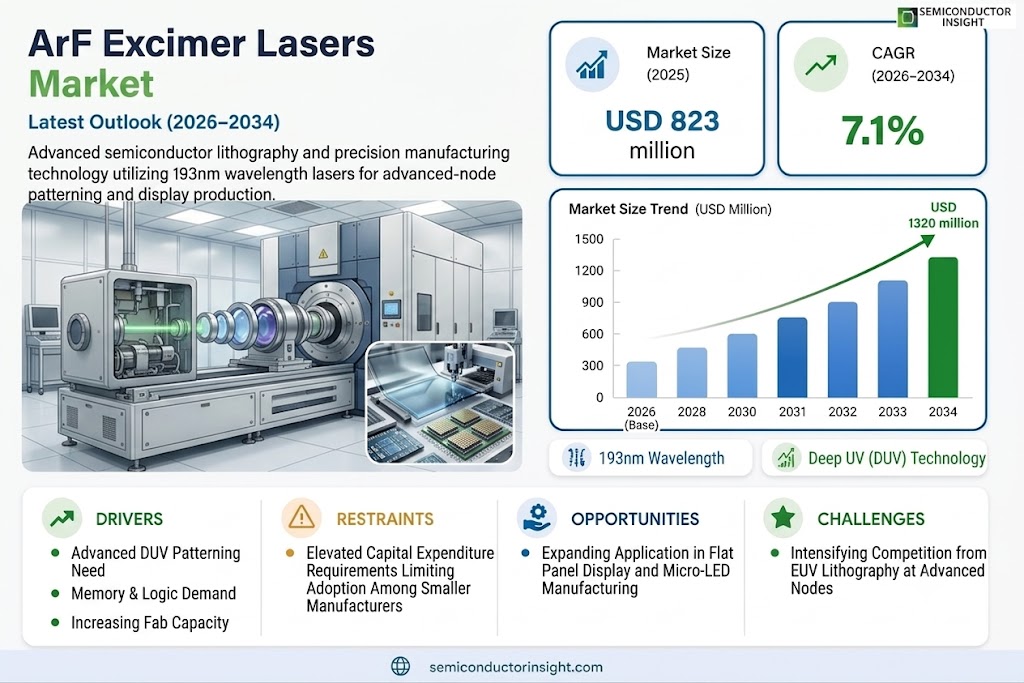
Global ArF Excimer Lasers market size was valued at USD 823 million in 2025. The market is projected to grow from USD 882 million in 2026 to USD 1,320 million by 2034, exhibiting a CAGR of 7.1% during the forecast period.
ArF excimer lasers are a specialized category of gas lasers that operate by utilizing argon fluoride (ArF) as the active laser medium, capable of producing deep ultraviolet (DUV) light at a precise wavelength of 193 nanometers. The term “excimer” refers to a unique molecular state in which two atoms , which do not ordinarily bond under normal conditions , are induced to form a temporary, unstable complex under ionized or excited-state conditions. This transient molecular structure, known as an excited dimer or excimer, releases energy in the form of coherent ultraviolet light upon returning to its ground state through stimulated emission. The 193nm wavelength produced by ArF excimer lasers falls within the far ultraviolet (FUV) spectrum, making these systems uniquely suited for applications demanding extreme precision at the nanoscale level.
The market is primarily driven by the surging global demand for semiconductor manufacturing, where ArF excimer lasers serve as the core light source in advanced ArF lithography machines used by leading equipment manufacturers such as ASML and Nikon. The downstream semiconductor ArF lithography machine market is estimated to reach USD 11.5 billion in 2025, underscoring the critical role of ArF excimer lasers as indispensable components within this high-precision ecosystem. The rapid proliferation of high-tech sectors , including 5G communications, the Internet of Things (IoT), and artificial intelligence , continues to intensify chip demand, further accelerating the need for advanced lithography solutions. Key players operating in the global ArF Excimer Lasers market include Cymer (ASML) and Coherent in the United States, Gigaphoton in Japan, and Keyi Hongyuan in China, with the top three companies collectively accounting for more than 80% of the global market share.
MARKET DRIVERS
Surging Demand from Semiconductor Lithography Applications
ArF Excimer Lasers Market is experiencing robust growth driven primarily by the escalating demand for advanced semiconductor lithography processes. ArF (Argon Fluoride) excimer lasers, operating at a wavelength of 193 nm, remain indispensable in deep ultraviolet (DUV) lithography systems used for fabricating logic chips and memory devices at nodes ranging from 65 nm down to sub-10 nm when deployed in immersion and multi-patterning configurations. As global chipmakers continue to expand capacity to meet insatiable demand for consumer electronics, automotive semiconductors, and AI-driven computing hardware, the dependency on proven ArF-based lithography tools has intensified considerably.
Proliferation of Advanced Packaging and Heterogeneous Integration Technologies
Beyond traditional front-end-of-line (FEOL) patterning, the ArF excimer lasers segment is benefiting from growing adoption in advanced packaging workflows including fan-out wafer-level packaging (FOWLP), silicon interposers, and through-silicon via (TSV) formation. Heterogeneous integration strategies pursued by leading fabless designers and integrated device manufacturers (IDMs) require precision patterning capabilities that ArF laser sources reliably deliver. This broadening application scope is materially expanding the total addressable market for ArF excimer laser system providers and component suppliers.
➤ The sustained relevance of 193 nm ArF excimer laser technology in multi-patterning DUV lithography continues to underpin substantial capital investment from both established foundries and emerging semiconductor manufacturing entrants globally.
Government-backed semiconductor self-sufficiency initiatives across the United States, European Union, Japan, South Korea, and China are fueling unprecedented fab construction activity. This geopolitical catalyst is translating into direct procurement demand for DUV lithography tools and, by extension, the ArF excimer laser light sources central to their operation. National programs supporting domestic chip manufacturing infrastructure are expected to sustain strong capital equipment spending through the latter half of this decade, providing a durable tailwind for the overall ArF Excimer Lasers Market.
MARKET CHALLENGES
Intensifying Competition from EUV Lithography at Advanced Nodes
One of the most significant challenges confronting ArF Excimer Lasers Market is the accelerating transition to extreme ultraviolet (EUV) lithography at the most advanced process nodes. Leading-edge foundries operating at 5 nm, 3 nm, and below are increasingly relying on EUV systems for critical layer patterning, reducing the number of DUV ArF exposures required per wafer. While multi-patterning techniques have extended the competitive viability of ArF immersion lithography, the structural shift toward EUV at bleeding-edge nodes introduces a degree of long-term displacement risk for ArF laser system vendors targeting the advanced logic segment specifically.
Other Challenges
High System Complexity and Maintenance Requirements
ArF excimer laser systems involve complex gas management, optical component maintenance, and stringent operational protocols that elevate total cost of ownership for end users. The corrosive nature of fluorine-based gas mixtures necessitates frequent consumable replacements, including laser gas refills, optical windows, and resonator components. These operational demands can strain fab productivity and increase lifecycle costs, presenting a recurrent challenge for cost-sensitive manufacturers operating mature node fabs where margin pressures are acute.
Supply Chain Constraints for Specialty Optical Components
ArF excimer laser supply chain relies on a concentrated ecosystem of specialized optical material suppliers, precision optics manufacturers, and rare gas distributors. Disruptions in the availability of high-purity fluorine gas, calcium fluoride (CaF₂) optical elements, or fused silica components can impede laser system production timelines. The limited number of qualified suppliers for these critical inputs creates vulnerability to bottlenecks, particularly during periods of elevated demand associated with capacity expansion cycles in the semiconductor industry.
MARKET RESTRAINTS
Elevated Capital Expenditure Requirements Limiting Adoption Among Smaller Manufacturers
The substantial upfront capital investment associated with ArF excimer laser-equipped lithography systems represents a meaningful restraint on market expansion, particularly among smaller and mid-tier semiconductor manufacturers. Complete DUV immersion lithography systems integrated with high-power ArF laser sources command significant price points that may be prohibitive for foundries operating at mature nodes with constrained capital budgets. This financial barrier tends to concentrate ArF lithography adoption among large-scale foundries and memory manufacturers with the financial capacity to sustain multi-year equipment refresh cycles, thereby limiting the breadth of the addressable customer base.
Regulatory and Export Control Restrictions on Advanced Lithography Equipment
Tightening export control frameworks governing the transfer of advanced semiconductor manufacturing equipment, including DUV lithography tools utilizing ArF excimer laser technology, are increasingly shaping market access dynamics. Restrictions imposed on exports to certain geographies have complicated the commercial strategies of both laser system OEMs and their lithography tool integration partners. While these controls are intended to address national security considerations, they introduce market segmentation effects that can restrict revenue opportunities in what would otherwise represent high-growth regional markets for ArF-based lithography solutions.
Technological Maturity Compressing Average Selling Price Trajectories
The relative technological maturity of 193 nm ArF excimer laser platforms, which have been commercially deployed in semiconductor manufacturing for multiple decades, introduces downward pressure on average selling prices for replacement and upgrade units. As the installed base of ArF lithography systems matures and established foundries shift incremental investment toward EUV for advanced nodes, competitive pricing dynamics intensify among ArF laser suppliers vying for service contracts, laser head replacements, and consumable revenue streams. This pricing environment constrains revenue per unit and compresses margins across segments of ArF Excimer Lasers Market focused on mature node customer accounts.
MARKET OPPORTUNITIES
Expanding Application in Flat Panel Display and Micro-LED Manufacturing
Beyond semiconductor lithography, ArF Excimer Lasers Market is well-positioned to capitalize on growing adoption in flat panel display (FPD) manufacturing and the emerging micro-LED production ecosystem. ArF laser annealing and patterning processes are finding increasing application in low-temperature polysilicon (LTPS) and oxide thin-film transistor (TFT) backplane fabrication for high-resolution display panels. As consumer demand for premium OLED and micro-LED displays accelerates, driven by smartphones, automotive displays, and augmented reality devices, ArF laser system providers have a tangible opportunity to diversify revenue streams beyond their traditional semiconductor customer base.
Growth in Legacy Node Capacity Expansion Supporting Sustained ArF Tool Demand
The global shortage of mature node semiconductors, which supply critical components for automotive electronics, industrial controls, and connectivity devices, has catalyzed substantial investment in 28 nm to 90 nm capacity expansion at both established and greenfield fabs. These process nodes are optimally served by ArF dry and immersion lithography, creating a durable and multi-year demand opportunity for ArF excimer laser systems and associated service infrastructure. Unlike leading-edge transitions, mature node capacity additions represent a lower-risk, higher-volume demand driver that is geographically distributed across Asia-Pacific, North America, and Europe.
Emerging Opportunities in Directed Self-Assembly and Nanopatterning Research
The ArF excimer laser platform is also finding relevance in next-generation nanofabrication research, including directed self-assembly (DSA) lithography pre-patterning and nanoimprint lithography (NIL) template fabrication. Academic institutions, national laboratories, and semiconductor research consortia continue to invest in ArF laser-enabled patterning infrastructure to advance post-EUV and beyond-EUV lithography roadmaps. This research and development demand segment, while smaller in volume than production applications, represents a strategically important growth avenue for laser system vendors seeking to embed their technology at the frontier of lithography innovation within the broader ArF Excimer Lasers Market.
ArF Excimer Lasers Market Trends
Semiconductor Lithography Driving Sustained Demand for ArF Excimer Lasers
ArF Excimer Lasers Market continues to be shaped primarily by the relentless advancement of semiconductor manufacturing. ArF excimer lasers, which emit light at a wavelength of 193nm in the deep ultraviolet range, remain a cornerstone technology in photolithography processes used to fabricate advanced semiconductor chips. As chip architectures push toward smaller nanoscale nodes to meet the performance and power efficiency demands of high-growth segments such as artificial intelligence, 5G communications, and the Internet of Things, precision lithography equipment has become increasingly critical. This sustained push for miniaturization has reinforced the strategic importance of ArF excimer lasers as indispensable components within ArF lithography systems produced by leading manufacturers including ASML, Nikon, and SMEE. ArF Excimer Lasers Market is therefore closely correlated with overall trends in semiconductor capital expenditure and technology node transitions occurring across the global chip supply chain.
Other Trends
High Market Concentration Among Leading Suppliers
A defining structural trend in ArF Excimer Lasers Market is the high degree of market consolidation. The top three companies , Cymer (a subsidiary of ASML), Gigaphoton of Japan, and China-based Keyi Hongyuan , collectively account for more than 80% of global market share. This concentration reflects significant barriers to entry, including the advanced engineering expertise, long-term customer relationships, and continuous R&D investment required to develop and maintain laser sources that meet the stringent performance specifications demanded by lithography system manufacturers. Smaller participants such as Coherent, Beijing RSLaser, and MLase AG serve niche or emerging segments but face considerable competitive pressure from the dominant players. This oligopolistic structure is expected to persist, with incremental consolidation possible through strategic mergers and acquisitions.
Geographic Expansion and China’s Growing Role
Geographically, ArF Excimer Lasers Market is concentrated in the United States, Japan, Europe, and China. However, a notable trend is China’s accelerating domestic development of ArF excimer laser technology, driven by national priorities around semiconductor self-sufficiency. Companies such as Keyi Hongyuan and Shenzhen ShengFang Tech represent the emerging domestic supply base in China, catering to local lithography manufacturers including SMEE. This regional diversification is gradually reshaping global supply chain dynamics and introducing new competitive variables into a historically U.S.- and Japan-dominated market landscape.
Immersion vs. Dry ArF Laser Technology Segmentation
Within ArF Excimer Lasers Market, a key technology trend involves the distinction between ArF immersion excimer lasers and ArF dry excimer lasers. ArF immersion lithography, which uses water as an optical medium between the lens and wafer to effectively reduce the printed feature size, has become the preferred approach for manufacturing chips at advanced nodes. As a result, ArF immersion excimer lasers have gained increasing share within the overall product mix. Meanwhile, ArF dry excimer lasers continue to serve mature node applications and select scientific research use cases, ensuring sustained demand across both product segments. Beyond semiconductors, medical applications represent a secondary but growing end-use area, further broadening the commercial relevance of ArF Excimer Lasers Market over the forecast horizon.
COMPETITIVE LANDSCAPE
Key Industry Players
ArF Excimer Lasers Market: A Highly Concentrated Global Competitive Arena Driven by Semiconductor Lithography Demand
The global ArF Excimer Lasers market is characterized by a high degree of concentration, with the top three players , Cymer (ASML), Gigaphoton, and Keyi Hongyuan , collectively commanding more than 80% of the total market share. Cymer, operating as a wholly owned subsidiary of ASML, holds a dominant position in the market, supplying high-performance 193nm deep ultraviolet laser sources that are integral to advanced semiconductor lithography systems used by leading chipmakers worldwide. Coherent, another major U.S.-based photonics company, complements this duopoly with its broad laser portfolio and strong R&D capabilities, while Japan’s Gigaphoton has established itself as a critical supplier to lithography equipment manufacturers such as ASML and Nikon. Valued at approximately US$ 823 million in 2025 and projected to reach US$ 1,320 million by 2034 at a CAGR of 7.1%, the ArF excimer laser market is increasingly shaped by the escalating demand for high-precision semiconductor manufacturing driven by 5G, IoT, and artificial intelligence applications. This competitive intensity is further amplified by the market’s bifurcation into ArF Immersion and ArF Dry excimer laser segments, each serving distinct lithography nodes and resolution requirements.
Beyond the leading players, a number of specialized and regional companies occupy significant niches within the ArF excimer laser ecosystem. Beijing RSLaser and Shenzhen ShengFang Tech represent China’s growing domestic capabilities, as the country accelerates efforts to reduce reliance on foreign laser technology amid semiconductor supply chain pressures. European firms such as MLase AG and ATL Lasertechnik GmbH bring targeted expertise in precision laser engineering, serving both industrial and scientific research applications. LightMachinery and GAM Laser, Inc. cater to specialized segments including medical applications and laboratory-grade instrumentation, while Optosystems and LDI Innovation contribute to the market through application-specific laser solutions. The competitive dynamics across North America, Europe, Japan, and China are further intensified by ongoing investments in R&D, mergers and acquisitions, and strategic partnerships with downstream lithography machine manufacturers including ASML, Nikon, and SMEE, underscoring the critical role of ArF excimer lasers as indispensable components in the global semiconductor supply chain.
List of Key ArF Excimer Lasers Companies Profiled
- Cymer (ASML)
- Coherent
- Gigaphoton
- Beijing RSLaser
- MLase AG
- LightMachinery
- GAM Laser, Inc.
- Optosystems
- ATL Lasertechnik GmbH
- LDI Innovation
- Shenzhen ShengFang Tech
Segment Analysis:
| Segment Category | Sub-Segments | Key Insights |
| By Type |
|
ArF Immersion Excimer Lasers represent the dominant and most technologically advanced segment within the ArF excimer laser market, owing to their superior capability in enabling ultra-fine patterning on semiconductor wafers.
|
| By Application |
|
Semiconductor Lithography is the overwhelmingly dominant application segment for ArF excimer lasers, underpinned by the irreplaceable role these lasers play as core light sources in ArF lithography machines manufactured by leading OEMs such as ASML and Nikon.
|
| By End User |
|
Semiconductor Lithography Equipment Manufacturers constitute the primary and most strategically significant end-user category, with global leaders such as ASML, Nikon, and SMEE relying on ArF excimer laser suppliers as mission-critical partners in their lithography machine manufacturing chains.
|
| By Technology Maturity |
|
Advanced Node ArF Laser Systems lead this segment, representing the frontier of excimer laser engineering where continuous improvement in pulse stability, coherence length, and repetition rate is essential to support the most demanding semiconductor fabrication processes.
|
| By Supply Chain Position |
|
Integrated OEM-Captive Suppliers dominate this segment, exemplified by Cymer operating within the ASML ecosystem, where deep vertical integration between laser supplier and lithography machine OEM creates powerful competitive advantages in terms of co-development, technical optimization, and long-term supply security.
|
Regional Analysis: ArF Excimer Lasers Market
Asia-Pacific
Asia-Pacific hosts the highest density of leading-edge semiconductor fabrication plants globally. The continuous race toward smaller process nodes demands increasingly precise ArF excimer laser lithography solutions. Countries like Taiwan and South Korea are at the forefront of next-generation chip production, ensuring that demand for ArF excimer laser systems remains robust and technologically progressive throughout the forecast horizon.
China’s strategic national initiatives aimed at achieving semiconductor independence have triggered unprecedented investment in domestic chip fabrication capacity. New and expanding fabs across key Chinese technology corridors are generating accelerating procurement activity for ArF excimer laser lithography equipment, making China one of the fastest-growing individual country markets within the Asia-Pacific ArF excimer lasers landscape.
Japan’s deeply established precision optics and photonics manufacturing base provides Asia-Pacific with a critical competitive advantage in ArF Excimer Lasers Market. Japanese firms contribute essential optical components, laser gain media, and system integration expertise that support the broader regional supply chain, fostering continuous performance improvements and reliability enhancements in ArF excimer laser systems deployed across the region.
Coordinated government policies across Asia-Pacific actively support semiconductor technology development through subsidies, tax incentives, and state-sponsored research programs. These policy frameworks accelerate the adoption of advanced lithography technologies including ArF excimer lasers, while also nurturing indigenous innovation ecosystems that strengthen the region’s long-term competitive position in the global ArF excimer lasers market.
North America
North America represents a strategically significant region in ArF Excimer Lasers Market, underpinned by the presence of world-leading semiconductor design firms, research universities, and advanced manufacturing facilities concentrated primarily in the United States. While North America does not match Asia-Pacific in terms of sheer fabrication volume, it maintains a critical role through its deep focus on cutting-edge research and development, next-generation lithography innovation, and the manufacturing of high-value semiconductor devices. The United States government’s renewed focus on domestic semiconductor production, catalyzed by supply chain resilience concerns and national security considerations, has led to significant policy-driven investment in new fab construction and technology upgrades. This is expected to steadily increase regional demand for ArF excimer laser systems. Additionally, North America’s thriving ecosystem of photonics, defense optics, and medical laser applications creates secondary demand streams that further sustain ArF Excimer Lasers Market across the region through the 2026 to 2034 period.
Europe
Europe occupies a distinctive position in the global ArF excimer lasers market, characterized by its concentration of specialized semiconductor equipment manufacturers, precision optics producers, and advanced research institutions. The Netherlands, Germany, and Belgium are particularly notable contributors, with the region serving as a critical innovation hub for lithography technology development. European industrial policy increasingly emphasizes technological sovereignty and supply chain resilience, prompting investments in domestic semiconductor manufacturing that will gradually generate new demand for ArF excimer laser systems. The region’s ArF excimer lasers market also benefits from strong activity in adjacent application sectors including ophthalmology, materials processing, and precision microfabrication. Europe’s rigorous regulatory environment and focus on sustainable manufacturing practices are additionally shaping how ArF excimer laser systems are designed, deployed, and maintained across the continent’s growing industrial base.
South America
South America currently represents an emerging and relatively nascent segment of the global ArF excimer lasers market. The region’s semiconductor manufacturing base remains limited compared to Asia-Pacific and North America, constraining immediate large-scale demand for ArF excimer laser lithography systems. However, growing investments in electronics manufacturing, an expanding base of technology-oriented industries in Brazil and other economies, and increasing interest in establishing domestic technology capabilities are laying the groundwork for gradual market development. ArF Excimer Lasers Market in South America is also supported by demand from medical and industrial laser application sectors, particularly in ophthalmology and precision material processing. Over the 2026 to 2034 forecast period, South America is expected to register moderate growth as regional technology infrastructure continues to mature and international partnerships in semiconductor development expand.
Middle East & Africa
The Middle East and Africa region represents an early-stage but progressively evolving participant in the global ArF excimer lasers market. The Middle East, particularly the Gulf Cooperation Council countries, is witnessing growing investment in technology diversification as part of broader economic transformation agendas. Initiatives to develop domestic electronics and semiconductor capabilities, alongside expanding medical technology infrastructure, are creating nascent demand for ArF excimer laser applications. Africa’s contribution to ArF Excimer Lasers Market remains minimal at present, though long-term industrialization trends and technology sector development initiatives may unlock future opportunities. The region’s market trajectory through 2034 is expected to be shaped primarily by government-led technology investment programs, international technology transfer agreements, and the expansion of medical and industrial laser application segments in key urban and economic centers across both the Middle East and Africa.
Report Scope
This market research report provides a comprehensive analysis of ArF Excimer Lasers Market, covering the forecast period 2026–2034. It offers detailed insights into market dynamics, technological advancements, competitive landscape, and key trends shaping the industry.
Key focus areas of the report include:
- Market Overview: The report begins with an overview outlining its current market scenario, key growth indicators, and industry transformation drivers. It discusses macroeconomic factors, demand–supply balance, regulatory landscape, and the strategic role of semiconductors in powering advancements across industries such as automotive, telecommunications, consumer electronics, and industrial automation.
- Market Size & Forecast: Historical data and future projections for revenue, unit shipments, and market value across major regions and segments.
- Segmentation Analysis: Detailed breakdown by product type, technology, application, and end-user industry to identify high-growth segments and investment opportunities.
- Regional Insights: Insights into market performance across North America, Europe, Asia-Pacific, Latin America, and the Middle East & Africa, including country-level analysis where relevant.
- Competitive Landscape: Profiles of leading market participants, including their product offerings, R&D focus, manufacturing capacity, pricing strategies, and recent developments such as mergers, acquisitions, and partnerships.
- Technology Trends & Innovation: Assessment of emerging technologies, integration of AI/IoT, semiconductor design trends, fabrication techniques, and evolving industry standards.
- Market Drivers & Restraints: Evaluation of factors driving market growth along with challenges, supply chain constraints, regulatory issues, and market-entry barriers.
- Stakeholder Insights: Insights for component suppliers, OEMs, system integrators, investors, and policymakers regarding the evolving ecosystem and strategic opportunities.
Primary and secondary research methods are employed, including interviews with industry experts, data from verified sources, and real-time market intelligence to ensure the accuracy and reliability of the insights presented.
FREQUENTLY ASKED QUESTIONS:
What is the current market size of ArF Excimer Lasers Market?
-> Global ArF Excimer Lasers Market was valued at USD 823 million in 2025 and is expected to reach USD 1320 million by 2034, growing at a CAGR of 7.1% during the forecast period.
Which key companies operate in ArF Excimer Lasers Market?
-> Key players include Cymer (ASML), Coherent, Gigaphoton, Beijing RSLaser, MLase AG, LightMachinery, GAM Laser, Inc., Optosystems, ATL Lasertechnik GmbH, LDI Innovation, and Shenzhen ShengFang Tech, among others. The top 3 companies occupy more than 80% of the market share, indicating a highly concentrated market.
What are the key growth drivers?
-> Key growth drivers include rising demand for semiconductor chips driven by IoT, 5G communications, and artificial intelligence, the advancement of chip design toward smaller nanoscale nodes requiring high-precision lithography, and the expanding application of ArF excimer lasers in semiconductor ArF lithography machines. The ArF lithography machine market is projected to reach USD 11.5 billion in 2025, reflecting sustained demand for ArF excimer laser systems.
Which region dominates the market?
-> Asia is a dominant and fast-growing region, driven by major semiconductor manufacturing hubs in China, Japan, and South Korea. North America also holds a significant share, led by leading ArF excimer laser companies such as Cymer (ASML) and Coherent headquartered in the United States.
What are the emerging trends?
-> Emerging trends include advancements in ArF immersion lithography technology, growing adoption of deep ultraviolet (DUV) lasers at 193nm wavelength, increased investment in semiconductor fabrication capacity, and the rising role of ArF excimer lasers in enabling next-generation chip manufacturing for high-performance computing and low-power applications.
Need proxies cheaper than the market?
https://op.wtf

Get Sample Report PDF for Exclusive Insights
Report Sample Includes
- Table of Contents
- List of Tables & Figures
- Charts, Research Methodology, and more...




