
MARKET INSIGHTS
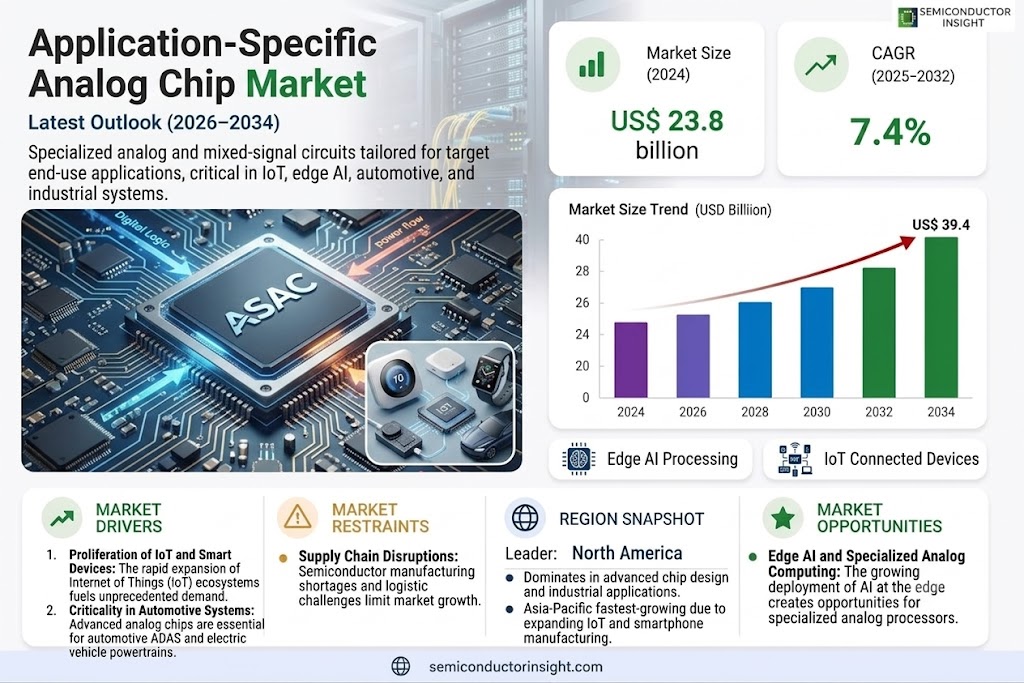
The global Application-Specific Analog Chip Market size was valued at US$ 23.8 billion in 2024 and is projected to reach US$ 39.4 billion by 2032, at a CAGR of 7.4% during the forecast period 2025-2032.
Application-Specific Analog Chips (ASACs) are integrated circuits designed for specialized functions in specific end-use applications rather than general-purpose use. These chips process real-world signals like sound, temperature, and pressure by converting them into digital data streams. Key product categories include power management ICs, data converters, and interface chips that enable communication between different electronic components.
The market growth is driven by expanding demand in consumer electronics, automotive systems, and industrial automation. While the broader semiconductor market saw moderated growth of 4.4% in 2022 (reaching USD 580 billion), analog chips demonstrated resilience with 20.8% year-over-year growth according to WSTS data. This outperformance stems from analog chips’ critical role in emerging technologies like electric vehicles and IoT devices. Leading manufacturers including Texas Instruments, Analog Devices, and Infineon Technologies are investing heavily in R&D to develop energy-efficient solutions for 5G infrastructure and smart manufacturing applications.
MARKET DYNAMICS
MARKET DRIVERS
Proliferation of IoT and Smart Devices Fuels Demand for Application-Specific Analog Chips
The rapid expansion of Internet of Things (IoT) ecosystems is creating unprecedented demand for application-specific analog chips. With projections indicating over 29 billion connected IoT devices by 2030, semiconductor manufacturers are developing specialized analog solutions for sensor interfaces, power management, and signal conditioning. These chips enable precise analog-to-digital conversion necessary for environmental monitoring, industrial automation, and smart home applications. The automotive sector alone is expected to account for 25% of IoT chip demand as vehicles incorporate more advanced driver assistance systems (ADAS).
5G Network Expansion Accelerates Specialized Analog Chip Adoption
Global 5G infrastructure deployment is driving innovation in radio frequency (RF) analog chips designed specifically for base stations and mobile devices. The transition to higher frequency bands requires advanced power amplifiers, low-noise amplifiers, and filters that can only be achieved through application-specific designs. Over 300 operators in 100 countries had launched commercial 5G services by mid-2023, with infrastructure investments exceeding $200 billion annually. This creates substantial opportunities for analog chip vendors offering optimized solutions for millimeter-wave frequencies and massive MIMO antenna systems.
Automotive Electrification Demands Custom Analog Solutions
The automotive industry’s shift to electrification is transforming requirements for in-vehicle electronics. Battery management systems in electric vehicles require highly accurate voltage monitoring and current sensing capabilities, leading to increased adoption of application-specific analog chips. With global EV sales projected to reach 45 million units annually by 2030, semiconductor suppliers are developing automotive-grade analog ICs that meet stringent reliability standards. These specialized chips also enable advanced features like regenerative braking control and thermal management, crucial for optimizing EV performance.
MARKET RESTRAINTS
Semiconductor Supply Chain Disruptions Limit Market Growth
The application-specific analog chip market continues to face significant supply chain challenges that impact production capacity and lead times. While demand remains strong, geopolitical tensions and manufacturing bottlenecks have created uncertainties in the semiconductor ecosystem. The industry experienced average lead times of 20-30 weeks for specialized analog components throughout 2023, forcing many OEMs to redesign products or seek alternative solutions. These constraints are particularly acute for automotive and industrial applications where qualification cycles for new components can exceed 12 months.
Design Complexity Increases Development Costs and Time-to-Market
Developing application-specific analog ICs requires substantial R&D investment and specialized engineering expertise. Unlike digital chips that benefit from process scaling, analog circuits often require custom process technologies that add to development expenses. A single tape-out for a complex analog ASIC can cost several million dollars, with design cycles typically spanning 12-18 months. This creates significant barriers for smaller players and limits the pace of innovation in niche applications where volumes may not justify the development costs.
Skill Shortage in Analog Design Threatens Innovation Pace
The semiconductor industry faces a critical shortage of experienced analog design engineers capable of developing application-specific solutions. Analog circuit design requires specialized knowledge that takes years to master, with fewer than 20% of electrical engineering graduates pursuing careers in analog IC design. This talent gap is particularly acute for mixed-signal designers who can integrate analog and digital functions on the same die. Industry surveys indicate that over 60% of semiconductor companies struggle to fill analog design positions, potentially slowing innovation in emerging application areas.
MARKET OPPORTUNITIES
AI at the Edge Creates Demand for Specialized Analog Processors
The growing deployment of artificial intelligence in edge devices presents significant opportunities for analog computing architectures. New analog matrix processors can perform neural network computations more efficiently than digital alternatives, reducing power consumption by up to 90% for inference tasks. This makes them ideal for battery-powered devices in industrial IoT, wearables, and smart sensors. Several startups have demonstrated analog AI chips achieving 20-30 TOPS/W efficiency, potentially revolutionizing edge AI implementations where power constraints limit digital solutions.
Medical Electronics Drive Need for Precision Analog Components
Advancements in medical diagnostics and wearable health monitors are creating strong demand for high-performance analog chips. Continuous glucose monitors, for example, require ultra-low power signal conditioning circuits with exceptional accuracy. The global market for medical electronics is projected to exceed $100 billion by 2027, with analog components playing a critical role in biosignal acquisition and processing. New applications in advanced prosthetics and implantable devices further expand opportunities for application-specific analog designs that meet stringent medical safety standards.
Renewable Energy Systems Require Optimized Power Management ICs
The transition to renewable energy sources is driving innovation in power management integrated circuits. Solar microinverters and battery storage systems require specialized analog chips for maximum power point tracking and efficient energy conversion. With global investment in energy transition technologies surpassing $1 trillion annually, semiconductor vendors are developing application-specific solutions for next-generation power electronics. These chips must handle high voltages while maintaining precision control, creating design challenges that favor customized analog approaches over generic solutions.
MARKET CHALLENGES
Analog Design Scaling Limitations Hinder Performance Gains
Unlike digital circuits that benefit from process node shrinks, analog components face fundamental physics limitations when scaling below 28nm. Device matching, noise performance, and voltage tolerances often degrade with smaller geometries, forcing designers to use older process technologies for precision analog functions. This creates integration challenges for system-on-chip solutions requiring both advanced digital logic and high-performance analog. Over 70% of analog ICs are still manufactured using 180nm or larger nodes, reflecting these technical constraints on process migration.
Testing and Validation Requirements Increase Cost Structure
Application-specific analog chips face rigorous testing requirements that significantly impact manufacturing costs. Each device must be characterized across temperature, voltage, and process variations to ensure performance specifications are met. Complex mixed-signal ICs may require thousands of test patterns and specialized measurement equipment, with test time accounting for 30-40% of total production cost in some cases. These testing challenges are compounded by the lack of standardized test methodologies for novel analog architectures, creating additional barriers for emerging applications.
Intellectual Property Protection Complexities Slow Innovation
The analog IC industry faces unique intellectual property challenges compared to digital designs. Circuit topologies and device configurations that provide competitive advantages can be difficult to protect, as small modifications may circumvent patents while maintaining functionality. This creates disincentives for companies to invest in innovative analog architectures, particularly in applications where reverse engineering is relatively straightforward. Industry surveys suggest that over 50% of analog design firms consider IP protection a major concern that influences their R&D investment decisions and product strategies.
APPLICATION-SPECIFIC ANALOG CHIP MARKET TRENDS
Growth in IoT and Edge Computing Driving Demand for Application-Specific Analog Chips
The proliferation of Internet of Things (IoT) devices and edge computing applications is significantly boosting the demand for application-specific analog chips. These specialized ICs are critical for sensor interfacing, power management, and signal conditioning in smart devices. The global IoT market is projected to connect over 75 billion devices by 2025, with analog chips serving as the bridge between physical signals and digital processing. Furthermore, the emergence of 5G networks is accelerating adoption in telecommunications infrastructure, where analog front-ends and RF components require precise customization. With automotive IoT applications alone expected to grow at a CAGR of 24%, analog chip manufacturers are investing heavily in domain-specific solutions.
Other Trends
Automotive Electrification
The rapid transition toward electric vehicles (EVs) and advanced driver-assistance systems (ADAS) is creating robust demand for automotive-grade analog ICs. These chips handle critical functions including battery management, motor control, and in-vehicle networking with stringent reliability requirements. The EV market is forecast to reach 45 million units annually by 2030, requiring specialized analog solutions that can operate in harsh environments while maintaining precision. Tier-1 suppliers are increasingly partnering with semiconductor firms to develop application-specific chips that meet automotive safety standards while optimizing power efficiency.
Industrial Automation and Industry 4.0 Adoption
Manufacturing sectors worldwide are implementing Industry 4.0 solutions that heavily rely on customized analog ICs for process control and equipment monitoring. Analog chips enable precise measurement of parameters like temperature, pressure, and vibration in industrial environments where standard components might fail. With the global industrial automation market expected to surpass $400 billion by 2028, demand for ruggedized analog solutions continues rising. Recent technological advancements include higher integration of analog front-ends with embedded processing cores, reducing component count while improving system reliability in factory automation applications.
COMPETITIVE LANDSCAPE
Key Industry Players
Semiconductor Giants Strategize to Dominate the Burgeoning Analog IC Market
The global application-specific analog chip market exhibits a moderately consolidated structure, dominated by established semiconductor players with strong R&D capabilities and diversified product portfolios. Texas Instruments Incorporated (TI) leads the market with an estimated 19% revenue share in 2024, owing to its extensive portfolio of analog and embedded processing chips. The company’s dominance stems from its vertical integration strategy and focus on industrial, automotive, and personal electronics applications.
Analog Devices, Inc. and Infineon Technologies AG collectively account for approximately 25% of the market, having strengthened their positions through strategic acquisitions. Analog Devices’ 2021 merger with Maxim Integrated created a powerhouse in precision analog solutions, while Infineon’s focus on automotive and power management ICs drives its growth in emerging markets.
These market leaders are accelerating innovation through substantial R&D investments – TI allocated $2.1 billion (15% of revenue) to research in 2023, reflecting the sector’s commitment to technological advancement. Meanwhile, mid-tier players like STMicroelectronics and NXP Semiconductors are gaining traction through specialized solutions for IoT and automotive applications, capitalizing on industry-specific demand.
The competitive landscape is further shaped by regional players such as China’s Shanghai Belling and Will Semiconductor, which benefit from domestic sourcing preferences in Asia’s electronics manufacturing ecosystem. These companies are expanding their analog IC capabilities to reduce reliance on Western suppliers amid ongoing geopolitical tensions.
List of Key Application-Specific Analog Chip Companies
- Texas Instruments Incorporated (U.S.)
- Analog Devices, Inc. (U.S.)
- Infineon Technologies AG (Germany)
- STMicroelectronics (Switzerland)
- NXP Semiconductors (Netherlands)
- Shanghai Belling (China)
- ON Semiconductor (U.S.)
- Qualcomm (U.S.)
- Intel (U.S.)
- Will Semiconductor (China)
Segment Analysis:
By Type
Mixed Signal IC Segment Dominates the Market Due to Rising Demand for Hybrid Analog-Digital Systems
The market is segmented based on type into:
- Analog Signal IC
- Subtypes: Amplifiers, Comparators, Voltage Regulators, and others
- Mixed Signal IC
By Application
Consumer Electronics Segment Leads Due to Proliferation of Smart Devices and IoT Ecosystems
The market is segmented based on application into:
- Consumer Electronics
- Computer
- Communications Industry
- Auto Industry
- Others
By Region
Asia-Pacific Segment Dominates Owing to Thriving Semiconductor Manufacturing Ecosystem
The market is segmented based on region into:
- North America
- Europe
- Asia-Pacific
- South America
- Middle East & Africa
Regional Analysis: Application-Specific Analog Chip Market
North America
North America maintains technological leadership in application-specific analog chips, driven by robust R&D investments and high demand from the automotive, industrial automation, and communications sectors. The U.S. dominates with semiconductor sales reaching $142.1 billion in 2022 (a 17% YoY increase), supported by strong fabless semiconductor ecosystems in Silicon Valley and Texas. Key players like Texas Instruments and Analog Devices focus on customized analog solutions for 5G infrastructure and electric vehicle power management systems. However, supply chain disruptions and export controls on advanced chip technologies are creating short-term challenges for the regional market.
Europe
Europe’s market benefits from stringent quality standards and growing adoption in automotive electrification, particularly in Germany and France where leading automakers are accelerating EV production. The region posted $53.8 billion in semiconductor sales in 2022 (12.6% growth YoY), with Infineon and STMicroelectronics driving analog chip innovation for industrial IoT applications. EU initiatives like the Chips Act aim to double Europe’s semiconductor market share by 2030, though reliance on Asian manufacturing remains a key vulnerability in the analog segment where specialized foundries are limited.
Asia-Pacific
Accounting for over 60% of global semiconductor sales despite a 2% regional decline in 2022, Asia-Pacific remains the production hub for application-specific analog chips. China’s domestic manufacturers like Shanghai Belling are gaining ground in power management ICs, while Taiwan and South Korea dominate specialty foundry services. The region benefits from integrated electronics supply chains supporting consumer electronics manufacturing, though geopolitical tensions and U.S. export restrictions are forcing local firms to accelerate self-sufficiency in analog chip design. India’s emerging fab ecosystem presents new opportunities as global players diversify production beyond China.
South America
Market development trails other regions due to limited local semiconductor infrastructure, though Brazil is seeing increased demand for automotive and industrial analog chips as multinational manufacturers expand operations. Chile’s growing renewable energy sector is driving need for power management ICs in solar and wind applications. However, economic instability, import dependencies, and lack of specialized engineering talent constrain the regional market’s growth potential compared to other developing economies.
Middle East & Africa
The market is in early stages but shows promise with sovereign wealth funds in UAE and Saudi Arabia investing in semiconductor design capabilities. Israel’s strong analog chip expertise (notably in automotive radar and medical devices) positions it as a regional innovation hub. African demand is growing for basic analog components in mobile infrastructure and consumer electronics, though the lack of local manufacturing means nearly all supply is imported. Strategic partnerships with Asian and European firms could accelerate market development over the next decade.
Report Scope
This market research report provides a comprehensive analysis of the global and regional Application-Specific Analog Chip markets, covering the forecast period 2025–2032. It offers detailed insights into market dynamics, technological advancements, competitive landscape, and key trends shaping the industry.
Key focus areas of the report include:
- Market Size & Forecast: Historical data and future projections for revenue, unit shipments, and market value across major regions and segments. The global Application-Specific Analog Chip market was valued at US$ 23.8 billion in 2024 and is projected to reach US$ 39.4 billion by 2032, growing at a CAGR of 7.4% during the forecast period.
- Segmentation Analysis: Detailed breakdown by product type (Analog Signal IC, Mixed Signal IC), application (Consumer Electronics, Computer, Communications Industry, Auto Industry, Others), and end-user industry to identify high-growth segments and investment opportunities.
- Regional Outlook: Insights into market performance across North America, Europe, Asia-Pacific, Latin America, and the Middle East & Africa, including country-level analysis where relevant. Asia-Pacific accounted for 42% of the global market share in 2024.
- Competitive Landscape: Profiles of leading market participants including Texas Instruments, Analog Devices, Infineon Technologies, and STMicroelectronics, covering their product offerings, R&D focus, manufacturing capacity, and recent strategic developments.
- Technology Trends & Innovation: Assessment of emerging technologies, integration of AI/ML in analog chip design, advanced fabrication techniques, and evolving industry standards for power efficiency and miniaturization.
- Market Drivers & Restraints: Evaluation of factors driving market growth (5G deployment, IoT expansion, automotive electrification) along with challenges (supply chain constraints, geopolitical tensions, and design complexity).
- Stakeholder Analysis: Strategic insights for semiconductor manufacturers, fabless companies, system integrators, investors, and policymakers regarding the evolving ecosystem and business opportunities.
Primary and secondary research methods are employed, including interviews with industry experts, data from verified sources, and real-time market intelligence to ensure the accuracy and reliability of the insights presented.
FREQUENTLY ASKED QUESTIONS:
What is the current market size of Global Application-Specific Analog Chip Market?
-> Application-Specific Analog Chip Market size was valued at US$ 23.8 billion in 2024 and is projected to reach US$ 39.4 billion by 2032, at a CAGR of 7.4% during the forecast period 2025-2032.
Which key companies operate in Global Application-Specific Analog Chip Market?
-> Key players include Texas Instruments Incorporated, Analog Devices, Inc., Infineon Technologies AG, STMicroelectronics, and NXP Semiconductors, among others.
What are the key growth drivers?
-> Key growth drivers include 5G infrastructure deployment, increasing IoT adoption, automotive electrification, and demand for energy-efficient devices.
Which region dominates the market?
-> Asia-Pacific holds the largest market share (42% in 2024), driven by semiconductor manufacturing hubs in China, Taiwan, and South Korea.
What are the emerging trends?
-> Emerging trends include AI-integrated analog chips, advanced packaging technologies, and growing adoption in industrial automation applications.

Get Sample Report PDF for Exclusive Insights
Report Sample Includes
- Table of Contents
- List of Tables & Figures
- Charts, Research Methodology, and more...
 Download Sample Report PDF






