
MARKET INSIGHTS
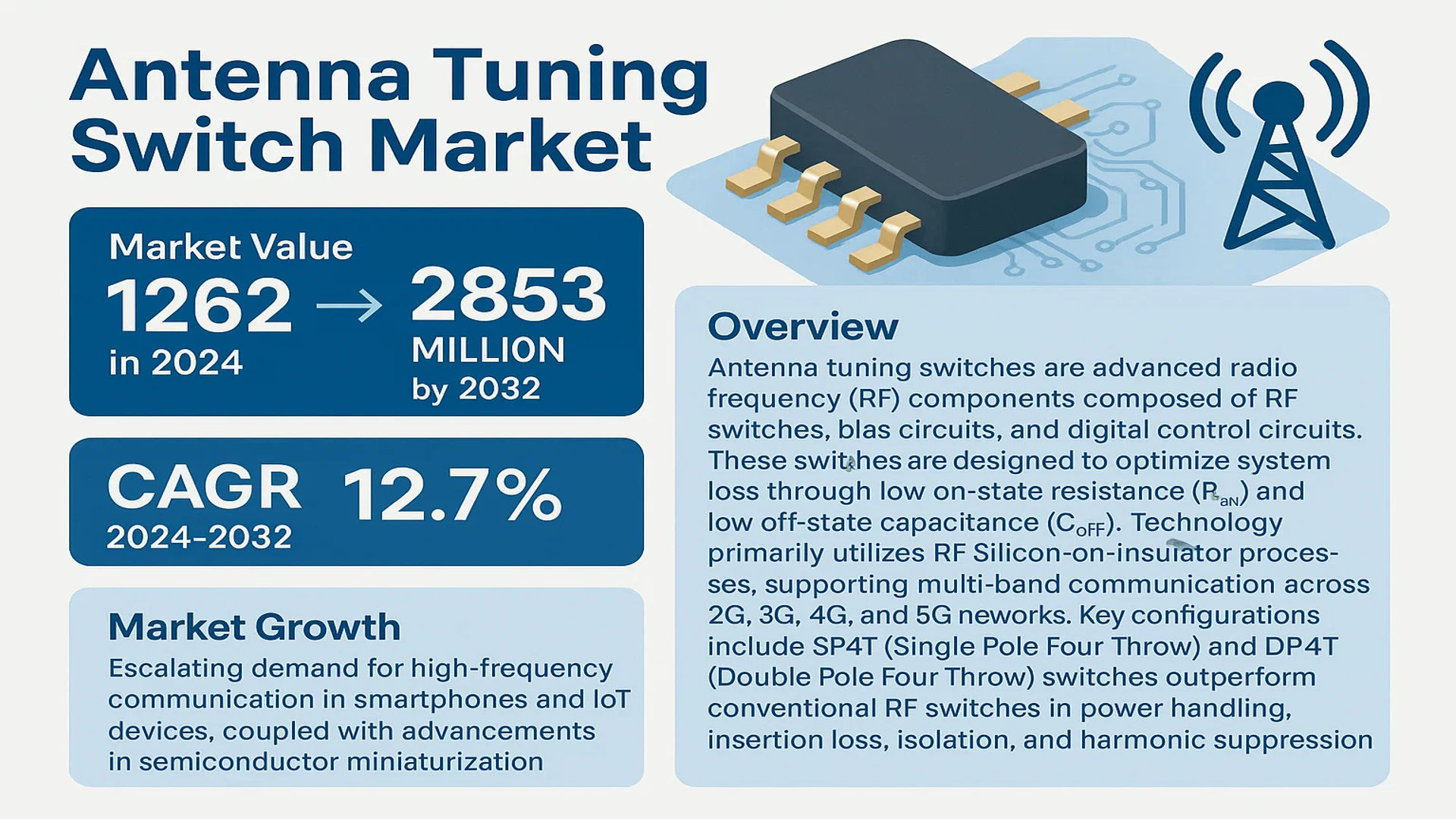
The global Antenna Tuning Switch Market was valued at 1262 million in 2024 and is projected to reach US$ 2853 million by 2032, at a CAGR of 12.7% during the forecast period.
Antenna tuning switches are advanced radio frequency (RF) components composed of RF switches, bias circuits, and digital control circuits. These switches are designed to optimize signal performance by minimizing system loss through low on-state resistance (Ron) and low off-state capacitance (Coff). The technology primarily utilizes RF Silicon-on-Insulator (SOI) processes, supporting multi-band communication across 2G, 3G, 4G, and 5G networks. Key configurations include SP4T (Single Pole Four Throw) and DP4T (Double Pole Four Throw) switches, which outperform conventional RF switches in power handling, insertion loss, isolation, and harmonic suppression.
The market growth is driven by escalating demand for high-frequency communication in smartphones and IoT devices, coupled with advancements in semiconductor miniaturization. Key players such as Qorvo, Skyworks Solutions, and Infineon Technologies dominate the APAC region, which holds a 60% market share. Aperture tuning and impedance tuning segments collectively account for 70% of product demand, while mobile applications remain the primary end-use sector.
MARKET DYNAMICS
MARKET DRIVERS
Proliferation of 5G Networks Accelerating Antenna Tuning Switch Adoption
The global transition to 5G networks is significantly driving demand for advanced antenna tuning switches that can handle higher frequency bands and spectrum flexibility. With 5G requiring complex antenna systems capable of operating across multiple frequency ranges (sub-6GHz and mmWave), the need for efficient impedance matching has intensified. The superior performance characteristics of modern antenna tuning switches – including low insertion loss (typically below 0.5dB) and high isolation (exceeding 30dB) – make them indispensable in 5G-enabled devices. Market projections indicate that 5G smartphones alone will account for over 70% of antenna tuning switch demand by 2026 as network operators expand coverage.
Smartphone Miniaturization Trends Fueling Component Innovation
As smartphone manufacturers continue pushing for thinner form factors without compromising performance, the integration of compact yet efficient RF front-end components becomes critical. Antenna tuning switches enable OEMs to achieve better signal quality in constrained spaces by optimizing antenna performance dynamically. The average number of antenna tuning switches per premium smartphone has increased from 2-3 units in 2018 to 5-6 units in current flagship models. This trend is particularly evident in foldable devices where space optimization is paramount. Major chipset manufacturers are responding by developing even more compact switch solutions with reduced package sizes below 1mm².
Expansion of IoT and Connected Devices Creating New Application Areas
The proliferation of IoT devices across industrial, automotive and consumer sectors presents significant growth opportunities for antenna tuning technology. Smart home devices, wearables and vehicle-to-everything (V2X) communication systems increasingly incorporate antenna tuning switches to maintain reliable connectivity in diverse environments. The automotive sector alone is projected to account for nearly 15% of the antenna tuning switch market by 2028 as vehicle connectivity becomes standard. Emerging applications such as smart city infrastructure and industrial IoT further contribute to the expanding demand landscape for these components.
MARKET CHALLENGES
Complex RF Front-End Integration Posing Design Challenges
While antenna tuning switches offer significant performance benefits, their integration into increasingly complex RF front-end modules presents substantial engineering challenges. Modern smartphones must accommodate numerous radio technologies (5G, Wi-Fi 6E, Bluetooth) while maintaining strict thermal and power budgets. The need to support carrier aggregation across up to 16 bands in some configurations creates signal integrity issues that push current switch technologies to their limits. Design teams frequently face trade-offs between insertion loss, harmonic performance and power handling when implementing tuning switches in space-constrained layouts.
Production Yield and Cost Pressures
Manufacturers face ongoing challenges in maintaining high production yields while meeting the stringent performance requirements of modern antenna tuning switches. The shift to more advanced RF SOI processes with smaller nodes, while improving performance, has introduced new manufacturing variability concerns. Yield improvements of just a few percentage points can significantly impact overall profitability given the high volume nature of the smartphone market. Additionally, ongoing price pressure from OEMs forces component suppliers to continuously optimize production costs without compromising quality.
Standardization and Certification Hurdles
The lack of global standardization in 5G frequency bands creates certification complexities for antenna tuning switch manufacturers. Each regional market has unique spectrum allocations and regulatory requirements that must be accommodated in switch designs. Compliance testing across multiple regulatory domains (FCC, CE, NCC) adds substantial time and cost to the development cycle. Moreover, ongoing spectrum re-farming initiatives by carriers necessitate frequent design updates to maintain compatibility.
MARKET RESTRAINTS
Supply Chain Constraints Hindering Market Expansion
The antenna tuning switch market faces significant constraints from ongoing semiconductor supply chain challenges. While demand continues to grow, manufacturers struggle with lead time fluctuations for specialty substrates and packaging materials. The concentration of RF SOI wafer production capacity among a limited number of foundries creates bottlenecks during periods of high demand. These constraints are particularly acute for advanced node processes required for cutting-edge switch designs, where qualification cycles can extend beyond 12 months.
Maturity of 4G Markets Slowing Upgrade Cycles
In many emerging markets where 4G networks remain predominant, the business case for incorporating advanced antenna tuning solutions is less compelling. The slower-than-anticipated transition from 4G to 5G in price-sensitive regions has delayed adoption of next-generation RF components. OEMs serving these markets often opt for cost-optimized solutions that may use fewer or less sophisticated tuning switches. This creates a bifurcation in the market between premium-tier devices with advanced RF capabilities and value-tier products with more basic implementations.
MARKET OPPORTUNITIES
Emerging mmWave Applications Opening New Frontiers
The gradual rollout of mmWave 5G networks presents significant opportunities for antenna tuning switch innovation. mmWave systems require highly adaptive antenna arrays where tuning switches play a crucial role in beamforming and signal optimization. Early implementations suggest that mmWave-capable devices may incorporate 50% more tuning elements than sub-6GHz designs. The automotive sector represents a particularly promising opportunity, with mmWave radar systems for advanced driver assistance requiring sophisticated tuning capabilities. Development of switches capable of operating at 28GHz and 39GHz with minimal loss will be critical to realizing these opportunities.
Integration With AI-Powered RF Optimization
The integration of machine learning algorithms into RF management systems creates new possibilities for intelligent antenna tuning solutions. Future generations of tuning switches may incorporate embedded sensors and control logic to enable real-time, adaptive impedance matching. Such systems could autonomously optimize performance based on usage scenarios, environmental conditions and user behavior. Several leading chipset vendors are already exploring neural network-assisted tuning algorithms that leverage switch telemetry data to predict and prevent signal degradation.
Expansion Into Non-Traditional Verticals
Beyond consumer electronics, antenna tuning technology is finding applications in sectors such as healthcare, defense and industrial automation. Medical devices incorporating wireless connectivity for remote monitoring represent a growing market for compact, reliable tuning solutions. In defense applications, tunable antenna systems enable multi-band operation across varied terrains and mission profiles. These specialized applications often command premium pricing and improved margins compared to the highly competitive smartphone market.
ANTENNA TUNING SWITCH MARKET TRENDS
5G Network Expansion Driving Demand For Advanced Antenna Tuning Switches
The rapid global rollout of 5G networks is significantly boosting demand for advanced antenna tuning switches, as these components play a critical role in optimizing signal performance across multiple frequency bands. With the Asia-Pacific region leading 5G adoption at 60% market share, manufacturers are developing switches that support high-frequency mmWave applications while maintaining low insertion loss. The transition to 5G requires more sophisticated tuning capabilities in smartphones and IoT devices that operate across diverse spectrum allocations, from sub-6GHz to 28GHz bands. This technological shift has prompted chipmakers to innovate SP4T and DP4T switch configurations that deliver superior isolation characteristics and power handling capacities exceeding 30dBm.
Other Trends
Integration With RF Front-End Modules
A key industry trend involves the increasing integration of antenna tuning switches with complete RF front-end modules (FEMs), reducing component footprint while improving system efficiency. Leading manufacturers now combine tuning switches with power amplifiers, filters, and low-noise amplifiers in compact system-in-package (SiP) designs. This integration trend is particularly evident in flagship smartphones where space constraints demand solutions that combine aperture tuning and impedance matching functions within a single chip. The market has responded with SOI-based switches featuring Ron values below 0.5Ω and Coff under 100fF to minimize signal degradation in crowded RF environments.
Automotive Connectivity Expanding Application Horizons
The automotive sector is emerging as a high-growth market for antenna tuning switches, driven by the need for reliable vehicle-to-everything (V2X) communication systems. Modern vehicles incorporate multiple antenna systems for cellular connectivity, satellite navigation, and emergency services, creating strong demand for switches that maintain performance across temperature extremes from -40°C to 125°C. The development of 5G-enabled telematics and autonomous driving systems has led to new switch designs featuring enhanced ESD protection above 8KV and improved linearity for coexistence with radar frequencies. Tier-1 automotive suppliers increasingly specify switches with AEC-Q100 qualification, particularly for electric vehicles that require robust EMI performance.
COMPETITIVE LANDSCAPE
Key Industry Players
Innovation and Strategic Expansion Drive Market Positioning in Antenna Tuning Switch Segment
The global antenna tuning switch market features a mix of established semiconductor giants and emerging innovators, all competing aggressively in this high-growth segment. Qorvo currently leads the market with an estimated 28% revenue share as of 2024, leveraging its expertise in RF solutions and strong relationships with smartphone manufacturers. Their dominance stems from continuous R&D investments in RF SOI technology and strategic partnerships with 5G infrastructure providers.
Skyworks Solutions follows closely with approximately 22% market share, thanks to its comprehensive portfolio of aperture tuning solutions for mobile applications. The company’s recent acquisition of Silicon Labs’ infrastructure business has significantly strengthened its position in IoT applications. Meanwhile, Infineon Technologies is making rapid gains with its unique GaN-on-Si technology, particularly in automotive and industrial applications where high-voltage tolerance is critical.
Notably, Chinese manufacturers like Maxscend Technologies and Vanchip are capturing increasing market share through cost-competitive solutions tailored for the massive APAC smartphone market. These regional players benefit from localized supply chains and government support for semiconductor independence, allowing them to undercut traditional leaders on price while maintaining acceptable performance metrics.
Industry consolidation is accelerating as smaller players struggle with the capital requirements for RF SOI process development. Recent months have seen multiple strategic partnerships between IDMs and foundries to secure capacity for antenna tuning switch production, particularly for 5G mmWave applications that require specialized manufacturing capabilities.
List of Key Antenna Tuning Switch Companies Profiled
- Qorvo, Inc. (U.S.)
- Skyworks Solutions, Inc. (U.S.)
- Murata Manufacturing Co., Ltd. (Japan)
- Infineon Technologies AG (Germany)
- ON Semiconductor Corporation (U.S.)
- Maxscend Technologies Co., Ltd. (China)
- Shanghai CanaanTek (China)
- Awinic Electronics (China)
- Vanchip (Tianjin) Technology Co., Ltd. (China)
- Tagore Technology (U.S.)
Segment Analysis:
By Type
SP4T and DP4T Segment Dominates Due to Widespread Utilization in 5G and IoT Applications
The market is segmented based on type into:
- Single Pole Four Throw (SP4T)
- Double Pole Four Throw (DP4T)
- Other RF Switch Configurations
By Technology
RF SOI Process Leads the Market Owing to Superior Performance in High-Frequency Applications
The market is segmented based on technology into:
- RF SOI (Silicon-on-Insulator)
- GaAs (Gallium Arsenide)
- CMOS (Complementary Metal-Oxide-Semiconductor)
- Other semiconductor processes
By Application
Smartphone Segment Dominates Drive by Increasing 5G Handset Adoption
The market is segmented based on application into:
- Smartphones
- Tablets and Notebooks
- IoT Devices
- Automotive Communication Systems
- Other Wireless Devices
By Tuning Method
Aperture Tuning Holds Majority Share Due to Enhanced Efficiency in Adaptive Antenna Systems
The market is segmented based on tuning method into:
- Aperture Tuning
- Impedance Tuning
- Matching Network Tuning
- Hybrid Tuning Solutions
Regional Analysis: Antenna Tuning Switch Market
Asia-Pacific
The Asia-Pacific region dominates the global antenna tuning switch market, accounting for 60% of total market share in 2024. This leadership position is driven by the rapid adoption of 5G technology, particularly in China, South Korea, and Japan, along with thriving smartphone manufacturing ecosystems. The region benefits from strong semiconductor fabrication capabilities and the presence of key suppliers like Maxscend Technologies and Shanghai CanaanTek, which provide cost-competitive solutions. Governments actively support IoT infrastructure, creating additional demand for radio frequency (RF) components. However, intense price competition among manufacturers and concerns about IP protection pose challenges to premium product adoption.
North America
North America holds a 30% market share, led by cutting-edge RF innovation from companies such as Qorvo and Skyworks Solutions. The region’s focus on high-performance antenna tuning switches for military communications and automotive radar systems drives demand for specialized, high-reliability components. Regulatory pressures for better spectrum efficiency in 5G networks are accelerating R&D investments. Nevertheless, higher production costs compared to Asian competitors and dependency on offshore manufacturing for cost-sensitive consumer electronics limit broader market expansion. The U.S. remains the largest contributor, with Canada and Mexico experiencing slower but stable growth.
Europe
Europe accounts for 10% of the market, with demand centered on automotive and industrial IoT applications. Strict EU emissions and efficiency regulations push OEMs to adopt advanced RF solutions. Germany’s strong automotive sector and France’s telecom infrastructure upgrades contribute significantly. European manufacturers like Infineon focus on energy-efficient tuning switches for smart city projects and Industry 4.0 applications. Challenges include slower 5G rollout compared to Asia and North America, along with higher component costs due to stringent quality standards. Collaboration between academia and industry helps maintain Europe’s competitive edge in niche applications.
South America
The South American market is nascent but shows steady growth potential, particularly in Brazil and Argentina. Expanding mobile network coverage and increasing smartphone penetration drive demand for mid-range antenna tuning switches. Local manufacturers prioritize cost-effective SP4T-type switches for budget devices, though reliance on imports for advanced components persists. Political instability and currency fluctuations hinder large-scale investments, but partnerships with Chinese suppliers are helping local players address affordability barriers. Adoption in agricultural IoT and smart metering presents new opportunities despite infrastructure limitations.
Middle East & Africa
This region is in early development stages, with growth concentrated in GCC countries and South Africa. Telecom operators investing in 5G base stations and smart city initiatives create demand for high-power tuning switches. Limited local manufacturing capability leads to heavy dependence on imports from Asia and Europe. While low smartphone penetration outside urban areas curtails mass-market potential, partnerships with global players like Murata and Vanchip are gradually expanding distribution networks. Long-term prospects remain positive as digital transformation agendas gain traction across the region.
Report Scope
This market research report provides a comprehensive analysis of the global Antenna Tuning Switch market, covering the forecast period 2024–2032. It offers detailed insights into market dynamics, technological advancements, competitive landscape, and key trends shaping the industry.
Key focus areas of the report include:
- Market Size & Forecast: Historical data and future projections for revenue, unit shipments, and market value across major regions and segments. The market was valued at USD 1,262 million in 2024 and is projected to reach USD 2,853 million by 2032, growing at a CAGR of 12.7%.
- Segmentation Analysis: Detailed breakdown by product type (Aperture Tuning, Impedance Tuning), application (Cell Phone, Computer, Others), and end-user industry to identify high-growth segments and investment opportunities.
- Regional Outlook: Insights into market performance across North America, Europe, Asia-Pacific, Latin America, and the Middle East & Africa. APAC dominates with 60% share, followed by North America (30%) and Europe (10%).
- Competitive Landscape: Profiles of leading market participants including Qorvo, Skyworks, Murata, Infineon, Onsemi, Maxscend Technologies, and others, covering their product portfolios, market strategies, and recent developments.
- Technology Trends & Innovation: Assessment of RF SOI process advancements, high-voltage tuning technology, low-power solutions, and increasing chip integration in antenna tuning switches.
- Market Drivers & Restraints: Evaluation of factors like 5G adoption, IoT expansion, and mobile device proliferation driving growth, along with challenges in semiconductor supply chains and design complexities.
- Stakeholder Analysis: Strategic insights for semiconductor manufacturers, OEMs, component suppliers, and investors regarding the evolving RF components ecosystem.
Primary and secondary research methods are employed, including interviews with industry experts, manufacturer data, and market intelligence to ensure accuracy and reliability of the analysis.
FREQUENTLY ASKED QUESTIONS:
What is the current market size of Global Antenna Tuning Switch Market?
-> Antenna Tuning Switch Market was valued at 1262 million in 2024 and is projected to reach US$ 2853 million by 2032, at a CAGR of 12.7% during the forecast period 2032.
Which key companies operate in Global Antenna Tuning Switch Market?
-> Key players include Qorvo, Skyworks, Murata, Infineon, Onsemi, Maxscend Technologies, Shanghai CanaanTek, Awinic Electronics, Vanchip, and Tagore Technology.
What are the key growth drivers?
-> Key growth drivers include 5G network expansion, increasing smartphone adoption, IoT device proliferation, and demand for high-performance RF components.
Which region dominates the market?
-> Asia-Pacific leads with 60% market share, driven by strong electronics manufacturing in China, South Korea, and Japan.
What are the emerging trends?
-> Emerging trends include RF SOI process advancements, integration with AI-powered antenna systems, and development of ultra-low power tuning solutions for IoT applications.

Get Sample Report PDF for Exclusive Insights
Report Sample Includes
- Table of Contents
- List of Tables & Figures
- Charts, Research Methodology, and more...





