Android TV Set-Top Box Chip Market Insights
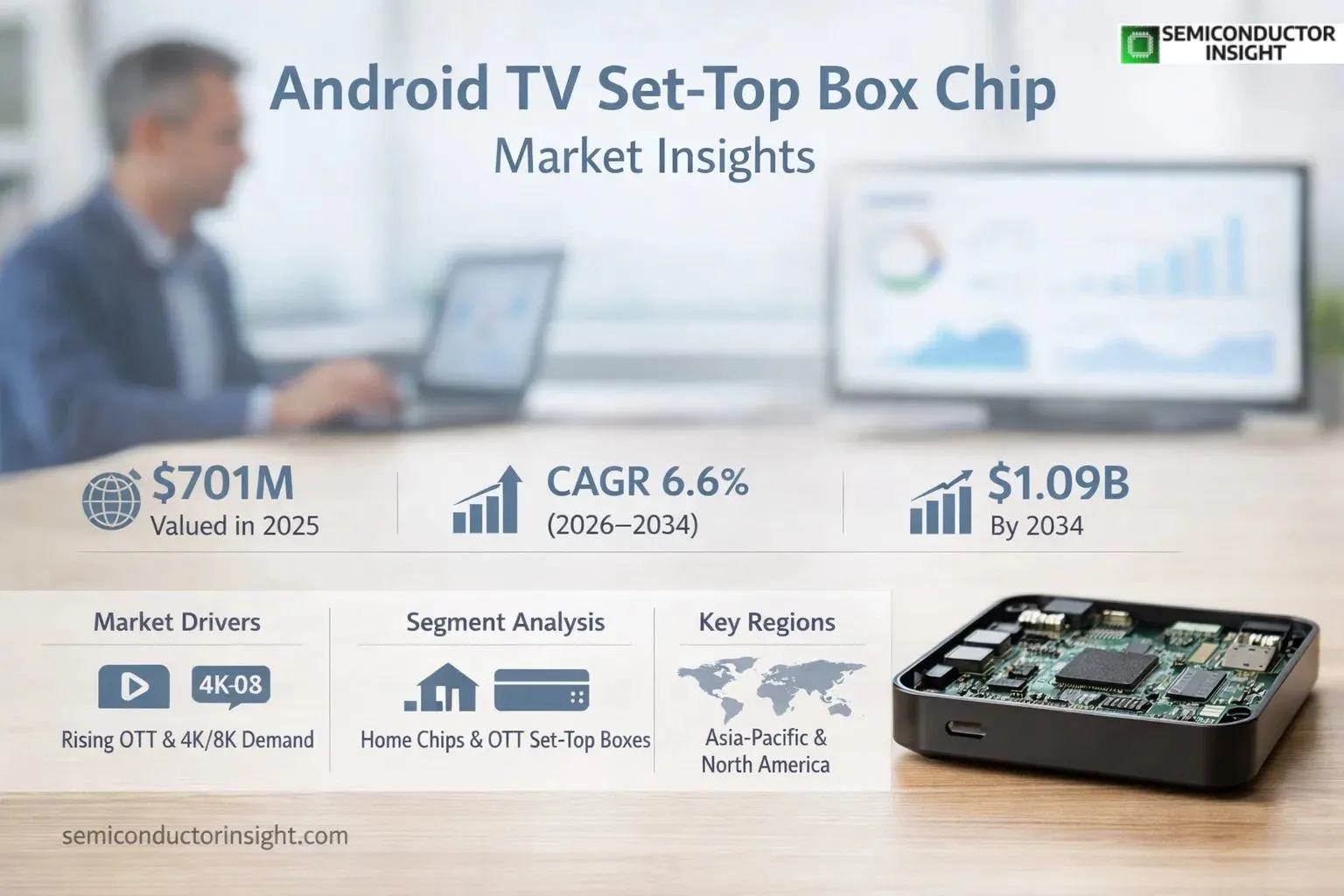
Global Android TV set-top box chip market size was valued at USD 701 million in 2025. The market is projected to grow from USD 735 million in 2026 to USD 1,092 million by 2034, exhibiting a CAGR of 6.6% during the forecast period.
Android TV set-top box chips are integrated circuits designed to power smart television devices, combining multiple functional units such as CPU (central processing unit), GPU (graphics processing unit), memory controllers, and video decoders. These components enable seamless playback of high-definition content, application execution, and user interface responsiveness in modern streaming devices.
The market growth is driven by increasing demand for over-the-top (OTT) content consumption and Global shift towards IPTV services. Technological advancements in chipset architecture have enabled support for higher resolutions including 4K and emerging 8K standards. Key industry players like MediaTek and Broadcom continue to innovate with energy-efficient designs while integrating AI capabilities for enhanced user experiences.
MARKET DRIVERS
Growing Demand for Smart TV Experiences
Global Android TV set-top box chip market is experiencing robust growth due to increasing consumer preference for smart TV functionalities. The shift from traditional cable TV to OTT platforms has created a 35% annual demand surge for Android-based streaming devices. Manufacturers are focusing on integrating advanced chips capable of 4K/8K resolution and AI upscaling.
Advancements in Chipset Technology
Recent developments in Android TV set-top box chip architecture have enabled support for HDR10+, Dolby Vision, and AV1 codecs. Leading manufacturers are adopting 6nm and 7nm fabrication processes, improving energy efficiency by approximately 40% compared to previous generations.
➤ The integration of AI processors in Android TV chips has increased DSP performance by 60%, enabling real-time content recommendation engines.
Emerging markets are witnessing rapid adoption due to declining hardware costs, with entry-level Android TV set-top box chips now priced under $15 for 1080p-capable solutions.
MARKET CHALLENGES
Intense Competition in Chip Design
The Android TV set-top box chip market faces pressure from competing platforms like Roku OS and proprietary solutions. Chip manufacturers must continuously innovate to maintain compatibility with over 5,000 streaming apps while optimizing power consumption.
Other Challenges
Supply Chain Constraints
Global semiconductor shortage has impacted production yields, particularly for high-end Android TV chips supporting 8K resolution. Lead times for certain components have extended to 45 weeks in some regions.
MARKET RESTRAINTS
Fragmentation in Android TV Ecosystem
Device fragmentation remains a significant challenge, with over 30 different chipset variants currently powering Android TV devices globally. This diversity complicates software updates and app optimization, potentially limiting market growth in premium segments.
MARKET OPPORTUNITIES
Emergence of Hybrid Broadcast-Broadband Solutions
The integration of ATSC 3.0 and DVB-I standards in Android TV set-top box chips presents new opportunities. Market projections indicate 65% growth potential for chips combining terrestrial broadcast reception with OTT streaming capabilities by 2025.
Android TV Set-Top Box Chip Market Trends
Shift Towards Higher Processing Power and Energy Efficiency
The Android TV Set-Top Box Chip market is witnessing a strong demand for chips with higher processing capabilities to support 4K/8K streaming and gaming applications. Leading manufacturers like MediaTek and Broadcom are focusing on developing chipsets with advanced GPU architectures and AI acceleration to enhance user experience while maintaining energy efficiency.
Other Trends
Integration of Advanced Connectivity Features
Modern Android TV Set-Top Box Chips are increasingly incorporating Wi-Fi 6 and Bluetooth 5.2 support to enable seamless content streaming and peripheral connectivity. This aligns with the growing consumer demand for wireless solutions in home entertainment systems.
Growing Competition Among Key Market Players
The market sees intense competition between established players like Huawei HiSilicon, Rockchip, and Samsung, with each company investing heavily in R&D to develop differentiated chip solutions. Market share concentration remains high, with the top five manufacturers controlling a significant portion of the Android TV Set-Top Box Chip revenue.
Regional Market Developments
Asia-Pacific continues to dominate the Android TV Set-Top Box Chip market, driven by strong demand from China and Southeast Asia. North America maintains steady growth with increasing adoption of OTT services, while Europe shows particular demand for energy-efficient chip solutions.
Application-Specific Chip Development
Manufacturers are increasingly developing specialized Android TV Set-Top Box Chips for different applications, with distinct solutions emerging for IPTV and OTT set-top box segments. This specialization allows for optimized performance in specific use cases and market requirements.
COMPETITIVE LANDSCAPE
Key Industry Players
Technology Giants and Specialized IC Designers Drive Android TV STB Chip Innovation
Broadcom and MediaTek dominate the Android TV set-top box chip market, leveraging their extensive semiconductor expertise and established relationships with OEMs. The competitive landscape features tight integration between chip manufacturers and major Android TV platform developers, with leading players holding approximately 60% combined market share as of 2025. These companies differentiate through advanced video processing capabilities, energy efficiency improvements, and AI-enhanced features for next-generation streaming experiences.
Specialized IC designers like Amlogic and Rockchip have carved significant niches, focusing on cost-optimized solutions for emerging markets. The market also sees increasing competition from Chinese semiconductor firms such as Huawei HiSilicon and Allwinner Technology, particularly in APAC regions. Smaller innovators are gaining traction with specialized solutions for commercial applications, while established players expand their footprints through strategic partnerships with OTT service providers.
List of Key Android TV Set-Top Box Chip Companies Profiled
- Broadcom Inc.
- MediaTek Inc.
- Amlogic Inc.
- Huawei HiSilicon
- Rockchip Electronics Co., Ltd.
- Allwinner Technology
- Samsung Electronics
- Realtek Semiconductor Corp.
- Sigma Designs (Acquired by Silicon Labs)
- Marvell Technology Group
- STMicroelectronics
- Novatek Microelectronics Corp.
- Amlogic (Shanghai) Co., Ltd.
- Actions Semiconductor
- ZTE Microelectronics
Segment Analysis:
| Segment Category | Sub-Segments | Key Insights |
| By Type |
|
Home Chips dominate residential entertainment systems with their optimized power consumption and cost-effective designs.
|
| By Application |
|
OTT Set-top Box solutions show strongest innovation momentum as streaming services proliferate globally.
|
| By End User |
|
Residential Consumers drive the bulk of demand through retail purchases and service provider bundles.
|
| By Processing Capability |
|
4K/Ultra HD chips represent the current mainstream standard in premium devices.
|
| By Integration Level |
|
System-on-Chip (SoC) designs dominate modern implementations through their space and power efficiency.
|
Regional Analysis: Android TV Set-Top Box Chip Market
Asia-Pacific
China’s Shenzhen region hosts concentrated chip fabrication plants specializing in cost-effective SoCs for Android STBs, creating supply chain efficiencies. Taiwan’s foundries provide advanced 7nm and 12nm process nodes for premium chipsets, positioning APAC as the complete solution hub from design to mass production.
Chipmakers are developing region-specific decoding capabilities for APAC’s diverse video standards including AVS3 in China and ISDB-T in Japan. Specialized neural processors handle real-time translation for regional languages in voice-controlled interfaces, a key differentiator in multilingual markets.
Government mandates for DRM support and content filtering in certain APAC countries have led to customized chip architectures. India’s PLI scheme for electronics manufacturing has attracted global semiconductor firms to establish Android STB chip design centers in Bengaluru and Hyderabad.
Hotels across Southeast Asia are adopting Android STBs with hospitality-optimized chips that enable multi-room synchronization. Education-focused chipsets with enhanced parental controls are gaining traction in family-centric markets like Indonesia and the Philippines.
North America
The North American Android TV set-top box chip market emphasizes premium features with chip manufacturers focusing on AV1 codec support and low-latency gaming capabilities. Major pay-TV operators are transitioning from proprietary systems to Android TV platforms, driving demand for chips with robust conditional access system integration. Silicon Valley startups are innovating in edge AI processing for contextual advertising – a critical revenue stream in the region’s subscription-based market. Canada’s bilingual requirements have spurred development of French-English voice processing chips with enhanced noise cancellation for living room environments.
Europe
European Android STB chip development centers around energy efficiency compliance with strict EU Ecodesign regulations. Manufacturers are integrating advanced power gating techniques that reduce standby consumption below 0.5W. The region sees growing demand for hybrid broadcast-broadband chips that seamlessly unite DVB-T2 terrestrial signals with OTT services. Germany’s automotive industry is creating specialized vehicle-infotainment variants with automotive-grade temperature tolerance and vibration resistance.
South America
Brazil’s ISDB-Tb migration drives Android STB chip demand with manufacturers optimizing for mobile TV reception in floating favela communities. Chipmakers are developing cost-effective solutions that bypass credit card requirements through integration with local cash payment systems. Argentina’s economic conditions have spurred demand for chips supporting legacy analog inputs to extend the lifespan of existing television sets among price-sensitive consumers.
Middle East & Africa
The MEA region shows divergent trends – Gulf states demand premium 8K-ready chips with Arabic voice recognition, while Sub-Saharan Africa focuses on ultra-low-cost solutions for solar-powered TV systems. Egypt’s elimination of satellite dish restrictions has created booming demand for Android STB chips with advanced tuner sensitivity. South African manufacturers are pioneering chipsets that combine Android TV functionality with localized digital radio standards for township markets.
Report Scope
This market research report provides a comprehensive analysis of the Global Android TV Set-Top Box Chip Market , covering the forecast period 2026–2034. It offers detailed insights into market dynamics, technological advancements, competitive landscape, and key trends shaping the industry.
Key focus areas of the report include:
- Market Overview: The report begins with an overview outlining its current market scenario, key growth indicators, and industry transformation drivers. It discusses macroeconomic factors, demand–supply balance, regulatory landscape, and the strategic role of semiconductors in powering advancements across industries such as automotive, telecommunications, consumer electronics, and industrial automation.
- Market Size & Forecast: Historical data and future projections for revenue, unit shipments, and market value across major regions and segments.
- Segmentation Analysis: Detailed breakdown by product type, technology, application, and end-user industry to identify high-growth segments and investment opportunities.
- Regional Insights: Insights into market performance across North America, Europe, Asia-Pacific, Latin America, and the Middle East & Africa, including country-level analysis where relevant.
- Competitive Landscape: Profiles of leading market participants, including their product offerings, R&D focus, manufacturing capacity, pricing strategies, and recent developments such as mergers, acquisitions, and partnerships.
- Technology Trends & Innovation: Assessment of emerging technologies, integration of AI/IoT, semiconductor design trends, fabrication techniques, and evolving industry standards.
- Market Drivers & Restraints: Evaluation of factors driving market growth along with challenges, supply chain constraints, regulatory issues, and market-entry barriers.
- Stakeholder Insights: Insights for component suppliers, OEMs, system integrators, investors, and policymakers regarding the evolving ecosystem and strategic opportunities.
Primary and secondary research methods are employed, including interviews with industry experts, data from verified sources, and real-time market intelligence to ensure the accuracy and reliability of the insights presented.
FREQUENTLY ASKED QUESTIONS:
What is the current market size of Android TV Set-Top Box Chip Market?
-> Global Android TV Set-Top Box Chip Market was valued at USD 701 million in 2025 and is expected to reach USD 1092 million by 2034 with a CAGR of 6.6%.
Which key companies operate in Android TV Set-Top Box Chip Market?
-> Key players include Broadcom, MediaTek, Amlogic, Huawei HiSilicon, Rockchip, Allwinner Technology, and Samsung.
What are the key market segments?
-> The market is segmented by:
- Type: Home Chips and Commercial Chips
- Application: IPTV Set-top Box and OTT Set-top Box
Which region dominates the market?
-> The U.S. market is estimated at $ million in 2025, while China is projected to reach $ million.
What is the growth projection by segment?
-> The Home Chips segment will reach $ million by 2034 with a % CAGR over the next six years.

Get Sample Report PDF for Exclusive Insights
Report Sample Includes
- Table of Contents
- List of Tables & Figures
- Charts, Research Methodology, and more...
 Download Sample Report PDF