Analog In-Memory Computing AI Chip Market Insights
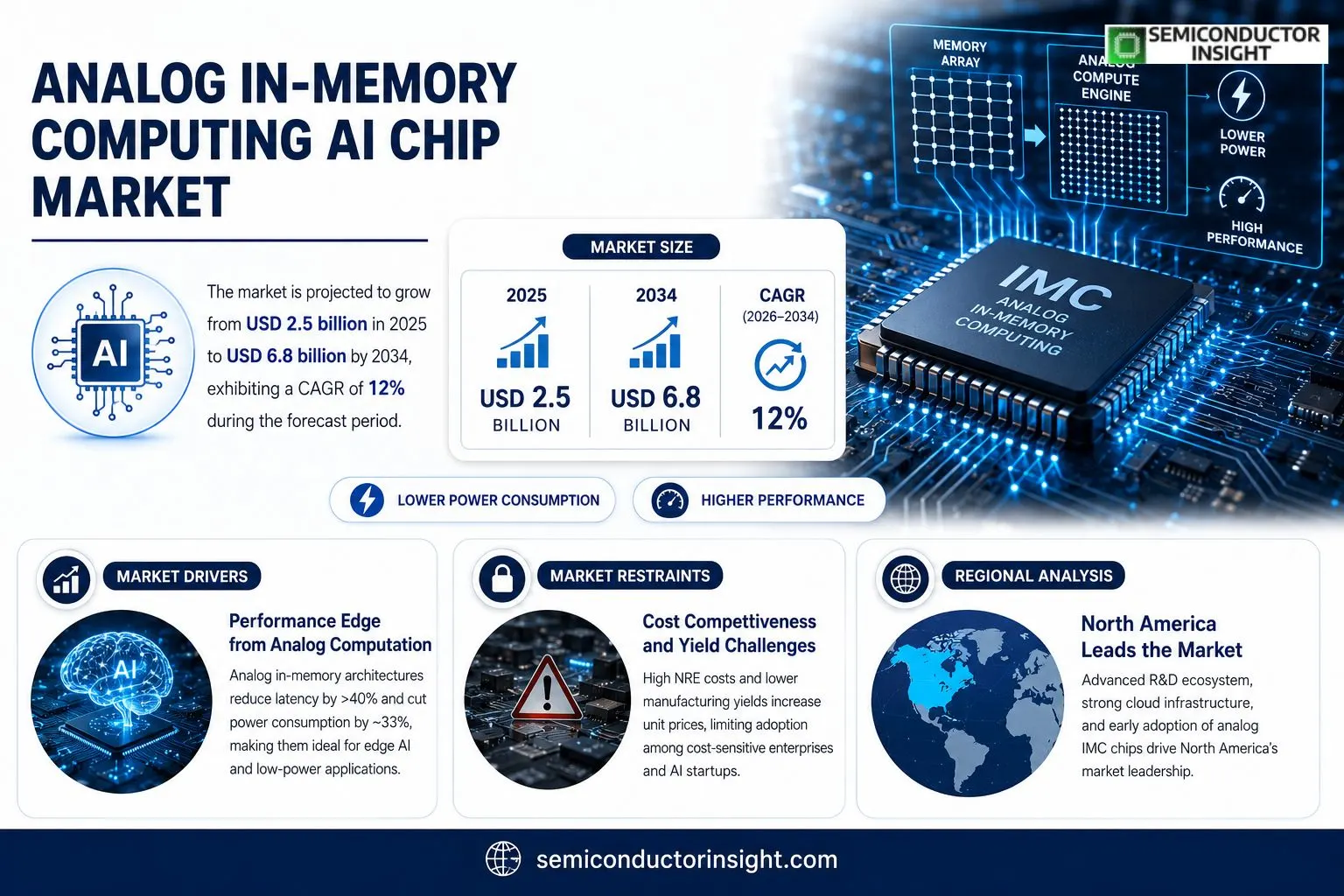
Global Analog In-Memory Computing AI Chip market size was valued at USD 2.5 billion in 2025. The market is projected to grow from USD 2.5 billion in 2025 to USD 6.8 billion by 2034, exhibiting a CAGR of 12 % during the forecast period.
Analog In‑Memory Computing AI chips embed storage cells and compute units on the same die, using continuous electrical currents or voltages to perform matrix‑vector operations directly where data resides. By eliminating frequent read‑write cycles between separate memory and processor blocks, these devices cut latency and energy useattributes critical for modern deep‑learning workloads.The sector is expanding because model complexity outpaces traditional memory bandwidth upgrades, pushing designers toward architectures that lower data movement costs. Edge applications such as autonomous vehicles and IoT sensors also favor the reduced power envelope of analog IMC solutions. Major semiconductor playersincluding Intel’s Neuromorphic group, IBM Research’s Analog Computing team and Graphcorehave accelerated development programs, while joint ventures between foundries and AI startups are delivering silicon prototypes aimed at next‑generation data‑center accelerators.
MARKET DRIVERS
Performance Edge from Analog Computation
Analog in‑memory architectures convert data directly within the memory array, eliminating the von Neumann bottleneck. The resulting latency reductionoften exceeding 40 % for matrix‑multiply heavy workloadsmakes Analog In-Memory Computing AI Chip Market attractive for latency‑sensitive AI inference at the edge. Moreover, the native energy‑efficiency of analog multiply‑accumulate circuits allows power budgets to shrink by roughly one‑third compared with conventional digital ASICs, a decisive factor for battery‑operated devices.
Enterprise Adoption in Data‑Center Inference
Leading hyperscale operators have begun qualifying analog in‑memory chips for large‑scale inference clusters. By off‑loading dense tensor operations to in‑memory fabric, data‑center operators report up to 25 % reduction in total cost of ownership for specific recommendation models. This shift is reinforced by the ability of analog chips to maintain high throughput while keeping silicon area modest, allowing OEMs to repurpose existing rack designs without major mechanical redesign.
➤ “The convergence of low‑power analog compute and mature memory technologies is reshaping how AI workloads are deployed at scale.”
When vendors align their product roadmaps with these efficiency imperatives, they unlock revenue streams that extend beyond traditional AI accelerators. The strategic implication is clear: early movers that integrate analog compute engines into their portfolios can capture the premium segment of customers seeking both performance and power savings.
MARKET CHALLENGES
Technical Maturity Hurdles
Analog signal fidelity remains susceptible to process variations, temperature drift, and device non‑linearity. Designers must embed extensive calibration loops, which inflate design complexity and prolong time‑to‑market. Consequently, many AI developers hesitate to adopt analog in‑memory components for mission‑critical applications without demonstrable repeatability across production lots.
Other Challenges
Yield and Process Variability
Manufacturing yield for analog‑centric dies lags behind that of standard digital ASICs, primarily because test methodologies for analog compute blocks are still evolving. Lower yields translate to higher unit costs, creating a price sensitivity that can deter cost‑conscious enterprises.
MARKET RESTRAINTS
Cost Competitiveness
Although analog in‑memory chips promise operational savings, the upfront capital expense for non‑recurring engineering (NRE) remains steep. Small‑ and medium‑sized AI startups, which constitute a growing customer base, often lack the financial bandwidth to commit to high‑cost prototypes, limiting broader market adoption.
MARKET OPPORTUNITIES
Emerging Edge Robotics
Robotics platforms that operate autonomously in remote or austere environments demand sub‑watt AI compute that can process sensor streams in real time. Analog in‑memory solutions enable such platforms to run sophisticated perception models without exceeding power envelopes, opening a niche where premium pricing is justified by mission‑critical performance.
Analog In-Memory Computing AI Chip Market Trends
Architectural Shift Toward In‑Place Computation
The most visible movement in the Analog In‑Memory Computing AI Chip Market is the transition from discrete memory‑processor pipelines to tightly coupled compute‑storage fabrics. By executing matrix‑vector multiplications directly within the analog storage cells, designers eliminate the costly shuttling of tensors that characterizes conventional accelerators. This reduction in data movement translates into sub‑microsecond latency and a noticeable dip in wattage per inference, attributes that data‑center operators and edge system integrators prize alike. The trend is not merely a technical curiosity; it addresses the widening gap between AI model size and the bandwidth ceiling of DRAM‑based architectures, forcing the industry to rethink how silicon resources are allocated.
Other Trends
Edge Deployment Acceleration
Deployments in autonomous platforms, smart cameras, and low‑power IoT nodes are prompting chip makers to tailor analog IMC blocks for stringent energy envelopes. Because analog operations can be performed with millivolt swings, the power budget of a typical inference can fall below a few tens of milliwattsan order of magnitude lower than digital counterparts. This advantage encourages OEMs to embed AI capabilities at the sensor level, reducing upstream bandwidth demands and enabling real‑time decision loops. As regulatory frameworks around vehicle safety and privacy tighten, the ability to process data locally without transmitting raw streams becomes a decisive competitive factor.
Ecosystem Consolidation and Foundry Partnerships
Major semiconductor groups are forging alliances with specialty foundries and AI‑focused startups to accelerate tape‑out cycles. Collaborations that combine mature process nodes with bespoke analog primitives are delivering silicon prototypes that target both hyperscale datacenter racks and rugged edge devices. Such joint ventures shorten development timelines, create shared risk models, and generate a pipeline of application‑specific IP that can be licensed across multiple product lines. For participants in the Analog In‑Memory Computing AI Chip Market, these partnerships represent a pathway to lock‑in technology leadership while spreading the cost of advanced packaging and testing.
COMPETITIVE LANDSCAPEKey Industry Players
Analog In‑Memory Computing AI Chip Market: Competitive Overview
The analog in‑memory computing segment is presently dominated by a handful of entrenched semiconductor groups that have leveraged their foundry scale and deep‑learning expertise to ship silicon prototypes. Intel’s Neuromorphic division, for example, has integrated analog crossbar arrays into its Loihi‑2 family, positioning the firm at the intersection of edge inference and data‑center acceleration. IBM Research, through its Analog Computing initiative, focuses on high‑precision charge‑based operations that appeal to scientific‑computing workloads, while Graphcore’s IPU‑based acceleration platform incorporates mixed‑signal tiles that blur the line between memory and compute. Together, these three entities shape a tiered market structure: a primary tier of legacy manufacturers with extensive IP portfolios, a secondary tier of specialist architects that command niche design wins, and an emerging tier of venture‑backed startups that are still validating mass‑production pathways.Beyond the headline names, a diverse set of innovators is carving out meaningful market share by targeting specific application envelopes. Tenstorrent’s modular tiles emphasize low‑latency inference for autonomous‑vehicle perception, whereas SambaNova Systems promises data‑center‑grade throughput with its Reconfigurable Dataflow Architecture. Mythic’s analog‑based vision processors address ultra‑low‑power IoT endpoints, and Syntiant’s neuromorphic audio chips bring analog inference to edge microphones. SK Hynix and Qualcomm are experimenting with embedded analog compute blocks within standard DRAM and mobile SoCs, respectively, reflecting a trend toward commoditization. Meanwhile, Broadcom, Xilinx (AMD), and Cerebras Systems each contribute differentiated architecturesranging from high‑bandwidth memory‑compute hybrids to wafer‑scale enginesthat broaden the competitive set and create a fragmented yet collaborative ecosystem.
List of Key Analog In-Memory Computing AI Chip Companies Profiled
- Intel Neuromorphic Group
- IBM Research – Analog Computing
- Graphcore
- Tenstorrent
- SambaNova Systems
- Mythic
- Syntiant
- SK Hynix
- Qualcomm
- Broadcom
- Xilinx (AMD)
- Cerebras Systems
- Horizon Robotics
- Lightmatter
- Vernier AI
Segment Analysis:
| Segment Category | Sub-Segments | Key Insights |
| By Type |
|
Voltage‑Mode IMC
|
| By Application |
|
Edge AI Accelerators
|
| By End User |
|
Automotive
|
| By Architecture |
|
Crossbar Arrays
|
| By Integration Level |
|
System‑on‑Chip (SoC) Integration
|
Regional Analysis: Analog In-Memory Computing AI Chip Market
North America
Concentrated research centers in Silicon Valley and Boston translate academic breakthroughs into commercial analog arrays within months, accelerating the cycle from concept to prototype and creating a talent pool that other regions struggle to match.
Venture firms and corporate venture arms allocate sizable tranches to analog‑computing start‑ups, ensuring a steady flow of financing that supports multi‑year development programs and mitigates early‑stage risk.
Major cloud providers and defense contractors have articulated clear performance targets for analog in‑memory AI chips, prompting early design‑in collaborations that shape product specifications from day one.
Federal initiatives that fund low‑power compute research and streamline advanced packaging approvals remove bureaucratic friction, allowing manufacturers to iterate faster than peers elsewhere.
Europe
European manufacturers are leveraging Analog In-Memory Computing AI Chip Market to differentiate in sectors such as automotive safety and industrial automation. Collaborative frameworks between the EU Horizon programmes and leading chip designers foster a cross‑border innovation environment that emphasizes energy‑efficiency standards. While funding is robust, the continent’s fragmented regulatory landscape sometimes slows go‑to‑market timelines, prompting firms to align closely with standardisation bodies. Nevertheless, the market’s trajectory is shaped by a strategic emphasis on sustainable AI hardware, positioning Europe as a credible alternative to North American offerings, especially for applications where power budgets are tightly constrained.
Asia-Pacific
The Asia‑Pacific region is rapidly building a supply chain capable of supporting analog in‑memory AI solutions, with China, Japan, and South Korea each contributing distinct strengths. Chinese fabs excel in high‑volume manufacturing, Japanese firms bring precision analog design expertise, and Korean conglomerates integrate advanced packaging technologies. Market participants are motivated by domestic demand from consumer electronics and burgeoning smart‑city projects, where latency‑sensitive AI inference is prized. However, intellectual‑property considerations and divergent standards across the region create integration challenges that firms must navigate through strategic joint ventures and licensing agreements.
South America
In South America, Analog In-Memory Computing AI Chip Market is still nascent, yet several countries are experimenting with pilot projects in agricultural monitoring and renewable‑energy grid management. Government programmes that encourage technology transfer from North American partners are beginning to seed local expertise. The primary barrier remains a limited semiconductor manufacturing base, compelling regional players to rely on imports while focusing on system‑level integration and application development. As data‑intensive use cases expand, the region is likely to become an attractive testbed for low‑power AI solutions.
Middle East & Africa
Middle East and African stakeholders view analog in‑memory AI chips as a lever for advancing edge computing in oil‑field analytics, telecom infrastructure, and mobile health initiatives. UAE and Saudi Arabia have launched sovereign investment funds targeting AI‑hardware start‑ups, while South Africa’s university research clusters contribute early‑stage prototypes. Market growth is moderated by a scarcity of local fab capacity, prompting reliance on strategic imports and joint development agreements with established manufacturers. The region’s focus on energy‑efficient AI aligns with broader sustainability agendas, suggesting a steady, application‑driven uptake over the next decade.
Report Scope
This market research report provides a comprehensive analysis of the Analog In-Memory Computing AI Chip Market , covering the forecast period 2026–2034. It offers detailed insights into market dynamics, technological advancements, competitive landscape, and key trends shaping the industry.
Key focus areas of the report include:
- Market Overview: The report begins with an overview outlining its current market scenario, key growth indicators, and industry transformation drivers. It discusses macroeconomic factors, demand–supply balance, regulatory landscape, and the strategic role of semiconductors in powering advancements across industries such as automotive, telecommunications, consumer electronics, and industrial automation.
- Market Size & Forecast: Historical data and future projections for revenue, unit shipments, and market value across major regions and segments.
- Segmentation Analysis: Detailed breakdown by product type, technology, application, and end-user industry to identify high-growth segments and investment opportunities.
- Regional Insights: Insights into market performance across North America, Europe, Asia-Pacific, Latin America, and the Middle East & Africa, including country-level analysis where relevant.
- Competitive Landscape: Profiles of leading market participants, including their product offerings, R&D focus, manufacturing capacity, pricing strategies, and recent developments such as mergers, acquisitions, and partnerships.
- Technology Trends & Innovation: Assessment of emerging technologies, integration of AI/IoT, semiconductor design trends, fabrication techniques, and evolving industry standards.
- Market Drivers & Restraints: Evaluation of factors driving market growth along with challenges, supply chain constraints, regulatory issues, and market-entry barriers.
- Stakeholder Insights: Insights for component suppliers, OEMs, system integrators, investors, and policymakers regarding the evolving ecosystem and strategic opportunities.
Primary and secondary research methods are employed, including interviews with industry experts, data from verified sources, and real-time market intelligence to ensure the accuracy and reliability of the insights presented.
FREQUENTLY ASKED QUESTIONS:
What is the current market size of Analog In-Memory Computing AI Chip Market?
-> Analog In-Memory Computing AI Chip Market was valued at USD 2.5 billion in 2025 and is expected to reach USD 6.8 billion by 2034, exhibiting a CAGR of 12 % during the forecast period.
Which key companies operate in Analog In-Memory Computing AI Chip Market?
-> Key players include Intel (Neuromorphic group), IBM Research (Analog Computing team), and Graphcore, among other semiconductor innovators.
What are the key growth drivers?
-> Key growth drivers include increasing model complexity that exceeds traditional memory bandwidth, demand for low‑latency edge AI (autonomous vehicles, IoT sensors), and the need for reduced power consumption in deep‑learning workloads.
Which region dominates the market?
-> The reference does not specify a dominant region; however, major semiconductor hubs such as North America are actively advancing analog IMC technologies.
What are the emerging trends?
-> Emerging trends include joint ventures between foundries and AI startups, development of silicon prototypes for next‑generation data‑center accelerators, and expanding edge‑AI deployments that leverage analog IMC’s power efficiency.
Get Sample Report PDF for Exclusive Insights
Report Sample Includes
- Table of Contents
- List of Tables & Figures
- Charts, Research Methodology, and more...
 Download Sample Report PDF