Analog IC Wafer Foundry Market Insights
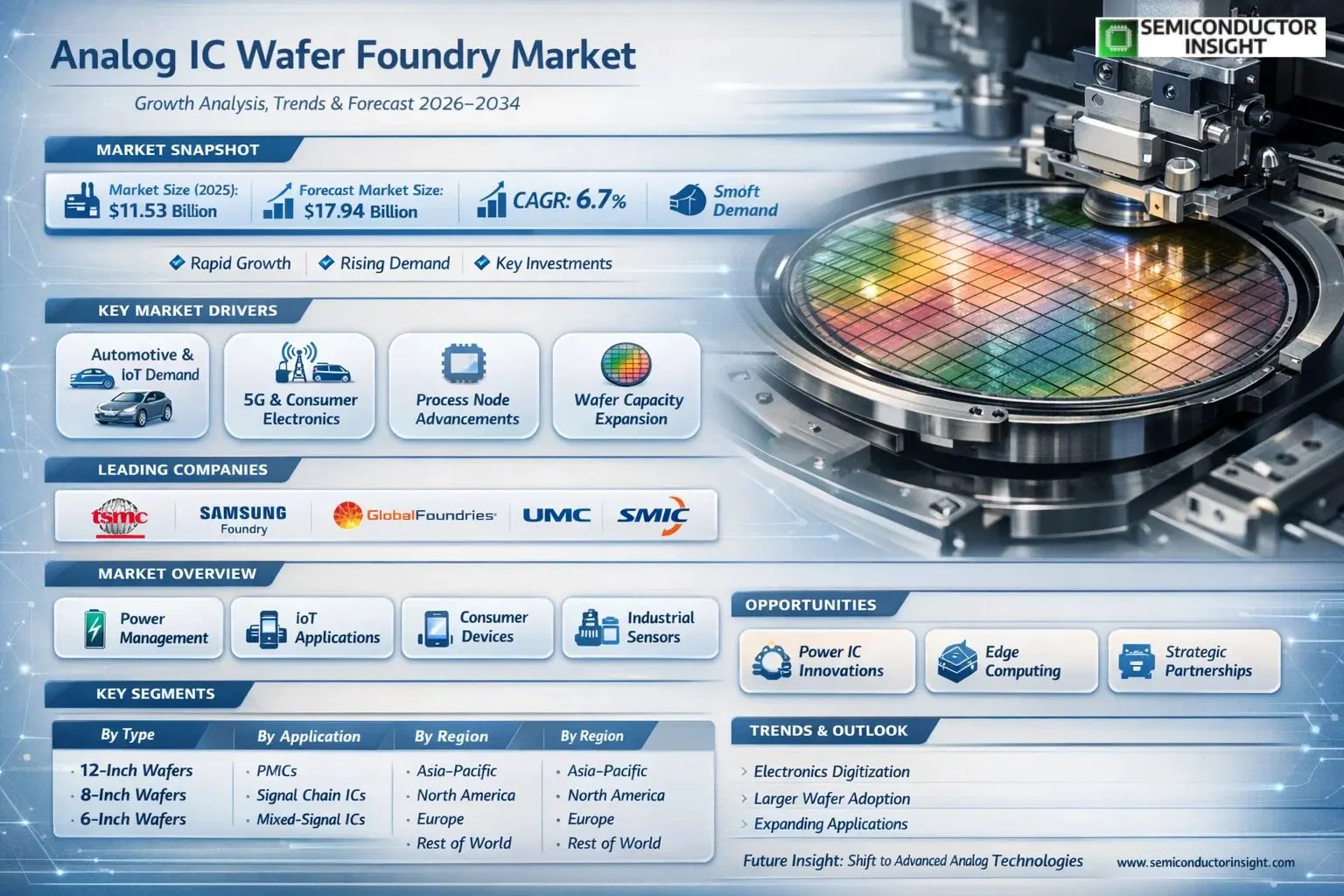
Global Analog IC Wafer Foundry market size was valued at USD 11,530 million in 2025. The market is projected to reach USD 17,940 million by 2034, exhibiting a CAGR of 6.7% during the forecast period.
Analog IC wafer foundries manufacture semiconductor wafers specialized for analog integrated circuits. These circuits process real-world signals, such as sound, temperature, pressure, or images, by conditioning, amplifying, and converting them into digital data streams for further processing by digital semiconductors like embedded processors. Furthermore, analog ICs manage power across electronic devices through energy conversion, distribution, storage, discharge, isolation, and measurement, supporting both plugged-in and battery-powered systems. With accelerating electronics digitization, demand intensifies for analog chips to enable device power delivery and seamless interfaces with humans, the physical environment, and other electronics.
The market is experiencing robust growth due to surging demand for analog semiconductors in automotive electrification, 5G infrastructure, IoT proliferation, and consumer devices. Additionally, advancements in mature process nodes optimized for analog performance, alongside capacity expansions in 8-inch and 12-inch wafers, drive further expansion. Initiatives by key players fuel this momentum as they invest in specialized foundry services. For instance, leading firms continue enhancing analog-specific technologies to address power efficiency needs. TSMC, Samsung Foundry, GlobalFoundries, United Microelectronics Corporation (UMC), SMIC, Tower Semiconductor, PSMC, VIS (Vanguard International Semiconductor), Hua Hong Semiconductor, and HLMC are prominent players offering diverse portfolios in this space.
MARKET DRIVERS
Rising Demand from Automotive and IoT Sectors
Analog IC Wafer Foundry Market is propelled by increasing adoption in electric vehicles and advanced driver-assistance systems, where analog components handle power management and sensor interfacing. Global EV production reached over 10 million units in 2023, driving foundry capacity expansions for specialized analog processes.
5G and Consumer Electronics Growth
Deployment of 5G infrastructure and proliferation of smartphones, wearables, and smart home devices necessitate high-performance analog ICs for RF amplification and signal conditioning. The market benefits from foundries optimizing wafer fabrication for mixed-signal technologies, supporting a projected 8% annual growth through 2028.
➤ Key foundry investments in 130nm to 28nm nodes are enhancing yield rates by 15-20% for analog IC production.
Furthermore, industrial automation trends amplify demand for robust analog solutions in sensors and actuators, positioning Analog IC Wafer Foundry Market for sustained expansion amid digital transformation.
MARKET CHALLENGES
Supply Chain Vulnerabilities
Geopolitical tensions and raw material shortages, particularly for specialty chemicals and substrates, disrupt Analog IC Wafer Foundry Market operations. Foundry utilization rates dipped below 80% in key regions during 2022-2023 supply crunches, delaying customer deliveries.
Other Challenges
Talent and Technology Gaps
Skilled engineers for analog design and process optimization remain scarce, with training programs lagging behind digital IC expertise. This hampers innovation in advanced nodes critical for Analog IC Wafer Foundry Market.
Competition from integrated device manufacturers offering in-house foundry services intensifies pricing pressures, forcing pure-play foundries to invest heavily in differentiation strategies.
MARKET RESTRAINTS
High Capital Expenditures
Establishing and maintaining cleanroom facilities for Analog IC Wafer Foundry Market demands investments exceeding $10 billion for leading-edge fabs, deterring new entrants and constraining capacity growth amid cyclical demand.
Regulatory compliance for environmental standards and export controls on semiconductor equipment further escalates costs, with compliance expenses rising 12% annually in major foundry hubs.
Maturity of legacy processes limits scalability, as shifting to sub-28nm nodes for analog ICs faces yield challenges, slowing market penetration in high-volume applications.
MARKET OPPORTUNITIES
Advancements in Power Management ICs
Analog IC Wafer Foundry Market stands to gain from surging needs in renewable energy and data centers for efficient power analog ICs, with global shipments forecasted to increase 10% yearly to 2029.
Edge computing and AI accelerators require integrated analog front-ends, opening avenues for foundries to develop custom processes that blend precision and low power consumption.
Strategic partnerships with fabless designers in medical and aerospace sectors promise diversified revenue, as analog IC demand in these areas grows at 9% CAGR, bolstering foundry backlogs.
Analog IC Wafer Foundry Market Trends
Growing Demand Driven by Electronics Digitization
Analog IC wafer foundries play a critical role in transforming real-world signals such as sound, temperature, pressure, and images into processed digital data for embedded processors. As electronics continue to digitize across industries, the need for analog semiconductors intensifies to provide essential interfaces with the physical world and other devices. These foundries specialize in conditioning, amplifying, and converting signals, ensuring seamless operation in diverse applications. Power management remains a cornerstone, where analog ICs handle energy conversion, distribution, storage, and measurement in both battery-powered and plugged-in equipment. This trend underscores Analog IC Wafer Foundry Market’s alignment with broader technological advancements, fostering reliable performance in consumer electronics, automotive systems, and industrial controls.
Other Trends
Shift Toward Larger Wafer Technologies
Foundries are increasingly focusing on 12-inch and 8-inch wafer technologies to enhance production efficiency and meet rising volumes. The 12-inch segment leads due to its scalability for high-volume manufacturing, enabling cost reductions and higher yields in analog IC production. Meanwhile, 8-inch and 6-inch wafers continue to serve specialized needs where mature processes offer advantages in reliability and customization. This progression reflects strategic investments by manufacturers to optimize capacity for complex analog designs, supporting Analog IC Wafer Foundry Market’s evolution amid supply chain demands.
Expansion in Key Application Segments
Power Management ICs (PMIC) and Analog Signal Chain ICs dominate applications, with PMICs driving efficiency in power distribution for portable devices and electric vehicles. Analog Signal Chain ICs excel in precision signal processing for sensors and interfaces, fueling growth in IoT and telecommunications. Leading players like TSMC, Samsung Foundry, GlobalFoundries, UMC, and SMIC hold significant shares, innovating through process technologies tailored to these segments. Regional dynamics highlight Asia’s prominence, particularly China and Taiwan, alongside North America and Europe, shaping a competitive landscape focused on technological differentiation and capacity expansion in Analog IC Wafer Foundry Market.
COMPETITIVE LANDSCAPE
Key Industry Players
Dominating the Analog IC Wafer Foundry Sector
Analog IC Wafer Foundry Market is led by a few dominant pure-play foundries, with TSMC holding the largest share due to its advanced process technologies and extensive capacity in 12-inch wafers tailored for analog semiconductors. Samsung Foundry and GlobalFoundries follow closely, leveraging specialized analog nodes that support power management ICs (PMICs) and signal chain applications. United Microelectronics Corporation (UMC) and SMIC complete the top tier, collectively capturing a substantial portion of global revenue in 2025. This oligopolistic structure is driven by high barriers to entry, including massive capital investments in fabrication facilities and expertise in mixed-signal processes essential for converting real-world signals into digital data.
Beyond the leaders, niche players like Tower Semiconductor and PSMC excel in customized analog processes, particularly for 8-inch and 6-inch wafers serving automotive and industrial segments. VIS (Vanguard International Semiconductor), Hua Hong Semiconductor, and HLMC provide cost-effective solutions in Asia, focusing on mature nodes for power distribution and isolation. Emerging competitors such as X-FAB and DB HiTek specialize in high-voltage analog foundry services, while Intel Foundry Services (IFS) expands into external manufacturing. These mid-tier firms enhance market diversity, addressing specific demands in battery-powered devices and interfaces amid growing digitization trends.
List of Key Analog IC Wafer Foundry Companies Profiled
- TSMC
- Samsung Foundry
- GlobalFoundries
- United Microelectronics Corporation (UMC)
- SMIC
- Tower Semiconductor
- PSMC
- VIS (Vanguard International Semiconductor)
- Hua Hong Semiconductor
- HLMC
- X-FAB
- DB HiTek
- Nexchip
- Intel Foundry Services (IFS)
- Polar Semiconductor, LLC
Segment Analysis:
| Segment Category | Sub-Segments | Key Insights |
| By Type |
|
12-inch Analog Wafer Foundry
|
| By Application |
|
Power Management ICs (PMIC)
|
| By End User |
|
Automotive
|
| By Process Node |
|
Mainstream Nodes (90-180nm)
|
| By Voltage Class |
|
Medium Voltage (10-40V)
|
Regional Analysis: Analog IC Wafer Foundry Market
Advanced nodes and specialized analog processes thrive in Asia-Pacific, enabling superior yield rates for complex wafers. Proximity to assembly sites reduces lead times, appealing to OEMs in automotive and power management sectors.
R&D centers in Taiwan and China drive breakthroughs in analog IC wafer fabrication, focusing on low-power and high-performance designs. Collaborations with universities foster next-gen technologies.
Integrated ecosystems minimize disruptions, supporting just-in-time delivery for Analog IC Wafer Foundry Market demands in consumer devices and IoT applications.
Ongoing fab investments enhance scalability, positioning the region to capture growing shares in automotive electrification and industrial automation.
North America
North America plays a vital role in Analog IC Wafer Foundry Market, emphasizing specialty processes for defense, aerospace, and medical devices. Key players leverage mature expertise in radiation-hardened and high-reliability analog wafers. Strong IP protection and proximity to leading design firms spur innovation in precision analog solutions. Investments in domestic manufacturing address supply chain vulnerabilities, focusing on automotive and power electronics. Collaborative initiatives with government support enhance capabilities in advanced packaging, ensuring competitiveness amid global shifts.
Europe
Europe’s Analog IC Wafer Foundry Market excels in niche high-voltage and power management applications, particularly for automotive and renewable energy sectors. Specialized foundries prioritize sustainability and quality standards, integrating green fabrication practices. Robust regulatory frameworks drive excellence in mixed-signal technologies. Partnerships across the value chain support customization for industrial controls and sensors, fostering steady growth and resilience against market fluctuations.
South America
South America emerges as a developing player in Analog IC Wafer Foundry Market, with focus on cost-effective production for consumer electronics and agriculture tech. Local incentives attract partnerships, building foundational capabilities in basic analog processes. Infrastructure improvements enable gradual scaling, targeting regional demands in power supplies and IoT devices while learning from global leaders to bridge technology gaps.
Middle East & Africa
The Middle East & Africa region in Analog IC Wafer Foundry Market centers on energy and telecommunications applications, leveraging oil-funded investments for fab developments. Emphasis on ruggedized analog ICs for harsh environments supports diversification efforts. Emerging collaborations with international foundries transfer knowledge, positioning the area for expansion in smart grid and wireless infrastructure projects.
Report Scope
This market research report provides a comprehensive analysis of the Analog IC Wafer Foundry Market , covering the forecast period 2026–2034. It offers detailed insights into market dynamics, technological advancements, competitive landscape, and key trends shaping the industry.
Key focus areas of the report include:
- Market Overview: The report begins with an overview outlining its current market scenario, key growth indicators, and industry transformation drivers. It discusses macroeconomic factors, demand–supply balance, regulatory landscape, and the strategic role of semiconductors in powering advancements across industries such as automotive, telecommunications, consumer electronics, and industrial automation.
- Market Size & Forecast: Historical data and future projections for revenue, unit shipments, and market value across major regions and segments.
- Segmentation Analysis: Detailed breakdown by product type, technology, application, and end-user industry to identify high-growth segments and investment opportunities.
- Regional Insights: Insights into market performance across North America, Europe, Asia-Pacific, Latin America, and the Middle East & Africa, including country-level analysis where relevant.
- Competitive Landscape: Profiles of leading market participants, including their product offerings, R&D focus, manufacturing capacity, pricing strategies, and recent developments such as mergers, acquisitions, and partnerships.
- Technology Trends & Innovation: Assessment of emerging technologies, integration of AI/IoT, semiconductor design trends, fabrication techniques, and evolving industry standards.
- Market Drivers & Restraints: Evaluation of factors driving market growth along with challenges, supply chain constraints, regulatory issues, and market-entry barriers.
- Stakeholder Insights: Insights for component suppliers, OEMs, system integrators, investors, and policymakers regarding the evolving ecosystem and strategic opportunities.
Primary and secondary research methods are employed, including interviews with industry experts, data from verified sources, and real-time market intelligence to ensure the accuracy and reliability of the insights presented.
FREQUENTLY ASKED QUESTIONS:
What is the current market size of Analog IC Wafer Foundry Market?
-> Analog IC Wafer Foundry Market was valued at USD 11,530 million in 2025 and is expected to reach USD 17,940 million by 2034, at a CAGR of 6.7% during the forecast period.
Which key companies operate in Analog IC Wafer Foundry Market?
-> Key players include TSMC, Samsung Foundry, GlobalFoundries, United Microelectronics Corporation (UMC), SMIC, Tower Semiconductor, among others.
What are the key growth drivers?
-> Key growth drivers include digitization of electronics, growing need for analog chips in power management, and interfaces with real-world signals.
Which region dominates the market?
-> Asia is the fastest-growing region, while North America remains a dominant market.
What are the emerging trends?
-> Emerging trends include 12-inch wafer technology adoption, power management ICs (PMIC), and analog signal chain ICs.

Get Sample Report PDF for Exclusive Insights
Report Sample Includes
- Table of Contents
- List of Tables & Figures
- Charts, Research Methodology, and more...
 Download Sample Report PDF