Analog beamforming IC for Ku-band satellite communication Market Insights
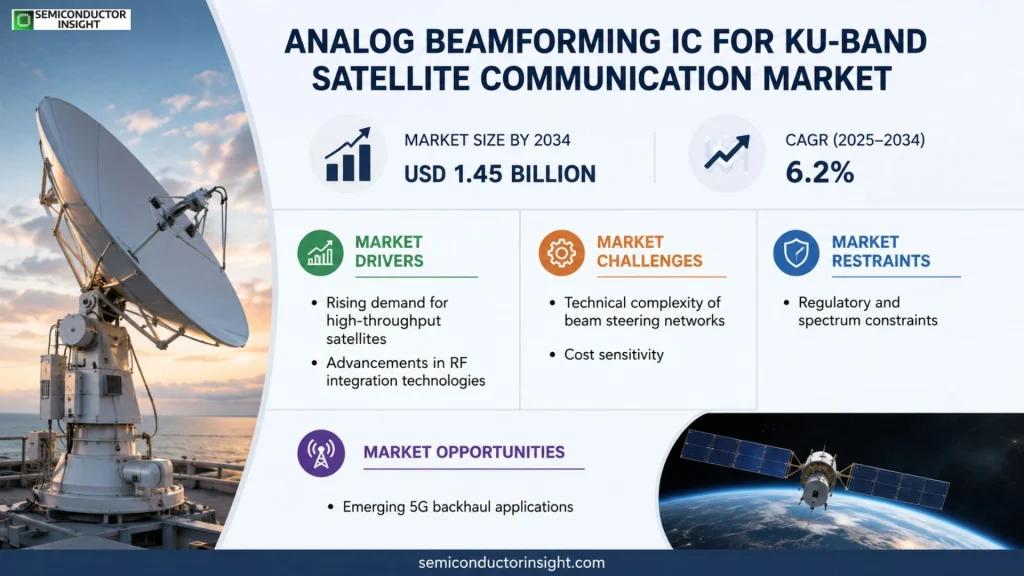
Global Analog beamforming IC for Ku-band satellite communication market size was valued at USD 0.85 billion in 2025. The market is projected to grow from USD 0.90 billion in 2026 to USD 1.45 billion by 2034, exhibiting a CAGR of 6.2% during the forecast period.
Analog beamforming integrated circuits enable phase‑shifted signal distribution across antenna arrays without digital conversion, delivering low‑latency steering of Ku‑band beams for satellite links.
These devices integrate RF front‑end components such as phase shifters, power amplifiers and variable gain amplifiers on a single silicon substrate, providing compact solutions essential for modern high‑throughput satellites.
The market is experiencing rapid growth because telecom operators are expanding broadband services via Ka/Ku‑band constellations, while aerospace manufacturers seek lighter weight RF subsystems.
Furthermore, rising demand for maritime and aeronautical connectivity drives adoption of cost‑effective analog beamformers.
MARKET DRIVERS
Rising Demand for High‑Throughput Satellites
Analog beamforming IC for Ku-band satellite communication Market is being propelled by the rapid deployment of high‑throughput satellites (HTS) that require precise, low‑loss beam steering to maximize capacity. Service providers are targeting data‑intensive applications such as broadband internet and remote sensing, driving a forecasted CAGR of around 12% through 2030.
Advancements in RF Integration Technologies
Recent progress in silicon‑germanium (SiGe) and CMOS processes enables the integration of analog beamforming functions with minimal power consumption, making these ICs more attractive for satellite payloads where weight and thermal budgets are critical. Manufacturers are leveraging these technologies to offer higher integration density, reducing bill‑of‑materials costs.
➤ “Analog beamforming solutions that combine low‑power operation with high linearity are becoming the preferred choice for next‑generation Ku‑band platforms,”
The convergence of cost‑effective manufacturing and increasing demand for reliable Ku‑band links in maritime and aviation sectors further strengthens the market outlook, reinforcing confidence among investors and OEMs.
MARKET CHALLENGES
Technical Complexity of Beam Steering Networks
Designing analog beamforming ICs that maintain phase accuracy across wide temperature ranges remains a significant hurdle. The need for precise calibration in space environments adds engineering overhead, potentially extending development cycles for new satellite platforms.
Other Challenges
Cost Sensitivity
While integration reduces component count, the high‑precision analog circuitry still commands premium pricing. Budget‑constrained operators may opt for digital alternatives despite higher power penalties, limiting market penetration for analog solutions.
MARKET RESTRAINTS
Regulatory and Spectrum Constraints
Stringent spectrum allocation rules for the Ku‑band, coupled with varying national licensing regimes, create compliance challenges for manufacturers. Navigating these regulatory landscapes can delay product launches and increase certification costs.
MARKET OPPORTUNITIES
Emerging 5G Backhaul Applications
The rollout of 5G networks is driving demand for robust satellite backhaul solutions in remote regions. Analog beamforming ICs, with their low latency and power efficiency, are well‑positioned to support dense 5G fronthaul architectures that rely on Ku‑band connectivity, opening new revenue streams for component manufacturers.
Analog beamforming IC for Ku-band satellite communication Market Trends
Rising Adoption of Analog Beamforming for High‑Throughput Satellites
Analog beamforming IC for Ku-band satellite communication Market is experiencing a pronounced shift as broadband operators deploy larger constellations to meet growing data demand. By consolidating phase‑shift networks, power amplifiers and variable gain stages onto a single silicon substrate, these ICs eliminate the need for bulky digital converters while preserving sub‑microsecond steering latency. This architecture aligns with the industry’s emphasis on reduced mass and power consumption, two critical parameters for launch‑vehicle cost optimization. Suppliers are increasingly integrating adaptive biasing circuits that respond to temperature and radiation fluctuations, improving the reliability of Ku‑band links in the harsh space environment. In addition, strategic collaborations between semiconductor firms and satellite manufacturers are accelerating the introduction of new product families that support wider beamwidths and finer granularity in coverage, thereby enhancing service flexibility for end‑users across remote regions.
Other Trends
Lightweight RF Subsystems
Aerospace designers are prioritizing weight reduction, and analog beamforming ICs respond directly to this requirement by merging multiple RF front‑end components into a monolithic die. The resulting system‑in‑package typically achieves a 20‑30 % decrease in overall mass compared with conventional waveguide‑based assemblies, translating into lower launch expenses and higher payload capacity. Moreover, the integrated approach simplifies assembly, reduces part count, and diminishes the likelihood of inter‑connect failures, which collectively improve mean‑time‑between‑failures metrics for satellite payloads. Production processes leveraging silicon‑germanium and advanced CMOS technologies also enable tighter tolerances, supporting consistent phase‑shift accuracy across large antenna arrays.
Maritime and Aeronautical Connectivity Growth
Demand for robust Ku‑band connectivity aboard vessels and aircraft is intensifying as operators seek to offer uninterrupted high‑speed internet to passengers and crew. Analog beamformers provide the low‑latency, high‑gain performance required for dynamic platform motion, while their compact footprint allows integration into constrained avionics bays and shipboard communication modules. Regulatory trends favoring spectrum harmonization in the Ku‑band further incentivize operators to adopt analog solutions that can be rapidly re‑configured to meet evolving allocation policies. As a result, service contracts in these verticals are projected to represent a sizable portion of overall market revenue, reinforcing the strategic relevance of analog beamforming ICs in the next generation of mobile satellite services.
COMPETITIVE LANDSCAPE
Key Industry Players
Analog Beamforming ICs in the Ku‑Band Satellite Communication Market – Competitive Overview
Ku‑band analog beamforming IC market is anchored by a handful of large‑scale semiconductor firms that command the majority of revenue and technology leadership. Skyworks Solutions, Qorvo, Analog Devices, and Texas Instruments dominate the high‑performance segment by delivering integrated phase‑shifter arrays, power amplification, and variable‑gain blocks on silicon‑germanium or CMOS platforms. These leaders benefit from deep R&D pipelines, strategic alliances with satellite OEMs, and broad automotive and aerospace customer bases. Their product portfolios are characterized by high linearity, low insertion loss, and extensive qualification for space‑grade operation, which reinforces a consolidated market structure where the top four capture roughly 60 % of total sales.
Beyond the core quartet, a diverse set of niche players contributes specialized expertise and regional market reach. NXP Semiconductors and STMicroelectronics focus on mixed‑signal solutions for maritime and aeronautical connectivity, while Infineon Technologies and Murata Manufacturing offer compact RF front‑end modules optimized for weight‑critical payloads. MACOM Technology, RFMD (now part of Analog Devices), and Broadcom provide high‑frequency GaAs/SiGe beamforming chips targeting emerging high‑throughput satellite constellations. Additional contributors such as Lattice Semiconductor and Qorvo’s subsidiary RFMD‑GaN add differentiated silicon‑germanium and GaN technologies that address specific power‑efficiency niches, enriching the competitive fabric of Analog beamforming ecosystem.
List of Key Analog Beamforming IC for Ku‑Band Satellite Communication Companies Profiled
- Skyworks Solutions
- Qorvo
- Analog Devices
- Texas Instruments
- NXP Semiconductors
- Infineon Technologies
- STMicroelectronics
- Murata Manufacturing
- MACOM Technology Solutions
- Broadcom (formerly Avago)
- Lattice Semiconductor
- Qorvo RFMD‑GaN
- RFMD (now part of Analog Devices)
- Hittite (acquired by Analog Devices)
- SiGe Solutions Inc.
Segment Analysis:
| Segment Category | Sub-Segments | Key Insights |
| By Type |
|
Phase‑Shifter Based is widely preferred because it delivers fine‑grained beam steering while preserving low latency.
|
| By Application |
|
Satellite Broadband drives the most intense demand for analog beamforming ICs.
|
| By End User |
|
Telecom Operators are the primary catalyst for adoption.
|
| By Architecture |
|
MMIC architecture dominates due to its inherent high‑frequency performance and robustness.
|
| By Integration Level |
|
Integrated RF Front‑End Module is gaining traction as system designers look to consolidate functionality.
|
Regional Analysis: Analog beamforming IC for Ku-band satellite communication Market
Strong governmental support for broadband expansion, combined with rising data traffic in remote areas, fuels demand for efficient analog beamforming ICs that can handle high‑throughput Ku‑band links.
Clear spectrum allocation by the FCC and coordinated international standards provide a stable framework, encouraging manufacturers to invest in high‑performance Ku‑band components.
Rapid integration of silicon‑based beamforming ICs into satellite payloads reduces cost and weight, accelerating adoption across commercial constellations and defence platforms.
Leading semiconductor firms are forging strategic alliances with satellite operators, fostering a competitive ecosystem that drives continual innovation in analog beamforming technologies.
Europe
Europe remains a pivotal region, driven by the European Space Agency’s initiatives and the growing rollout of Ku‑band services for broadband connectivity in rural territories. Countries such as Germany and France host major semiconductor design centers that focus on low‑power analog beamforming solutions. Collaborative research programs emphasize integration of AI‑assisted beam steering to enhance link reliability. While regulatory frameworks are harmonized across the EU, emerging standards for spectrum sharing introduce both opportunities and challenges for market participants, prompting a shift toward more adaptable IC architectures.
Asia‑Pacific
The Asia‑Pacific market exhibits strong momentum as satellite operators in Japan, South Korea, and India expand Ku‑band constellations to meet soaring broadband demand. Regional manufacturers are investing heavily in advanced analog processes, targeting cost‑effective mass production. Government‑backed satellite programs, especially in India’s National Satellite Initiative, drive the need for high‑efficiency beamforming ICs that can support large antenna arrays. Despite varied regulatory regimes, the region’s rapid adoption of low‑Earth‑orbit (LEO) platforms creates a fertile environment for innovative analog designs tailored to diverse climatic conditions.
South America
South America’s growth prospects are anchored in efforts to bridge the digital divide across remote Andes and Amazon regions. Nations such as Brazil and Chile are deploying Ku‑band satellite links to provide broadband access to underserved communities. Local telecom providers are collaborating with global chip manufacturers to integrate analog beamforming ICs that can tolerate harsh environmental factors while delivering reliable high‑throughput connectivity. Policy incentives encouraging satellite infrastructure investment are gradually shaping a more attractive market landscape for analog component suppliers.
Middle East & Africa
In the Middle East & Africa, the demand for resilient Ku‑band satellite communication is driven by expansive oil‑gas operations and remote education initiatives. The United Arab Emirates and Saudi Arabia are spearheading large‑scale satellite projects that require sophisticated analog beamforming ICs for high‑capacity links. African nations are increasingly turning to satellite solutions to overcome terrestrial network limitations, prompting a rise in demand for cost‑effective, rugged ICs. While regulatory environments differ widely, regional cooperation on spectrum management is fostering a more predictable market for analog beamforming technologies.
Report Scope
This market research report provides a comprehensive analysis of the Analog beamforming IC for Ku-band satellite communication Market , covering the forecast period 2026–2034. It offers detailed insights into market dynamics, technological advancements, competitive landscape, and key trends shaping the industry.
Key focus areas of the report include:
- Market Overview: The report begins with an overview outlining its current market scenario, key growth indicators, and industry transformation drivers. It discusses macroeconomic factors, demand–supply balance, regulatory landscape, and the strategic role of semiconductors in powering advancements across industries such as automotive, telecommunications, consumer electronics, and industrial automation.
- Market Size & Forecast: Historical data and future projections for revenue, unit shipments, and market value across major regions and segments.
- Segmentation Analysis: Detailed breakdown by product type, technology, application, and end-user industry to identify high-growth segments and investment opportunities.
- Regional Insights: Insights into market performance across North America, Europe, Asia-Pacific, Latin America, and the Middle East & Africa, including country-level analysis where relevant.
- Competitive Landscape: Profiles of leading market participants, including their product offerings, R&D focus, manufacturing capacity, pricing strategies, and recent developments such as mergers, acquisitions, and partnerships.
- Technology Trends & Innovation: Assessment of emerging technologies, integration of AI/IoT, semiconductor design trends, fabrication techniques, and evolving industry standards.
- Market Drivers & Restraints: Evaluation of factors driving market growth along with challenges, supply chain constraints, regulatory issues, and market-entry barriers.
- Stakeholder Insights: Insights for component suppliers, OEMs, system integrators, investors, and policymakers regarding the evolving ecosystem and strategic opportunities.
Primary and secondary research methods are employed, including interviews with industry experts, data from verified sources, and real-time market intelligence to ensure the accuracy and reliability of the insights presented.
FREQUENTLY ASKED QUESTIONS:
What is the current market size of Analog beamforming IC for Ku-band satellite communication Market?
-> Analog beamforming IC for Ku-band satellite communication market size is projected to grow from USD 0.90 billion in 2026 to USD 1.45 billion by 2034.
Which key companies operate in Analog beamforming IC for Ku-band satellite communication Market?
-> Key players include Skyworks Solutions, Qorvo, Analog Devices, and Texas Instruments, among others.
What are the key growth drivers?
-> Key growth drivers include expansion of broadband services via Ka/Ku‑band constellations, demand for lighter‑weight RF subsystems by aerospace manufacturers, and rising maritime and aeronautical connectivity requirements.
Which region dominates the market?
-> The market is globally distributed with no single region explicitly dominating according to the available data.
What are the emerging trends?
-> Emerging trends include integration of phase shifters, power amplifiers and variable gain amplifiers onto a single silicon substrate, enabling compact, low‑latency analog beamforming solutions for high‑throughput satellites.

Get Sample Report PDF for Exclusive Insights
Report Sample Includes
- Table of Contents
- List of Tables & Figures
- Charts, Research Methodology, and more...