Aluminium hybrid polymer capacitor for 400V DC link Market Insights
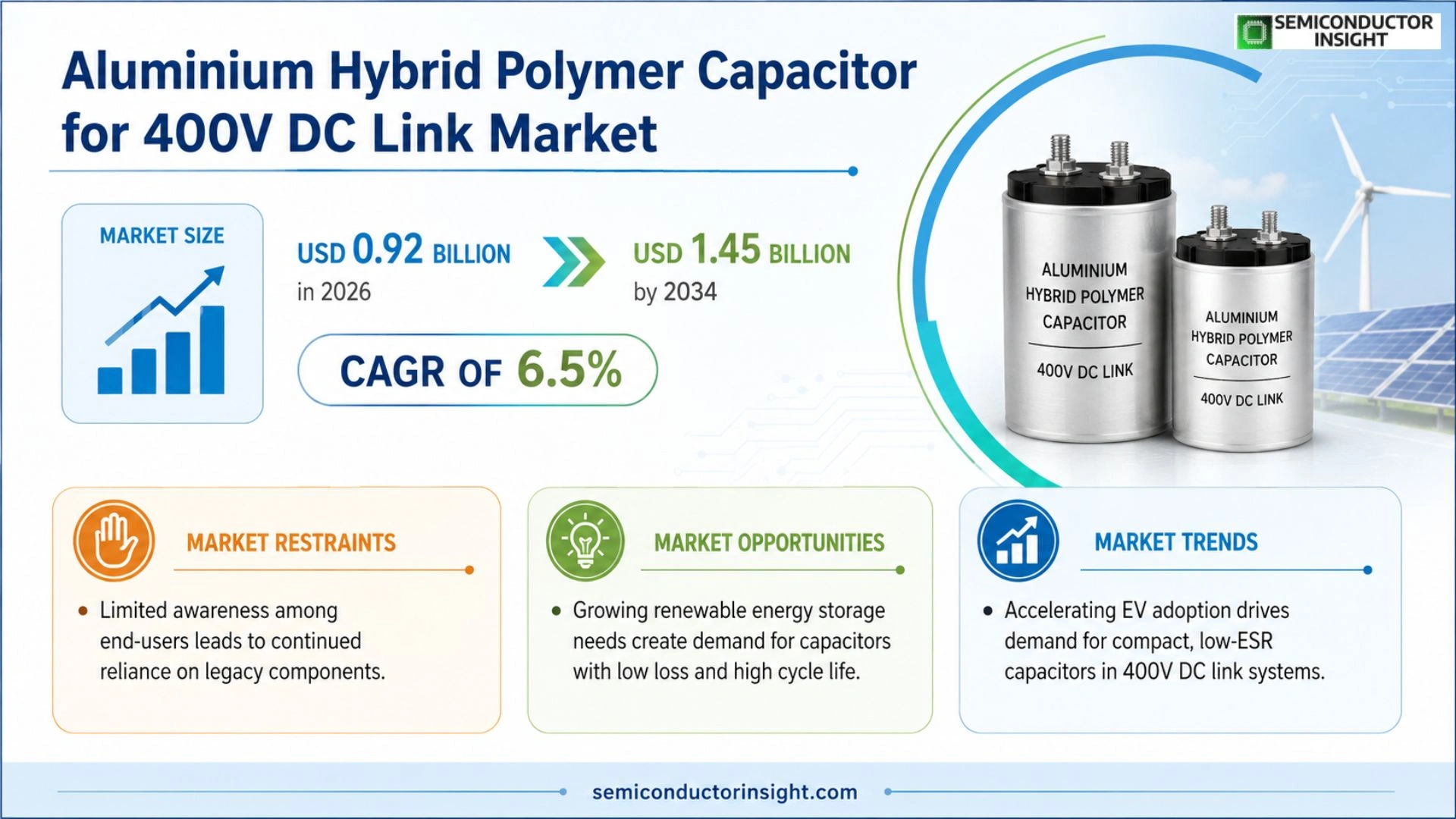
Global Aluminium hybrid polymer capacitor for 400V DC link market size was valued at USD 0.85 billion in 2025. The market is projected to grow from USD 0.92 billion in 2026 to USD 1.45 billion by 2034, exhibiting a CAGR of 6.5% during the forecast period.
Aluminium hybrid polymer capacitors combine an aluminium electrolytic base with a solid‑state polymer electrolyte, delivering low ESR and high ripple‑current capability while maintaining a voltage rating of up to 400 V DC. This architecture enables compact energy‑storage solutions ideal for automotive traction inverters, renewable‑energy converters and industrial motor drives.
The market is experiencing rapid growth because electric‑vehicle adoption accelerates and grid‑scale renewable projects demand reliable high‑voltage DC links. Furthermore, advancements in polymer chemistry reduce loss and improve lifetime, making these capacitors attractive over traditional electrolytics.
MARKET DRIVERS
Growing Adoption of High‑Efficiency Power Electronics
The rise of electric vehicles, renewable‑energy inverters and data‑center power supplies is accelerating demand for compact, low‑loss energy storage components. Aluminium hybrid polymer capacitor for 400V DC link Market benefits from this trend because the technology offers a superior ripple‑current capability and a longer lifespan compared with traditional electrolytic capacitors.
Regulatory Push for Energy‑Saving Standards
Stringent efficiency standards such as IEC 61800‑9‑1 and EU eco‑design directives require manufacturers to minimise losses in DC‑link applications. The hybrid polymer architecture enables lower ESR and higher temperature tolerance, directly supporting compliance and creating a clear market pull.
➤ Industry analysts forecast a compound annual growth rate of around 9% for Aluminium hybrid polymer capacitor segment, driven primarily by automotive electrification.
In parallel, supply‑chain resilience improvements and the scaling of aluminium foil production are reducing unit costs, making the technology financially attractive for OEMs seeking to optimise total‑cost‑of‑ownership.
MARKET CHALLENGES
Technical Integration Complexity
Designers must balance the capacitor’s voltage rating, ESR and physical footprint within constrained power‑module layouts. Mis‑matching the capacitor to motor‑drive topologies can lead to premature failure, which discourages some manufacturers from rapid adoption.
Other Challenges
Cost Competitiveness
While the hybrid polymer design offers performance gains, its price remains higher than conventional electrolytic alternatives. Vendors need to demonstrate clear ROI through reduced maintenance and longer service intervals.
MARKET RESTRAINTS
Limited Awareness Among End‑Users
Many system integrators are still unfamiliar with the benefits of aluminium hybrid polymer technology, leading to reliance on legacy components. This knowledge gap slows market penetration despite clear technical advantages.
MARKET OPPORTUNITIES
Expansion into Renewable Energy Storage
As solar‑and‑wind farms adopt higher‑voltage DC links, the need for capacitors that can handle frequent charge‑discharge cycles grows. Aluminium hybrid polymer capacitor’s low loss profile positions it as a prime candidate for these applications, opening new revenue streams for manufacturers.
Aluminium hybrid polymer capacitor for 400V DC link Market Trends
Accelerating Electric‑Vehicle Adoption
Aluminium hybrid polymer capacitor for 400V DC link Market is being reshaped by the accelerating shift toward electrified transportation. OEMs are integrating higher‑power inverters that require compact, low‑ESR energy storage, and the 400 V DC link architecture aligns with the voltage envelope of modern traction systems. As manufacturers streamline vehicle platforms, the demand for reliable high‑voltage capacitors that can sustain rapid charge‑discharge cycles has risen sharply. This trend is reinforced by stricter efficiency standards and the need to reduce overall system weight, prompting suppliers to prioritize aluminium‑based hybrid designs over conventional electrolytic options. Manufacturers are also collaborating with automotive Tier‑1 suppliers to develop standardised module formats that ease system integration.
Other Trends
Technological Advancements in Polymer Electrolytes
The polymer electrolyte layer has seen measurable improvements in conductivity and thermal stability. Recent formulations incorporate nanostructured additives that lower loss tangent by roughly 15 % while extending operational lifetime beyond 10 years under typical automotive thermal profiles. These advances enable designers to lower the number of series‑connected units, which translates into smaller printed‑circuit‑board footprints and reduced cooling requirements. In renewable‑energy converters, the enhanced ripple‑current capability supports smoother power conversion from photovoltaic strings or wind turbine generators, decreasing harmonic distortion and improving grid‑code compliance. Consequently, system integrators are favoring aluminium hybrid polymer capacitors for a broader range of DC‑link applications. Field trials in heavy‑duty trucks have confirmed a 12 % reduction in total harmonic distortion compared with legacy parts.
Expanding Renewable‑Energy Grid‑Link Deployments
The broader rollout of utility‑scale solar and wind farms is creating a parallel surge in high‑voltage DC link projects. Grid operators are deploying modular multilevel converters that rely on robust energy‑storage components to manage intermittency and support voltage regulation. Aluminium hybrid polymer capacitors meet these requirements by delivering high ripple current tolerance with minimal inductive losses, making them well suited for both standby and active power‑conditioning functions. As policy incentives encourage renewable integration, the cumulative effect is a steady uptick in procurement volumes across Aluminium hybrid polymer capacitor for 400V DC link Market, reinforcing its strategic importance in the evolving energy landscape. In addition, the reduced footprint contributes to lower installation costs for substations and offshore platforms.
COMPETITIVE LANDSCAPE
Key Industry Players
Aluminium Hybrid Polymer Capacitor for 400V DC Link – Competitive Overview
Panasonic Corporation remains the market anchor for aluminium hybrid polymer capacitors in the 400 V DC link segment. Leveraging its extensive aluminium electrolytic heritage and recent polymer‑electrolyte R&D, Panasonic has introduced the ECH400 series, which targets automotive traction‑inverter applications and high‑power renewable‑energy converters. The company’s vertically integrated supply chain, combined with manufacturing plants in Japan, China and Europe, enables it to meet the rising demand for compact, low‑ESR modules while maintaining cost competitiveness. Market structure is characterised by an oligopolistic core where Panasonic, Vishay and KEMET together account for roughly 55 % of global shipments, each operating large‑scale fabs and offering multiple voltage‑rated families. Their product road‑maps focus on incremental ESR reductions, extended lifetime at 105 °C, and compliance with IEC 61851‑2, positioning them as primary suppliers for OEMs seeking certified 400 V DC link solutions.
Beyond the dominant trio, several niche players have carved out specialized positions. Vishay Intertechnology’s HYPER‑CAP line differentiates through ultra‑low ripple current performance, catering to high‑frequency motor‑drive modules. KEMET’s PP400 series emphasizes automotive‑grade reliability, with a 200 khr lifetime guarantee. AVX Corporation targets the renewable‑energy market, offering thin‑profile modules that integrate easily into grid‑scale inverter boards. Rubycon Corporation leverages its polymer‑film expertise to deliver high‑temperature variants, while Tai‑Yen (Taiyo Yuden) focuses on compact footprint designs for electric‑bus chargers. Nichicon and EPCOS (TDK) provide customized capacitance options for industrial motor drives. Murata Manufacturing and Samsung Electro‑Mechanics are expanding their polymer‑based portfolios to serve emerging 400 V DC link applications in fast‑charging infrastructure. Collectively, these companies enhance competition by addressing specific performance niches, driving incremental innovation and price pressure across the segment.
List of Key Aluminium Hybrid Polymer Capacitor for 400V DC Link Companies Profiled
- Panasonic Corporation
- Vishay Intertechnology
- KEMET Corporation
- AVX Corporation
- Rubycon Corporation
- Taiyo Yuden Co., Ltd.
- Nichicon Corporation
- EPCOS (TDK)
- Murata Manufacturing Co., Ltd.
- Samsung Electro‑Mechanics
- Yageo Corporation
- Panasonic Energy Co., Ltd.
Segment Analysis:
| Segment Category | Sub-Segments | Key Insights |
| By Type |
|
Aluminium‑Electrolytic Hybrid delivers a robust combination of low equivalent series resistance with the proven reliability of aluminium foil, making it the preferred choice for high‑stress automotive inverters. – Provides a balanced trade‑off between cost and performance, encouraging adoption in volume‑produced EV platforms. – Enables longer operational lifetimes under high ripple‑current conditions, reducing field maintenance. – Supports compact module designs that meet the stringent packaging constraints of modern power‑electronic architectures. |
| By Application |
|
Automotive Traction Inverters dominate the application landscape because the hybrid polymer architecture meets the demanding power density and thermal management needs of electric drivetrains. – The low ESR characteristic improves inverter efficiency, directly supporting extended vehicle range. – High ripple‑current capability aligns with the fast switching speeds of silicon‑carbide and gallium‑nitride devices. – Compact footprint simplifies integration within constrained battery‑pack under‑body spaces. |
| By End User |
|
Electric Vehicle Manufacturers prioritize reliability and weight savings, making hybrid polymer capacitors a strategic component in next‑generation EV platforms. – Aligns with aggressive efficiency targets set by OEMs for power‑train modules. – Offers a stable performance envelope across diverse climate conditions, supporting global market expansion. – Facilitates modular design approaches that accelerate platform diversification. |
| By Voltage Tier |
|
Mid‑Voltage (300‑350 V) is emerging as the sweet spot for many traction applications, balancing voltage headroom and component cost. – Enables designers to select lower‑rated devices without compromising safety margins. – Supports incremental improvements in inverter topology that reduce overall system weight. – Encourages broader adoption across medium‑power EV segments, such as city‑grid vehicles. |
| By Technology Trend |
|
Advanced Polymer Formulations are driving the next wave of performance gains, reducing dielectric loss and extending operational life. – New cross‑linked polymer matrices improve thermal stability under high‑frequency stress. – Compatibility with emerging wide‑bandgap semiconductor devices enhances overall power‑conversion efficiency. – Supports the development of fully integrated hybrid modules that combine electrolytic and polymer layers for seamless power‑train architecture. |
Regional Analysis: Aluminium hybrid polymer capacitor for 400V DC link Market
Strong demand for electric vehicles, coupled with stringent emissions regulations, pushes manufacturers toward high‑performance capacitors that can handle rapid charge‑discharge cycles in 400V DC link architectures.
EU directives on energy efficiency and safety create a favorable environment, encouraging adoption of aluminium hybrid polymer capacitor technology across automotive and renewable‑energy sectors.
Ongoing research on polymer electrolytes and aluminium foil processing enhances capacitance and lifespan, making the technology increasingly attractive for high‑power DC link systems.
A cluster of European firms, supported by strategic partnerships with battery manufacturers, dominate design innovation and set performance standards in the market.
North America
North America is experiencing steady uptake of aluminium hybrid polymer capacitors as electric‑vehicle manufacturers focus on extending range and improving power‑train efficiency. The region’s strong venture‑capital environment fuels startups that specialize in polymer‑based energy storage, while legacy automotive firms invest in redesigning DC link architectures. Regulatory pressure from federal emissions standards further incentivizes the shift toward lightweight, high‑reliability capacitors, positioning the market for continued growth over the next decade.
Asia‑Pacific
Asia‑Pacific represents the fastest‑growing demand base, driven by large‑scale EV roll‑outs in China, India and Southeast Asia. Manufacturers are capitalising on lower production costs and rising consumer acceptance of electric mobility. Government incentives, such as subsidies and tax breaks for clean‑energy vehicles, accelerate the deployment of 400V DC link systems that rely on aluminium hybrid polymer capacitor technology, fostering a dynamic ecosystem of suppliers and end‑users.
South America
In South America, market momentum is emerging as countries adopt renewable‑energy projects and modernise their automotive fleets. Brazil and Chile lead initiatives to incorporate advanced capacitors into grid‑integration hardware and electric‑bus networks. Although infrastructure challenges remain, policy commitments to carbon‑reduction targets create a favorable outlook for aluminium hybrid polymer capacitor adoption in the coming years.
Middle East & Africa
The Middle East & Africa region shows early signs of interest, primarily in high‑temperature‑tolerant capacitor designs for solar‑farm inverter applications and emerging EV markets. Strategic partnerships with European technology providers enable knowledge transfer, while regional investment funds support pilot projects that showcase the benefits of aluminium hybrid polymer capacitors in harsh climatic conditions.
Report Scope
This market research report provides a comprehensive analysis of the Aluminium hybrid polymer capacitor for 400V DC link Market , covering the forecast period 2026–2034. It offers detailed insights into market dynamics, technological advancements, competitive landscape, and key trends shaping the industry.
Key focus areas of the report include:
- Market Overview: The report begins with an overview outlining its current market scenario, key growth indicators, and industry transformation drivers. It discusses macroeconomic factors, demand–supply balance, regulatory landscape, and the strategic role of semiconductors in powering advancements across industries such as automotive, telecommunications, consumer electronics, and industrial automation.
- Market Size & Forecast: Historical data and future projections for revenue, unit shipments, and market value across major regions and segments.
- Segmentation Analysis: Detailed breakdown by product type, technology, application, and end-user industry to identify high-growth segments and investment opportunities.
- Regional Insights: Insights into market performance across North America, Europe, Asia-Pacific, Latin America, and the Middle East & Africa, including country-level analysis where relevant.
- Competitive Landscape: Profiles of leading market participants, including their product offerings, R&D focus, manufacturing capacity, pricing strategies, and recent developments such as mergers, acquisitions, and partnerships.
- Technology Trends & Innovation: Assessment of emerging technologies, integration of AI/IoT, semiconductor design trends, fabrication techniques, and evolving industry standards.
- Market Drivers & Restraints: Evaluation of factors driving market growth along with challenges, supply chain constraints, regulatory issues, and market-entry barriers.
- Stakeholder Insights: Insights for component suppliers, OEMs, system integrators, investors, and policymakers regarding the evolving ecosystem and strategic opportunities.
Primary and secondary research methods are employed, including interviews with industry experts, data from verified sources, and real-time market intelligence to ensure the accuracy and reliability of the insights presented.
FREQUENTLY ASKED QUESTIONS:
What is the current market size of Aluminium hybrid polymer capacitor for 400V DC link Market?
-> Aluminium hybrid polymer capacitor for 400V DC link market is projected to grow from USD 0.92 billion in 2026 to USD 1.45 billion by 2034.
Which key companies operate in Aluminium hybrid polymer capacitor for 400V DC link Market?
-> Key players include Panasonic Corporation, Vishay Intertechnology, KEMET Corporation and AVX Corporation, among others.
What are the key growth drivers?
-> Key growth drivers include rising electric‑vehicle adoption, increasing grid‑scale renewable energy projects requiring reliable high‑voltage DC links, and advances in polymer chemistry that reduce losses and extend capacitor lifetime.
Which region dominates the market?
-> Global market shows strong activity across all major regions, with particularly notable growth in North America, Europe and Asia‑Pacific as manufacturers scale production to meet automotive and renewable‑energy demand.
What are the emerging trends?
-> Emerging trends include enhanced polymer electrolyte formulations for lower ESR, integration of these capacitors in automotive traction inverters and renewable‑energy converters, and the development of next‑generation high‑voltage DC link architectures.

Get Sample Report PDF for Exclusive Insights
Report Sample Includes
- Table of Contents
- List of Tables & Figures
- Charts, Research Methodology, and more...