MARKET INSIGHTS
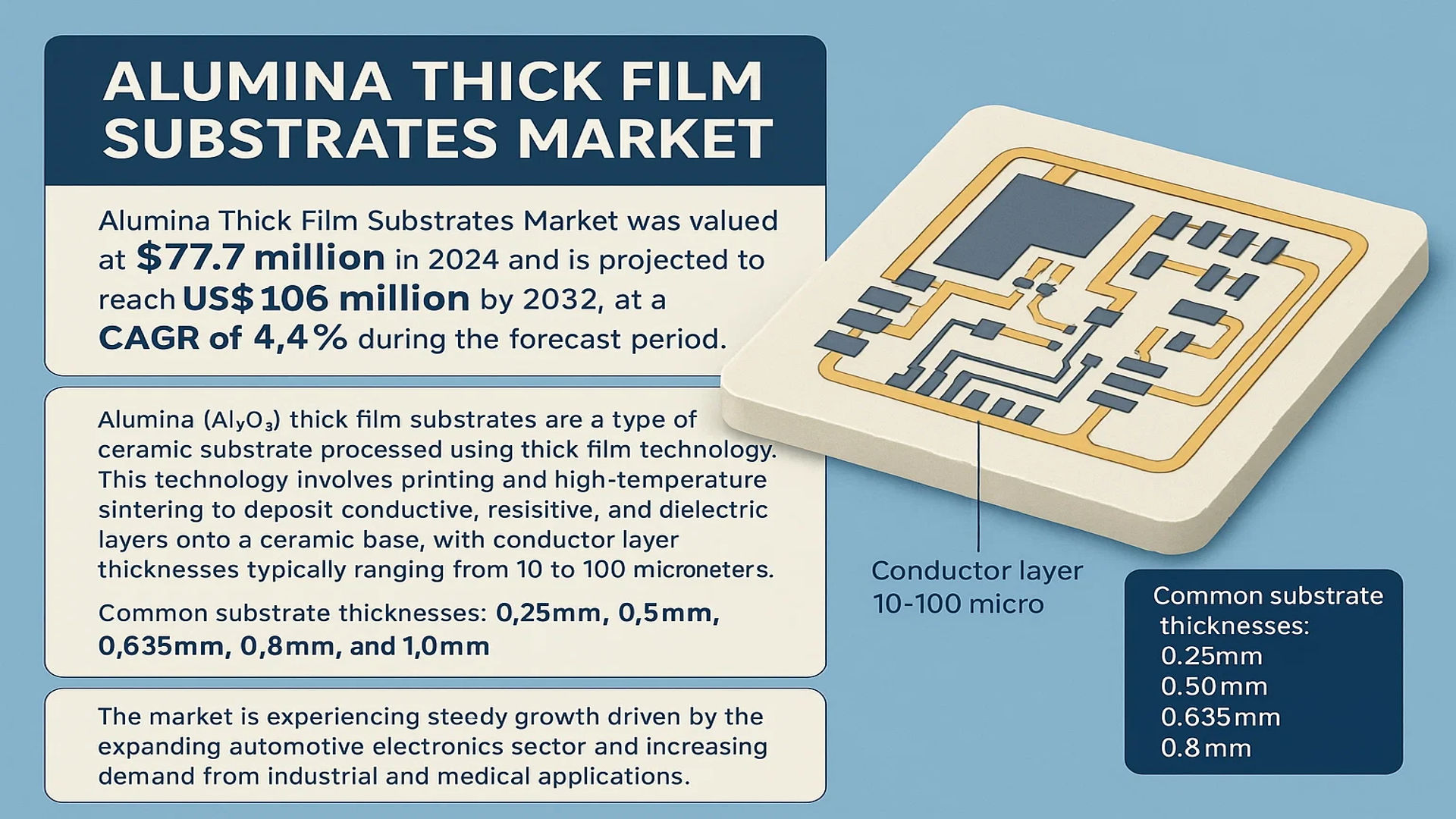
The global Alumina Thick Film Substrates Market was valued at 77.7 million in 2024 and is projected to reach US$ 106 million by 2032, at a CAGR of 4.4% during the forecast period.
Alumina (Al2O3) thick film substrates are a type of ceramic substrate processed using thick film technology. This technology involves printing and high-temperature sintering to deposit conductive, resistive, and dielectric layers onto a ceramic base, with conductor layer thicknesses typically ranging from 10 to 100 micrometers. These substrates are crucial components in electronic packages that do not require extremely high graphics accuracy, valued for their mature technology, simple manufacturing process, and cost-effectiveness. Common substrate thicknesses include 0.25mm, 0.5mm, 0.635mm, 0.8mm, and 1.0mm.
The market is experiencing steady growth driven by the expanding automotive electronics sector and increasing demand from industrial and medical applications. The Asia-Pacific region dominates the market, holding a share of approximately 37% in 2024, fueled by strong manufacturing and electronics industries in China, Japan, and South Korea. The global competitive landscape is concentrated, with the top six players, including Noritake, NCI, and Kyocera, collectively holding a market share of about 42%. The product segment itself commands a significant portion of the broader thick film ceramic substrates market, accounting for roughly 77% of its total value.
MARKET DYNAMICS
MARKET DRIVERS
Expanding Automotive Electronics and Sensor Applications to Drive Market Growth
The global alumina thick film substrates market is experiencing robust growth driven by increasing demand from the automotive electronics sector. Modern vehicles incorporate numerous electronic control units, sensors, and power modules that require reliable ceramic substrates for thermal management and electrical insulation. The automotive industry’s shift toward electric vehicles has further accelerated this demand, with EV power electronics and battery management systems extensively utilizing alumina substrates. The global electric vehicle market is projected to grow at a compound annual growth rate exceeding 20%, directly correlating with increased substrate consumption. Additionally, advancements in automotive safety systems, including ADAS technologies, require precision electronic components that alumina substrates effectively support due to their excellent thermal conductivity and mechanical stability.
Growth in Industrial Automation and Medical Electronics to Boost Market Expansion
Industrial automation and medical electronics represent significant growth drivers for alumina thick film substrates. The Industry 4.0 revolution has increased demand for robust electronic components capable of operating in harsh industrial environments. Alumina substrates provide ideal solutions for motor drives, power supplies, and control systems due to their high thermal endurance and electrical insulation properties. The medical electronics sector similarly relies on these substrates for critical applications including patient monitoring equipment, diagnostic devices, and surgical instruments. The global medical electronics market has demonstrated consistent growth, particularly in imaging systems and portable medical devices, which extensively incorporate thick film ceramic circuits. This sustained demand across multiple high-reliability sectors ensures continued market expansion.
Furthermore, the renewable energy sector’s rapid development creates additional opportunities. Solar inverters, wind power systems, and energy storage solutions increasingly utilize alumina substrates for power electronic modules.
➤ For instance, the global solar inverter market is projected to reach significant valuation by 2030, directly driving substrate demand for power semiconductor packaging and circuit integration.
The convergence of these industrial trends, coupled with technological advancements in substrate manufacturing, positions the market for sustained growth throughout the forecast period.
MARKET CHALLENGES
Intense Competition from Alternative Substrate Technologies to Challenge Market Position
While the alumina thick film substrates market demonstrates growth potential, it faces significant challenges from competing substrate technologies. Direct bonded copper (DBC) substrates and active metal brazed (AMB) ceramics offer superior thermal performance for high-power applications, capturing market share in power electronics segments. Additionally, low-temperature co-fired ceramic (LTCC) substrates provide better integration capabilities for complex multilayer circuits. The material cost structure presents another challenge, as alumina powder prices have experienced volatility due to supply chain disruptions and geopolitical factors. Manufacturing these substrates requires specialized equipment and precise process control, creating barriers for new market entrants and limiting production scalability.
Other Challenges
Technical Limitations in High-Frequency Applications
Alumina substrates face performance limitations in high-frequency applications above 10 GHz, where alternative materials like aluminum nitride or specialized microwave ceramics offer superior characteristics. This restricts their use in advanced RF and microwave communication systems, particularly in 5G infrastructure and satellite communications where signal integrity is paramount.
Environmental Regulations and Material Handling
Stringent environmental regulations governing ceramic manufacturing processes impact production costs and operational flexibility. The sintering process requires high energy consumption, and waste management of ceramic materials presents additional compliance challenges. These factors collectively affect profit margins and may deter investment in capacity expansion.
MARKET RESTRAINTS
Supply Chain Vulnerabilities and Raw Material Dependencies to Restrict Market Growth
The alumina thick film substrates market faces constraints due to supply chain vulnerabilities and critical dependencies on raw material availability. High-purity alumina powder, the primary raw material, experiences price fluctuations influenced by mining output, geopolitical factors, and transportation costs. Several major alumina production facilities are concentrated in specific geographic regions, creating potential supply risks. The specialized nature of thick film pastes containing precious metals like silver, gold, and platinum further compounds cost pressures. These materials not only contribute significantly to overall substrate cost but also face volatility in global commodity markets. Additionally, the manufacturing process requires precise control of multiple parameters including sintering temperature, printing accuracy, and materials compatibility, creating technical barriers that limit production yield and efficiency.
Geopolitical tensions and trade policies have disrupted the supply of critical materials, particularly affecting manufacturers with limited supplier diversification. The industry’s reliance on specific geographic regions for raw material sourcing creates vulnerability to logistical challenges and regulatory changes.
Furthermore, the capital-intensive nature of manufacturing facilities and the requirement for specialized equipment create high entry barriers, restricting market expansion and innovation from new participants.
MARKET OPPORTUNITIES
Emerging Applications in 5G Infrastructure and IoT Devices to Create New Growth Avenues
The rapid deployment of 5G networks and expansion of Internet of Things (IoT) devices presents substantial opportunities for alumina thick film substrates. 5G base stations require robust RF components and power amplifiers that utilize ceramic substrates for thermal management and signal integrity. The global 5G infrastructure market is experiencing exponential growth, with deployment accelerating across both developed and emerging economies. Similarly, IoT devices across industrial, automotive, and consumer segments increasingly incorporate ceramic-based circuits for reliability and miniaturization. The proliferation of smart sensors in industrial environments and connected devices in automotive applications specifically drives demand for alumina substrates capable of withstanding harsh operating conditions while maintaining electrical performance.
Advancements in thick film technology enable higher circuit density and improved thermal performance, making these substrates increasingly competitive in applications previously dominated by alternative technologies. Manufacturers are developing innovative printing techniques and material compositions that enhance substrate performance while controlling costs.
Additionally, the growing emphasis on domestic semiconductor and electronics manufacturing across various regions creates opportunities for local substrate production, reducing import dependencies and shortening supply chains for end-users.
ALUMINA THICK FILM SUBSTRATES MARKET TRENDS
Expansion in Automotive Electronics and Sensor Applications
The automotive industry’s rapid transition towards electrification and advanced driver-assistance systems (ADAS) is significantly driving demand for alumina thick film substrates. These substrates provide excellent thermal management, electrical insulation, and mechanical stability required for harsh automotive environments. With the global automotive sensor market projected to exceed $40 billion by 2028, alumina substrates have become critical components in oxygen sensors, pressure sensors, and temperature monitoring systems. Furthermore, the increasing adoption of electric vehicles, which require approximately 30% more electronic content than traditional vehicles, has created substantial growth opportunities. Recent developments include substrates capable of withstanding higher operating temperatures up to 350°C, making them ideal for under-hood applications where reliability is paramount.
Other Trends
Miniaturization and High-Density Packaging Requirements
The relentless push toward smaller, more powerful electronic devices is compelling manufacturers to develop advanced alumina thick film substrates that support higher component density. While traditional substrates typically feature conductor line widths of 100-200 μm, recent technological advancements have enabled line widths as fine as 50 μm, allowing for more complex circuitry on the same surface area. This trend is particularly evident in the medical device sector, where implantable devices and diagnostic equipment require increasingly compact form factors. The global medical electronics market, valued at approximately $6.5 billion in 2024, continues to drive innovation in substrate design, with manufacturers developing multi-layer configurations that incorporate embedded passive components directly into the substrate structure.
Growing Adoption in LED and Power Electronics Applications
Alumina thick film substrates are experiencing increased utilization in high-power LED lighting and power electronic devices due to their superior thermal conductivity and electrical insulation properties. The global LED market, expected to reach $127 billion by 2027, relies heavily on these substrates for thermal management in high-brightness applications. Meanwhile, the power electronics sector, particularly in renewable energy systems and industrial motor drives, requires substrates that can handle high current loads and dissipate heat effectively. Recent innovations include substrates with thermal conductivity ratings of 24-28 W/mK and improved metallization techniques that enhance solder joint reliability. The expansion of 5G infrastructure has further driven demand, as base stations and communication equipment require power amplifiers and RF components mounted on reliable ceramic substrates that can maintain performance under continuous operation.
COMPETITIVE LANDSCAPE
Key Industry Players
Manufacturers Focus on Technological Innovation and Geographic Expansion to Maintain Market Position
The global alumina thick film substrates market exhibits a semi-consolidated structure, characterized by the presence of established multinational corporations alongside specialized regional manufacturers. Noritake Co., Limited emerges as a dominant force, leveraging its extensive manufacturing expertise and diverse product portfolio spanning multiple thickness specifications. The company’s strong foothold across Asia-Pacific, North America, and Europe, coupled with its continuous investment in advanced printing and sintering technologies, positions it as a market leader with approximately 12% global revenue share in 2024.
NCI and Miyoshi Electronics Corporation collectively command significant market influence, with their combined market share exceeding 15% based on 2024 estimates. These Japanese manufacturers have built their competitive advantage through precision engineering capabilities and longstanding relationships with automotive and industrial electronics manufacturers. Their growth is particularly notable in applications requiring high-reliability substrates for harsh environments, such as automotive sensors and power devices.
Market participants are actively pursuing strategic initiatives to strengthen their positions. Kyocera Corporation has recently expanded its production capacity in Vietnam to better serve Southeast Asian markets, while Maruwa Co., Ltd. has introduced new low-temperature co-fired ceramic (LTCC) compatible alumina substrates to address evolving MEMS packaging requirements. These developments reflect the industry’s focus on both geographic expansion and technological differentiation to capture growth opportunities.
Meanwhile, European and American players including Cicor Group and TTM Technologies are enhancing their market presence through targeted acquisitions and R&D investments. Cicor’s acquisition of specialized substrate manufacturers in 2023 has strengthened its capabilities in medical device applications, while TTM Technologies has focused on developing substrates for 5G infrastructure and aerospace applications. These strategic moves demonstrate how companies are diversifying their application expertise to reduce market dependency on specific sectors.
List of Key Alumina Thick Film Substrates Companies Profiled
- Noritake Co., Limited (Japan)
- NCI (Japan)
- Miyoshi Electronics Corporation (Japan)
- Kyocera Corporation (Japan)
- CMS Circuits, Inc (U.S.)
- Cicor Group (Switzerland)
- Maruwa Co., Ltd. (Japan)
- Nikko Company (Japan)
- APITech (CMAC) (U.S.)
- Mitsuboshi Belting Ltd. (Japan)
- TTM Technologies, Inc. (U.S.)
- MST (Micro Systems Technologies) (Switzerland)
- Micro-Precision Technologies, Inc. (U.S.)
- Stellar Industries Corp (U.S.)
- Remtec, Inc. (U.S.)
Segment Analysis:
By Type
Thickness: 0.51mm-1.0mm Segment Dominates Due to Superior Mechanical Strength and Thermal Management
The market is segmented based on substrate thickness into:
- Thickness: 0.2mm-0.5mm
- Thickness: 0.51mm-1.0mm
- Others
By Application
Automotive & Sensors Segment Leads Owing to Proliferation of Electronic Control Units and Advanced Driver Assistance Systems
The market is segmented based on application into:
- Automotive & Sensors
- Industrial & Medical
- Power Device
- LEDs
- MEMS Packages
- Military & Defence
- Others
By End User
Electronics Manufacturing Services (EMS) Providers Hold Significant Share Due to Outsourcing Trends
The market is segmented based on end user into:
- Electronics Manufacturing Services (EMS) Providers
- Original Equipment Manufacturers (OEMs)
- Research & Development Institutions
- Others
By Manufacturing Process
Screen Printing Remains Prevalent Owing to Cost-Effectiveness and Process Maturity
The market is segmented based on manufacturing process into:
- Screen Printing
- Photolithography
- Laser Processing
- Others
Regional Analysis: Alumina Thick Film Substrates Market
Asia-Pacific
The Asia-Pacific region dominates the global alumina thick film substrates market, holding approximately 37% of the total market share. This leadership position is primarily driven by robust manufacturing ecosystems and high demand from key countries including China, Japan, and South Korea. China’s massive electronics production industry, valued at over $700 billion annually, creates substantial consumption for alumina substrates used in automotive sensors, consumer electronics, and industrial applications. Japan remains a technological hub with companies like Noritake, Kyocera, and Maruwa leading innovation in substrate manufacturing. South Korea’s strong semiconductor and display industries further contribute to regional demand. The region benefits from cost-competitive manufacturing, established supply chains, and growing investments in electric vehicles and renewable energy systems, which increasingly utilize thick film substrates for power electronics and sensor applications.
North America
North America represents a significant market for alumina thick film substrates, characterized by high-value applications and stringent quality requirements. The region’s market is driven by advanced automotive electronics, aerospace and defense systems, and medical device manufacturing. The United States accounts for the majority of regional demand, with particular strength in military applications where reliability under extreme conditions is paramount. Recent investments in electric vehicle infrastructure and renewable energy systems have created new opportunities for power electronics utilizing thick film substrates. The presence of leading technology companies and research institutions fosters innovation in substrate materials and manufacturing processes. However, the region faces cost pressures compared to Asian manufacturers, leading to a focus on high-performance, specialty substrates rather than cost-competitive volume production.
Europe
Europe maintains a strong position in the alumina thick film substrates market, particularly in high-reliability applications for automotive, industrial, and medical sectors. Germany stands as the regional leader, leveraging its automotive industry’s transition toward electrification and advanced driver assistance systems, which require numerous sensors and power control units. The region’s market is characterized by stringent quality standards and environmental regulations, driving innovation in materials and manufacturing processes. European manufacturers focus on value-added substrates with enhanced thermal management properties and improved reliability for harsh environments. The medical device sector, particularly in countries like Switzerland and Germany, provides steady demand for high-precision substrates used in diagnostic equipment and implantable devices. Research and development activities remain strong, with collaborations between academic institutions and industrial partners advancing substrate technology.
South America
The South American market for alumina thick film substrates is emerging but remains relatively small compared to other regions. Brazil represents the largest market within the region, primarily driven by automotive production and industrial applications. The market faces challenges including limited local manufacturing capabilities, economic volatility, and dependence on imported substrates from North America and Asia. However, growing investments in telecommunications infrastructure and renewable energy projects are creating new opportunities for substrate applications. The region’s market development is constrained by technological infrastructure gaps and limited domestic R&D investment, but gradual industrialization and economic development projects are expected to drive steady growth in substrate demand over the coming years.
Middle East & Africa
The Middle East and Africa region represents the smallest market share for alumina thick film substrates, though with potential for gradual growth. The market is primarily driven by oil and gas industry applications, where substrates are used in sensing and control systems for extraction and refining operations. Telecommunications infrastructure development, particularly in Gulf Cooperation Council countries, provides additional demand for substrates in networking equipment. South Africa maintains some electronic manufacturing capabilities, serving both domestic and regional markets. The region faces significant challenges including limited local manufacturing, technological infrastructure gaps, and political instability in certain areas. However, economic diversification efforts in Gulf states and infrastructure development across Africa are expected to create incremental growth opportunities for substrate applications in coming years.
Report Scope
This market research report provides a comprehensive analysis of the global and regional Alumina Thick Film Substrates market, covering the forecast period 2025–2032. It offers detailed insights into market dynamics, technological advancements, competitive landscape, and key trends shaping the industry.
Key focus areas of the report include:
- Market Size & Forecast: Historical data and future projections for revenue, unit shipments, and market value across major regions and segments.
- Segmentation Analysis: Detailed breakdown by product type, thickness, application, and end-user industry to identify high-growth segments and investment opportunities.
- Regional Outlook: Insights into market performance across North America, Europe, Asia-Pacific, Latin America, and the Middle East & Africa, including country-level analysis where relevant.
- Competitive Landscape: Profiles of leading market participants, including their product offerings, R&D focus, manufacturing capacity, pricing strategies, and recent developments such as mergers, acquisitions, and partnerships.
- Technology Trends & Innovation: Assessment of emerging fabrication techniques, integration of advanced materials, evolving industry standards, and process optimization.
- Market Drivers & Restraints: Evaluation of factors driving market growth along with challenges, supply chain constraints, regulatory issues, and market-entry barriers.
- Stakeholder Analysis: Insights for substrate manufacturers, OEMs, system integrators, investors, and policymakers regarding the evolving ecosystem and strategic opportunities.
Primary and secondary research methods are employed, including interviews with industry experts, data from verified sources, and real-time market intelligence to ensure the accuracy and reliability of the insights presented.
FREQUENTLY ASKED QUESTIONS:
What is the current market size of Global Alumina Thick Film Substrates Market?
-> Alumina Thick Film Substrates Market was valued at 77.7 million in 2024 and is projected to reach US$ 106 million by 2032, at a CAGR of 4.4% during the forecast period.
Which key companies operate in Global Alumina Thick Film Substrates Market?
-> Key players include Noritake, NCI, Kyocera, Miyoshi Electronics Corporation, Maruwa, CMS Circuits, Inc, Cicor Group, Nikko, APITech (CMAC), and Mitsuboshi Belting, among others.
What are the key growth drivers?
-> Key growth drivers include increasing demand from automotive sensors, expansion of industrial automation, growth in medical electronics, and adoption in power devices.
Which region dominates the market?
-> Asia-Pacific is the largest market with approximately 37% share, driven by strong demand from China, Japan, and South Korea.
What are the emerging trends?
-> Emerging trends include development of thinner substrates, integration with advanced packaging technologies, adoption in 5G infrastructure, and increasing use in renewable energy applications.

Get Sample Report PDF for Exclusive Insights
Report Sample Includes
- Table of Contents
- List of Tables & Figures
- Charts, Research Methodology, and more...