
Alumina Substrates for Chip Resistors Market Insights
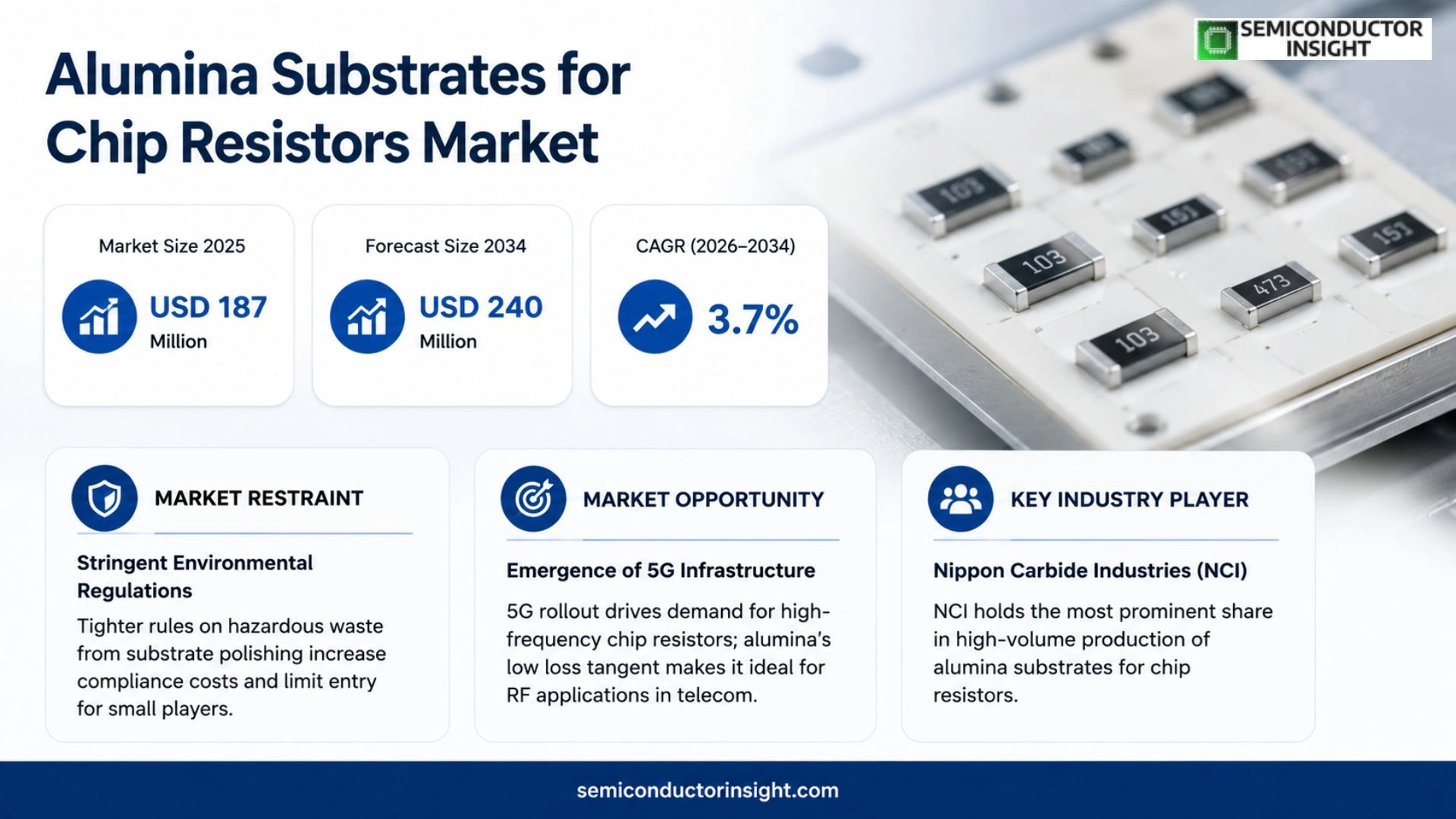
Alumina Substrates for Chip Resistors market size was valued at USD 187 million in 2025 and will reach USD 240 million by 2034, reflecting a CAGR of 3.7 % over the forecast period.
Alumina substrates serve as the ceramic foundation for thick‑film chip resistors, providing electrical insulation, thermal spreading and dimensional stability while supporting precise screen‑printing and singulation processes. Leading manufacturers such as Nippon Carbide Industries and MARUWA emphasize thin‑profile strength, low porosity and surface flatness that enable reliable adhesion of resistive pastes.
Growth stems from rising reliability requirements in automotive and industrial electronics, ongoing miniaturization toward smaller package sizes (e.g., 0402/01005), and strategic efforts by suppliers to broaden second‑source qualifications across key regions.
MARKET DRIVERS
Rising Demand for High‑Temperature Performance
Manufacturers of power electronics are increasingly specifying substrates that can tolerate temperatures above 250 °C. Alumina Substrates for Chip Resistors Market benefits because alumina’s thermal conductivity allows resistors to dissipate heat more efficiently, reducing failure rates in automotive power‑train modules and industrial inverters.
Cost Efficiency Relative to Alternatives
When compared with silicon carbide or ceramic composites, alumina offers a lower material cost while delivering comparable dielectric strength. This price advantage drives procurement decisions in high‑volume consumer‑electronics lines, where margins are tightly managed.
➤ “Design engineers cite alumina’s balance of thermal performance and price as the decisive factor when qualifying chip resistor platforms for next‑generation power converters.”
Overall, the convergence of thermal requirements and cost pressure creates a fertile environment for suppliers to expand capacity and introduce thinner, high‑density alumina sheets.
MARKET CHALLENGES
Material Consistency Issues
Achieving uniform grain structure across large wafers remains a technical hurdle. Variations in porosity can lead to impedance mismatches, forcing OEMs to reject batches and incur rework expenses.
Other Challenges
Supply Chain Constraints
The limited number of certified alumina producers means that sudden spikes in demand can outpace raw‑material availability, prompting longer lead times and price volatility.
Moreover, the reliance on high‑purity alumina powders subjects the market to geopolitical supply risks, especially when key mineral sources are concentrated in a few regions.
MARKET RESTRAINTS
Stringent Environmental Regulations
Regulatory bodies in Europe and North America are tightening limits on hazardous waste generated during substrate polishing. Compliance requires additional filtration stages, elevating production overhead and discouraging smaller players from entering the field.
MARKET OPPORTUNITIES
Emergence of 5G Infrastructure
The rollout of 5G networks calls for RF front‑ends that operate at gigahertz frequencies. Alumina’s low loss tangent makes it an attractive substrate for chip resistors embedded in high‑frequency filters, opening a niche that has seen modest uptake in telecom equipment manufacturers.
Alumina Substrates for Chip Resistors Market Trends
Miniaturization and Thin‑Film Substrate Adoption
The push toward ever‑smaller passive components has placed alumina substrates at the center of the chip resistor supply chain. Manufacturers such as Nippon Carbide Industries and MARUWA are refining powder‑sintering cycles to produce sheets that are both thinner and capable of withstanding the mechanical stresses of 0402 and even 01005 footprints. This evolution reduces the overall stack height of electronic modules, enabling higher packing density in smartphones, wearables, and high‑frequency communication boards. At the same time, tighter dimensional tolerances improve print registration for thick‑film pastes, which translates directly into more predictable resistance values and lower scrap rates. Companies that master these “thin‑yet‑strong” processes gain a pricing edge because downstream assemblers can consolidate board layers and eliminate redundant heat‑spreading components.
Other Trends
Automotive Reliability Demands
Vehicle electrification and the rise of advanced driver‑assistance systems have raised the bar for component durability. Alumina substrates contribute thermal stability that helps resistors maintain performance across the extreme temperature swings typical of under‑hood environments. Suppliers are therefore emphasizing high‑purity alumina formulations and precision‑machined flatness to meet automotive qualification standards such as AEC‑Q100. The consequence for the market is a bifurcation: firms that can certify their products for automotive use command premium contracts, while those limited to consumer‑grade specs face tighter margins and heightened competition.
Supply‑Chain Diversification and Regional Sourcing
Recent disruptions have prompted OEMs to broaden their qualified supplier base beyond the traditional Japan‑US‑Europe cluster. Companies in China and Southeast Asia are investing in sintering kilns and clean‑room sheet‑forming lines to meet the same dimensional accuracy that long‑standing players offer. This geographic spread reduces lead times for regional assembly plants and mitigates the risk of single‑source interruptions. For market participants, the strategic implication is clear: establishing secondary sources that meet identical technical specifications not only safeguards production schedules but also introduces pricing leverage in negotiations with end‑users.
COMPETITIVE LANDSCAPE
Key Industry Players
Alumina Substrates for Chip Resistors: Competitive Overview
Among the suppliers, Nippon Carbide Industries (NCI) retains the most visible share of high‑volume production. NCI leverages a vertically integrated sintering line that delivers thin, low‑warp alumina sheets suitable for 0402 and even 01005 chip formats. Its ability to regulate powder purity and sheet‑forming parameters translates into tighter dimensional tolerances, a critical advantage for automotive and industrial resistor assemblies where thermal cycling is severe. Maruwa, another Japanese contender, differentiates itself through surface‑finish control that minimizes porosity and supports strong adhesion of thick‑film pastes. Kyoritsu Elex’s portfolio emphasizes pre‑formed green‑sheet features such as through‑holes and singulation slits, allowing downstream manufacturers to achieve higher throughput without compromising geometry. Collectively these firms define a tier of high‑specification providers that command premium pricing and dominate contracts that require long‑term reliability and stringent qualification.
Beyond the top tier, a cluster of regionally focused firms adds depth to the supply base. China’s Chaozhou Three‑Circle Group and Zhejiang Xinna Ceramic New Material have expanded capacity through investments in automated tape‑casting lines, targeting mid‑range volume customers in consumer‑electronics and communication equipment. LEATEC Fine Ceramics, based in Germany, supplies ultra‑high‑purity substrates for niche aerospace and defense applications where dielectric loss must stay below tight limits. CoorsTek and CeramTec, both with global footprints, provide a broad catalog that spans thick‑film to thin‑film substrates, enabling customers to source a single supplier for multiple product families. Kyocera and Shin‑Etsu contribute sophisticated polishing techniques that reduce substrate warp, a factor increasingly important as chip dimensions shrink. Saint‑Gobain’s European operations complement the North‑American market with a focus on automotive reliability programs. The emergence of these players mitigates the risk of over‑reliance on a handful of manufacturers and encourages competitive pricing across the value chain.
List of Key Alumina Substrates for Chip Resistors Companies Profiled
- Nippon Carbide Industries
- Maruwa
- Kyoritsu Elex
- Chaozhou Three-Circle Group
- Zhejiang Xinna Ceramic New Material
- LEATEC Fine Ceramics
- CoorsTek
- CeramTec
- Kyocera
- Shin-Etsu Chemical
- Saint-Gobain
- 3M
Segment Analysis:
| Segment Category | Sub-Segments | Key Insights |
| By Type |
|
Thick‑film substrates dominate due to their proven reliability in high‑power applications.
|
| By Application |
|
Automotive electronics drive demand for substrates that endure harsh thermal and mechanical cycles.
|
| By End User |
|
OEM manufacturers prioritize substrates that enable precise screen‑printing and high yield.
|
| By Process Technology |
|
Tape casting remains the primary route for high‑volume substrate production.
|
| By Performance Requirement |
|
High thermal conductivity is critical for power‑resistor reliability in compact designs.
|
Regional Analysis: Alumina Substrates for Chip Resistors Market
Asia‑Pacific
A cluster of tier‑1 and boutique foundries in China, Taiwan, and South Korea supplies more than half of global output. Their capability to run continuous‑grade furnaces aligns with the high‑temperature sintering requirements of alumina substrates, ensuring both yield stability and dimensional precision.
Regional logistics networks, bolstered by expansive port facilities and rail corridors, mitigate lead‑time volatility. Recent investments in buffer stock strategies for high‑purity alumina powders have further insulated manufacturers from raw‑material price spikes.
Universities and corporate R&D labs collaborate on low‑loss dielectric formulations, pushing substrate performance beyond traditional thermal limits. The resulting patents are quickly commercialized through joint‑venture production lines.
Harmonized environmental standards across the region reduce compliance cost differentials, allowing firms to focus resources on process optimization rather than navigating fragmented regulations.
North America
North America retains a strong foothold in high‑reliability applications such as aerospace and defense, where alumina substrates are prized for their thermal stability. Domestic producers emphasize rigorous qualification protocols, which command a premium but satisfy stringent performance specifications. Recent strategic partnerships between substrate manufacturers and semiconductor design houses aim to embed thermal‑management considerations early in the chip‑resistor development cycle, a move that could offset the region’s higher labor costs with added value. Additionally, the push for greener manufacturing has spurred investments in energy‑recovering furnace technologies, aligning cost control with sustainability objectives.
Europe
European players differentiate themselves through precision engineering and compliance with the most exacting safety standards. The market is fragmented, with several midsize firms specializing in niche substrate thicknesses that support ultra‑compact resistor footprints. Cross‑border collaboration within the EU framework facilitates shared testing facilities, reducing R&D duplication. Emerging automotive electrification projects are driving demand for substrates that can endure higher power densities, prompting European firms to explore hybrid ceramic‑metal composites as a next‑generation solution.
South America
In South America, the market is anchored by a growing automotive component sector that increasingly adopts imported alumina substrates for power‑management modules. Local assemblers are forging long‑term supply agreements with Asian manufacturers to ensure consistent quality while keeping inventory levels low. Government incentives aimed at boosting high‑tech manufacturing clusters in Brazil and Chile are attracting modest foreign direct investment, which may gradually elevate the region’s design capability and reduce reliance on external expertise.
Middle East & Africa
The Middle East & Africa region is still nascent in the alumina substrate space, yet it is witnessing strategic interest from multinational suppliers eyeing emerging data‑center projects in the Gulf. Investment in specialized clean‑room facilities is beginning to address the skill gap that has historically limited local production. Partnerships with academic institutions are being leveraged to develop a pipeline of engineers versed in high‑temperature ceramic processes, laying groundwork for future self‑sufficiency.
Report Scope
This market research report provides a comprehensive analysis of the Alumina Substrates for Chip Resistors Market , covering the forecast period 2026–2034. It offers detailed insights into market dynamics, technological advancements, competitive landscape, and key trends shaping the industry.
Key focus areas of the report include:
- Market Overview: The report begins with an overview outlining its current market scenario, key growth indicators, and industry transformation drivers. It discusses macroeconomic factors, demand–supply balance, regulatory landscape, and the strategic role of semiconductors in powering advancements across industries such as automotive, telecommunications, consumer electronics, and industrial automation.
- Market Size & Forecast: Historical data and future projections for revenue, unit shipments, and market value across major regions and segments.
- Segmentation Analysis: Detailed breakdown by product type, technology, application, and end-user industry to identify high-growth segments and investment opportunities.
- Regional Insights: Insights into market performance across North America, Europe, Asia-Pacific, Latin America, and the Middle East & Africa, including country-level analysis where relevant.
- Competitive Landscape: Profiles of leading market participants, including their product offerings, R&D focus, manufacturing capacity, pricing strategies, and recent developments such as mergers, acquisitions, and partnerships.
- Technology Trends & Innovation: Assessment of emerging technologies, integration of AI/IoT, semiconductor design trends, fabrication techniques, and evolving industry standards.
- Market Drivers & Restraints: Evaluation of factors driving market growth along with challenges, supply chain constraints, regulatory issues, and market-entry barriers.
- Stakeholder Insights: Insights for component suppliers, OEMs, system integrators, investors, and policymakers regarding the evolving ecosystem and strategic opportunities.
Primary and secondary research methods are employed, including interviews with industry experts, data from verified sources, and real-time market intelligence to ensure the accuracy and reliability of the insights presented.
FREQUENTLY ASKED QUESTIONS:
What is the current market size of Alumina Substrates for Chip Resistors Market?
-> Alumina Substrates for Chip Resistors market will reach USD 240 million by 2034, reflecting a CAGR of 3.7 % over the forecast period.
Which key companies operate in Alumina Substrates for Chip Resistors Market?
-> Key players include Chaozhou Three-Circle (Group), Maruwa, LEATEC Fine Ceramics, NCI (Nippon Carbide Industries Co., Inc.), Zhejiang Xinna Ceramic New Material, and Kyoritsu Elex, among others.
What are the key growth drivers?
-> Key growth drivers include automotive and industrial reliability requirements, ongoing miniaturization of chip sizes, higher power density and thermal management needs, and supply‑chain resilience initiatives expanding qualified supplier pools.
Which region dominates the market?
-> Asia‑Pacific leads the market, driven by strong fine‑ceramics capabilities in Japan and growing demand across China, while Europe and North America also maintain significant shares.
What are the emerging trends?
-> Emerging trends include development of ultra‑thin and high‑strength alumina substrates, improved surface flatness and low‑porosity characteristics, and integration of advanced sintering and sheet‑formation technologies to support next‑generation thick‑film resistor applications.

Get Sample Report PDF for Exclusive Insights
Report Sample Includes
- Table of Contents
- List of Tables & Figures
- Charts, Research Methodology, and more...
