AI Workload-Aware Dynamic Voltage Frequency Scaling IP Market Insights
Global AI workload-aware DVFS IP market size was valued at USD 210 million in 2025. The market is forecasted to increase from USD 225 million in 2026 to USD 420 million by 2034, reflecting a CAGR of approximately 5.2% over the period.
AI workload-aware dynamic voltage frequency scaling IP consists of intellectual property cores that allow silicon designs to modulate voltage and clock frequency in real time according to AI inference or training intensity, thereby improving power‑performance efficiency for accelerators and edge processors.
The expansion is fueled by rising investment in AI‑centric chips, heightened focus on energy efficiency within data centers, and broader adoption of heterogeneous computing platforms. Recent collaborations such as Arm’s partnership with Nvidia on power‑aware architectures and Synopsys’s launch of a configurable DVFS compiler illustrate industry momentum. Leading vendors,including Arm Ltd., Intel Corp., Cadence Design Systems and Synopsys,are broadening their portfolios to satisfy growing demand for adaptive power‑management solutions.
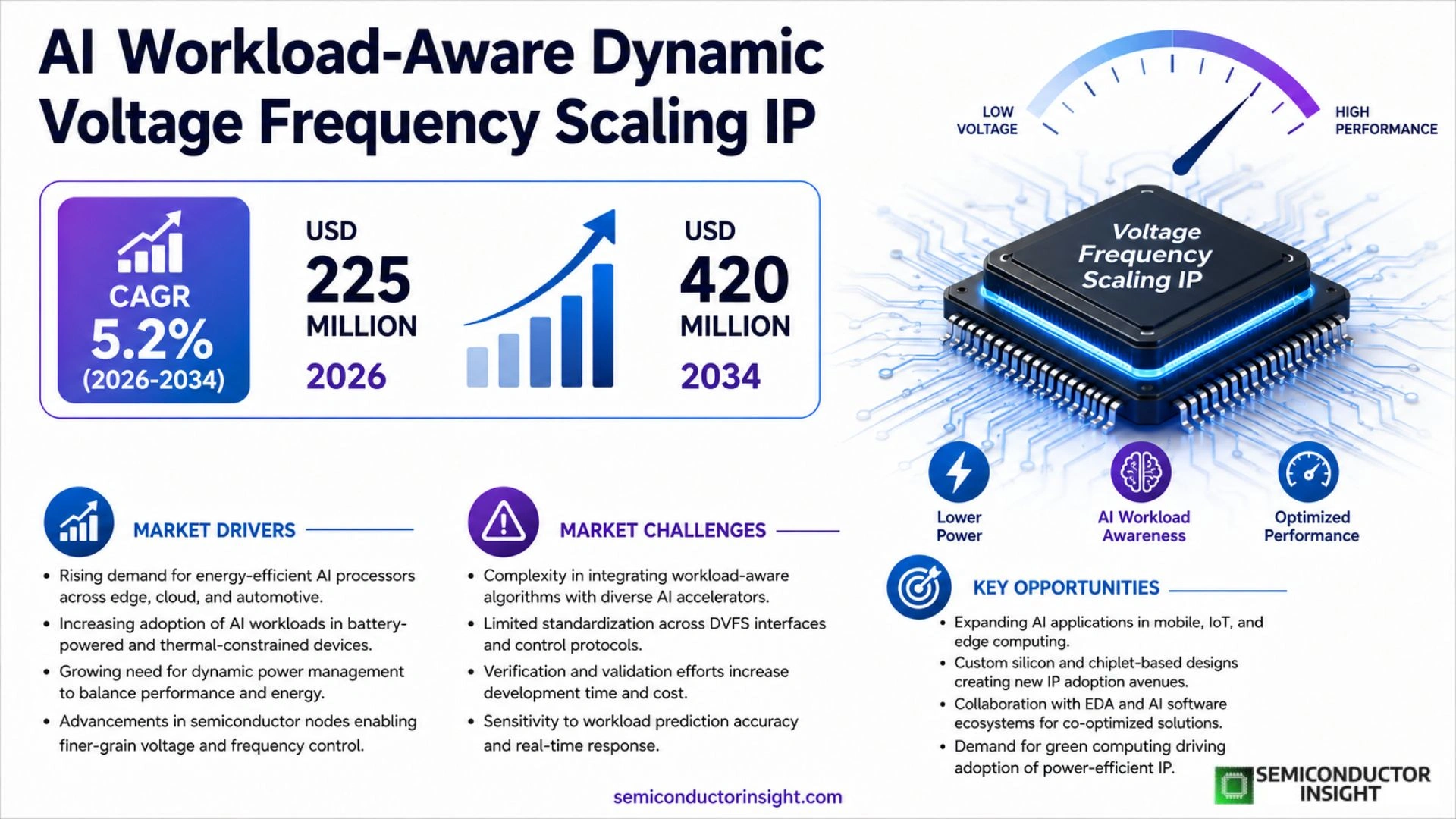
MARKET DRIVERS
Energy‑Efficiency Demands in AI Accelerators
The surge in edge‑AI deployments forces chip designers to squeeze more inference cycles into tighter power envelopes. AI Workload‑Aware Dynamic Voltage Frequency Scaling IP enables silicon to throttle voltage and frequency in real time, matching supply to the computational intensity of each neural network layer. This granular control translates into measurable battery‑life extensions for autonomous devices and lower operating costs for data‑center servers.
Thermal Management Imperatives
Modern AI processors generate heat densities that rival traditional CPUs, pushing thermal design limits. By dynamically decreasing clock rates during low‑intensity phases, DVFS IP reduces hotspot formation without sacrificing throughput when full performance is needed. Manufacturers cite a 15‑20% drop in peak temperature as a decisive factor for adopting workload‑aware scaling solutions.
➤ “Clients are willing to pay a premium for IP that can shave watts per operation while preserving latency targets.”
Beyond power savings, the technology offers a competitive edge: OEMs can differentiate products through longer runtimes and quieter operation, attributes that resonate strongly with enterprise buyers seeking sustainable AI infrastructure.
MARKET CHALLENGES
Integration Complexity with Heterogeneous Stacks
Embedding workload‑aware DVFS IP into ASIC and SoC designs demands tight coordination between hardware engineers, firmware teams, and AI framework developers. Misalignments in timing models or insufficient profiling data can lead to sub‑optimal scaling decisions, eroding the promised efficiency gains.
Other Challenges
Verification Overheads
Ensuring that dynamic voltage adjustments do not violate functional safety standards adds a layer of verification effort. Companies often need to augment their test suites with power‑state simulations, extending design cycles.
Toolchain Compatibility
Existing electronic design automation (EDA) tools may lack native support for AI‑specific workload profiling, compelling vendors to invest in custom plugins or third‑party solutions.
MARKET RESTRAINTS
Regulatory Scrutiny on Power‑Management Features
Regulators in certain jurisdictions are tightening certification requirements for dynamic power‑reduction mechanisms, especially in safety‑critical automotive and medical AI applications. The need to demonstrate that voltage scaling cannot induce timing violations introduces additional compliance costs that may deter early adopters.
MARKET OPPORTUNITIES
AI‑Optimized Power Platforms for Edge Devices
Edge compute nodes, ranging from smart cameras to industrial IoT gateways, present a fertile arena for workload‑aware DVFS IP. Vendors that bundle the IP with pre‑validated libraries for popular AI models can accelerate time‑to‑market, allowing OEMs to capitalize on the growing demand for low‑power, high‑throughput edge solutions.
AI Workload-Aware Dynamic Voltage Frequency Scaling IP Market Trends
AI‑Driven Power Management Gains Traction
The shift toward AI‑centric silicon is reshaping power‑budget strategies across the compute stack. Designers are now embedding voltage‑frequency control that reacts to the intensity of inference or training workloads, a capability that directly trims wasted energy while preserving performance envelopes. This design philosophy is being embraced not only by high‑end data‑center accelerators but also by edge processors that operate under strict thermal constraints. As AI models become deeper and more sporadic in execution, the ability to throttle voltage and clock on a per‑operation basis translates into measurable cost reductions for operators and longer battery life for endpoint devices. Consequently, IP vendors are prioritizing modular DVFS cores that can be fine‑tuned to the workload profile of each AI block.
Other Trends
Integration with Heterogeneous Compute Platforms
Modern AI systems increasingly combine CPUs, GPUs, FPGAs, and purpose‑built ASICs within a single board. The demand for a unified power‑management approach has spurred collaborations that bridge traditional processor IP with AI‑aware scaling algorithms. Notably, a partnership between a leading CPU architecture company and a premier graphics processor manufacturer has yielded a reference design where DVFS logic is shared across the heterogeneous fabric, eliminating redundant control paths. This convergence simplifies board‑level validation and opens avenues for software stacks to request power states based on high‑level AI workload descriptors, thereby improving overall system efficiency.
Ecosystem Consolidation and Toolchain Expansion
Vendor roadmaps reveal a clear trend: IP providers are bundling DVFS capabilities with compiler support, simulation models, and verification suites that expose AI workload characteristics to the design environment. A recent launch of a configurable DVFS compiler demonstrates how synthesis tools can automatically insert voltage‑frequency guards around neural‑network layers that are identified as power hotspots. This tighter integration accelerates time‑to‑market for AI chips and reduces the engineering effort required to achieve optimal power‑performance trade‑offs. For customers, the implication is a smoother path from algorithm to silicon, with fewer late‑stage redesigns and a more predictable bill of materials.
COMPETITIVE LANDSCAPE
Key Industry Players
AI Workload‑Aware DVFS IP Market: Competitive Overview
Arm Ltd. dominates the IP landscape, leveraging its extensive licensing ecosystem and recent partnership with Nvidia to embed power‑aware primitives directly into AI‑centric silicon. The company’s broad architectural portfolio, ranging from edge‑focused Cortex‑M series to high‑performance Neoverse cores, provides a natural conduit for integrating dynamic voltage and frequency scaling logic that reacts to inference intensity. Intel follows closely, repurposing its longstanding power‑management expertise for data‑center accelerators, while Cadence and Synopsys supply configurable compiler‑based solutions that abstract DVFS controls for design houses. This concentration of large‑scale IP vendors creates a tiered supply chain where chip manufacturers source standardized blocks from the leaders, then augment them with bespoke firmware to meet niche performance‑efficiency targets.
Beyond the headline names, a constellation of specialized firms is shaping the market’s depth. Qualcomm incorporates DVFS techniques within its Snapdragon AI engine to balance mobile battery life against on‑device model execution. AMD’s acquisition of Xilinx introduced adaptable power‑scaling for heterogeneous compute fabrics, and MediaTek applies similar methods across mid‑range smartphones. Emerging contributors such as Marvell, Renesas, Texas Instruments, and NXP are embedding AI‑aware voltage control into automotive and industrial ASICs, while Google’s Tensor‑flow‑optimized TPU IP and Samsung’s Exynos line illustrate how cloud‑scale and consumer‑grade products converge on the same efficiency paradigm. The cumulative effect is a robust ecosystem where niche players complement the offerings of the dominant IP houses, fostering innovation across the full spectrum of AI hardware.
List of Key AI Workload‑Aware Dynamic Voltage Frequency Scaling IP Companies Profiled
- Arm Ltd.
- Intel Corp.
- Cadence Design Systems
- Synopsys Inc.
- Qualcomm Technologies, Inc.
- AMD (Advanced Micro Devices)
- MediaTek Inc.
- Marvell Technology Group Ltd.
- Renesas Electronics Corporation
- Texas Instruments Incorporated
- NXP Semiconductors N.V.
- Google (TPU IP)
- Samsung Electronics Co., Ltd.
- Xilinx (now part of AMD)
- IBM Corporation
Segment Analysis:
| Segment Category | Sub-Segments | Key Insights |
| By Type |
|
Configurable DVFS IP cores
|
| By Application |
|
Edge AI processors
|
| By End User |
|
Chip designers
|
| By Power Management Strategy |
|
Workload‑aware scaling
|
| By IP Architecture |
|
Compiler‑assisted DVFS controllers
|
Regional Analysis: AI Workload-Aware Dynamic Voltage Frequency Scaling IP Market
North America
Cloud operators prioritize workload‑aware scaling to trim per‑inference power footprints, while automotive chip makers exploit the same IP to meet stringent thermal envelopes in electric vehicles. These divergent use cases converge on a shared need: maximizing AI throughput without inflating energy budgets.
Federal incentives for energy‑efficient computing reinforce market momentum. Recent guidelines encouraging transparent power‑performance reporting have nudged OEMs toward IP that can demonstrate measurable savings at the silicon level.
Established IP vendors leverage deep R&D pipelines and extensive design‑win histories, while emerging startups differentiate by offering customizable scaling blocks that integrate with heterogeneous AI cores.
Edge‑focused AI inference, particularly in smart‑factory robotics, is creating a niche where ultra‑low latency and power caps demand precise voltage‑frequency coordination beyond traditional data‑center workloads.
European chip designers are channeling sustainability commitments into AI hardware, prompting integration of voltage‑frequency scaling IP that aligns with the EU’s Green Digital Accord. While the market trail is slightly behind North America, collaborative standards bodies are harmonising measurement methodologies, which will simplify cross‑border IP licensing and accelerate adoption across telecom and industrial automation sectors.
In Asia‑Pacific, rapid expansion of AI‑centric manufacturing hubs fuels demand for power‑aware silicon. Countries such as Japan and South Korea invest heavily in research collaborations that blend AI workloads with advanced power management, while emerging markets in India leverage cost‑sensitive designs that rely on scalable IP to stay competitive in global supply chains.
South American adopters focus on telecom infrastructure upgrades, where AI‑enhanced base stations benefit from dynamic scaling to meet variable traffic loads. The region’s burgeoning data‑center footprint, especially in Brazil, is prompting local fabless firms to source IP that can reconcile performance spikes with constrained electrical grids.
The Middle East & Africa region is gradually entering the AI workload‑aware scaling arena, driven by sovereign cloud initiatives and smart‑city projects that demand energy‑efficient AI processing. Partnerships between regional telecom operators and global IP vendors are laying the groundwork for wider diffusion once broadband penetration reaches critical mass.
Europe
European policymakers have woven energy efficiency into the regulatory fabric of AI hardware, making compliance a strategic lever for market participants. Design houses that can certify their scaling solutions against EU standards gain a distinct advantage when courting OEMs in automotive and aerospace, sectors where certifiable power metrics are increasingly tied to procurement decisions. Collaborative research consortia further reduce time‑to‑market by pooling expertise across borders, fostering a climate where IP developers iterate rapidly on workload‑specific scaling algorithms.
Asia‑Pacific
The Asia‑Pacific landscape blends high‑volume manufacturing with aggressive AI adoption, especially in consumer electronics and autonomous systems. Manufacturers prioritize IP that can be tuned for diverse process nodes, allowing them to reconcile cost pressures with the need for AI accelerators that react swiftly to fluctuating workload demands. Regional venture capital flows into start‑ups offering modular scaling components, suggesting a future where plug‑and‑play IP blocks become commonplace in next‑generation chips.
South America
South America’s telecom operators are retrofitting legacy infrastructure with AI‑enabled network functions, a shift that places voltage‑frequency scaling at the heart of performance optimization. The region’s electrical grid constraints amplify the business case for IP that delivers measurable power reduction during peak traffic periods. Consequently, local system integrators are seeking partnerships with IP providers who can furnish granular control interfaces, thereby extending the operational lifespan of existing hardware.
Middle East & Africa
In the Middle East & Africa, government‑driven smart‑city initiatives are the primary catalyst for AI hardware investment. Projects that embed AI in surveillance, traffic management, and utility monitoring require chips that can scale voltage and frequency in real time to meet unpredictable computational loads while adhering to strict energy budgets. Early adopters are experimenting with licensing models that allow incremental IP upgrades, signaling a market trend toward flexible, usage‑based agreements.
Report Scope
This market research report provides a comprehensive analysis of the AI Workload-Aware Dynamic Voltage Frequency Scaling IP Market , covering the forecast period 2026–2034. It offers detailed insights into market dynamics, technological advancements, competitive landscape, and key trends shaping the industry.
Key focus areas of the report include:
- Market Overview: The report begins with an overview outlining its current market scenario, key growth indicators, and industry transformation drivers. It discusses macroeconomic factors, demand–supply balance, regulatory landscape, and the strategic role of semiconductors in powering advancements across industries such as automotive, telecommunications, consumer electronics, and industrial automation.
- Market Size & Forecast: Historical data and future projections for revenue, unit shipments, and market value across major regions and segments.
- Segmentation Analysis: Detailed breakdown by product type, technology, application, and end-user industry to identify high-growth segments and investment opportunities.
- Regional Insights: Insights into market performance across North America, Europe, Asia-Pacific, Latin America, and the Middle East & Africa, including country-level analysis where relevant.
- Competitive Landscape: Profiles of leading market participants, including their product offerings, R&D focus, manufacturing capacity, pricing strategies, and recent developments such as mergers, acquisitions, and partnerships.
- Technology Trends & Innovation: Assessment of emerging technologies, integration of AI/IoT, semiconductor design trends, fabrication techniques, and evolving industry standards.
- Market Drivers & Restraints: Evaluation of factors driving market growth along with challenges, supply chain constraints, regulatory issues, and market-entry barriers.
- Stakeholder Insights: Insights for component suppliers, OEMs, system integrators, investors, and policymakers regarding the evolving ecosystem and strategic opportunities.
Primary and secondary research methods are employed, including interviews with industry experts, data from verified sources, and real-time market intelligence to ensure the accuracy and reliability of the insights presented.
FREQUENTLY ASKED QUESTIONS:
What is the current market size of AI Workload-Aware Dynamic Voltage Frequency Scaling IP Market?
-> AI workload-aware DVFS IP market size is forecasted to increase from USD 225 million in 2026 to USD 420 million by 2034, reflecting a CAGR of approximately 5.2%.
Which key companies operate in AI Workload-Aware Dynamic Voltage Frequency Scaling IP Market?
-> Key players include Arm Ltd., Intel Corp., Cadence Design Systems, and Synopsys, among others.
What are the key growth drivers?
-> Key growth drivers include rising investment in AI‑centric chips, heightened focus on energy efficiency in data centers, and broader adoption of heterogeneous computing platforms.
Which region dominates the market?
-> The reference does not specify a dominant region.
What are the emerging trends?
-> Emerging trends include power‑aware AI chip architectures, configurable DVFS compilers, and collaborations between major semiconductor vendors to deliver adaptive power‑management solutions.

Get Sample Report PDF for Exclusive Insights
Report Sample Includes
- Table of Contents
- List of Tables & Figures
- Charts, Research Methodology, and more...
 Download Sample Report PDF