AI Training Accelerator Market Insights
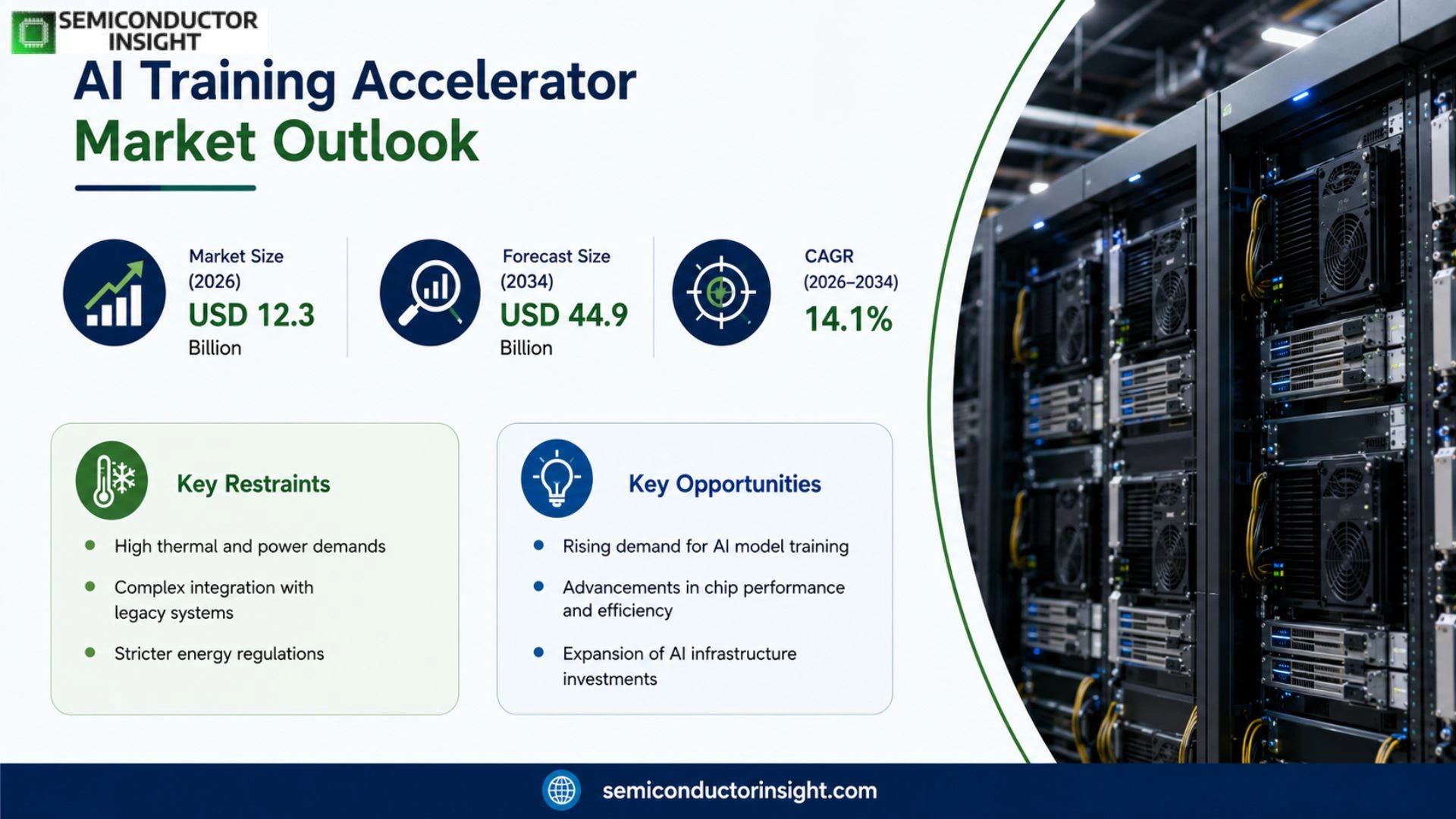
Global AI Training Accelerator market size was valued at USD 11.2 billion in 2025. The market is projected to grow from USD 12.3 billion in 2026 to USD 44.9 billion by 2034, exhibiting a CAGR of 14.1% during the forecast period.
AI training accelerators are purpose‑built processors that accelerate deep‑learning model training workloads. They include graphics processing units (GPUs), tensor processing units (TPUs), field‑programmable gate arrays (FPGAs) and application‑specific integrated circuits (ASICs), all engineered for high compute density, massive parallelism and optimized memory bandwidth.
The sector is expanding because enterprises are scaling generative‑AI projects while cloud providers enlarge their infrastructure capacities. Rising demand for real‑time inference at the edge also pushes manufacturers toward power‑efficient designs. Recent collaborations underscore this trend; in March 2024 Nvidia entered a joint development agreement with Microsoft Azure to embed next‑generation Hopper GPUs into Azure’s AI supercomputing service, and Intel launched its Habana Gaudi 3 accelerator series aimed at hyperscale datacenters. Leading firms such as Nvidia, AMD, Intel and Graphcore continue broadening their portfolios, reinforcing the upward trajectory of the industry.
MARKET DRIVERS
Rising Computational Demands
Enterprises tackling models with hundreds of billions of parameters are encountering wall‑time limits that traditional GPUs cannot overcome. This pressure compels firms to adopt purpose‑built AI Training Accelerators, which deliver higher FLOPS per watt and compress training cycles from weeks to days. Speed gains translate directly into faster product rollout and competitive advantage, prompting budget reallocations toward accelerator‑centric infrastructure.
Edge Deployment and Energy Efficiency
As inference migrates from data‑center clouds to edge nodes, the need for training platforms that can simulate low‑latency constraints grows. Accelerators engineered for energy‑aware workloads allow developers to prototype edge‑ready models without over‑provisioning power. Businesses that master this balance gain pricing power in latency‑sensitive sectors such as autonomous transport and industrial IoT.
➤ “Accelerator‑based pipelines can trim model training time by up to 60 % while cutting energy consumption by roughly one third.”
The confluence of massive data generation, tighter time‑to‑market expectations, and sustainability mandates positions tAI Training Accelerator Market as a strategic priority for leading AI adopters. Companies that embed these chips early are already reshaping R&D roadmaps and establishing new cost baselines.
MARKET CHALLENGES
Escalating Capital Expenditure
Acquiring next‑generation accelerator clusters often requires multi‑digit investments, stretching the CapEx of mid‑size firms. While the performance upside is clear, financing structures and ROI calculations become more complex, especially when revenue cycles extend beyond a single fiscal year. Decision makers must weigh depreciation schedules against the risk of technology obsolescence.
Other Challenges
Supply Chain Volatility
Component shortages for high‑bandwidth memory and silicon wafers have introduced lead‑time extensions of 30‑40 %. This unpredictability forces buyers to maintain safety stock or negotiate long‑term contracts, both of which erode the cost advantage of accelerator adoption.
In parallel, the talent pool proficient in low‑level accelerator programming remains shallow. Organizations spend additional resources on upskilling or contracting niche expertise, which can delay project timelines and inflate operational budgets.
MARKET RESTRAINTS
Thermal and Power Constraints
High‑density accelerator racks generate heat levels that exceed the cooling capacity of legacy data‑center designs. Installing advanced liquid‑cooling systems entails retrofits that add both capital and maintenance burdens. Without adequate thermal management, performance throttling becomes inevitable, deterring some enterprises from scaling accelerator fleets.
Regulatory frameworks governing data‑center energy usage have tightened, especially in regions with aggressive carbon‑reduction targets. Compliance often requires detailed reporting and may impose penalties for excess consumption, curbing the enthusiasm for power‑hungry acceleration solutions.
Integration complexity represents another restraint. Legacy software stacks must be re‑engineered to communicate efficiently with proprietary accelerator APIs, a process that can introduce bugs and extend validation cycles.
MARKET OPPORTUNITIES
Custom ASIC Design Services
Companies that offer turnkey ASIC development,covering architecture definition, layout, and post‑silicon validation,stand to capture a growing slice of tAI Training Accelerator Market. Tailored designs allow customers to target niche workloads, achieving efficiency gains unattainable with off‑the‑shelf GPUs. Service‑oriented providers can monetize recurring design‑iteration contracts, creating a sustainable revenue stream.
AI‑as‑a‑Service platforms that embed accelerator‑backed training modules are extending their reach to mid‑market firms. By abstracting hardware management, these platforms lower the entry barrier and accelerate adoption across industries that previously lacked in‑house expertise.
Emerging economies are investing heavily in sovereign AI initiatives, establishing national compute clusters that prioritize locally manufactured accelerators. This geopolitical shift opens avenues for joint ventures, technology transfer agreements, and localized supply chains.
AI Training Accelerator Market Trends
Enterprise Scaling of Generative AI Fuels Accelerator Adoption
Enterprises are expanding generative‑AI initiatives at a pace that outstrips the capabilities of conventional compute. To keep training cycles within acceptable windows, firms are turning to purpose‑built processors that can deliver higher compute density and parallelism. The March 2024 partnership between Nvidia and Microsoft Azure, which integrates the latest Hopper GPUs into Azure’s AI supercomputing offering, illustrates how cloud providers are layering specialized silicon into their service stacks to meet this pressure. Likewise, Intel’s introduction of the Habana Gaudi 3 series signals a shift toward accelerators optimized for hyperscale datacenters, where energy consumption and throughput are tightly coupled. These moves underscore a market that is aligning hardware roadmaps with the aggressive timelines of AI product development.
Other Trends
Edge Computing and Power‑Efficient Designs
Real‑time inference at the edge is compelling organizations to demand accelerators that balance performance with low power draw. Field‑programmable gate arrays and emerging ASICs are being tweaked to fit within the thermal envelopes of remote installations, from autonomous vehicles to industrial IoT gateways. This emphasis on efficiency is prompting vendors to offer modular solutions that can be scaled down without sacrificing the parallel processing needed for on‑device model refinement. The ripple effect is a broader customer base that includes not only hyperscale cloud operators but also midsized firms deploying AI at the network perimeter.
Software Stack Maturation and Ecosystem Diversification
Parallel to hardware progress, the software ecosystem surrounding tAI Training Accelerator Market is reaching a level of abstraction that reduces integration friction. Open‑source frameworks now expose vendor‑agnostic APIs, allowing developers to target GPUs, TPUs, FPGAs, or ASICs with minimal code changes. This convergence accelerates time‑to‑value for organizations that previously hesitated due to the perceived lock‑in of proprietary toolchains. At the same time, a growing roster of niche players such as Graphcore is expanding the competitive landscape, fostering innovation in both architecture and compiler technologies. For customers, the combined effect is a richer selection of solutions that can be matched to specific workload characteristics, ultimately driving more nuanced investment decisions across the AI training value chain.
COMPETITIVE LANDSCAPE
Key Industry Players
AI Training Accelerator Market – Competitive Overview
Nvidia dominates the accelerator segment through a blend of high‑performance GPU families and strategic cloud alliances. Its Hopper architecture, recently integrated into Microsoft Azure’s AI supercomputing tier, illustrates how the company leverages both hardware speed and ecosystem lock‑in to command premium pricing. The company’s breadth of product generations,ranging from consumer‑grade RTX cards to data‑center‑grade H100 units,creates a tiered value proposition that satisfies start‑ups and hyperscale operators alike. This tiered approach forces rivals to specialize: AMD pushes a differentiated price‑performance curve, Intel concentrates on ASIC‑based Habana Gaudi designs for power‑constrained hyperscale workloads, while Google’s TPU line exploits tight software integration within its own cloud services. The market architecture therefore comprises three clear strata,high‑end GPUs, purpose‑built ASICs, and emerging FPGA/neuromorphic solutions,each with distinct cost structures and developer ecosystems.
Beyond the headline makers, a cohort of niche innovators is reshaping specific workload corners. Graphcore’s IPU targets irregular neural‑network topologies, offering developers fine‑grained parallelism that GPUs cannot match. Cerebras delivers wafer‑scale engines that collapse latency for massive models, while SambaNova focuses on turnkey AI systems that bundle hardware, software, and data pipelines. Tenstorrent and Qualcomm are betting on energy‑efficient architectures for edge inference, positioning themselves for the expanding demand of on‑device AI. Alibaba’s PAI accelerator and Horizon Robotics pursue the Chinese market’s blend of cloud and edge, whereas smaller firms such as Mythic and Cambrian concentrate on analog or mixed‑signal designs that promise lower power draw. The diversity of these players illustrates a market where no single technology can claim universal supremacy; instead, competitive advantage hinges on the ability to align processor characteristics with evolving model sizes, deployment footprints, and software stacks.
List of Key AI Training Accelerator Companies Profiled
- Nvidia
- AMD
- Intel (Habana)
- Google (TPU)
- Graphcore
- Cerebras Systems
- SambaNova Systems
- Tenstorrent
- Qualcomm AI Research
- Alibaba Cloud PAI
- Horizon Robotics
- Mythic
- Cambrian
- Untether AI
- Wave Computing
Segment Analysis:
| Segment Category | Sub-Segments | Key Insights |
| By Type |
|
GPUs remain the dominant accelerator due to:
|
| By Application |
|
Data‑Center Training drives market momentum because:
|
| By End User |
|
Cloud Service Providers lead because:
|
| By Deployment Model |
|
Hybrid Cloud is emerging as the preferred model due to:
|
| By Performance Tier |
|
High‑End accelerators attract the most attention because:
|
Regional Analysis: AI Training Accelerator Market
North America
The North American talent pipeline feeds tAI Training Accelerator Market with a steady stream of PhDs and cloud‑native engineers. Universities in the Bay Area and Toronto emphasize systems‑level AI curricula, while industry consortia sponsor bootcamps that focus on accelerator‑aware model optimization. This blend of academic depth and practical exposure shortens the skill acquisition curve for firms expanding their training capacities.
The region’s infrastructure investment is anchored by both private and public capital targeting next‑generation compute fabrics. Sovereign wealth funds in Canada and venture partners in Silicon Valley allocate funds to custom ASIC development and high‑bandwidth interconnects. Such financing accelerates the rollout of clusters that can sustain petaflop‑scale training, keeping the market’s performance envelope expanding.
Regulators in the United States and Canada have crafted frameworks that balance innovation with responsible AI use. Guidelines around model provenance and export controls provide clarity for firms navigating multi‑jurisdictional deployments. This regulatory predictability reduces friction for companies scaling accelerator workloads across borders.
Enterprises across finance, health, and autonomous systems are layering accelerator clusters onto existing data lakes to cut inference latency. By co‑locating training nodes with storage arrays, firms realize cost efficiencies that make large‑scale model iteration financially viable. The resulting shift from experimental pilots to production‑grade deployments signals deeper market entrenchment.
Europe
Europe remains a strong contender in tAI Training Accelerator Market, leveraging a policy‑driven approach that emphasizes ethical AI and data sovereignty. The European Union’s investment in high‑performance computing hubs,such as the EuroHPC initiatives in Germany and France,creates shared resources that smaller firms can tap without massive capital spend. Coupled with a dense network of research labs in the UK and the Nordic countries, the continent nurtures expertise in power‑efficient accelerator design. However, fragmented funding cycles and varying national regulations sometimes slow cross‑border collaborations, prompting firms to adopt a modular architecture that can operate under divergent compliance regimes. This adaptive strategy allows European players to stay competitive while aligning with the region’s sustainability agenda.
Asia‑Pacific
Asia‑Pacific’s role in tAI Training Accelerator Market is defined by rapid scaling of cloud providers and a surge in AI‑centric startups. Nations such as Japan, South Korea, and Singapore invest heavily in semiconductor R&D, resulting in home‑grown accelerator chips that compete on performance per watt. The vast data reservoirs generated by mobile ecosystems in India and Indonesia fuel demand for localized training solutions, encouraging cloud operators to launch region‑specific accelerator instances. Cultural emphasis on rapid go‑to‑market cycles pushes firms to prioritize speed over exhaustive testing, which can accelerate adoption but also raise concerns about model robustness. Balancing speed with quality will be a decisive factor for sustained growth in this diverse landscape.
South America
South America’s contribution to tAI Training Accelerator Market is emerging, driven primarily by Brazil’s push to modernize its digital infrastructure. Government‑backed programs aim to establish national AI labs that integrate accelerator hardware with public datasets in agriculture and energy sectors. While capital availability lags behind more mature markets, collaboration between universities and fintech startups creates innovative use‑cases that showcase the efficiency gains of specialized training pipelines. Language diversity and lower bandwidth in certain regions compel firms to adopt model compression techniques, turning the continent into a testbed for lightweight accelerator strategies that could later be exported globally.
Middle East & Africa
The Middle East & Africa region is carving a niche within tAI Training Accelerator Market by aligning accelerator deployments with sovereign cloud initiatives. In the United Arab Emirates and Saudi Arabia, state‑owned enterprises are building data centers equipped with purpose‑built AI chips to support national visions for smart city development. Africa’s burgeoning mobile economy, especially in Kenya and Nigeria, generates vast streams of unstructured data that call for on‑device training capabilities. Limited local manufacturing pushes operators to import hardware, but favorable tax regimes and strategic partnerships with global OEMs mitigate cost pressures. As regional sovereign cloud platforms mature, they are likely to become launchpads for accelerator‑centric services tailored to local market needs.
Report Scope
This market research report provides a comprehensive analysis of the AI Training Accelerator Market , covering the forecast period 2026–2034. It offers detailed insights into market dynamics, technological advancements, competitive landscape, and key trends shaping the industry.
Key focus areas of the report include:
- Market Overview: The report begins with an overview outlining its current market scenario, key growth indicators, and industry transformation drivers. It discusses macroeconomic factors, demand–supply balance, regulatory landscape, and the strategic role of semiconductors in powering advancements across industries such as automotive, telecommunications, consumer electronics, and industrial automation.
- Market Size & Forecast: Historical data and future projections for revenue, unit shipments, and market value across major regions and segments.
- Segmentation Analysis: Detailed breakdown by product type, technology, application, and end-user industry to identify high-growth segments and investment opportunities.
- Regional Insights: Insights into market performance across North America, Europe, Asia-Pacific, Latin America, and the Middle East & Africa, including country-level analysis where relevant.
- Competitive Landscape: Profiles of leading market participants, including their product offerings, R&D focus, manufacturing capacity, pricing strategies, and recent developments such as mergers, acquisitions, and partnerships.
- Technology Trends & Innovation: Assessment of emerging technologies, integration of AI/IoT, semiconductor design trends, fabrication techniques, and evolving industry standards.
- Market Drivers & Restraints: Evaluation of factors driving market growth along with challenges, supply chain constraints, regulatory issues, and market-entry barriers.
- Stakeholder Insights: Insights for component suppliers, OEMs, system integrators, investors, and policymakers regarding the evolving ecosystem and strategic opportunities.
Primary and secondary research methods are employed, including interviews with industry experts, data from verified sources, and real-time market intelligence to ensure the accuracy and reliability of the insights presented.
FREQUENTLY ASKED QUESTIONS:
What is the current market size of AI Training Accelerator Market?
-> AI Training Accelerator market is projected to grow from USD 12.3 billion in 2026 to USD 44.9 billion by 2034, exhibiting a CAGR of 14.1%
Which key companies operate in AI Training Accelerator Market?
-> Key players include Nvidia, AMD, Intel, and Graphcore, among others.
What are the key growth drivers?
-> Key growth drivers include enterprises scaling generative‑AI projects, cloud providers expanding infrastructure capacities, rising demand for real‑time inference at the edge, and the push for power‑efficient accelerator designs.
Which region dominates the market?
-> North America leads the market due to the concentration of major AI accelerator vendors and extensive cloud infrastructure investments.
What are the emerging trends?
-> Emerging trends include development of power‑efficient accelerator architectures, integration of AI accelerators into edge devices, and strategic collaborations such as Nvidia’s partnership with Microsoft Azure and Intel’s launch of the Habana Gaudi 3 series.

Get Sample Report PDF for Exclusive Insights
Report Sample Includes
- Table of Contents
- List of Tables & Figures
- Charts, Research Methodology, and more...
 Download Sample Report PDF