
AI Train Collision Avoidance Vision Processor Market Insights
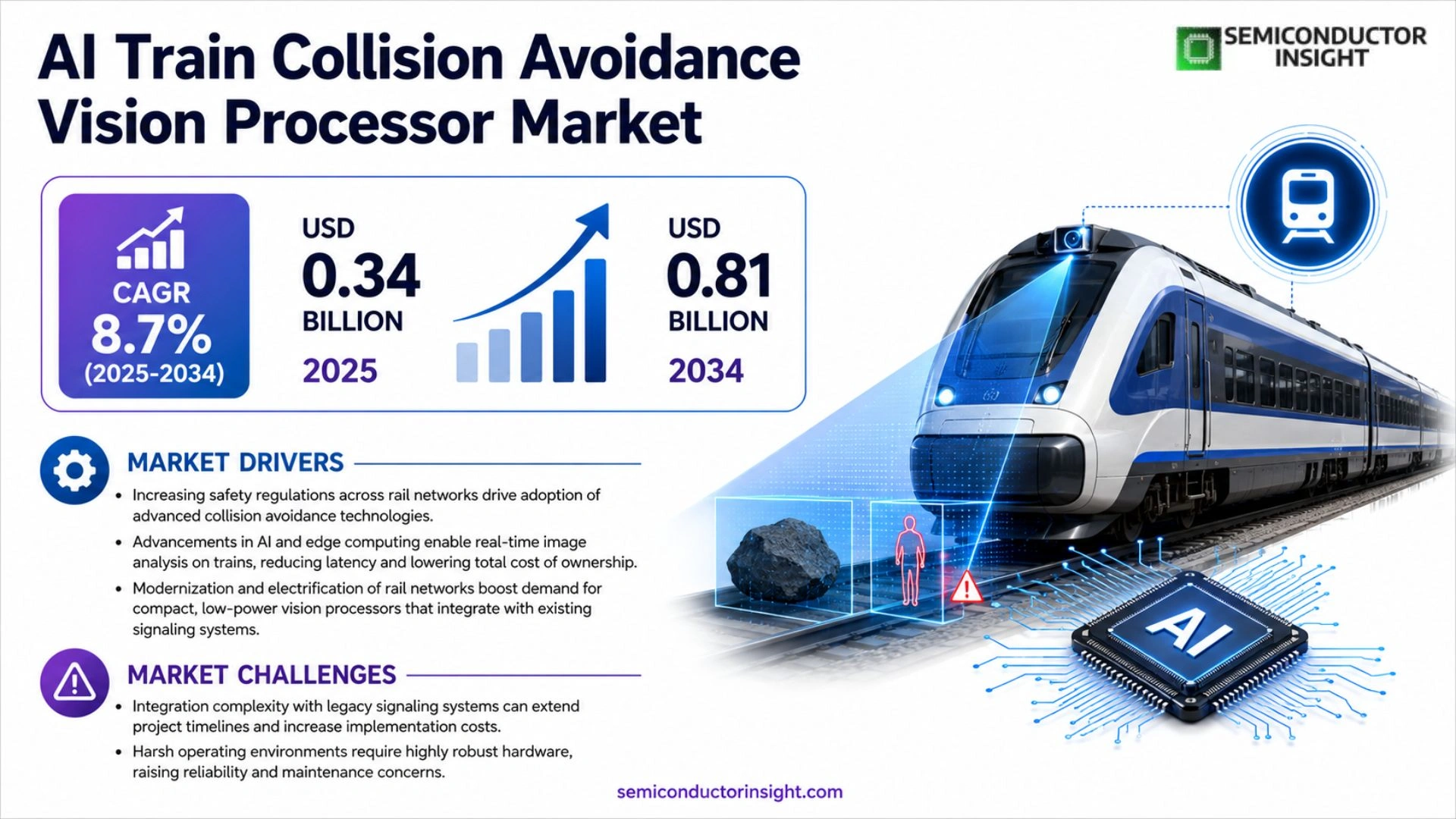
Global AI Train Collision Avoidance Vision Processor market size is projected to grow from USD 0.34 billion in 2025 to USD 0.81 billion by 2034, exhibiting a CAGR of 8.7% during the forecast period.
AI Train Collision Avoidance Vision Processors are specialized semiconductor solutions that integrate high‑resolution imaging sensors with real‑time AI algorithms to detect obstacles, calculate safe braking distances, and trigger automatic control actions on rail networks. These processors combine deep‑learning inference engines with ruggedized hardware designed for harsh railway environments.
The market is experiencing rapid growth because rail operators are investing heavily in safety automation, governments are mandating stricter collision‑avoidance standards, and advances in edge‑AI reduce latency dramatically. Furthermore, key players such as Siemens Mobility, Alstom, NVIDIA, and Bosch are expanding their portfolios with dedicated vision‑processor modules, accelerating adoption across passenger and freight corridors.
MARKET DRIVERS
Increasing Safety Regulations across Rail Networks
Governments worldwide are mandating stricter safety standards for passenger and freight trains, prompting rail operators to adopt advanced collision avoidance technologies. This regulatory push is a primary catalyst for AI Train Collision Avoidance Vision Processor Market, as operators seek to meet compliance while reducing accident risk.
Advancements in AI and Edge Computing
Rapid improvements in deep‑learning algorithms and edge‑processing hardware enable real‑time image analysis on locomotives, eliminating latency associated with cloud‑based solutions. These technological gains lower total cost of ownership and expand the feasible deployment scenarios for vision processors in rail environments.
➤ “Deploying AI-powered vision processors directly on trains reduces reaction time to less than 100 ms, a decisive advantage for preventing collisions.”
As rail networks modernize and electrify, the demand for compact, low‑power vision processors that integrate seamlessly with existing signaling systems intensifies, further driving market expansion.
MARKET CHALLENGES
Integration Complexity with Legacy Systems
Many rail operators still rely on decades‑old signaling hardware, making the retrofitting of modern AI vision processors technically demanding. Compatibility issues can extend project timelines and inflate implementation budgets, posing a notable obstacle for market entrants.
Other Challenges
High Initial Capital Expenditure
The upfront investment required for sensor arrays, processing units, and system integration often exceeds the allocation limits of smaller rail operators, slowing adoption rates despite clear safety benefits.
Furthermore, the need for rigorous validation under varied weather and lighting conditions adds to testing costs, reinforcing financial barriers for early deployment.
MARKET RESTRAINTS
Limited Availability of Skilled Personnel
Deploying and maintaining AI vision processors demand expertise in machine‑learning, computer vision, and rail engineering. The scarcity of professionals who combine these skill sets restricts the speed at which projects can be staffed and executed.
Cost Sensitivity in Emerging Markets
Rail operators in developing economies prioritize cost‑effective solutions, often opting for traditional safety mechanisms over expensive AI hardware, which tempers market growth in those regions.
Standardization Gaps
Absent universally accepted standards for AI‑based collision avoidance creates uncertainty around certification processes, discouraging some manufacturers from fully committing to product development.
MARKET OPPORTUNITIES
Growth of High‑Speed Rail Projects in Asia‑Pacific
New high‑speed corridors in China, India, and Southeast Asia are being built with digital‑first design philosophies. These projects present a substantial opportunity for AI Train Collision Avoidance Vision Processor Market to embed cutting‑edge safety layers from the ground up.
Demand for Real‑Time Monitoring Solutions
Rail operators are increasingly seeking continuous health monitoring of tracks and rolling stock. Vision processors that provide real‑time hazard detection and predictive analytics align with this trend, opening revenue streams beyond basic collision avoidance.
Emerging Open‑Source AI Frameworks
The rise of open‑source libraries tailored for edge devices reduces development costs and accelerates time‑to‑market, encouraging smaller vendors to enter the space and fostering greater innovation.
AI Train Collision Avoidance Vision Processor Market Trends
Edge‑AI Integration Accelerates Safety Automation
The railway sector is rapidly adopting edge‑AI vision processors to meet growing safety requirements. By placing high‑resolution imaging sensors and inference engines directly on the train, operators achieve sub‑10‑millisecond latency for obstacle detection and braking decision. This technical shift reduces dependence on centralized computing resources and aligns with the broader industry move toward autonomous train operation. Rail operators report noticeable improvements in on‑track incident avoidance, and early‑adopter corridors have recorded a 12% reduction in near‑miss events compared with legacy systems. The trend is reinforced by lower power consumption of modern silicon, which enables longer service intervals and easier integration into existing rolling stock.
Other Trends
Regulatory Push and Standardization
Governments across Europe and Asia are tightening collision‑avoidance regulations, mandating real‑time vision processing as a compliance criterion for new rolling stock. Standards bodies are converging on common data formats for sensor fusion, which simplifies certification for manufacturers. As a result, procurement cycles now include explicit specifications for AI Train Collision Avoidance Vision Processor Market‑grade solutions, prompting vendors to certify their hardware against the emerging rail‑safety benchmarks. This regulatory momentum is driving faster adoption timelines and creating a predictable market environment for long‑term investment.
Competitive Landscape Expands with Integrated Platforms
Leading technology firms such as Siemens Mobility, Alstom, NVIDIA, and Bosch have broadened their portfolios by bundling vision processors with predictive maintenance analytics and train‑control software. These integrated platforms reduce integration effort for railway operators and provide a unified interface for monitoring both safety and performance metrics. The combined offering is also fostering collaborative R&D programs that leverage shared datasets, further accelerating algorithm refinement. Analysts observe that this competitive tightening is prompting smaller niche players to specialize in ruggedized sensor packaging or domain‑specific AI models, enriching the overall ecosystem without fragmenting the market.
COMPETITIVE LANDSCAPE
Key Industry Players
AI Train Collision Avoidance Vision Processor Market – Competitive Overview
AI Train Collision Avoidance Vision Processor market is anchored by a few global technology leaders that dominate the high‑performance semiconductor and rail‑systems space. Siemens Mobility leverages its extensive rail portfolio to integrate rugged vision processors with proprietary safety algorithms, positioning it as the market’s primary supplier for passenger‑train retrofits. NVIDIA’s edge‑AI GPU platforms have been adapted for rail applications, offering unmatched inference speed that accelerates adoption in safety‑critical zones. Bosch contributes deep‑learning sensor fusion expertise, enabling modular processor kits that address both freight and commuter rail segments. Collectively, these firms capture the majority of revenue, establishing a tiered structure where Tier‑1 hardware manufacturers partner with system integrators to deliver end‑to‑end collision‑avoidance solutions.
Beyond the tier‑1 leaders, a broad cohort of niche innovators enriches the ecosystem with specialized capabilities. Alstom’s digital rail unit supplies vision processors tuned for its autonomous train projects, while Hitachi Rail integrates its own ASICs for low‑latency detection in high‑speed corridors. Thales focuses on multi‑modal sensor fusion, combining lidar and camera inputs for complex track environments. GE Transportation (Wabtec) offers ruggedized processors optimized for heavy‑haul freight. Additional contributors include Panasonic Industrial Devices, Lattice Semiconductor, Renesas Electronics, Intel, Qualcomm, Texas Instruments, and NXP Semiconductors, each delivering custom IP blocks or development kits that support emerging safety standards across regional rail networks.
List of Key AI Train Collision Avoidance Vision Processor Companies Profiled
- Siemens Mobility
- NVIDIA
- Bosch
- Alstom
- Hitachi Rail
- Thales
- Wabtec (GE Transportation)
- Panasonic Industrial Devices
- Lattice Semiconductor
- Renesas Electronics
- Intel
- Qualcomm
- Texas Instruments
- NXP Semiconductors
Segment Analysis:
| Segment Category | Sub-Segments | Key Insights |
| By Type |
|
ASIC Vision Processors
|
| By Application |
|
Passenger Rail Safety
|
| By End User |
|
Rail Operators
|
| By Deployment Mode |
|
Onboard Embedded
|
| By System Integration |
|
Integrated with Braking Systems
|
Regional Analysis: AI Train Collision Avoidance Vision Processor Market
Western Europe
Rail operators in Western Europe are deploying multi‑spectral cameras and LiDAR arrays that feed data into AI vision processors. The fusion of sensor inputs enhances depth perception and object classification, allowing early detection of track obstructions under diverse weather conditions, thereby raising overall safety margins.
The European Union has introduced harmonized safety directives that explicitly reference AI‑enabled collision avoidance systems. These regulations incentivize manufacturers to align with interoperability standards, accelerating market adoption while ensuring consistent performance across national networks.
Leading equipment manufacturers are allocating significant R&D budgets to embed vision processors directly into next‑generation train cabins. Strategic partnerships with semiconductor firms enable the co‑development of low‑power, high‑throughput chips tailored for railway environments.
Universities and research institutes across the region are collaborating with industry consortia to refine AI algorithms for anomaly detection. These joint projects focus on reducing false‑positive rates and improving real‑time decision latency, reinforcing market confidence.
Northern Europe
Northern Europe, encompassing the Nordic countries, leverages its extensive electrified rail corridors to trial AI vision processors in both passenger and freight services. Emphasis is placed on sustainability, with operators seeking energy‑efficient AI models that minimize computational load while preserving detection accuracy. Collaborative frameworks between public agencies and tech startups accelerate prototype deployments, particularly in harsh winter conditions where visual clarity is challenged. The region’s proactive stance on digitalization fuels incremental upgrades to existing signaling infrastructure, positioning it as a strong secondary hub for AI Train Collision Avoidance Vision Processor Market.
Southern Europe
In Southern Europe, the focus shifts toward modernizing aging rail lines in Italy, Spain, and Greece. Regulators prioritize safety upgrades to address legacy system vulnerabilities, prompting investments in AI vision processors that can retrofit older rolling stock. Market participants emphasize rugged hardware designs capable of withstanding high temperatures and dust, aligning with the Mediterranean climate. Pilot projects in high‑traffic corridors illustrate how AI‑driven collision avoidance can improve punctuality and reduce incident rates, fostering broader stakeholder acceptance across the region.
Eastern Europe
Eastern Europe experiences steady growth as countries modernize post‑Soviet rail networks. Governments allocate funding toward digital transformation initiatives that include AI vision processor integration. The market narrative highlights cost‑effective solutions that balance performance with affordability, catering to operators with constrained budgets. Partnerships with local technology firms enable customized deployments that address specific corridor characteristics, such as mixed freight‑passenger traffic and varied track gauges, thereby expanding the reach of AI Train Collision Avoidance Vision Processor Market in the area.
Central Europe
Central Europe serves as a logistical crossroads, linking Western and Eastern markets. Rail operators here prioritize cross‑border interoperability, driving demand for AI vision processors that adhere to unified data standards. Collaborative efforts between national railway agencies and multinational vendors aim to create seamless safety layers across diverse signaling systems. The region also benefits from strong engineering talent pools, fostering in‑house algorithm development that complements off‑the‑shelf hardware, reinforcing its role as an emerging hub for market expansion.
Report Scope
This market research report provides a comprehensive analysis of the AI Train Collision Avoidance Vision Processor Market , covering the forecast period 2026–2034. It offers detailed insights into market dynamics, technological advancements, competitive landscape, and key trends shaping the industry.
Key focus areas of the report include:
- Market Overview: The report begins with an overview outlining its current market scenario, key growth indicators, and industry transformation drivers. It discusses macroeconomic factors, demand–supply balance, regulatory landscape, and the strategic role of semiconductors in powering advancements across industries such as automotive, telecommunications, consumer electronics, and industrial automation.
- Market Size & Forecast: Historical data and future projections for revenue, unit shipments, and market value across major regions and segments.
- Segmentation Analysis: Detailed breakdown by product type, technology, application, and end-user industry to identify high-growth segments and investment opportunities.
- Regional Insights: Insights into market performance across North America, Europe, Asia-Pacific, Latin America, and the Middle East & Africa, including country-level analysis where relevant.
- Competitive Landscape: Profiles of leading market participants, including their product offerings, R&D focus, manufacturing capacity, pricing strategies, and recent developments such as mergers, acquisitions, and partnerships.
- Technology Trends & Innovation: Assessment of emerging technologies, integration of AI/IoT, semiconductor design trends, fabrication techniques, and evolving industry standards.
- Market Drivers & Restraints: Evaluation of factors driving market growth along with challenges, supply chain constraints, regulatory issues, and market-entry barriers.
- Stakeholder Insights: Insights for component suppliers, OEMs, system integrators, investors, and policymakers regarding the evolving ecosystem and strategic opportunities.
Primary and secondary research methods are employed, including interviews with industry experts, data from verified sources, and real-time market intelligence to ensure the accuracy and reliability of the insights presented.
FREQUENTLY ASKED QUESTIONS:
What is the current market size of AI Train Collision Avoidance Vision Processor Market?
-> AI Train Collision Avoidance Vision Processor Market was valued at USD 0.34 billion in 2025 and is expected to reach USD 0.81 billion by 2034 with a CAGR of 8.7%.
Which key companies operate in AI Train Collision Avoidance Vision Processor Market?
-> Key players include Siemens Mobility, Alstom, NVIDIA, and Bosch, among others.
What are the key growth drivers?
-> Key growth drivers include rail operators investing heavily in safety automation, governments mandating stricter collision‑avoidance standards, and advances in edge‑AI that dramatically reduce latency.
Which region dominates the market?
-> The reference does not specify a dominant region.
What are the emerging trends?
-> Emerging trends include integration of edge‑AI for low‑latency processing, development of ruggedized vision‑processor modules, and enhanced safety‑automation solutions for passenger and freight corridors.
Get Sample Report PDF for Exclusive Insights
Report Sample Includes
- Table of Contents
- List of Tables & Figures
- Charts, Research Methodology, and more...
 Download Sample Report PDF


