AI-Specific Vapor Chamber Cold Plate Market Insights
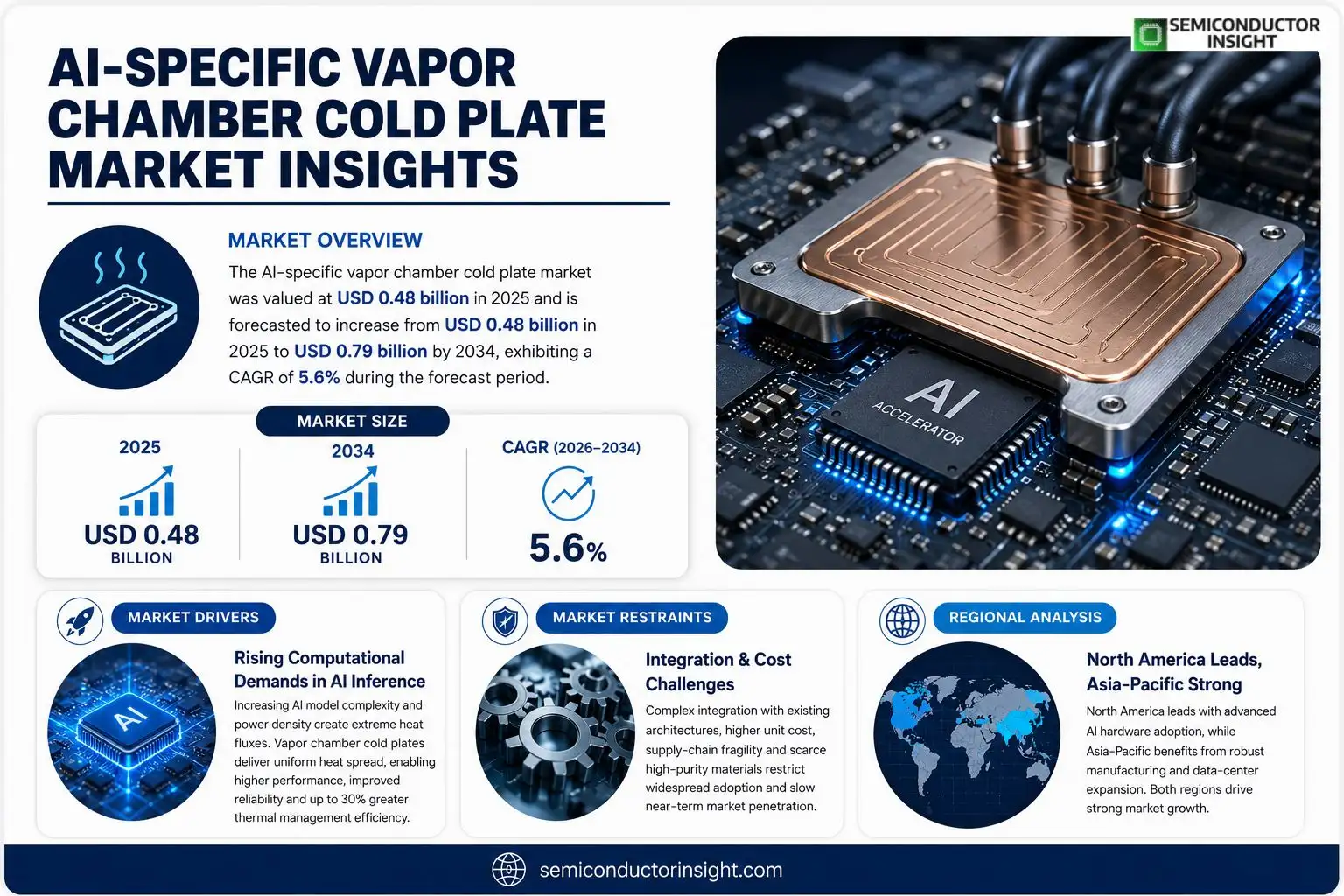
AI-specific vapor chamber cold plate market size was valued at USD 0.48 billion in 2025. The market is forecasted to increase from USD 0.48 billion in 2025 to USD 0.79 billion by 2034, exhibiting a CAGR of 5.6% during the forecast period.
Vapor‑chamber cold plates are sealed metal enclosures containing a working fluid that evaporates at low pressure, spreading heat uniformly across their surface before condensing back into liquid form. In AI hardware they are mounted directly on high‑density processorssuch as GPUs and TPUsto remove hotspots more efficiently than conventional heat sinks, thereby sustaining peak performance while reducing energy consumption.The expansion of this segment reflects heightened demand for ultra‑efficient cooling solutions as AI workloads intensify and data‑center power budgets tighten. Moreover, ongoing investments in edge‑computing infrastructure and the rollout of next‑generation semiconductor nodes encourage manufacturers to adopt vapor‑chamber technology for its superior thermal conductivity. Companies such as Asetek, CoolIT Systems and Fujikura are actively expanding their portfolios to meet these requirements.
MARKET DRIVERS
Rising Computational Demands in AI Inference
Modern AI models now operate with parameter counts that eclipse earlier generations, creating heat fluxes that exceed the capacity of conventional cooling solutions. Companies that embed inference engines at the edge are forced to confront thermal ceilings that, if unaddressed, erode reliability and throttle performance. Thermal bottlenecks are therefore a primary catalyst for adopting vapor‑chamber cold plates tuned to AI workloads.
Thermal Management Efficiency Gains
Vapor‑chamber technology spreads heat laterally with minimal temperature gradients, delivering a uniform surface that keeps high‑density chips within optimal operating windows. The resulting reduction in hotspot intensity translates into longer device lifespans and tighter power budgets, a compelling proposition for data‑center operators seeking to lower total cost of ownership. Efficiency improvements of up to 30 % over traditional heat sinks have been reported in benchmark studies.
➤ “Adopting AI‑Specific vapor‑chamber cold plates has become a competitive differentiator for OEMs targeting high‑performance compute modules.”
Manufacturers that integrate these cold plates early gain a strategic edge, as the thermal headroom they provide enables more aggressive silicon scaling without incurring costly redesigns. The ripple effect is visible across supply chains, where component vendors adjust specifications to accommodate the higher heat‑removal rates demanded by next‑generation AI accelerators.
MARKET CHALLENGES
Integration Complexity with Existing Architectures
Embedding a vapor‑chamber cold plate into an already packed board often requires redesign of mechanical mounting points and re‑evaluation of airflow pathways. This added engineering effort can stretch development cycles, especially for firms lacking in‑house thermal expertise. The need to harmonize fluid‑tight seals with electronic packaging standards introduces an extra layer of validation that many OEMs find resource‑intensive.
Other Challenges
Cost Sensitivity
While performance gains are evident, the unit cost of a precision‑engineered vapor chamber remains higher than that of conventional aluminum heat sinks. Budget‑constrained projects may therefore postpone adoption until economies of scale materialize, limiting near‑term market penetration.Regulatory scrutiny over the use of certain refrigerants in vapor chambers adds another hurdle; manufacturers must ensure compliance with evolving environmental directives, which can delay product launches in key regions.
MARKET RESTRAINTS
Supply‑Chain Fragility for High‑Purity Materials
The production of ultra‑thin copper sheets and high‑conductivity graphite corescore components of vapor‑chamber cold platesrelies on a limited pool of specialized suppliers. Recent geopolitical tensions have amplified lead times, prompting manufacturers to hold higher inventory levels and thus increasing working capital requirements.Furthermore, the specialized bonding processes required to seal the chamber are not widely available, creating a bottleneck that can slow down volume ramp‑up for large‑scale projects.
MARKET OPPORTUNITIES
Emerging Edge‑AI Deployments
Edge devices that run inference locallysuch as autonomous drones, industrial vision systems, and smart sensorsdemand compact yet powerful cooling solutions. AI-Specific Vapor Chamber Cold Plate Market is uniquely positioned to satisfy this niche, where space constraints rule out oversized heat exchangers and power budgets are tightly capped. By tailoring chamber geometry to specific ASIC footprints, vendors can unlock performance margins that were previously unattainable.Partnerships between silicon designers and thermal‑module manufacturers are expected to accelerate product co‑development, shortening time‑to‑market and creating differentiated offerings that command premium pricing.
AI-Specific Vapor Chamber Cold Plate Market Trends
Rising Demand for Ultra‑Efficient Thermal Management in AI Accelerators
AI-Specific Vapor Chamber Cold Plate Market has moved beyond a niche solution toward a mainstream component for high‑density processors. As AI models become deeper and inference workloads grow, power densities on GPUs and TPUs exceed 300 W/in², creating localized hot spots that traditional heat sinks struggle to dissipate. Vapor‑chamber cold plates spread heat through phase‑change dynamics, delivering a uniform temperature profile and allowing chips to operate near their thermal limits without throttling. This capability translates directly into lower energy draw per computation, an outcome that data‑center operators value when power budgets tighten. The market’s valuation of US 0.48 billion in 2025 and its projected climb to US 0.79 billion by 2034 illustrate that manufacturers are allocating design resources to this technology at a measurable pace.
Other Trends
Edge‑Computing Expansion
Edge deployments introduce a new set of thermal constraints: limited enclosure space, variable ambient temperatures, and the need for silent operation. Vapor‑chamber cold plates address these challenges by combining compact form factors with high thermal conductivity, enabling AI inference nodes to be placed in environments such as factories, autonomous vehicles, and retail kiosks. Companies like CoolIT Systems have announced edge‑focused modules that integrate directly with system‑in‑package (SiP) designs, reducing the thermal resistance chain. The shift toward edge AI is prompting OEMs to specify vapor‑chamber solutions early in the product development cycle, thereby creating a feedback loop that accelerates component standardization and drives modest price improvements.
Competitive Landscape and Product Innovation
Leading firmsincluding Asetek, Fujikura, and emerging specialist manufacturersare expanding their portfolios to cover a broader range of processor architectures and power envelopes. Recent product releases feature modular chambers that can be re‑configured for varying coolant flow rates, allowing system integrators to fine‑tune performance without redesigning the hardware. In parallel, supply‑chain adjustments aimed at securing high‑purity working fluids have reduced lead times, making the technology more accessible to mid‑size data‑center operators. These competitive dynamics encourage continual iteration, meaning customers can expect incremental efficiency gains each generation, reinforcing the market’s incremental upward trajectory.
COMPETITIVE LANDSCAPEKey Industry Players
AI‑Specific Vapor Chamber Cold Plate Market – Competitive Overview
Asetek commands the forefront of the AI‑specific vapor‑chamber cold‑plate arena, leveraging its heritage in liquid‑cooling solutions for high‑performance computing. The firm’s modular architecture, which permits integration directly onto GPU and TPU modules, has earned it early contracts with leading hyperscale data‑center operators. Asetek’s ability to combine precision machining with proprietary working‑fluid formulations translates into lower thermal resistance than most conventional heat‑sink assemblies, an attribute that resonates strongly with customers seeking to tighten power envelopes while preserving compute density. The company’s recent expansion of its OEM network across North America and Europe has reinforced a tiered supply‑chain model where system integrators rely on Asetek’s design‑win capabilities to differentiate their AI‑accelerated offerings.Beyond the market leader, a cluster of specialized firms is carving out distinct niches. CoolIT Systems differentiates itself through fully‑customizable cold‑plate geometries that address irregular processor layouts common in edge‑AI devices. Fujikura brings deep expertise in metallurgical sealing techniques, enabling thinner chambers that fit within constrained chassis. Delta Electronics supplies high‑volume, cost‑effective units to enterprise‑scale deployments, emphasizing reliability under continuous‑load conditions. Arctic Cooling, Sunon, Laird Technologies, Advanced Cooling Solutions, Thermocore, Celsia, Coolervision, and Hyco complete the competitive set, each targeting sub‑segments ranging from autonomous‑vehicle compute modules to telecom‑infrastructure base‑stations. Their collective focus on material innovations, fluid‑dynamic optimization, and strategic partnerships with semiconductor fabs signals a market that rewards both breadth of application knowledge and agility in product rollout.
List of Key AI‑Specific Vapor Chamber Cold Plate Companies Profiled
- Asetek
- CoolIT Systems
- Fujikura
- Delta Electronics
- Arctic Cooling
- Sunon
- Laird Technologies
- Advanced Cooling Solutions
- Thermocore
- Celsia
- Coolervision
- Hyco
- Thermal Design Solutions
- VaporTech
- Quantum Heatflow
Segment Analysis:
| Segment Category | Sub-Segments | Key Insights |
| By Type |
|
Monolithic Vapor Chambers dominate because they deliver uniform temperature distribution across the entire plate, eliminating localized hotspots.
|
| By Application |
|
Data‑Center Server Racks are the leading application as they host the highest density AI workloads.
|
| By End User |
|
Cloud Service Providers drive adoption because they must guarantee uptime and performance for diverse AI workloads.
|
| By Technology Platform |
|
GPU‑Centric Platforms are the most prominent because GPUs generate concentrated thermal zones that benefit most from vapor‑chamber uniformity.
|
| By Deployment Environment |
|
Industrial Edge Sites are emerging as a critical segment due to the need for localized AI inference with limited space for traditional cooling.
|
Regional Analysis: AI-Specific Vapor Chamber Cold Plate Market
North America
The San Francisco Bay Area and Austin clusters host startups that fuse AI algorithm development with custom cooling architectures, creating a feedback loop where software demands directly influence hardware form‑factor innovations.
Midwest fabs provide precision machining and low‑stress bonding processes, enabling production of vapor chambers that maintain structural integrity under the high‑frequency thermal loads typical of AI inference workloads.
Federal efficiency standards reward designs that achieve higher compute per watt, prompting vendors to validate vapor‑chamber plates through certified testing programs that reinforce market credibility.
Diversified sourcing of high‑purity copper and advanced polymers mitigates bottlenecks, allowing firms to scale production without compromising the tight tolerances essential for AI‑targeted thermal management.
Europe
European manufacturers are leveraging their reputation for precision engineering to carve a niche in the AI‑Specific Vapor Chamber Cold Plate Market. Companies in Germany and France combine CNC expertise with emerging additive‑manufacturing techniques, delivering bespoke plate geometries that cater to sector‑specific AI workloads such as autonomous driving and industrial robotics. The EU’s emphasis on circular‑economy principles drives designers to consider recyclability, prompting innovations in removable vapor‑chamber modules that can be refreshed without discarding the entire cooling assembly. Moreover, cross‑border collaborations foster standards that align thermal performance metrics with the continent’s stringent safety directives, granting European suppliers a competitive edge in regulated markets.
Asia‑Pacific
Asia‑Pacific’s momentum derives from its expansive consumer electronics base and aggressive AI adoption in data centers. Taiwanese and South Korean firms excel at integrating vapor‑chamber cold plates into compact AI chips destined for smartphones and smart‑home hubs, where space savings are paramount. Meanwhile, China’s massive cloud infrastructure pushes demand for large‑scale plates that sustain high‑density blade servers. The region’s cost‑effective manufacturing ecosystem, supported by government incentives for advanced cooling technologies, encourages rapid prototyping and volume scaling. This environment accelerates the diffusion of AI‑specific thermal solutions across both consumer and enterprise segments.
South America
In South America, emerging AI initiatives in Brazil and Mexico are prompting local integrators to explore vapor‑chamber cooling as a way to improve reliability of edge devices deployed in harsh climates. The region’s growing renewable‑energy projects also create a demand for AI‑enabled monitoring systems that operate continuously; efficient thermal management extends hardware lifespan, reducing total cost of ownership. Partnerships between multinational OEMs and regional engineering firms facilitate technology transfer, allowing adaptation of vapor‑chamber designs to meet local power‑grid constraints and environmental regulations.
Middle East & Africa
The Middle East & Africa market is shaped by extreme ambient temperatures and a rising interest in AI‑driven oil‑&‑gas analytics and security surveillance. Vendors are customizing vapor‑chamber cold plates with high‑temperature‑tolerant materials to sustain performance in desert installations. In South Africa, academic‑industry consortia are piloting AI edge devices for wildlife monitoring, where compact, rugged cooling solutions are essential. While overall market size remains modest, the strategic focus on resilience and energy‑efficiency positions the region as a testbed for next‑generation thermal technologies that could later be exported to other hot‑climate markets.
Report Scope
This market research report provides a comprehensive analysis of the AI-Specific Vapor Chamber Cold Plate Market , covering the forecast period 2026–2034. It offers detailed insights into market dynamics, technological advancements, competitive landscape, and key trends shaping the industry.
Key focus areas of the report include:
- Market Overview: The report begins with an overview outlining its current market scenario, key growth indicators, and industry transformation drivers. It discusses macroeconomic factors, demand–supply balance, regulatory landscape, and the strategic role of semiconductors in powering advancements across industries such as automotive, telecommunications, consumer electronics, and industrial automation.
- Market Size & Forecast: Historical data and future projections for revenue, unit shipments, and market value across major regions and segments.
- Segmentation Analysis: Detailed breakdown by product type, technology, application, and end-user industry to identify high-growth segments and investment opportunities.
- Regional Insights: Insights into market performance across North America, Europe, Asia-Pacific, Latin America, and the Middle East & Africa, including country-level analysis where relevant.
- Competitive Landscape: Profiles of leading market participants, including their product offerings, R&D focus, manufacturing capacity, pricing strategies, and recent developments such as mergers, acquisitions, and partnerships.
- Technology Trends & Innovation: Assessment of emerging technologies, integration of AI/IoT, semiconductor design trends, fabrication techniques, and evolving industry standards.
- Market Drivers & Restraints: Evaluation of factors driving market growth along with challenges, supply chain constraints, regulatory issues, and market-entry barriers.
- Stakeholder Insights: Insights for component suppliers, OEMs, system integrators, investors, and policymakers regarding the evolving ecosystem and strategic opportunities.
Primary and secondary research methods are employed, including interviews with industry experts, data from verified sources, and real-time market intelligence to ensure the accuracy and reliability of the insights presented.
FREQUENTLY ASKED QUESTIONS:
What is the current market size of AI-Specific Vapor Chamber Cold Plate Market?
-> AI-Specific Vapor Chamber Cold Plate Market was valued at USD 0.48 billion in 2025 and is expected to reach USD 0.79 billion by 2034, exhibiting a CAGR of 5.6% during the forecast period.
Which key companies operate in AI-Specific Vapor Chamber Cold Plate Market?
-> Key players include Asetek, CoolIT Systems and Fujikura, among others.
What are the key growth drivers?
-> Key growth drivers include rising demand for ultra‑efficient cooling in AI hardware, intensifying AI workloads, tighter data‑center power budgets, expanding edge‑computing deployments and the rollout of next‑generation semiconductor nodes.
Which region dominates the market?
-> The market is ly distributed, with North America and Asia‑Pacific showing the strongest adoption due to high AI‑hardware concentration.
What are the emerging trends?
-> Emerging trends include integration of vapor‑chamber cold plates in edge‑computing devices, adoption alongside advanced semiconductor processes, and ongoing material innovations to further boost thermal conductivity.

Get Sample Report PDF for Exclusive Insights
Report Sample Includes
- Table of Contents
- List of Tables & Figures
- Charts, Research Methodology, and more...
 Download Sample Report PDF