AI-Specific Power Distribution Unit Market Insights
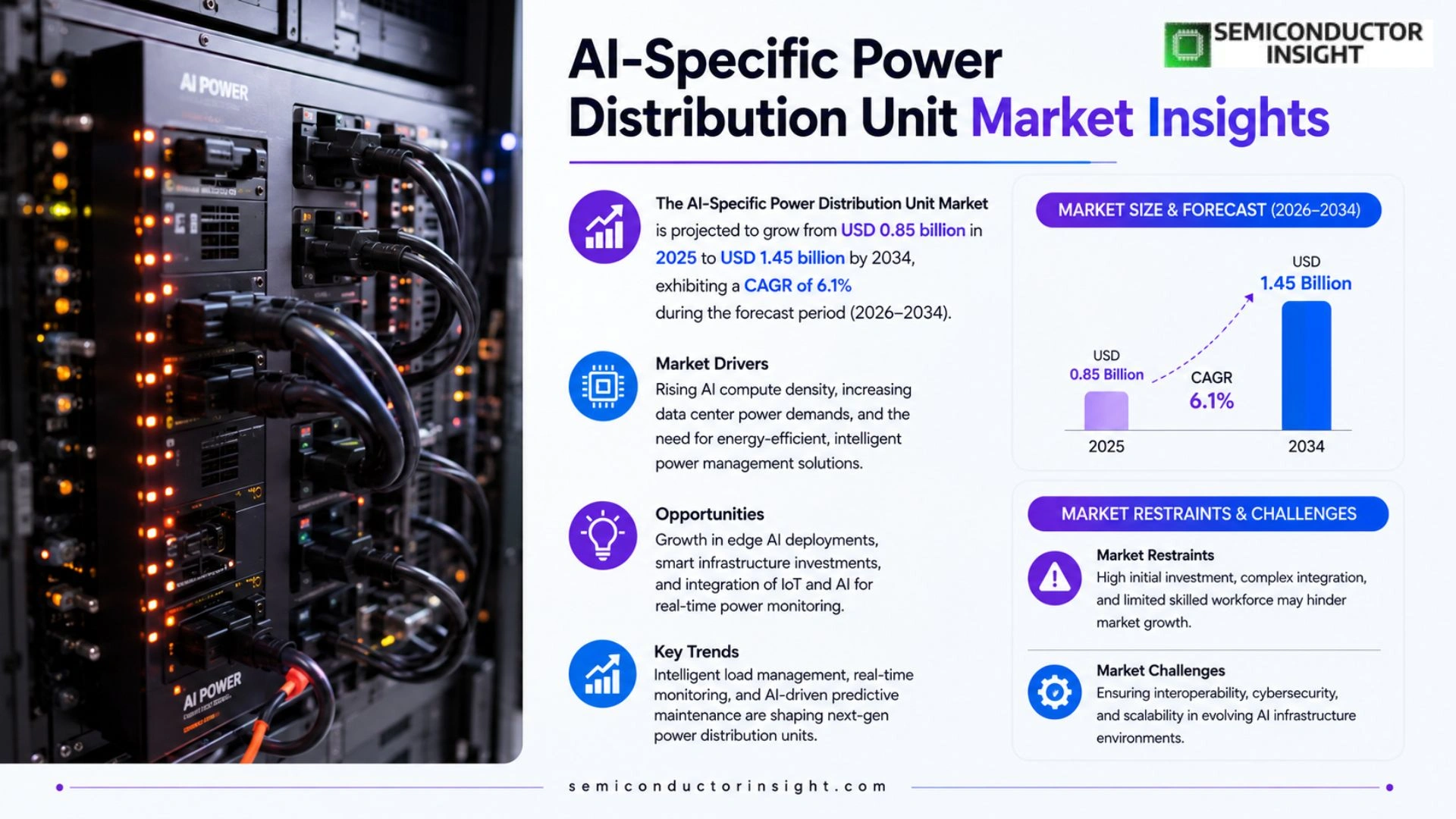
Global AI-Specific Power Distribution Unit Market size was valued at USD 0.85 billion in 2025. The market is projected to grow from USD 0.85 billion in 2025 to USD 1.45 billion by 2034, exhibiting a CAGR of 6.1% during the forecast period.
AI‑specific power distribution units are intelligent electrical distribution devices designed to allocate, monitor, and optimise power delivery for high‑performance computing clusters that run artificial‑intelligence workloads. They integrate sensors, analytics software, and machine‑learning algorithms to balance load, predict failures, and reduce energy waste.
The market is gaining momentum because data‑center operators seek higher efficiency as AI model training consumes ever‑greater electricity volumes; meanwhile, regulatory pressure on carbon footprints pushes adoption of smarter infrastructure. Recent announcements,such as Schneider Electric’s launch of an AI‑driven PDU platform in March 2024 and Vertiv’s partnership with Nvidia for predictive power management,illustrate how OEMs are embedding analytics into hardware offerings.
MARKET DRIVERS
Rising AI Compute Density
Enterprises are consolidating GPU, TPU and specialized ASIC clusters within confined footprints, compelling data‑center operators to seek distribution units that can deliver granular, AI‑aware power sequencing. Higher circuit‑level intelligence reduces idle‑power bleed and preserves thermal headroom, directly translating into lower operating expenditure for hyperscale facilities.
Regulatory Pressure on Energy Efficiency
New data‑center efficiency standards in North America and Europe mandate real‑time monitoring of power quality. AI‑Specific Power Distribution Unit (PDU) solutions that embed machine‑learning analytics can demonstrate compliance without retrofitting legacy infrastructure, making them an attractive upgrade path.
➤ Operators that replace conventional PDUs with AI‑aware units report up to a 12% reduction in peak power demand within the first six months.
The convergence of compute intensity and tighter carbon‑footprint targets creates a compelling business case for vendors that integrate AI‑driven load balancing, predictive fault detection, and dynamic voltage scaling into their PDU portfolios.
MARKET CHALLENGES
Integration Complexity with Existing Infrastructure
Many data‑centers operate heterogeneous power architectures, and retrofitting AI‑Specific Power Distribution Unit Market offerings often requires firmware harmonization across legacy breakers, UPS systems, and BMS platforms. Misaligned communication protocols can cause latency spikes that negate the expected efficiency gains.
Other Challenges
Cost Sensitivity
While the long‑term savings are measurable, the upfront capital outlay for intelligent PDUs remains a barrier for mid‑size operators who must justify expense against modest workload growth.
MARKET RESTRAINTS
Limited Skilled Workforce
Deploying and maintaining AI‑enhanced distribution hardware demands engineers versed in both power electronics and data‑science analytics. The scarcity of such hybrid talent slows adoption, especially in regions where training pipelines have not kept pace with the technology’s evolution.
MARKET OPPORTUNITIES
Edge‑Centric AI Deployments
As AI inference workloads migrate to edge locations,industrial IoT sites, autonomous‑vehicle depots, and telecom micro‑cells,the need for compact, AI‑Specific Power Distribution Unit Market solutions that can autonomously manage fluctuating loads becomes pronounced. Modular, plug‑and‑play designs promise rapid rollout and open new revenue streams for vendors willing to tailor hardware to constrained, remote environments.
AI-Specific Power Distribution Unit Market Trends
Intelligent Load Management for AI Workloads
Data‑center operators are confronting a new tier of power demand as generative‑AI models expand in size and complexity. Conventional PDUs lack the visibility required to keep pace with fluctuating draw, leading to voltage irregularities and avoidable downtime. By embedding sensors, edge analytics and machine‑learning‑based balancing algorithms, the AI‑Specific Power Distribution Unit segment offers a feedback loop that can re‑allocate capacity in milliseconds. This capability not only trims energy waste but also extends hardware lifespan, a factor that resonates with operators seeking to protect capital expenditures while supporting uninterrupted model training cycles. The trend reflects a shift from static distribution to a dynamic, software‑defined power fabric that aligns directly with the computational intensity of modern AI workloads.
Other Trends
Regulatory and Sustainability Drivers
Governmental initiatives targeting carbon intensity have compelled large‑scale facilities to adopt smarter power infrastructure. Regulations that tie utility tariffs to real‑time energy efficiency metrics encourage the deployment of devices that can predict and mitigate overload situations before they translate into excess consumption. In parallel, corporate ESG commitments are translating into procurement clauses that favour equipment capable of delivering measurable energy savings. The convergence of policy pressure and voluntary sustainability goals creates a business environment where the AI‑Specific Power Distribution Unit market finds accelerated relevance, as enterprises look for quantifiable levers to reduce their environmental footprint while maintaining compute performance.
OEM Integration of Predictive Analytics
Recent product announcements illustrate how leading manufacturers are embedding predictive capabilities into their hardware line‑up. One major European OEM introduced a platform that couples real‑time load metrics with AI‑driven fault forecasting, enabling operators to schedule maintenance before a failure cascades. Another prominent system integrator announced a partnership with a leading GPU supplier to deliver a joint solution that synchronises power provisioning with workload scheduling, effectively aligning energy use with compute demand. These collaborations signal a strategic move toward offering not just hardware, but an integrated service that turns power distribution into a competitive differentiator for AI‑focused data centers.
COMPETITIVE LANDSCAPE
Key Industry Players
AI‑Specific Power Distribution Unit Market: Competitive Overview
Schneider Electric dominates the upper tier of the AI‑specific PDU segment, leveraging its extensive power‑management portfolio to embed predictive analytics directly into distribution hardware. The March 2024 introduction of its AI‑driven PDU platform signaled a shift from legacy, static devices toward solutions that continuously balance load, anticipate component fatigue, and trim waste. Vertiv, buoyed by a strategic partnership with Nvidia, has woven machine‑learning inference engines into its PDU line, offering data‑center operators a unified view of power consumption and AI workload intensity. These two firms command a sizable share of global shipments, largely because they couple deep engineering resources with worldwide service networks, enabling rapid deployment in hyperscale environments. Their product roadmaps reflect a clear emphasis on modularity and software‑defined control, setting the benchmark that smaller rivals must emulate to stay relevant.
Beyond the marquee names, a constellation of specialized manufacturers is carving out valuable niches. Eaton’s Intelligent Power Distribution solutions target mid‑size facilities that demand granular monitoring without the price premium of hyperscale equipment. Siemens and ABB focus on rugged, industry‑grade PDUs suited for edge AI clusters in manufacturing and logistics. Delta Electronics, Huawei, and Cisco each contribute domain‑specific intelligence,Delta through high‑efficiency converters, Huawei via integrated AI chipsets, and Cisco by coupling power control with network orchestration. European‑focused players such as Raritan (APC), Panduit, Legrand, and Server Technology (Legrand) supply boutique configurations for research labs and boutique colocation providers. Collectively, these firms enrich the market with differentiated form‑factors, regional support, and price‑point variations that keep competitive pressure alive.
List of Key AI‑Specific Power Distribution Unit Companies Profiled
- Schneider Electric
- Vertiv
- Eaton
- Siemens
- ABB
- Delta Electronics
- Huawei
- Cisco
- Raritan
- Panduit
- Legrand
- Server Technology
Segment Analysis:
| Segment Category | Sub-Segments | Key Insights |
| By Type |
|
Modular Intelligent PDUs are preferred because they enable scalable deployment across expanding AI compute farms, allow seamless integration of analytics modules, and simplify maintenance through hot‑swappable units. • They provide granular control over power zones, supporting fine‑tuned load distribution for heterogeneous AI workloads. • Their architecture aligns with the trend toward edge‑to‑core continuity, reducing cable clutter and improving airflow management. |
| By Application |
|
High‑Performance AI Training Clusters drive the most sophisticated power‑distribution requirements. • The intense, fluctuating power draw of GPU‑dense racks demands predictive analytics to pre‑empt overloads. • Integrated machine‑learning based load balancing enhances energy efficiency while preserving computational throughput. • Operators value the ability to remotely monitor and adjust power envelopes in response to evolving training job profiles. |
| By End User |
|
Cloud Service Providers are leading adopters because they operate massive multi‑tenant AI infrastructures. • Their need for automated power provisioning aligns with AI‑driven PDUs that can self‑optimize across thousands of nodes. • Sustainability agendas push these providers toward solutions that embed carbon‑aware analytics directly within the power layer. • The flexibility of modular PDUs supports rapid capacity scaling in response to bursting AI workloads. |
| By Architecture |
|
Hybrid Architecture is gaining traction as it blends the reliability of centralized oversight with the resilience of distributed control. • It enables localized micro‑grid logic within racks while preserving a global view for coordinated load shifting. • The architecture reduces single‑point‑of‑failure risk, a critical consideration for continuous AI model training. • Hybrid designs also simplify integration with legacy power infrastructures, smoothing migration paths for data‑center upgrades. |
| By Energy Efficiency Feature |
|
Predictive Load Balancing stands out as the most valued efficiency capability. • By forecasting power spikes based on AI job scheduling patterns, it proactively redistributes load to avoid wasteful peaks. • The feature integrates seamlessly with data‑center orchestration tools, enabling holistic energy‑aware workload placement. • Operators appreciate the reduction in cooling demand that follows smoother power consumption curves. |
Regional Analysis: AI-Specific Power Distribution Unit Market
Federal initiatives promote energy‑aware design for AI‑specific hardware, granting tax incentives for projects that integrate smart power distribution. State‑level safety codes have been updated to recognize the higher fault currents typical of AI workloads, easing certification pathways for innovative units.
Close ties between component suppliers and design houses shorten lead times, while diversified sourcing across Canada and Mexico mitigates geopolitical risk. The emergence of domestic silicon fabs further insulates the market from overseas disruptions.
Large cloud operators prioritize units that support hot‑swap capabilities, enabling seamless upgrades as AI model complexity rises. Mid‑size enterprises favor scalable designs that grow with their compute budgets, driving demand for tiered product portfolios.
Established power‑management firms leverage legacy relationships to bundle AI‑specific features, while startups differentiate through AI‑aware firmware that predicts load spikes and adjusts distribution proactively.
Europe
European stakeholders exhibit a cautious but steady embrace of AI‑Specific Power Distribution Units, reflecting a balance between rigorous compliance standards and a desire for technological sovereignty. The EU’s emphasis on Green Deal objectives encourages manufacturers to embed real‑time efficiency analytics, making power‑saving a competitive differentiator. Cross‑border data‑center clusters demand interoperable solutions, prompting vendors to adopt open‑interface standards that satisfy diverse national grids. Funding programmes targeting AI research infrastructure further incentivize the rollout of intelligent power modules across both established hubs and emerging tech corridors.
Asia‑Pacific
In Asia‑Pacific, rapid urbanization and the proliferation of 5G edge sites create fertile ground for AI‑Specific Power Distribution Units. Countries such as Singapore and South Korea invest heavily in smart‑city pilots, where compact, high‑efficiency units become essential for localized AI inference. The region’s cost‑sensitive market forces suppliers to optimise component footprints without compromising reliability, leading to innovative thermal‑management designs. Meanwhile, the rise of regional chip foundries shortens development cycles, aligning hardware supply with the brisk pace of AI model iteration.
South America
South American markets are entering a phase of incremental adoption, spurred by expanding cloud footprints in Brazil and Chile. Companies focus on modular units that can be retrofitted into aging facilities, addressing budget constraints while still delivering AI‑ready power quality. Energy‑price volatility drives interest in units equipped with predictive load‑balancing, enabling operators to shift consumption to off‑peak periods. Regional trade agreements ease the import of advanced components, gradually narrowing the technology gap with more mature markets.
Middle East & Africa
The Middle East & Africa region showcases a divergent landscape: Gulf states accelerate high‑density deployments to support sovereign AI initiatives, whereas many African economies prioritize resilient power solutions for nascent data centres. Weather‑extreme conditions inspire the integration of ruggedized enclosures and advanced cooling strategies within AI‑Specific Power Distribution Units. Collaborative projects between multinational providers and local utilities aim to embed AI‑driven fault detection, enhancing grid stability while laying groundwork for future AI‑centric infrastructure.
Report Scope
This market research report provides a comprehensive analysis of the AI-Specific Power Distribution Unit Market , covering the forecast period 2026–2034. It offers detailed insights into market dynamics, technological advancements, competitive landscape, and key trends shaping the industry.
Key focus areas of the report include:
- Market Overview: The report begins with an overview outlining its current market scenario, key growth indicators, and industry transformation drivers. It discusses macroeconomic factors, demand–supply balance, regulatory landscape, and the strategic role of semiconductors in powering advancements across industries such as automotive, telecommunications, consumer electronics, and industrial automation.
- Market Size & Forecast: Historical data and future projections for revenue, unit shipments, and market value across major regions and segments.
- Segmentation Analysis: Detailed breakdown by product type, technology, application, and end-user industry to identify high-growth segments and investment opportunities.
- Regional Insights: Insights into market performance across North America, Europe, Asia-Pacific, Latin America, and the Middle East & Africa, including country-level analysis where relevant.
- Competitive Landscape: Profiles of leading market participants, including their product offerings, R&D focus, manufacturing capacity, pricing strategies, and recent developments such as mergers, acquisitions, and partnerships.
- Technology Trends & Innovation: Assessment of emerging technologies, integration of AI/IoT, semiconductor design trends, fabrication techniques, and evolving industry standards.
- Market Drivers & Restraints: Evaluation of factors driving market growth along with challenges, supply chain constraints, regulatory issues, and market-entry barriers.
- Stakeholder Insights: Insights for component suppliers, OEMs, system integrators, investors, and policymakers regarding the evolving ecosystem and strategic opportunities.
Primary and secondary research methods are employed, including interviews with industry experts, data from verified sources, and real-time market intelligence to ensure the accuracy and reliability of the insights presented.
FREQUENTLY ASKED QUESTIONS:
What is the current market size of AI-Specific Power Distribution Unit Market?
-> AI-Specific Power Distribution Unit Market was valued at USD 0.85 billion in 2025 and is expected to reach USD 1.45 billion by 2034 with a CAGR of 6.1% during the forecast period.
Which key companies operate in AI-Specific Power Distribution Unit Market?
-> Key players include Schneider Electric, Vertiv, Nvidia (through strategic partnerships), and other leading OEMs that embed AI-driven analytics into PDU hardware.
What are the key growth drivers?
-> Key growth drivers include rising electricity consumption of AI model training, data‑center operators’ demand for higher energy efficiency, and regulatory pressure to reduce carbon footprints.
Which region dominates the market?
-> North America is currently the largest market for AI‑specific PDUs, driven by early adoption of advanced data‑center infrastructure, while Asia‑Pacific shows the fastest growth rate.
What are the emerging trends?
-> Emerging trends include integration of AI/ML analytics for predictive power management, sensor‑rich smart PDUs, and collaborative platforms that combine hardware with cloud‑based energy‑optimization services.
Get Sample Report PDF for Exclusive Insights
Report Sample Includes
- Table of Contents
- List of Tables & Figures
- Charts, Research Methodology, and more...
 Download Sample Report PDF